

Editor’s note: This 2026 update revises our 2024 post on Vinayaka Chaturthi with fresh data on Bengaluru’s PoP ban, Karnataka’s enforcement drives, and the latest eco-friendly idol trends.
Vinayaka Chaturthi arrives every year like an old friend. I say that with love, and a little mischief. I grew up watching drumbeats fill our street corner. Marigold garlands hung everywhere, and a plaster idol always looked slightly cross-eyed. Yet I began asking an uncomfortable question. Does our devotion come at nature’s expense? This year, that question feels sharper. Bengaluru’s Greater Bengaluru Authority has banned Plaster of Paris (PoP) idols outright. Karnataka’s forest department seized hundreds of illegal idols across nine cities. So, let’s walk through this together. We’ll unpack the science, the politics, and the human choices. Together, we can keep Vinayaka Chaturthi joyous without leaving our lakes gasping for breath.
Why Vinayaka Chaturthi Still Divides Devotion and Ecology
Every devotee wants Ganesha’s blessing. Yet few pause to ask what happens after the drums fall silent. Plaster of Paris idols contain a gypsum-based compound. They refuse to dissolve the way clay does. Instead, they sink, crack, and leach chemical paint into our water. Minister Eshwar Khandre explained this bluntly. He said toxic metals from these idols “dissolve into the water, contaminating drinking water sources, harming livestock, killing fish and other aquatic life, and causing long-term ecological damage.” A festival meant to honor wisdom quietly undermines the ecosystems that sustain us.
Bengaluru learned this lesson across several festival seasons. Kalyanis turned cloudy and lifeless after mass immersions. Officials tested lake sediment and found rising iron and pH levels. These tests confirmed what green groups had long feared. Meanwhile, ordinary devotees kept buying whichever idol looked prettiest. Few ever checked the material or asked hard questions. Isn’t it strange how devotion can quietly become destruction? That paradox sits at the heart of every Vinayaka Chaturthi debate today.
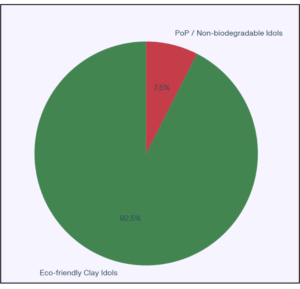
Fortunately, awareness is shifting faster than most people realize. Karnataka’s own numbers prove it clearly. Coastal districts like Dakshina Kannada, Udupi, and Uttara Kannada already worship almost entirely eco-friendly idols. These districts are setting a template for the rest of the state. Therefore, the real story of 2026 isn’t despair. It’s a quiet, stubborn migration toward cleaner celebration.
Bengaluru’s 2026 Crackdown: A Turning Point for Vinayaka Chaturthi
This year marks a genuine inflection point. I don’t use that phrase lightly. The Greater Bengaluru Authority (GBA) has prohibited PoP idol production, sale, and immersion citywide. This goes further than most Indian metros dare to go. GBA Special Commissioner Sushama Godbole explained the reasoning plainly. She said “the restrictions were necessary to prevent the pollution of water bodies,” and warned that “POP, chemical paints and artificial decorations used on the idols can pollute the water and soil and pose a threat to aquatic life.” That single sentence carries real regulatory weight.
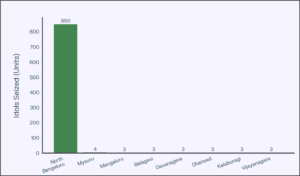
Enforcement, refreshingly, hasn’t stayed on paper this time. The Karnataka Forest Department formed task forces across nine cities. Officials seized and destroyed 850 PoP idols in North Bengaluru alone. They flagged Yelahanka, Byatarayanapura, Doddaballapur, Dasarahalli, and Nelamangala as the state’s biggest illegal-idol hub. This shows crackdowns now target supply chains, not just festival-day violations. Meanwhile, citizens received clear immersion calendars. Ulsoor Lake permits entry only on nine specified days between September 14th and 29th.
I’ll admit, watching a city enforce its own promises feels rare. It also feels strangely hopeful. Gram panchayats received matching instructions too. Minister Khandre directed rural bodies to permit only unpainted, eco-friendly clay idols. So whether you live in a Bengaluru apartment or a Kalaburagi village, this year’s message stays identical. Clay in, plaster out.
PoP Ganesh Idols Seized Across Karnataka Cities (2026)
Source: The Hans India, Times of India Bengaluru, September 2026
The Real Environmental Cost Hiding Inside Every PoP Idol
Numbers rarely lie, even when we wish they would. Historical Karnataka State Pollution Control Board (KSPCB) data once recorded over ten thousand PoP idols immersed in Bengaluru’s lakes despite an active ban. This proves policy alone cannot fix habits overnight. Sediment studies at Lalbagh and Ulsoor lakes showed iron levels climbing well beyond safe limits. Some water bodies saw pH levels spike by roughly twenty percent after immersion. These aren’t abstract statistics. They represent fish gasping and drinking sources quietly degrading. Idol immersion isn’t an isolated problem either — it feeds directly into the same water contamination crisis we’ve unpacked before, where Indore’s deadly outbreaks and Delhi’s black-water woes reveal just how fragile our drinking water systems have become.
Karnataka’s government frames this danger in stark biological terms. Khandre noted that PoP idols contain “harmful elements like sulfur, phosphorus, gypsum, and magnesium.” These poisons harm fish and farm animals alike. Meanwhile, Mumbai’s Bombay High Court intervened this year too. It mandated that idols under six feet must use artificial ponds, not natural water bodies. Several Karnataka municipalities now echo that same principle. Courts and officials across India now agree. Natural water and industrial plaster simply cannot coexist.
Yet here’s the twist worth savoring. Clay, the humble eco-friendly alternative, costs less and dissolves within hours. It even enriches soil rather than poisoning it. Why did PoP ever dominate the market at all? Mostly because it’s cheaper to mass-produce and survives shipping without cracking. Those priorities flatter convenience over conscience. Once you see that trade-off clearly, the ethical choice practically makes itself.
PoP vs Eco-Friendly Idol Materials
| Material | Dissolve Time | Water Impact | Relative Cost | Legal Status (Karnataka, 2026) |
|---|---|---|---|---|
| Plaster of Paris (PoP) | Weeks to months, often never fully | High toxicity, heavy metals | Low upfront | Banned statewide since 2023 |
| Natural clay (shadu mati) | A few hours | Minimal, enriches soil | Low, often free via panchayats | Actively promoted |
| Paper-mache | A few hours | Low | Moderate | Permitted |
| Seed-embedded idols | A few hours | Minimal, grows plant life | Moderate | Permitted, encouraged |
Source: Karnataka Forest, Ecology and Environment Department; CPCB 2020 guidelines
Choosing Idols That Honor Both Ganesha and Ganga
Selecting an idol shouldn’t feel like solving a riddle. Yet many shoppers default to whatever looks vivid on a roadside stall. Natural clay, called shadu mati, remains the gold standard. It dissolves completely and leaves no toxic residue behind. Paper-mache idols offer a lighter, safe, natural option for smaller homes. Seed-embedded idols have also gained real traction lately. Devotees can plant the dissolved remains and literally grow a tree from their prayer.
Bengaluru’s environmentalists have watched this shift happen in real time. Ramprasad, a well-known Bengaluru lake champion, tracked this trend closely. He observed that rising clay-idol numbers show residents “becoming more aware of environmentally friendly solutions.” Coastal Karnataka now proves this awareness can reach above ninety percent adoption. Naturally, price and availability still matter to most families. That’s why Karnataka distributes free eco-friendly clay idols through panchayats and municipal drives. If cost was ever your excuse, it no longer holds up.
Beyond the idol itself, colour matters more than most devotees realize. Chemical paints loaded with heavy metals make even clay idols dangerous upon immersion. Insist on natural, unpainted, or turmeric-and-vegetable-dye finishes instead. Decorations deserve equal scrutiny during your shopping trip. Favour jute, banana-stalk, and fresh flowers over plastic buntings that outlive the festival for centuries. Every small material swap compounds into a genuinely cleaner Vinayaka Chaturthi.
Celebrating Ganesh Chaturthi can also involve using sustainable decorations. Instead of plastic and synthetic materials, opt for natural items like flowers and leaves. These organic decorations enhance the festive spirit while being eco-friendly.
When preparing offerings, consider using biodegradable materials. For instance, using clay diyas instead of electric lights can create a warm ambiance. Natural colors for rangoli and decorations can also minimize environmental harm. By making these small changes, we can collectively contribute to a cleaner and greener celebration.
Idol Composition in Coastal Karnataka (2026)
Source: Karnataka Rural Development and Panchayat Raj Department, August 2026
Community Immersion: Where Individual Choices Meet Collective Impact
No single household can rescue a lake alone. That’s precisely why community infrastructure matters this year. Bengaluru’s civic corporations rolled out designated kalyanis and mobile immersion tanks. These intercept idols before they reach open lakes directly. Ulsoor Lake’s staggered calendar permits entry only on alternating days. This lets water quality recover between waves of devotion. Mumbai, for comparison, now operates 378 immersion sites citywide, blending ponds, beaches, and monitored lakes.
Resident welfare associations across Bengaluru now organize collective immersion drives. They pool household idols into one supervised event, not scattered chaos. Clean-up crews typically follow within hours of each drive. They clear floral waste before it can rot into the water table. Isn’t it remarkable how personal devotion becomes civic cooperation? That duality defines Vinayaka Chaturthi’s best modern expression.
Tree-planting drives timed alongside immersion have also multiplied this year. They turn festival closure into ecological renewal, not simple cleanup. Several apartment complexes now pair immersion weekends with sapling ceremonies. This closes the loop between what we take and what we return. Consequently, the festival’s final day increasingly resembles a small environmental celebration too.
Educating Tomorrow’s Devotees Today
Children absorb values faster through participation than lectures. Every parent eventually rediscovers this simple truth. Clay-modelling workshops ahead of Vinayaka Chaturthi let kids sculpt their own miniature Ganesha. This turns green ideas into something they can hold. Schools across Bengaluru now weave these workshops into September curriculums. Consequently, children learn chemistry, ecology, and devotion all at once.
Youth groups have also taken up lake-monitoring roles recently. They test water samples before and after each immersion event. Watching pH strips change colour teaches lessons no textbook quite matches. Meanwhile, college environmental clubs across Karnataka now partner with KSPCB. This turns rule-checks into peer learning, not just policing. That shift, from punishment to participation, tends to stick longer.
Ultimately, a generation raised on clay idols won’t need bans later in life. They’ll simply consider PoP idols as outdated as leaded petrol. That’s the quiet, generational victory hiding inside this year’s eco-friendly crackdown.
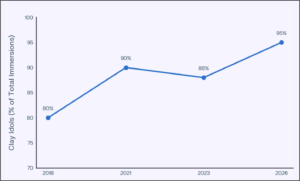
Rise of Clay Idol Adoption in Bengaluru Over the Years
Source: Karnataka State Pollution Control Board; The News Minute; Deccan Herald
Carry Vinayaka Chaturthi’s Spirit Beyond the Immersion
Vinayaka Chaturthi celebrates wisdom at its core. Wisdom demands that we notice consequences before repeating mistakes. We’ve seen Bengaluru’s 2026 ban and Karnataka’s seizure drives sketch a hopeful model. Coastal districts’ near-total clay adoption proves this model actually works. We’ve also faced uncomfortable data: sediment poisoning, pH spikes, and years of weak enforcement. Individually, choosing an eco-friendly clay idol costs almost nothing yet changes everything downstream. Collectively, supporting local artisans and mentoring children builds systems that outlast one single festival.
So here’s my closing question, the one I ask every September. What will your Ganesha be made of this year? Choose clay, choose accountability, and choose a Vinayaka Chaturthi our lakes will thank you for.
On behalf of ExpressIndia.info, we promise to keep tracking every policy and every quiet act of civic courage that makes India’s festivals kinder to our planet.
#VinayakaChaturthi #EcoFriendlyGanesha #SustainableFestivals #BengaluruGoesGreen #ClayNotPlaster
The environmental impact has been very nicely presented, crisp and clear. Community level awareness has to be created to address this environmental issue.
Thank you, Saji for the feedback. I agree with you that measures should be taken by the government to create community awareness for celebrating Ganesha in an eco-friendly manner. Strictly enforcing sale of only environment friendly idols and other materials should certainly make a difference.
Ganpati Bappa Morya
Love this article! It’s so important to celebrate Vinayaka Chaturthi in a way that respects our environment. The tips on using clay idols and reducing waste are super practical. Let’s all do our part to make this festival greener and more sustainable. Thanks for sharing these great ideas!”8
Thank you, Manish for your valuable feedback.