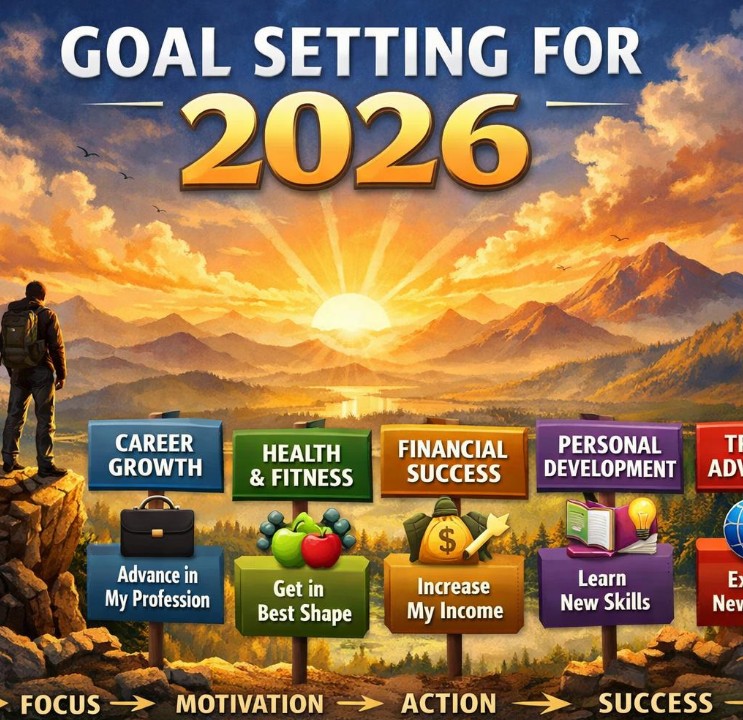
Wishing you all A Very Happy New Year, 2026!! At the start of 2025, I had provided holistic personal growth tips to transform your life in 2025. It’s time now for a reality check of the goals you had set at the beginning of last year, and how many you have achieved or persisted with.
Goal setting for 2026 cannot remain a superficial ritual as has been the usual practice too often. Instead, it must become a deliberate framework for individual growth and development. Every person now lives at the intersection of personal ambition and social responsibility. Therefore, goals must consider inner psychology, family realities, and civic duties. When intentions acknowledge these multiple layers, they naturally convert into lasting impact. Consequently, the question shifts from “What do I want?” to “What must I become?” Instead of treating goals as private checklists, individuals can treat them as societal levers. In other words, personal ambitions can deliberately intersect with community well-being and shared futures.
At the same time, India’s rapid change continually intensifies pressure on individuals. Workplaces demand agility, families expect stability, and technology accelerates everything relentlessly. Thus, readers now require frameworks that respect complexity yet remain practical. Personally, when I think about 2026, I see intertwined responsibilities everywhere. Because my choices influence colleagues, neighbours, and even strangers online, intentions gain weight. Therefore, designing thoughtful goals becomes both an inward journey and an outward duty. Consequently, goal setting for 2026 can redefine how Indians understand success itself.
Honest self-reflection as the starting point
Any meaningful framework for Goal Setting for 2026 begins with structured self-reflection. In the Indian context, individuals often balance desire, family expectations, and social norms. Therefore, before drafting any resolution, they can ask clarifying, probing questions. For instance, they can ask which aspirations genuinely excite them beyond external validation. Likewise, they can revisit past years and notice patterns of motivation and fatigue. As this reflection deepens, goals shift from imitation toward authentic internal alignment.
Furthermore, robust self-reflection considers age, responsibilities, and daily realities very carefully. A young graduate in Bengaluru experiences different constraints than a parent in Jaipur. Similarly, a senior professional in Mumbai experiences different opportunities than a freelancer elsewhere. Consequently, people design better goals when they recognise these contextual differences honestly. Personally, I find that acknowledging limitations actually strengthens, rather than weakens, ambition. Because clarity replaces fantasy, goals become specific, grounded, and emotionally sustainable.
Psychological foundations of sustainable goal setting
From a psychological standpoint, the human brain resists vague, undefined objectives. Therefore, “exercise more” usually fails, whereas “walk thirty minutes daily after dinner” survives. Likewise, “contribute to society” sounds noble but dissolves without a clear structure. So, individuals benefit when they translate ideals into concrete, observable behaviours consistently. As a result, Goal Setting for 2026 gains traction and credibility. Because each behaviour becomes measurable, feedback arrives faster, and motivation multiplies naturally.
Additionally, sustainable goals often anchor themselves in identity rather than deadlines. When people start saying “I am a reader,” reading habits stabilise gradually. Similarly, when they adopt the tag “I am a responsible citizen,” civic engagement increases. Personally, I notice that identity-based statements reshape my daily choices powerfully. Instead of forcing action, I act in accordance with that chosen identity. Consequently, personal growth and social impact reinforce each other through subtle psychological shifts.
Balancing ambition and mental health in modern India
Modern Indian life increasingly operates in a climate of continuous urgency. Deadlines tighten, commutes lengthen, and notifications interrupt concentration every few minutes. Therefore, high ambition without mental health safeguards often leads directly to burnout. Certainly, this reality demands deliberate integration of rest into frameworks. In other words, sleep, boundaries, and emotional processing deserve parity with promotion targets. When individuals protect mental health, they strengthen long-term performance and contribution.
Moreover, popular culture still frequently glorifies overwork and celebrates exhaustion as dedication. Yet, research consistently emphasises recovery as essential for sustained excellence. Consequently, Goal Setting for 2026 can normalise humane timelines rather than extreme sprints. Personally, I value small daily progress more than dramatic but short-lived bursts. Because consistent, low-intensity effort preserves both enthusiasm and health, with enduring momentum. Thus, ambition remains sharp while psychological stability stays intact and respected.
From private benefit to personal growth and social impact
Traditionally, goals in India often focused narrowly on private milestones only. Salary jumps, property purchases, exam results, and lifestyle upgrades dominated conversations everywhere. However, contemporary challenges reveal how deeply interdependent Indian lives actually remain. Therefore, individuals increasingly recognise that personal growth and social impact must connect. A promotion, for instance, can include ethical leadership and mentorship responsibilities. Similarly, a financial goal can include structured giving or local community investments.
As this perspective spreads, purpose-driven goals start transforming ordinary routines. For example, a health goal can integrate participation in periodic charity runs. A learning goal can integrate free weekend sessions for neighbourhood children. Personally, I feel that this dual design adds depth to every aspiration. Because success then uplifts others, achievements carry quieter, longer-lasting satisfaction. Consequently, Goal Setting for 2026 can help citizens treat progress as a shared resource.
Designing systems rather than chasing isolated outcomes
Outcome-obsessed goal setting often creates pressure spikes and eventual abandonment. “Lose ten kilograms” or “double income” encourages extremes, shortcuts, and self-criticism. Instead, systems-based thinking focuses on daily, repeatable actions that compound. For example, individuals can prioritise consistent walking, budgeting, reading, or outreach routines. As these systems stabilise, desired outcomes usually emerge as natural consequences. Hence, purpose-driven goals significantly benefit from robust system designs.
Furthermore, systems adapt more easily to India’s unpredictable daily disruptions. Power cuts, family demands, traffic delays, and health issues frequently intervene. Personally, I find that flexible routines survive such interruptions better than rigid plans. Because the focus rests on returning to the system, not perfection, thereby reducing guilt. Consequently, people recover faster after setbacks and maintain dignity through difficult seasons. Over time, systems quietly transform character while outcomes accumulate steadily in the background.
Navigating digital distraction and protecting attention
One of the most serious threats to Goal Setting for 2026 is distraction. Social media, short videos, and constant news cycles fragment attention deeply. Therefore, Indians across age groups now need intentional strategies for attention management. Simple actions like disabling non-essential notifications already reclaim significant mental bandwidth. Additionally, scheduling defined “online windows” prevents aimless, unconscious scrolling from expanding. When individuals treat attention as scarce capital, goals receive higher-quality focus.
However, technology itself can also amplify personal growth and social impact. For instance, people can use online platforms to access high-quality courses. They can join volunteer networks, civic forums, and knowledge communities across regions. Personally, I use digital tools to track habits, support causes, and learn. Because I align my digital choices with my values, the internet becomes my close ally. Thus, rather than rejecting technology, individuals can practise mindful, purpose-driven engagement instead.
Flexible goal frameworks within an evolving Indian economy
India’s economic environment remains dynamic, sometimes unpredictable, yet rich with opportunity. Industries transform, automation expands, and new roles appear frequently across sectors. Therefore, rigid, single-path goals can become fragile under such conditions. Instead, individuals can design flexible frameworks with multiple possible routes forward. For example, they can cultivate adjacent skills that support lateral career shifts. As they do this, they convert uncertainty into a structured field of options.
Moreover, contingency planning can accompany major long-term aspirations thoughtfully. Personally, I ask myself how I might respond if circumstances change. If one role disappears, which capabilities still retain meaningful market value? If relocation becomes necessary, which skills travel fairly well across geographies? Consequently, purpose-driven goals remain ambitious yet realistically prepared for volatility. In effect, flexibility protects both livelihood and self-respect over longer horizons.
Learning, upskilling and lifelong intellectual development
For ambitious individuals, intellectual expansion itself stands as a central objective. Lifelong learning now acts as both a survival strategy and enrichment path. In India, individuals can leverage open courses, professional certifications, and local institutions. Additionally, they can engage with diverse viewpoints through books, online content, and professional journals. Personally, I experience learning as a continuous recalibration of assumptions and priorities. As understanding deepens, Goal Setting for 2026 naturally becomes more nuanced and contextual.
Crucially, learning goals achieve their full power only when applied actively. Knowledge that never reaches practice slowly becomes ornamental rather than transformative. Therefore, new skills can deliberately address concrete needs in one’s surroundings. For instance, someone could help a small business improve digital visibility and reach. Another person might support students with applications, interviews, or language skills. In this way, personal growth and social impact intersect through practical, everyday acts.
Community, empathy and shared accountability
Individual development in India unfolds within dense networks of relationships and expectations. Families, colleagues, friends, and neighbours constantly shape habits and everyday choices. Therefore, goals often become stronger when individuals share them selectively and wisely. When trusted people know intentions, they provide encouragement and constructive accountability. Personally, I notice that spoken commitments feel more solid than private resolutions. Because others are watching kindly, I instinctively try harder to honour them.
Empathy, moreover, deserves explicit presence inside Goal Setting for 2026. Listening attentively, acknowledging invisible labour, and respecting differing circumstances matter greatly. In workplaces, empathetic leadership enhances trust, creativity, and collective performance measurably. At home, empathetic conversations reduce conflict and support intergenerational understanding. As many Indian thinkers emphasise, strong societies rest on mutual respect and sensitivity. Consequently, purpose-driven goals in India must include emotional intelligence as a deliberate dimension.
Goal Setting for 2026: Redefining success in holistic terms
Finally, 2026 offers an opportunity to redefine success more holistically. Traditionally, many Indian narratives celebrated income, status, and visible consumption patterns. However, rising awareness of burnout, loneliness, and anxiety challenges that narrow vision. Therefore, today, individuals increasingly include health, relationships, meaning, and ethics in success. Personally, I consider a year successful when integrity, curiosity, and kindness expand. When these inner metrics advance, external achievements feel significantly more satisfying.
Thus, Goal Setting for 2026 invites integrated change across multiple dimensions. People can pursue financial stability while protecting rest and mental balance. They can chase excellence while treating colleagues, service workers, and strangers respectfully. They can use every new capability to strengthen communities, not merely resumes. Ultimately, when Indians design such multidimensional goals, they uplift both the self as well as society. In doing so, personal growth and social impact become the natural measure of progress in 2026. Wishing all my readers a Happy and Successful 2026, personally, professionally as well as in terms of your social commitment. May this year be a defining year in your lives. All the very best to you all from Team ExpressIndia.info!! 👍❤️
#GoalSetting2026 #NewYearIntentions #SocialImpactIndia #PersonalGrowth2026 #PurposeDrivenLife