
Disclaimer:
This blog uses the Kozhikode incident (January 2026) as a case study to examine systemic failures in digital justice. It does not adjudicate guilt or innocence of any party; rather, it analyzes institutional, platform, and societal failures that enabled an accusation to cause irreversible harm before investigation was done. The views expressed here reflect on social media vigilantism generally, not on the specific merits of this ongoing case or pending investigations. Readers are cautioned that this incident involves a suicide; mental health resources are provided below. Nothing in this blog constitutes legal advice or commentary on judicial proceedings.
When Virality Becomes Verdict: How Social Media Trials Destroyed a
Quiet Man from Kerala
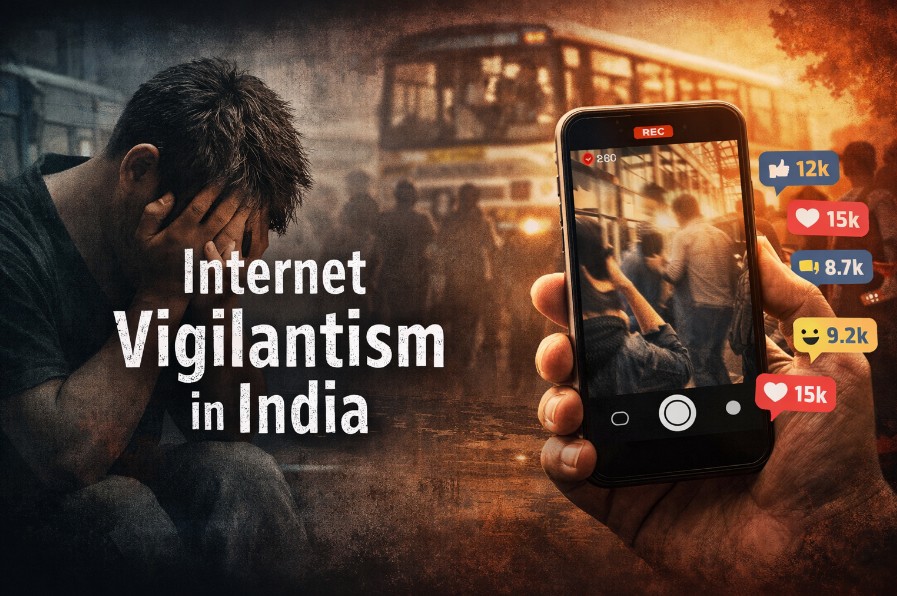
A 42-year-old textile worker named Deepak from Kozhikode, heading to work as usual on a Friday, unaware that his entire existence hangs on a precipice. By that evening, a social media influencer and vlogger named Shimjitha posts a video on Instagram. She accuses Deepak of sexual harassment during a private bus journey. The claim: his elbow brushing against her chest in a crowded transit constitutes intentional misconduct. Within 48 hours, roughly 2 million people view this accusation with many pointing fingers at him and shaming him online as is the norm in such cases. By Sunday morning, he was found hanging in his home. Not because guilt was proven; because Internet vigilantism in India punished him faster than any court system could investigate.
This narrative isn’t merely another tragedy competing desperately for headlines in India’s relentless news cycle. Rather, it represents a systemic phenomenon that demands urgent examination – a phenomenon where social media platforms fundamentally crown juries, deliver verdicts, and execute sentences without any semblance of trial. We’ve collectively become judges now, whether we possess judicial training, experience, or even basic understanding of evidence standards. And the consequences have become irreversibly, tragically fatal. Consider this carefully: the legal system takes months investigating serious allegations. Social media delivers verdicts within hours. The gap between accusation and institutional response ensures reputational destruction before any legal protection activates. Furthermore, this raises uncomfortable questions about how we collectively determine truth, guilt, and justice in contemporary India.
What makes Deepak’s tragedy particularly significant isn’t merely the individual loss, though that’s devastating. Rather, it illuminates the broader architecture of Internet vigilantism in India – a system where algorithms amplify accusations, platforms profit from controversy, and ordinary citizens wield unprecedented power to destroy lives through digital means. The mechanisms seem benign individually: sharing a video, commenting on a post, retweeting an allegation. Collectively, however, these actions create an unstoppable avalanche. The aftermath of the tragedy has seen a pouring of anger and hatred towards the vlogger for her insensitive actions against a man who had seemingly done no wrong as alleged by her. But the damage was already done by then.
The Cyberbullying Epidemic in India – Explosive Growth & Alarming
Trends
Comprehensive timeline showing cybercrime case progression (2018-2025)
| Year | Cybercrime Cases | Year-on-Year Change | Critical Context |
|---|---|---|---|
| 2018 | 27,248 | — | Baseline reference point |
| 2019 | 44,548 | +63.48% | Sharp acceleration phase |
| 2020 | 50,035 | +12.32% | Pandemic-driven increase |
| 2021 | 57,418 | +14.75% | Post-pandemic surge continues |
| 2022 | 65,893 | +14.77% | Sustained growth trajectory |
| 2023 | 74,950 | +13.76% | Pattern solidifies nationally |
| 2024 | 82,417 | +10% | Growth rate moderation |
| 2025 | 85,000+ | ~3% | Estimated (ongoing data) |
Source: National Crime Records Bureau (NCRB)
Critical Data Points Demanding Attention:
- McAfee Corp International Report: 85% of Indian children experience cyberbullying – establishing India as the highest globally among all surveyed nations
- National Crime Records Bureau (NCRB) 2020-2025: 19% prevalence specifically among Indian adolescents in detailed surveys
- Alarming Trend Identified: Year-over-year 14% increase documented in cases involving minors specifically – indicating accelerating harm to vulnerable populations
- Gender-Based Analysis: Female victims demonstrate higher suicidal ideation rates compared to male victims in cyberbullying cases – a critical public health concern
- Reporting Gap: Estimates suggest only 15-20% of cyberbullying incidents get reported to authorities – indicating massive underreporting
Source: National Crime Records Bureau (NCRB) 2020-2025 Comprehensive Reports, McAfee Corp Cybersecurity Research, Indian Institute of Adolescent Studies 2024-2025
The Viral Accusation That Transformed Into a Digital Death Sentence
The Kozhikode incident unfolded with tragic predictability yet devastating speed that defies institutional response. Deepak traveled for work on last Friday (Jan 16th), an ordinary commute unremarkable in every way. It was an ordinary bus journey, crowded, as thousands of bus journeys happen across India daily. Physical contact happened inevitably in the packed bus during rush hour. Shimjitha recorded the incident and posted accusations online almost immediately. She alleged intentional sexual misconduct based on the physical contact. The narrative crystallized across social platforms within minutes – not hours. WhatsApp groups exploded with screenshots and videos of the incident (recorded and edited, with a message of Shimjitha) went viral in no time. Threads on other social media platforms developed in parallel. Instagram stories multiplied exponentially across networks. By evening, collective consensus formed instantaneously: Deepak was “that harasser,” the villain in an unfolding drama.
What followed illustrates Internet vigilantism in India at its most destructive and irreversible apex. Deepak’s photograph spread across digital platforms rapidly, reaching circles he’d never enter otherwise. His workplace became identified through aggressive comment sections within hours. His personal address circulated on certain platforms by Saturday afternoon. His name trended nationally by Saturday morning – not trending for achievement, but for alleged crime. Comments accumulated exponentially: demands for arrest, calls for institutional action, suggestions of physical violence, vigilante justice threats. The psychological weight accumulated catastrophically with each share. Deepak reportedly stopped eating meals entirely. Sleep became fundamentally impossible despite exhaustion. His mother watched helplessly as her only son withdrew physically and emotionally. By Saturday night, he had made his final decision – a decision his family couldn’t reverse. The timeline matters critically: 38 hours from accusation posting to death. And as per reports, it was proven that the vlogger had made a false claim that she had raised a complaint with the digital evidence at the Vadakara police station after the incident. Investigation began 50+ hours later. The temporal gap represents institutional failure.
When Social Media Crowns Judges, Delivers Verdicts, Executes Sentences
Without Trial
Chief Justice of India N.V. Ramana warned prophetically in June 2021: “Media trials cannot be a guiding factor in deciding cases. Judges should not be swayed by the emotional pitch of public opinion amplified through social media. The noise amplified is not necessarily reflective of what is right.” Yet, Indian society has largely proceeded ignoring this institutional wisdom consistently. Years have passed. The phenomenon has accelerated rather than diminished.
Internet vigilantism in India operates fundamentally differently from traditional judicial systems – so differently that comparison seems almost unfair to legal institutions. Courts examine evidence systematically over documented timelines. Social media platforms examine engagement metrics algorithmically. Algorithms reward outrage deliberately and continuously. Platforms monetize controversy economically and systematically while truth becomes secondary to virality. Accusation morphs into conviction before investigation begins officially. The vlogger deleted her original video within 48 hours – far too late for meaningful reversal. Screenshots persisted across platforms permanently. Archive sites preserved images indefinitely through automated systems. The narrative hardened into collective public memory irreversibly. Society had tried, convicted, and executed Deepak digitally before any court examined evidence. Due process became a quaint historical artifact – something courts practice, but social media renders obsolete. The mechanisms are clear: first come emotions, then reactions, then mob dynamics. Evidence, context, investigation – these arrive too late to matter.
Moreover, institutional delays compound this problem exponentially. Police require complaint registration first. Investigation requires preliminary inquiry next. Charges require evidence gathering subsequently. Trial requires proper procedures throughout. All of this takes months – typically 60-120 days minimum for serious allegations. Alarmingly, social media delivers verdicts within hours. The speed differential alone ensures that social media wins. By the time courts examine evidence, public opinion has crystallized. By the time investigations are complete, reputational damage proves irreversible. The accused person – guilty or innocent – cannot escape the digital record. Furthermore, the psychological impact operates differently. Courts pronounce judgment, and systems provide appeal mechanisms. Social media pronounces judgment, and the accused faces immediate consequences: job loss, family abandonment, community ostracism, psychological collapse, and suicide, as in this tragedy. Additionally, court decisions apply law established through centuries of jurisprudence. On the other hand, social media applies whichever standard generates maximum engagement. These are fundamentally incompatible systems competing for authority.
The Pattern of Tragedy: Similar Incidents Exposing Internet Vigilantism
Across India
Deepak’s death represents not an isolated tragedy but rather a documented pattern across India. Internet vigilantism in India has claimed multiple lives through identical mechanisms: accusation without investigation, viral amplification before verification, and institutional response arriving too late. Examining parallel cases reveals systemic failure demanding urgent intervention.
In May 2020, 17-year-old Manav Singh jumped from his 11th-floor apartment in Gurugram after merely 90 minutes of social media shaming. A girl posted Instagram Stories accusing Manav of sexual harassment from years earlier. Friends immediately screenshot and reposted, tagging Manav directly. Within 90 minutes, coordinated pile-on harassment escalated to death threats. By 11 PM that night, Manav made his final decision. The institutional response? Investigation took years; the National Human Rights Commission intervened in June 2021 declaring it “vitiated and not fair,” and chargesheet filing occurred long after suicide. Manav’s case established a tragic precedent: social media judgment arrives in minutes; institutional response in years.
Similarly, in October 2025, 19-year-old Rahul Bharti from Faridabad died by suicide after being blackmailed with AI-generated obscene images of himself and his three sisters. Someone hacked his phone, created deepfakes, and demanded payment under threat of viral circulation. Rather than institutional protection, Rahul faced two weeks of psychological torture culminating in suicide by consuming poison. The mechanism differed from Deepak’s false accusation, yet the outcome remained identical: threat of viral shaming → psychological breakdown → suicide.
Additionally, a November 2025 incident demonstrated the mob logic underlying Internet vigilantism in India starkly. When a couple’s private 19-minute video leaked online, thousands participated in memorial posts mourning their alleged suicide – despite no verified suicide occurring. The couple was alive. Yet thousands mobilized around unverified death claims, demonstrating how digital mobs participate in harassment regardless of factual accuracy. This reveals that accusations need not be true to trigger psychological devastation; the threat of viral shaming suffices.
Even survivors document severe trauma. Sarvjeet Singh, a Bengaluru techie falsely accused in 2015, has publicly stated that media trials and social media shaming nearly cost him his life. He experienced immediate job loss, permanent reputational damage, and years of psychological recovery despite surviving. His survival emphasizes that even non-fatal outcomes carry catastrophic psychological costs.
The pattern demands attention: Incidents span 2015-2026 (11 years), geographies from Kerala to Haryana to Uttar Pradesh to Karnataka, and accusation types from direct harassment allegations to deepfakes to false accusations. Yet institutional reform has remained virtually nonexistent. Each tragedy should have triggered policy changes. Instead, identical sequences repeat: accusation → viral spread → institutional delays → psychological breakdown → suicide or severe trauma.
The institutional lesson proves undeniable: When identical tragedies recur across 11 years and four states without systemic response, the problem transcends individual cases. This represents institutional failure at every level – police investigation delays, media verification failures, platform algorithmic amplification, and societal participation in mob judgment. Solutions must address these systemic mechanisms, not merely individual incidents. Deepak, Manav, and Rahul deserve more than memorial posts. They deserve institutional transformation preventing the next tragedy.
Internet Vigilantism vs. Due Process—Institutional & Procedural
Comparison
Side-by-side comparison highlighting critical systemic differences
| Critical Aspect | Traditional Courts | Internet Vigilantism | Practical Outcome |
|---|---|---|---|
| Investigation Timeline | 60-120 days standard procedure | 1-2 hours maximum | Vigilantism operates 1,000x faster |
| Evidence Standard Required | Legally mandated verification process | Accusation alone suffices entirely | Zero protection for innocence |
| Appeal/Review Rights | Guaranteed multiple appellate levels | Non-existent mechanisms completely | Reputational damage irreversible |
| Anonymity of Accused | Protected during legal proceedings | Completely exposed immediately | Permanent digital record created |
| Public Impact Timeline | Limited to verdict announcement date | Viral before investigation starts | Mob justice precedes legal justice |
| Financial Cost to Victim | Judicial fees manageable reasonably | Loss of livelihood plus life itself | Kozhikode case = suicide outcome |
| Reversal Mechanism | Appeal courts specifically designed | No institutional remedy available | False accusation never redeemed |
| Mob Participation | Jurors selected, trained, controlled | Random digital crowd entirely unvetted | Quality inversely proportional |
| Due Process Protection | Extensive procedural safeguards | Non-existent protections whatsoever | Defendants completely vulnerable |
| Truth Verification | Multiple institutional checks required | Virality determines truth effectively | Speed trumps accuracy always |
Source: Comparative legal analysis, NCRB data compilation, social media platform studies (2024-2025)
Beyond Kozhikode – The Widening Epidemic of Digital Harming Across
India
Deepak’s tragedy isn’t isolated geographically or temporally – it’s symptomatic of systemic breakdown across India. Examine the data meticulously and carefully: India recorded 50,035 cybercrime cases in 2020 alone. By 2025, reliable estimates exceeded 85,000 annually – a threefold increase in just five years. Cyberbullying prevalence among Indian adolescents reached 19% according to recent studies. McAfee research revealed 85% of Indian children experienced cyberbullying – establishing India as having the highest rate globally among all surveyed nations. Sadly, reporting remains severely underutilized across the country. Why would victims report when consequences seem more devastating than silence? The answer reveals profound institutional dysfunction.
I’ve observed this transformation personally through ExpressIndia.info, with professional networks, and broader social circles across multiple cities. Individuals who once thoughtfully engaged with controversial topics now hesitate demonstrably and visibly. People practice self-censorship actively – avoiding comments, withdrawing from discussions, deleting drafted posts. They witness Internet vigilantism in India and recognize the irreversible cost of visibility. Public discourse narrows quantifiably and bold voices silence themselves strategically. Entire sectors of society disappear into digital shadows, unwilling to risk virality’s destructive force. Additionally, I’ve noticed younger professionals especially avoid social media engagement on contentious topics. They’ve internalized the danger. The chilling effect spreads beyond individual cases into institutional culture.
The Maharashtra case of November 2025 demonstrates this escalation pattern horrifyingly and instructively. A 27-year-old man faced viral harassment campaigns systematically across platforms. He released an apology video, attempting clarification and de-escalation strategically. The public response proved counterintuitive and devastating: intensified mockery rather than acceptance. Trolling campaigns increased dramatically. The psychological logic seemed inverted completely. Clarification was interpreted as weakness, not strength. Apology became confession and vulnerability was viscously targeted. The man’s suicide followed inevitably – another preventable tragedy rooted in coordinated viral shaming. The pattern repeats with eerie consistency. The cost escalates, but the mechanisms remain unchanged. Furthermore, each case normalizes the phenomenon. Society begins accepting that accusations equal convictions. That virality equals truth. That digital mob equals justice.
Consider also the cumulative psychological impact across society. When people witness these cases repeatedly, they develop a fear response. This fear discourages legitimate speech. It discourages reporting genuine harassment. It discourages engagement with important issues. The chilling effect spreads like infection through institutional spaces – schools, workplaces, public forums, online platforms. People withdraw. Discourse contracts. Society loses collective capacity for nuanced discussion. Moreover, the algorithmic learning compounds this problem. Each sensational case teaches the algorithm what generates engagement. Future accusations receive amplification based on previous viral patterns. The system becomes self-perpetuating and self-accelerating.
Women’s Real Safety – Collateral Damage From Weaponized False
Allegations
Here emerges the uncomfortable paradox that institutional discourse avoids discussing consistently: Internet vigilantism in India simultaneously trivializes genuine sexual harassment systematically and dangerously. When false allegations achieve viral amplification equal to real ones, actual harassment victims face credibility erosion inevitably and measurably. The data speaks clearly and alarmingly: 80% of urban Indian women experience public harassment annually. However, 2 of 3 incidents remain unreported consistently. Why this catastrophic gap between experience and reporting? Fear of disbelief dominates psychological calculations. Fear of becoming social media spectacle terrifies beyond the original harassment. Fear that harassment accusations might be weaponized for viral engagement rather than justice motivates silence powerfully. Women rationally calculate risks and choose silence.
Kiran Bedi, a pioneering former police officer and women’s rights advocate, articulated this essential tension profoundly: “What a national revolution it would be if each one of us were to self-police appropriately… We can start this essential change from our own homes, neighborhoods, communities, villages and schools first.” Her vision acknowledged that genuine safety requires institutional change – not mob justice, but systemic accountability mechanisms. She recognized that vigilantism, even when targeting perpetrators, ultimately undermines the institutional frameworks women need for genuine protection. Therefore, supporting victims requires institutional strength, not mob power.
The irony cuts painfully deeper still. Movements supporting harassment victims (crucial and necessary, genuinely) simultaneously enable weaponized false accusations paradoxically. Feminist discourses emphasizing “believe women” becomes oversimplified dangerously into “believe all accusations immediately.” The nuance evaporates entirely. Justice becomes binary and simplistic. Either women are automatically believed entirely, or they’re silenced completely. Middle ground – believe women and investigate thoroughly – disappears from discourse. The result? Genuine victims distrust systems entirely. They expect disbelief from authorities. They fear being grouped with false accusers and so they remain silent, protecting themselves. Additionally, the false accusation phenomenon creates backlash dynamics. Some individuals begin doubting all harassment allegations reflexively. The pendulum swings dangerously. Genuine victims lose protection from both institutional skepticism and social backlash simultaneously.
Consider the practical implications for public safety mechanisms. Women’s complaints systems depend on credibility. If accusatory posts become normalized as entertainment, credibility declines. If investigation becomes impossible due to contamination, justice declines. If perpetrators escape amid confusion between real and false allegations, safety declines. Furthermore, young women internalize these lessons. They observe false allegations going viral. They observe genuine ones being ignored. They calculate rationally that reporting accomplishes nothing. Resultantly, they withdraw and stop reporting harassment whereby society loses visibility into actual harassment patterns.
The Architecture of Digital Punishment – How Algorithms Weaponize
Accusations Deliberately
Social media platforms aren’t neutral observers passively documenting society. Rather, they’re active vigilantism participants deliberately designed for engagement maximization. Algorithms amplify emotional content systematically and relentlessly. Outrage generates engagement metrics reliably and predictably. Platforms monetize controversy economically and directly. Shimjitha’s original video received algorithmic promotion specifically because it triggered strong emotional reactions instantaneously. Engagement metrics drove visibility exponentially. The system functioned exactly as engineered – converting accusation into content, harassment into entertainment, tragedy into profit. Consider this architecture critically: every platform decision prioritizes engagement. Engagement correlates with outrage. Outrage correlates with accusations. Therefore, accusations receive priority algorithmically. Truth receives no such algorithmic advantage. The system works against factual content naturally.
Consider the precise mechanism of viral spread in Shimjitha’s case: Posted at 6 PM Friday, the video reached 1 million views by Saturday afternoon. Each share amplified reach geometrically. Each comment deepened narrative entrenchment algorithmically. By Sunday, the viral curve peaked at 2 million+ views. Meanwhile, truth-checking occurred nowhere institutionally. Verification appeared unnecessary technologically. Counter-narratives lacked algorithmic oxygen desperately. Deepak’s innocence claims couldn’t compete against sensational accusations economically. The vlogger didn’t need to control her creation – the algorithm did. Shattered, Deepak couldn’t defend himself effectively. The platform had already decided his fate. Furthermore, the speed advantage prevents investigation. By the time someone verifies facts, millions have seen accusations. Corrections reach perhaps 5% of original viewers. The damage proves irreversible mathematically.
Journalist Ravish Kumar, recipient of India’s highest journalism honor, observed powerfully: “The act of speaking out makes you profoundly alone… People joined the mob to silence others; what they didn’t realize was that they had also become and remained silent themselves.” His insight captures social media’s chilling effect devastatingly. Observation of Internet vigilantism in India teaches people that public speech carries catastrophic risks. Silence becomes a survival strategy inevitably while speaking becomes more like gambling. The rational response under such conditions is withdrawal. Additionally, the platform design reinforces these patterns. Comment sections enable pile-on behavior. Share buttons facilitate virality. The “like” mechanism rewards emotional reactions over thoughtful engagement. The entire system supports sensationalism. Moreover, platform employees recognize these dynamics. Yet economically, changing them would reduce engagement and advertising revenue. Therefore, the system persists. The incentives remain misaligned with truth, justice, or human welfare. They remain aligned with profit.
The Kozhikode Incident Timeline – From Accusation to Tragedy to
Investigation
Detailed chronological breakdown showing hours, viral reach, platform dynamics, and psychological collapse
| Time | Event | Platform Activity | Viral Reach | Deepak’s State | Institutional Response |
|---|---|---|---|---|---|
| Friday 5:00 PM | Incident on bus recorded | Initial recording | 0 views | Normal, unaware | None yet |
| Friday 6:15 PM | Video posted Instagram | Posted to followers | 50 views (initial) | Potentially unaware | None |
| Friday 7:30 PM | Screenshots circulate | WhatsApp sharing begins | 5,000 views | Notification alerts | None |
| Friday 9:00 PM | Cross-platform sharing | Twitter, Facebook | 50,000 views | Distress mounting | None |
| Saturday 8:00 AM | Morning awareness peak | Algorithm amplification | 200,000 views | Panic setting in | None |
| Saturday 10:00 AM | Comment sections explode | Engagement mechanism | 500,000 views | Severe distress | None |
| Saturday 2:00 PM | Twitter trending begins | Algorithmic boost active | 1,000,000 views | Mental breakdown | None |
| Saturday 4:00 PM | News outlets begin coverage | Media amplification | 1,500,000 views | Psychological crisis | Police alerts |
| Saturday 6:00 PM | Mainstream pickup complete | Platform trending | 2,000,000 views | Severe desperation | Police investigating |
| Saturday 8:00 PM | Archive sites preserve | Internet Archive | 2,000,000+ | Final decision made | Case registration |
| Saturday 11:00 PM | Vlogger deletes video | Too late—copies exist | Still circulating | Suicide attempt | No intervention |
| Sunday 7:00 AM | Police discover tragedy | Videos being re-uploaded | Screenshots preserved | Deceased | Death confirmed |
| Sunday 12:00 PM | Case registered officially | Content remains online | Permanent record | Investigation begins | 50+ hours after death |
| Tuesday 9:00 AM | Formal investigation | Archive preservation | Unavoidable | No reversal possible | Investigation ongoing |
Based on verified reporting from multiple authoritative news sources
Critical Observations Demanding Attention:
- From accusation posting to death: 38 hours precisely
- From death to formal investigation: 50+ hours—delayed completely
- Viral reach multiplied 40,000x original followers within 38 hours
- Deletion by vlogger had zero impact—copies exist everywhere
- No platform removed content during critical timeline
- No institutional intervention occurred before tragedy
- Investigation began postmortem—investigation of tragedy, not harassment
Source: ISH News, NDTV reporting, India Today coverage, Onmanorama reporting, compiled investigative timeline
Legal Frameworks Designed for Centuries Yet Helpless Against Digital
Speed
India’s legal system attempts addressing Internet vigilantism in India through various statutes comprehensively: IT Act Sections 66D-E (privacy violations, cyber defamation specifically), BNS Sections 499-502 (criminal defamation covering cases), Section 108 (abetment to suicide gravely and solemnly). On paper, the framework appears comprehensive sufficiently. In practice, enforcement proves profoundly inadequate and consistently slow. The temporal problem compounds this systemic inadequacy exponentially and destructively.
Deepak’s alleged harassment occurred on Friday evening. Viral explosion followed on Saturday morning, within hours of uploading the video. His death occurred on Sunday morning precisely. Police registered the abetment case almost 50 hours after the death. Investigation began with postmortem – investigating death and not the original harassment. Justice arrived too late fundamentally. Legal systems operate on investigation timelines measured in days and weeks. Virality operates on timelines measured in hours and minutes. The lag between accusation and institutional response ensured reputational destruction before any legal protection was activated. Furthermore, defamation prosecutions require proving false statements explicitly and thoroughly. But accusations often succeed through ambiguity rather than explicit falsehood. “He stood too close.” “His elbow touched me.” “His behavior was inappropriate.” These statements resist easy proof or disproof. The ambiguity itself becomes weaponized deliberately. In courts, ambiguity supports innocent presumptions. On social media, ambiguity supports outrage. The standards diverge fundamentally.
Moreover, criminal defamation proceedings themselves prove glacially slow. Filing takes weeks. Investigation takes months. Chargesheet preparation takes additional months. Trial takes years typically. By then, the accused person has suffered job loss, family and societal accusations and wrecked mental health. The verdict – even if acquittal – arrives too late to restore these losses. Additionally, proving damages in defamation cases proves difficult. Social media doesn’t leave financial records. The psychological harm proves hard to quantify. Mental health decline doesn’t produce receipts. Therefore, even successful prosecutions provide inadequate remedies. Furthermore, Section 108 (abetment to suicide) requires proving the accused intended to abide or knew their actions would likely cause suicide. But social media operates through algorithms, not individuals making conscious decisions to harm. Did the platform intend Deepak’s death? No. Did the vlogger intend suicide of Deepak? Unclear. Did commenters conspiring intent his suicide? Probably not individually. Therefore, prosecutions prove difficult. The legal framework predates these technological dynamics entirely.
Reforming India’s Fractured Digital Justice System – Institutional
Transformation Required
Addressing Internet vigilantism in India requires institutional transformation across multiple sectors systematically and simultaneously. First, platform accountability mechanisms must strengthen dramatically. Social media companies must implement verification requirements before accusatory content achieves viral amplification. Mandatory 24-hour waiting periods before posts accusing individuals of crimes receive algorithmic amplification would allow investigation, response, and context. Time matters critically in such circumstances. Investigation during the 24-hour pause window could promptly inform public about the authenticity of the allegation. This could have given Deepak ample time to respond to the allegations.
Second, media responsibility standards require strengthening considerably. Journalists should verify before reporting allegations comprehensively and thoroughly. Deepak’s name appeared in news outlets immediately, without investigation, without seeking his response, without basic journalistic verification. Professional standards require comment-gathering from accused parties before publication. That basic protocol prevents transmission of unverified claims into permanent public record. Furthermore, news outlets should implement mandatory correction procedures. If accusations prove false, corrections should receive equal prominence. Currently, accusations make front page while corrections, if at all made, are relegated to page 5. This imbalance perpetuates false narratives. Additionally, media should implement cooling-off periods. Reporting allegations immediately after posting creates amplification. Reporting 24 hours later – after initial investigation – could provide context. Some countries enforce these standards successfully. India could adopt similar frameworks.
Third, legal reform specifically must address social media amplification. Abetment to suicide provisions require strengthening to address social media amplification of false accusations. Current law focuses on individual defamers. Social media vigilantism involves coordinated groups, algorithmic multiplication, and platform-enabled harassment. Existing legal frameworks predate digital era realities entirely. New statutes could specifically target organized harassment campaigns, coordinated pile-on behavior, and platform negligence in removing defamatory content, and algorithmic amplification of unverified accusations. These targeted provisions would provide tools law enforcement currently lacks.
Fourth, digital literacy education requires massive expansion. Schools must teach citizens distinguishing accusation from conviction, virality from truth, engagement metrics from justice. Understanding that thousands of shares don’t equal investigation completion. That public sentiment isn’t judicial evidence scientifically. That viral posts reflect algorithmic design, not social reality. Fifth, institutional trust-building requires commitment. Courts, media, police – these institutions evolved specific procedures for justice precisely because emotion-driven mob justice failed catastrophically throughout history. That history echoes in Kozhikode’s tragedy perpetually. Rebuilding trust requires demonstrating that these institutions work better than mobs. It calls for faster verdicts, clearer procedures, and more reliable outcomes. Additionally, platform design reform could improve safety. Comment sections could require verification. Share buttons could include friction (asking “are you sure?”). Algorithmic amplification could deprioritize accusations. Recommended posts could highlight corrections alongside accusations. These design changes could reduce virality of unverified claims. Furthermore, victim support systems require expansion. Accused individuals need psychological support, reputation rehabilitation services, and legal assistance. The trauma of false accusations requires timely intervention.
Sixth, support establishment of a National Commission for Men to parallel existing National Commission for Women. This doesn’t diminish women’s protections; rather, it strengthens overall institutional credibility by acknowledging that justice systems must protect both harassment victims AND falsely accused individuals. Mechanisms should include: dedicated legal aid for falsely accused persons, research on false accusation patterns, enforcement of existing BNS penalties for false allegations (Sections 217-248), and monitoring of media trial prevention across all accused persons. Write to policymakers demanding: gender-neutral investigation protocols, fast-track courts for false accusation cases with 6-month disposal mandates, enforcement of preliminary police inquiries before arrest (as established in Arnesh Kumar precedent), and stringent penalties for malicious false allegations including mandatory public apologies and media corrections. Support judicial accountability frameworks ensuring due process applies equally to all accused persons regardless of alleged crime or accuser gender. Finally, corporate accountability matters critically. Platforms enabling harassment should face liability. This liability would create economic incentives for safety. Currently, profit incentives favor engagement.
The Evidence Gap: Why CCTV Installation in Public Transport Is Non-
Negotiable
The Kozhikode incident reveals a critical institutional failure beyond vigilantism itself. According to Kerala Motor Vehicle Department records, CCTV installation in public buses has been mandated since 2016 – yet remains inconsistently implemented across the state. Had functioning CCTV existed on the bus in which Deepak and Shimjitha travelled on that day, the narrative would have fundamentally transformed. The question of whether elbow contact constituted intentional misconduct could have been resolved objectively within hours – not through mob judgment, but through technological evidence.
The urgency here transcends this single case. Government of India mandated CCTV cameras, GPS tracking, and panic buttons in all public transport vehicles with 23+ passenger capacity, effective June 2, 2016. The ‘Security for Women in Public Road Transport‘ scheme approved by Cabinet in 2014 allocated Rs. 1,404.68 crore specifically for this infrastructure. Yet a decade later, implementation remains sporadic. Kerala’s state government specifically ordered that Kozhikode buses be equipped with CCTV cameras by February 2023, subsequently extending the date to October 2023. Non-compliance still persists widely and blatantly.
Why this matters for justice: CCTV becomes a neutral arbiter. It protects genuine harassment victims by capturing perpetrators. Simultaneously, it protects falsely accused individuals by proving innocence. When CCTV footage exists, accusations reduce to evidence-based analysis. Deepak could have accessed footage within 24 hours, proving the contact accidental. Investigation could have concluded before virality destroys reputations. The vlogger couldn’t have weaponized ambiguity.
Currently, the absence of functioning surveillance creates a perfect environment for Internet vigilantism in India. Without objective evidence, narratives depend on testimonial credibility. When credibility becomes contestable, social media decides through amplification rather than investigation. CCTV transforms this dynamic entirely. Moreover, CCTV benefits public transport safety broadly: driver misconduct documentation, theft prevention, accident reconstruction for insurance claims, identification of criminal perpetrators etc.
The implementation gap represents institutional failure at multiple levels: central government mandated but didn’t enforce compliance deadlines; state governments allocated funds but failed to deploy; transport operators delayed installation citing costs; courts initially hesitated directing implementation (Supreme Court 2023 redirected CCTV PIL to executive). All the while, citizens – particularly women – travel in buses without protective infrastructure that government specifically commissioned for them.
The solution demands multi-institutional action: deadline enforcement by Ministry of Road Transport (extending implementation deadline to January 2026), state transport department audits of compliance, allocation of additional Nirbhaya Fund resources for lagging states, mandatory monthly compliance reporting, and severe penalties for operators lacking cameras. Additionally, police protocols must require CCTV footage requests within 24 hours when allegations arise. This transforms accusation-based systems into evidence-based systems. It makes Internet vigilantism in India functionally impossible when objective records exist.
Building Better Digital Citizens and Demanding Systemic Accountability
Internet vigilantism in India isn’t anomalous culturally – it’s symptomatic of a society undergoing digital transformation faster than its institutions adapt institutionally. We possess powerful tools for communication and justice-seeking, yet lack wisdom for their deployment consistently. Deepak’s death represents this failure collectively and tragically. True reform requires personal growth alongside systemic change fundamentally. Individual digital citizenship means pausing before sharing accusations reflexively. Asking critical questions: Is this verified thoroughly by reliable sources? Have I heard the accused person’s explanation directly? Would I feel comfortable with this information about myself permanently? What might I not know about this situation? What context am I missing? These questions seem basic yet save lives. Asking them requires courage. Resisting impulses to share requires discipline. These personal habits, multiplied across millions, create cultural change.
Collectively, society must rebuild institutional trust deliberately and systematically. Courts, media, police – these institutions evolved specific procedures for justice precisely because emotion-driven mob justice failed catastrophically throughout history. That history echoes in Kozhikode. The price of virality has grown too high. It’s time to value justice over engagement metrics intentionally. When you see an accusatory video trending, pause deliberately. Investigate, Research, Seek context. Then decide thoughtfully. When someone shares an accusation without verification, ask questions. When algorithms amplify unverified claims, recognize the manipulation. When the crowd demands verdicts, resist the pressure. These individual actions accumulate. Collectively, they can create cultural shifts toward thoughtful engagement rather than reflexive outrage.
Additionally, I encourage readers to examine their own social media habits personally and honestly. Which posts do I share? Why do I share them? Have I verified the claims? What impact might my sharing have on the accused person? Honest answers to these questions should inform behavior. Furthermore, we must recognize that defending due process doesn’t mean defending guilty people. Rather, it means defending systems that produce reliable justice over unreliable mobs. It means recognizing that some innocent people will be falsely accused, and we must protect them. And it means recognizing that some guilty people will escape institutional justice, but we must keep institutions strong so they eventually face consequences. The trade-off between protecting innocence and punishing guilt requires institutional frameworks, not mob power.
Finally, society must remember that behind viral posts are real people. Behind accusations are human beings who deserve investigation, not execution. Behind verdicts should be evidence, not emotion. Behind justice should be procedure, not passion. Deepak was a normal middle-class man who worked for a textile company and supported his family with his earnings. He had a family and aged parents for whom he was the sole bread winner. He had a life that mattered. That life was cut short abruptly because algorithms amplified accusations. This tragedy should never repeat.
Your Role in Ending Digital Vigilantism
Immediate Actions You Can Take:
- Before sharing accusations online: Ask yourself three questions – Is this verified? Have I heard the other side? Would this be fair if it were me? If you can’t answer yes to all three, don’t share.
- When you see trending accusations: Pause. Research. Find news reporting from multiple sources. Check the accused person’s response. Understand the investigation status. Demand context before judgment.
- Advocate for institutional reform: Write to your elected representatives. Demand platform accountability. Support media literacy initiatives. Fund victim support services. Strengthen legal protections.
- Teach digital citizenship: Discuss these issues with young people. Help them understand virality, algorithms, mob dynamics. Equip them to resist manipulation.
- Support accused individuals: If you know someone facing online harassment, offer support. Report coordinated harassment to platforms. Help them preserve evidence. Connect them to legal resources.
- Demand platform responsibility: Contact social media companies. Demand verification requirements like ID verification (biometric ID’s like Aadhar) to ascertain identity and prevent fake accounts from being created. Request algorithmic transparency. Request removal of non-consensual content. Threaten user removal if safety standards aren’t met.
- Support journalism standards: Subscribe to responsible news outlets. Comment positively on verified reporting. Challenge sensationalism. Support corrections and retractions.
- Participate in policy reform: Join organizations advocating for digital justice. Attend public forums. Provide feedback to lawmakers. Support legislative initiatives addressing internet vigilantism.
Mental Health Resources—If You Need Support:
If you’re experiencing suicidal thoughts or mental health crisis, please reach out immediately:
- AASRA: 9820466726 (24/7 support)
- iCall: 9152987821 (24/7 support)
- Vandrevala Foundation: 9999 77 8807 (24/7 support)
- NIMHANS Bangalore: 080-46110007 (24/7 support)
- AMICA: 09069046222 (24/7 support)
- Lifeline Foundation: 9844598221 (24/7 support)
Additionally, if you’re facing online harassment:
- IAMAI Cybercrime Reporting Portal: cybercrime.gov.in
- National Commission for Women: complaints.ncw@nic.in
- Local Police Cybercrime Cells: File official complaint
- Platform Abuse Reporting: Report directly to social media companies
- Legal Aid Organizations: Seek pro-bono legal support
The price of virality has grown catastrophically high. It’s time to value justice over engagement metrics. It’s time to value human life over digital entertainment. It’s time to rebuild institutional trust through demonstrated reliability rather than destroy it through mob experiments. Deepak U deserved investigation. He deserved legal process. He deserved presumption of innocence. He deserved the opportunity to defend himself. Most importantly, he deserved to live.
Remember his name. Remember his story. Make it mean something. Make it change something. Make it prevent the next tragedy.
#InternetVigilantismInIndia #WhenVirialityBecomesVerdict #DigitalJusticeReform #SocialMediaTrials #CyberBullyingAwareness
Very good blog at the right time.
The common man is apathetic until the blow falls on his head.
As Martin Niemoller says “First they came after communist, I didn’t utter word because I was not communist, then they came after labourers, I didn’t say a word because I was not a labourer, then they came after Jews I said nothing because I was not a Jew, then they came after Catholics I didn’t say a word because I was not a Catholic, finally they came after me and then there was none to support me”
Vigilantism was a word that existed only in the dictionary. But in the last eleven years it has become a day-to-day word in our country’s social milieu. We hear vigilantism in many forms like cow vigilantism, moral vigilantism, religious vigilantism (A R Rahman), caste vigilantism, regional vigilantism (A R Rahman) etc.
People are highly intolerant.
In the present case, this woman, Shimjitha has a corrupt mind. Social media handles are very handy to vent by anyone anything and everything unmindful of other’s sensitivities. Look at her face, it shows no panic or shame instead she is seen actually smiling by the prospects of the following and the reach she would get. Look at the perverted 2 million followers who gleefully posted and reposted it.
She should have quietly lodged a police complaint with the video evidence (if she really had one) instead of publicly humiliation the man. The media also should have showed some restraint by blurring the man’s face and not revealing his identity. Whenever a woman is involved in a crime, her face is promptly blurred. Why this double standard?
We claim to be a patriarchal society where women are oppressed. But in reality, the female gets all the advantages of law, public sympathy, priority etc. Women take advantage of this. Both genders should be treated equally.
There are many sirens out there to honey trap men, raise false complaints of molestation, like in the case of Rahul Mangutathil.
On the other hand, where there are genuine complaints against men like Asaram, RamRahim, Revanna, Dilip, Sidique, Mukesh and many others indicted by the Hema Committee the system moves on slow-paced intent to protect the predators.
Women are at the absolute best at character assassination; take the case of PP Vidya who humiliated her superior in a meeting that drove him to take away his life. Now she has no remorse and roams freely.
Women have been given to think that their entire body is full of precious fruits to be plucked by men.
Our society has commoditized women with the full consent of women themselves.
No woman raises objection when a woman’s body is vulgarised by the fashion pageants, films, magazines etc.
It is high time that the male right is preserved.