
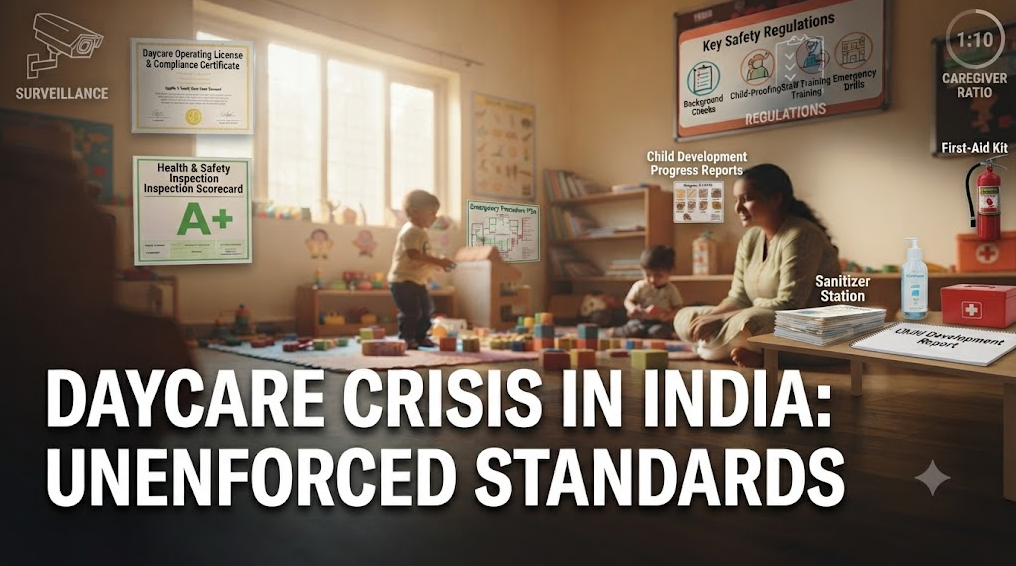
Daycare Centers in India promise safety on paper, but do they deliver it in practice? I’ve spent the last few weeks digging into this question, and honestly, the answer troubled me more than I expected. A recent incident at a Bengaluru IT campus forced thousands of working parents to ask themselves whether their child’s daycare is genuinely safe, or merely appears safe on a compliance checklist somewhere.
This isn’t a story about one bad daycare, though it certainly started there. It’s about a system where rules exist beautifully in policy documents yet often vanish the moment you step through the front door of an actual facility. As Dr. APJ Abdul Kalam once said, “If you want to shine like a sun, first burn like a sun,” and right now, India’s childcare regulators need that same fire to genuinely protect our youngest citizens. I want to walk you through what actually happened, what the law says should happen, and precisely where the two diverge.
The Bengaluru Incident That Started It All
Let me set the scene first, because context matters enormously here. The case involves Little Buds Day Care, a crèche operating inside Capgemini’s Brookefield campus in Bengaluru, within HAL police station limits. Viral videos allegedly showed caregivers locking toddlers in bathrooms, spraying them with jet water, and even placing children inside a front-loading washing machine when they cried. Consequently, an FIR was filed against five women employees, and police arrested at least two caregivers as investigations widened into whether the abuse had continued for months.
Meanwhile, both the National Commission for Protection of Child Rights and the National Human Rights Commission took suo motu cognisance, signaling how seriously this case escalated within days. Capgemini responded by shutting the facility temporarily, offering work-from-home options and counselling to affected employees while reviewing childcare providers across its India operations. Interestingly, though, the Karnataka State Commission for Protection of Child Rights chairperson stated that Capgemini wasn’t directly liable since an external operator, Little Scholars, managed daily operations. This single claim, as we’ll explore throughout this piece, exposes a much larger accountability puzzle that extends far beyond one company or one city.
How Many Daycare Centers in India Actually Exist?
Here’s something that genuinely surprised me during this research process. India has no single, reliable nationwide database tracking all daycare centers in India across corporate, private, government, and informal categories. Government statistics largely track Anganwadi-cum-Crèches under Mission Shakti, which represent only one slice of the childcare landscape rather than the full picture parents actually navigate daily.
Under the Palna scheme, authorities plan roughly 17,000 AWCCs nationwide, but that figure excludes private and corporate daycares entirely, leaving a massive data gap for the fastest-growing segment. Meanwhile, corporate chains like Klay operate over 160 centers by themselves, while India’s broader preschool and childcare market reached USD 5.1 billion in 2025, reflecting explosive, largely unregulated growth. Nevertheless, informal and home-based daycares remain almost completely unmapped, meaning nobody in government can currently say with confidence how many centers actually exist nationwide.
Consequently, when Bengaluru’s police commissioner promised to examine “other such daycare centres” post-incident, he essentially admitted authorities don’t even have a master list to check against. This data vacuum isn’t a minor bureaucratic footnote; it’s arguably the single biggest reason accountability remains so difficult to enforce, because you simply cannot regulate what you haven’t counted. Until India builds a comprehensive registry spanning every category of daycare, inspection and enforcement will always remain reactive rather than preventive.
States With Dedicated Daycare Regulations (2026)
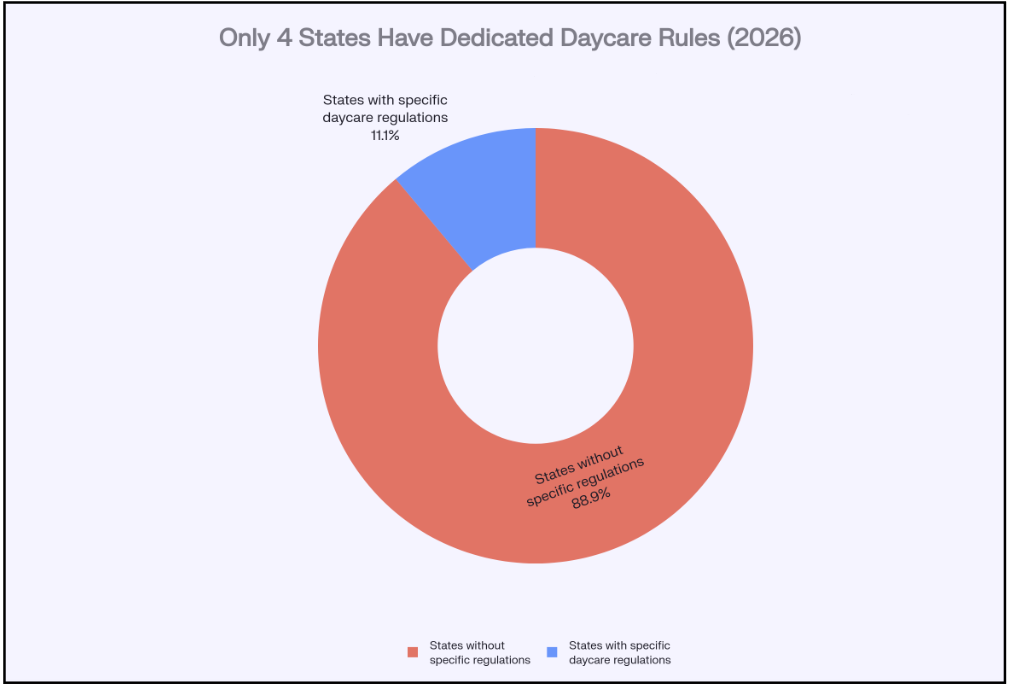
Source: TOI, Early Childhood Association India
Daycare Regulations in India: What the Law Actually Says
So what exactly governs daycare centers in India today, and how binding are these provisions really? The Maternity Benefit (Amendment) Act, 2017 mandates crèche facilities for establishments employing 50 or more people, covering permanent, temporary, and contractual staff alike. Additionally, the National Minimum Standards and Protocol for Crèches, released in 2024 by the Ministry of Women and Child Development, sets caregiver qualifications, CCTV mandates, and infrastructure norms meant to apply across all types of crèches nationwide.
These daycare regulations in India require women-only caregivers, mandatory police verification, medical fitness certificates, and functioning Crèche Administrative Committees that include parent representatives in oversight decisions. Furthermore, states like Maharashtra rolled out uniform safety monitoring norms in 2025, converting these central standards into binding local requirements rather than leaving them optional. This regional variation matters because it means a family’s actual legal protection depends heavily on which state, or even which city, their child’s daycare happens to sit in.
However, expert Swati Popat Vats points out something crucial that undercuts much of this apparent progress: “India still lacks a uniformly enforced national regulatory framework, unlike countries such as Singapore, Australia, New Zealand, the UK and the US”. That single sentence captures the entire regulatory gap in one breath, because having good standards on paper means little without a nationwide mechanism ensuring every facility actually follows them. Until enforcement catches up with documentation, these daycare regulations in India will continue functioning more as aspirational guidelines than as genuine legal safeguards.
Crèche Rules in India: One Size Doesn’t Fit All
Here’s where things get genuinely messy, and where I found myself most frustrated during this research. The 2024 protocol claims to apply to every crèche nationwide, whether government-run, corporate, or privately owned, promising a unified baseline of safety. Yet the Ministry of Women and Child Development itself describes these crèche rules in India as “suggestive,” meaning individual states must voluntarily adopt them into binding law before they carry any real legal weight.
Only four states – Maharashtra, Kerala, Karnataka, and Haryana – currently have specific regulations governing daycare centers in India, and even these frameworks stem primarily from labour law rather than dedicated, standalone childcare legislation. Therefore, corporate crèches typically answer to labour departments, government-supported centers fall under Women and Child Development structures, and informal home-based setups often escape any childcare-specific oversight whatsoever. This three-way split means identical safety failures could trigger completely different regulatory responses depending purely on which category a facility technically belongs to.
As Swati Popat Vats bluntly noted, “the WCD primarily focuses on anganwadis rather than the private sector, so regulations for private daycares are rarely enforced”. This fragmentation isn’t a minor technicality buried in fine print; it’s genuinely the crux of why enforcement fails so consistently across India’s childcare sector. Fixing this would require consolidating oversight under one clear authority, rather than continuing to let responsibility drift between multiple departments that rarely coordinate with each other.
Daycare Licensing and Registration in India: Who’s Actually in Charge?
I kept asking myself this question throughout my research, and I never found a satisfying answer. Who exactly registers and licenses a private daycare in India, and which office would a concerned parent even contact to verify a center’s legitimacy? The honest answer is nobody centrally, because responsibilities scatter across labour departments, municipal corporations, local police stations, and Women and Child Development offices depending on the facility type.
Private and corporate operators typically register merely under the Shops and Establishments Act, securing municipal NOCs without ever completing any dedicated childcare-specific licensing step. This means a daycare can legally open its doors having proven almost nothing about caregiver training, safety infrastructure, or child-protection protocols beyond basic commercial paperwork. Meanwhile, Karnataka now proposes mandatory registration via a government portal, implicitly admitting that countless centers currently operate completely unregistered and effectively invisible to regulators.
This lack of clean daycare licensing and registration in India means parents essentially have no verified way to confirm whether their chosen center meets even baseline standards before enrolling their child. Compare this to sectors like food service or pharmacies, where licensing is comparatively straightforward and publicly verifiable, and the contrast becomes stark. Until India builds an equivalent, transparent licensing system specifically for childcare, parents will keep making enrollment decisions essentially on faith and word-of-mouth reputation alone.
Daycare Center Inspections in India: Rare and Unpredictable
This next part is where the “rules on paper” argument truly falls apart under scrutiny. Karnataka’s 2015 guidelines technically require periodic and surprise inspections, empowering designated authorities to recommend improvements or even revoke licenses for serious violations. Yet, the state itself admitted these very guidelines “lack clarity regarding the specific authority or department responsible for enforcement,” which essentially means the rule exists without anyone clearly tasked to execute it.
Following the Bengaluru incident, KSCPCR proposed appointing a dedicated nodal agency specifically for daycare center inspections in India, alongside mandatory registration and clearly defined caretaker ratios per facility. This reactive reform, while welcome, only emerged after a viral scandal forced political attention onto a problem that quietly existed for years beforehand. Compare this to the United States, where licensing staff must conduct regular onsite visits and publish inspection reports publicly for parents to review before choosing a facility.
India, by contrast, relies overwhelmingly on paper-based compliance rather than genuine, unannounced audits that might actually catch problems before tragedy strikes. Frankly, this is the single biggest lever authorities could pull tomorrow if they truly wanted measurable results, since surprise inspections cost relatively little compared to the human cost of inaction. Until daycare center inspections in India become routine, transparent, and genuinely unpredictable, facilities will continue optimizing for compliance on paper rather than safety in practice.
Caregiver-to-Child Ratios Mandated Under NMSPC 2024
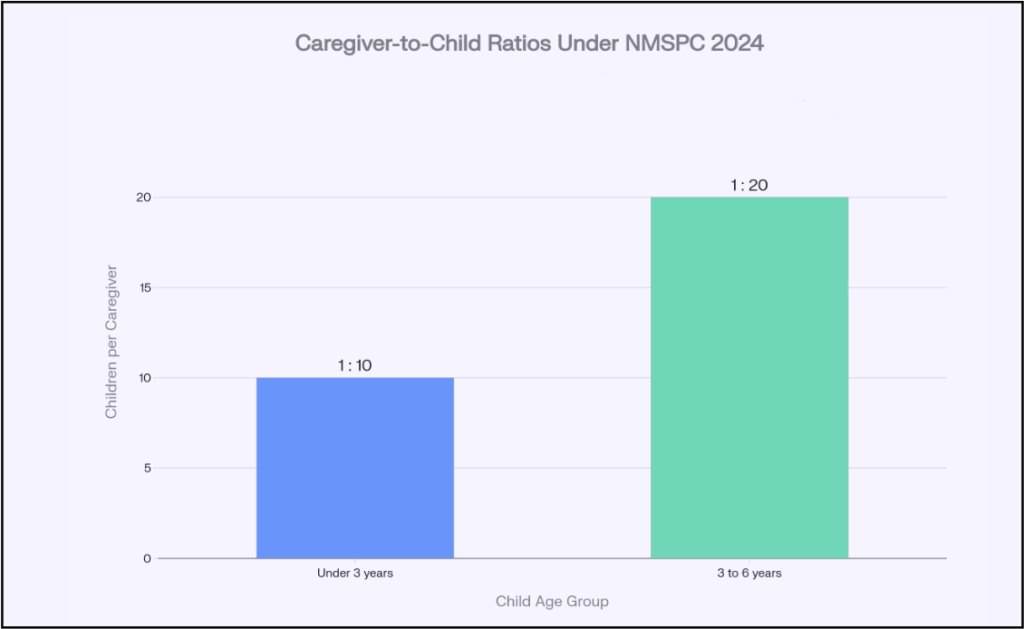
Source: NDTV, MWCD (2024)
| Regulatory Aspect | What the Rule Says | Reality on Ground |
|---|---|---|
| Caregiver ratio | 1:10 for under-3s, 1:20 for 3-6 years | Rarely audited; staffing often outsourced |
| CCTV | Mandatory with parent remote access | Installed but rarely monitored consistently |
| Inspections | Periodic + surprise checks (Karnataka 2015) | No clarity on enforcing authority |
| Registration | Should register with WCD/labour dept | Many centers operate unregistered |
| Staff verification | Police + medical certificates required | Skipped when staffing is outsourced |
Source: Compiled from NDTV, The Hindu, TOI, and MWCD guidelines
Corporate Daycare Centers in India: Who Bears the Blame?
Now here’s a genuinely thorny question I kept circling back to throughout this investigation. When a corporate outsources its crèche to a third-party vendor, who ultimately answers when something goes horribly wrong inside that facility? HR experts argue employer accountability persists regardless of outsourcing arrangements, insisting HR and EHS teams must conduct regular safety audits, review vendor contracts critically, and never treat childcare as a one-time compliance checkbox.
Yet KSCPCR’s own chairperson publicly stated Capgemini bore no direct liability since Little Scholars handled daily operations, effectively drawing a clean legal line between the host company and the vendor. This contradiction matters enormously for corporate daycare centers in India, because it essentially lets companies wash their hands off responsibility the moment they sign a vendor contract, regardless of how much oversight they actually exercised. If this precedent holds, companies have little incentive to conduct rigorous vendor audits, since liability conveniently transfers away the instant something goes wrong.
I’d argue this loophole needs closing immediately, ideally through binding vendor-liability clauses written directly into labour law rather than left to voluntary corporate goodwill. Companies benefit reputationally and financially from offering on-campus daycare as an employee perk; they should equally bear responsibility when that perk fails catastrophically. Until Indian law explicitly assigns shared liability between host companies and vendors, corporate daycare centers in India will remain vulnerable to exactly this kind of accountability gap.
Government-Funded Crèches and Private Daycare Centers in India: A Tale of Two Systems
Government-funded crèches, primarily Anganwadi-cum-Crèches under the Palna scheme, follow Integrated Child Development Services (ICDS) structures that bundle nutrition support, immunization tracking, and early education directly into daily operations. This integrated model means government-supported facilities are theoretically monitored not just for safety but for broader child development outcomes, creating multiple touchpoints where problems could surface. Private daycare centers in India, however, operate under an entirely separate universe of Shops and Establishments licensing with minimal childcare-specific oversight woven in.
This dual-track system creates wildly inconsistent safety baselines depending purely on which category a facility happens to fall under, even when both serve nearly identical age groups and needs. A government-supported crèche might follow ICDS nutrition and health protocols rigorously because inspectors visit regularly for those specific metrics, while a private daycare down the same street operates with essentially zero equivalent scrutiny. Parents rarely realize this distinction exists until something goes wrong, at which point they discover their chosen facility was never subject to the same standards they assumed applied universally.
Bridging this gap requires harmonizing standards across both public and private daycare centers in India, rather than continuing to treat them as fundamentally different entities requiring separate regulatory universes. A unified inspection framework, applied consistently regardless of ownership structure, would close much of this disparity almost overnight. Until that harmonization happens, choosing between government-supported and private daycare will remain, in part, a gamble about which regulatory system happens to actually function in your specific city.
Daycare CCTV Rules in India: Safety Net or Security Theatre?
CCTV gets treated almost like a magic fix in most policy discussions, doesn’t it? The NMSPC mandates cameras with parental remote access, and states like Navi Mumbai require daily footage review alongside IP-based systems that let parents check activity from their phones. On paper, this sounds like a comprehensive solution that should catch abuse in real time and deter bad behavior before it even starts.
Yet Swati Popat Vats warns pointedly that “it will take more than cameras to make creches safer,” a caution that cuts directly against the comforting narrative that surveillance alone solves everything. Blind spots, inconsistent footage monitoring, and genuine privacy or cybersecurity concerns all undermine these daycare CCTV rules in India when they’re treated as standalone solutions rather than one piece of a broader safety culture. Cameras also tend to document abuse only after it happens; they rarely prevent it in real time unless someone is actively, continuously watching the feed, which almost never occurs in practice.
Consequently, CCTV should function as one layer within a broader safeguarding culture, not as a substitute for trained, vetted, and genuinely caring staff who understand child psychology and de-escalation. Installing cameras without pairing them with active monitoring, staff accountability, and rapid escalation protocols essentially creates expensive security theatre rather than real protection. Until daycare CCTV rules in India get paired with mandatory footage audits and swift consequences for violations, cameras will remain a reassuring but largely symbolic gesture.
Daycare Caregiver Background Checks India: The Weakest Link
Staffing conditions deserve honest, careful examination here, because this is where good intentions most often collapse into practice. NMSPC mandates police verification, medical fitness certificates, and a stated preference for trained childcare professionals over untrained hires picked up quickly. Recommended ratios sit at 1:10 for under-3s and 1:20 for older toddlers, with at least one supervisor assigned per unit of roughly 25 to 30 children.
Unfortunately, daycare caregiver background checks India often get skipped entirely when staffing gets outsourced through unverified contractors racing to fill positions quickly and cheaply. This shortcut might save an operator time and money upfront, but it directly increases the risk of hiring individuals without proper screening, training, or psychological suitability for working with vulnerable toddlers. I want to be careful here: poor pay and inadequate training never excuse abuse or negligence, full stop, and nothing in this section should be read as shifting blame away from perpetrators themselves.
But these systemic gaps do help explain why enforcement failures translate into real, documented harm rather than remaining abstract policy footnotes buried in government reports. When background checks become optional in practice despite being mandatory on paper, the entire safety framework built around caregiver quality quietly collapses. Strengthening daycare caregiver background checks India would require centralized verification databases, mandatory certification renewal, and genuine consequences for operators who skip these steps entirely.
Daycare Complaint Mechanisms in India: Who Do Parents Actually Call?
Imagine suspecting something’s wrong at your child’s daycare, right now. Who would you even call first, and how confident would you feel that your complaint gets taken seriously? NCPCR holds intervention powers and acted swiftly in the Capgemini case, while NHRC pursued suo motu action separately through its own independent channel.
NGOs like Bachpan Bachao Andolan also run dedicated complaint helplines covering broader child-protection concerns, offering another avenue outside formal government bureaucracy. Still, no single, daycare-specific national complaint system consolidates reports or tracks outcomes consistently across facilities nationwide, meaning most parents genuinely don’t know where their complaint should even go. Consequently, daycare complaint mechanisms in India remain scattered, largely reactive, and heavily dependent on incidents going viral on social media rather than routine, proactive reporting channels functioning quietly in the background.
Parents deserve one unified helpline, clearly advertised at every daycare entrance, rather than a confusing scavenger hunt across five different agencies with overlapping but unclear jurisdictions. A centralized digital complaint portal, similar to consumer grievance systems already used in banking or e-commerce, could transform how quickly concerns get investigated and resolved. Until daycare complaint mechanisms in India consolidate into something genuinely accessible, most legitimate concerns will likely go unreported simply because parents don’t know where to direct them.
Working Parents and Childcare in India: The Bigger Social Picture
Step back for a moment and consider the broader stakes woven into this entire conversation. Accessible, safe childcare directly shapes women’s workforce participation across India, functioning as a quiet but powerful economic lever far beyond individual family decisions. Studies like “Women Need Creches” confirm that unreliable daycare access remains a major structural barrier to sustained female employment, particularly in low-income and informal-sector households.
Social commentary has even cited figures suggesting a significant share of women exit the workforce after motherhood, partly due to inadequate childcare support systems that leave them with few genuinely trustworthy options. Therefore, working parents and childcare in India isn’t merely a parenting inconvenience confined to individual households; it’s fundamentally an economic and gender-equity issue with national implications for productivity and growth. When daycare safety fails publicly, as it did in Bengaluru, it doesn’t just endanger children in that specific facility; it quietly reinforces every skeptical parent’s decision to keep a spouse home rather than risk institutional childcare altogether.
This ripple effect rarely makes headlines, but it shapes household economics across millions of Indian families navigating similar tradeoffs every single day. Improving working parents and childcare in India, therefore, requires treating daycare safety not as a niche parenting concern but as core economic infrastructure deserving the same seriousness as public transport or healthcare access. Until policymakers make that mental shift, childcare will keep getting treated as an afterthought rather than the foundational support system it actually represents.
This Wasn’t an Isolated Case
Sadly, Bengaluru wasn’t a one-off tragedy either, and that pattern deserves far more attention than any single viral video typically generates. In Chhatrapati Sambhajinagar, a 23-month-old was reportedly bitten 25 times by another toddler after staff left three children unsupervised in a locked room, a genuinely disturbing lapse in basic supervision. Investigators later discovered that daycare lacked valid registration entirely, meaning the facility was operating outside even the minimal paperwork requirements that theoretically exist.
Media investigations elsewhere have similarly documented cramped, unregulated play schools flouting basic safety laws nationwide, suggesting these aren’t isolated bad actors but a recognizable systemic pattern. Consequently, experts now treat these incidents collectively as evidence of genuine systemic oversight failure, rather than dismissing each case as isolated bad luck involving a few rogue employees. This pattern is precisely why I refuse to frame this entire piece around one company’s mistake, however dramatic and headline-worthy that particular incident became.
Treating Capgemini’s case as uniquely shocking risks letting policymakers off the hook once public attention inevitably fades in a few weeks. The Sambhajinagar case, occurring around the same period yet receiving far less coverage, proves this is a structural problem repeating quietly across different states and different types of facilities. Real reform requires acknowledging this broader pattern honestly, rather than treating each new scandal as a shocking, unprecedented exception.
What Reform Actually Requires
So where do we go from here, practically speaking, once the outrage cycle eventually settles down? Experts recommend converting the 2024 protocol from suggestive guidance into binding state law nationwide, removing the voluntary adoption clause that currently lets most states simply ignore it. Additionally, bi-annual surprise audits combining police, labour, and child-protection officials could genuinely catch violations before tragedy strikes, rather than investigating only after viral videos force political attention.
Karnataka’s proposed nodal agency, mandatory registration portal, and clearly defined caretaker ratios represent solid first steps worth replicating across every state rather than remaining a single-state experiment. A centralized public registry tracking certified caregivers, complete with blacklisting provisions for staff terminated over ethical violations, would add meaningful accountability that currently doesn’t exist anywhere in the system. These reforms aren’t expensive or technologically complex; they primarily require political will and sustained follow-through long after news cycles move on to other stories.
Ultimately, though, policy alone won’t fix this problem entirely, because parents must also actively audit centers themselves rather than assuming government oversight alone guarantees safety. Society, more broadly, must stop treating childcare work as invisible, undervalued labour deserving minimal pay and minimal scrutiny, since that devaluation directly feeds into the staffing shortcuts we’ve discussed throughout this blog. Real, lasting change requires policymakers, employers, and parents all treating childcare safety as a shared responsibility rather than someone else’s problem to solve.
Demand Better: What You Can Do Now
Daycare Centers in India stand at a genuine crossroads right now, and the choice ahead feels remarkably urgent given everything we’ve covered. We can either let this news cycle fade quietly, as it always has before following previous scandals, or we can demand structural accountability that genuinely outlasts headlines and political attention spans. I’d encourage every reader, parent or not, to ask their local representative one simple question: who inspects the daycare down your street, and precisely when did that inspection last happen?
If this investigative and analytical blog by ExpressIndia.info moved you even slightly, please share it widely, discuss it openly with other parents, and push collectively for the national registry this sector desperately needs. Our youngest citizens cannot advocate for themselves, which means the rest of us genuinely have no excuse for looking away any longer.
DaycareCentersIndia #ChildSafetyIndia #ParentingIndia #SocialImpactJournalism #IndiaChildWelfare