
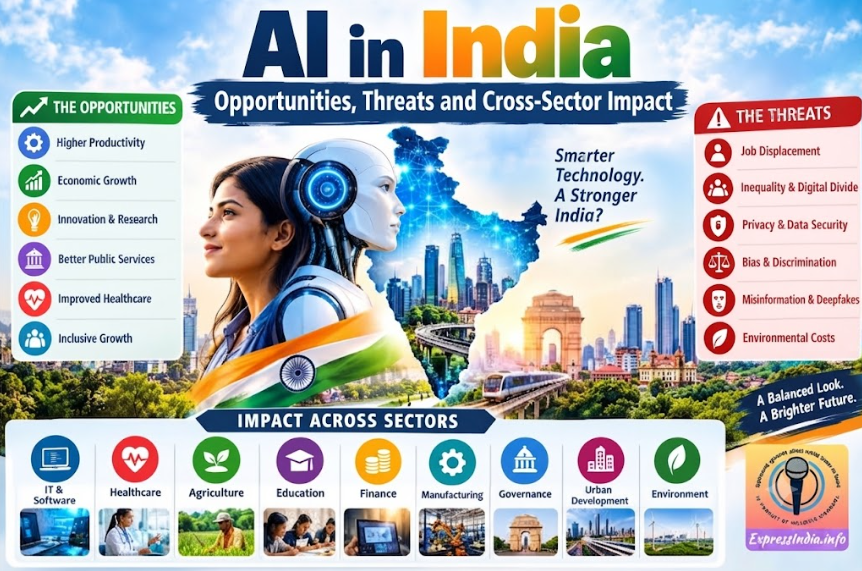
AI in India used to be a conference buzzword. You know the type. Executives dropped it into strategy decks to sound forward-thinking. Now? It’s everywhere. Bank apps flag suspicious transactions. Farm advisories ping farmers’ phones before pest outbreaks. Hospital waiting rooms use AI-assisted screening before you even see a doctor. This quiet transformation is reshaping how a billion people work, learn, and access services every single day.
Five years ago, I dismissed chatbots as “glorified FAQs.” I moved on with my day. These days, though, I ask one to draft emails before I’ve finished my morning chai. This is besides other AI tools I use regularly based on their use case. That small habit shift, scaled across a billion people, is the real story here. Not the technology itself, but how it’s quietly rewiring daily life. From boardrooms to village councils, AI in India is no longer a future promise; it’s a present reality that demands honest scrutiny.
This blog is a Part-1 overview of Artificial Intelligence (AI) in India in a series of AI-related blogs that I’ll be coming up with. Think of this one as a map, not a deep dive. So, I won’t drown you in a plethora of jargons. Instead, I’ll show you where AI in India is already creating value. I’ll show where it’s widening old cracks. And I’ll show how different sectors are absorbing this shift at wildly different speeds. Future blogs will dig into IT, health, farming, jobs, education and other AI-impacted sectors in India, one at a time. Each deserves its own room to breathe.
So, here’s the question: Is AI in India a shortcut to faster growth? Or could its costs land unevenly on people with the least cushion? Let’s work through that together, sector by sector, without pretending the answer is simple. The evidence suggests both promise and peril, often in the same breath.
AI Arrives at India’s Doorstep
Something quiet happened inside Indian boardrooms over the past two years. AI in India stopped being a slide in a strategy deck. Instead, it became a genuine line item in company budgets.NASSCOM’s AI Adoption Index, for instance, gives India a score of 2.45 out of 4. By December 2025, 87% of enterprises were actively using AI solutions. McKinsey, meanwhile, found that 88% of Indian firms already use AI in at least one business function. This rapid uptake signals a genuine shift in corporate priorities across the country.
Numbers alone rarely capture the mood, though. Deloitte’s 2026 “State of AI in the Enterprise” report says 40% of Indian firms report “significant or full” AI usage. That easily beats the 28% global average. Furthermore, enterprise AI investment jumped 119% in a single year. It outpaced the 110% global growth rate. Yet, only 22% of these firms have solid AI governance frameworks in place. That mismatch — ambition racing ahead of accountability — sits at the centre of this whole story.
Ashwini Vaishnaw, India’s IT minister, has pushed back hard on claims that India lags global peers. Speaking at Davos in early 2026, he pointed to Stanford rankings placing India third globally in AI penetration, preparedness, and talent. “I don’t think your classification is correct,” he told the IMF’s managing director. He argued India belongs in the world’s top tier of AI nations rather than a “second-tier” bracket. That confidence is backed by real numbers. Still, the governance gap suggests confidence alone won’t be enough.
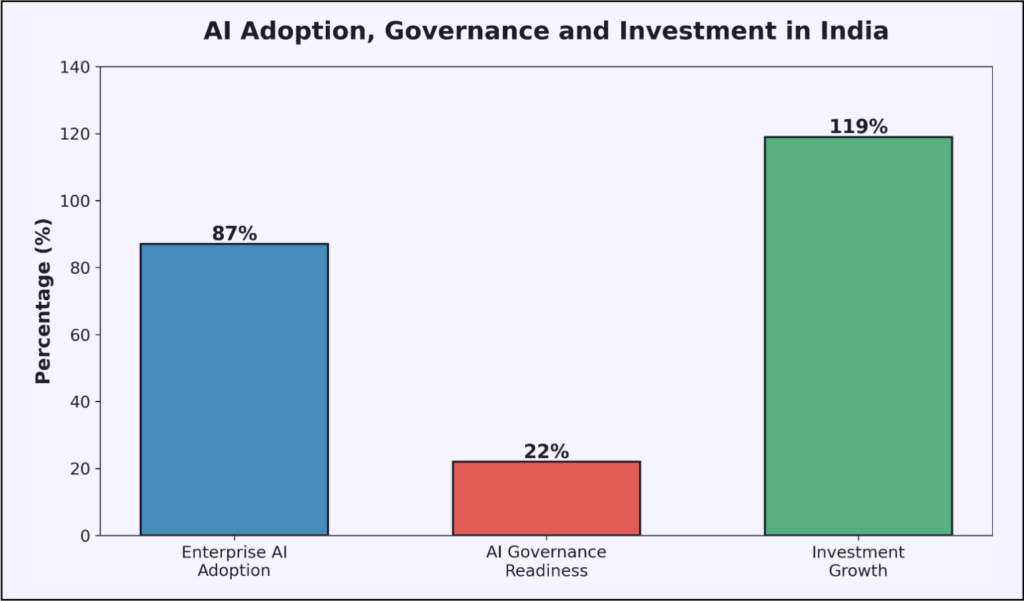
Source: NASSCOM AI Adoption Index (Dec 2025); ServiceNow Enterprise AI Maturity Index 2026
What “AI” Means in the Indian Context
Before going further, let’s define terms without turning this into a classroom lecture. When this blog says “AI,” it means a cluster of related tools working together across sectors. Machine learning drives fraud detection inside banks, where 71% of BFSI adopters already use it for risk management. Generative AI and large language models now draft content, write code, and summarise long documents inside Indian companies. These tools are no longer experimental; they’re embedded in daily workflows.
Computer vision screens millions of eyes for early disease signs. Tools like MadhuNetrAI, specifically, flag diabetic retinopathy before symptoms worsen. Meanwhile, smart bots, handle government helplines and bank queries around the clock. The telemedicine platform eSanjeevani has logged 282 million consultations since 2023. Many of these, notably, were assisted by AI-suggested diagnoses. Robotics is emerging too, particularly through farm drones spraying pesticides across fields in Punjab and neighbouring states. The scope is genuinely broad.
What genuinely sets AI in India apart is its pairing with Digital Public Infrastructure (DPI). Aadhaar supplies identity. UPI, likewise, supplies payment trails. Agristack, in turn, supplies farmer records. Bhashini, meanwhile, is building language models for over 500 million regional-language speakers whom most global tools still ignore entirely. Infosys co-founder Nandan Nilekani has described this relationship directly: “DPI has laid the foundation in terms of large systems, a lot of data, all of which are required for AI. AI will be built on top of DPI, and DPI will get turbocharged by AI. So, it’s a very synergistic relationship.” That’s not marketing language; rather, it’s a fairly accurate summary of what’s already happening on the ground.
The Opportunities AI Creates for India
Here’s where the optimism genuinely earns its place. Deloitte found that 97% of Indian firms expect AI to lift productivity. Gains, notably, look strongest in product design, strategy, and supply chains. In manufacturing, AI-driven predictive maintenance already cuts unplanned downtime by 30 to 50%. That market alone, as a result, may grow to $4.89 billion by 2030. NASSCOM, too, estimates the broader prize at up to $500 billion across nine industry verticals. That’s a serious number even after accounting for consultancy optimism.
India’s innovation drive is humming too, backed by public money. The IndiaAI Mission carries an outlay above ₹10,371 crore. So far, it has onboarded over 38,000 GPUs. The mission also hosts, in addition, 9,500-plus datasets on the AIKosh platform. Centres at AIIMS Delhi and PGIMER, consequently, now build local medical AI. They no longer simply import foreign models wholesale.
Agriculture offers some of the clearest early proof. AI-driven precision farming platforms have lifted yields by 15 to 20% for early adopters. NITI Aayog’s own pilots, similarly, documented 21% higher yields alongside 11% better prices and 9% lower input costs. These figures come from live programmes, not projections dressed up as certainties. Healthcare tells a similar story: AI tools inside India’s TB elimination programme cut adverse outcomes by 27%. Case detection, moreover, rose by 12 to 16% in trials. Meanwhile, eSanjeevani’s AI-assisted consultations have reached primary-care patients who once had no specialist access at all.
Education is shifting too, sometimes faster than schools can adjust. Under NEP 2020, CBSE now offers a 15-hour AI module from Class VI. Computational thinking, subsequently, becomes compulsory from Grade 3 starting 2026-27. NCERT has already translated early-grade textbooks into 22 Indian languages using AI. This, in effect, quietly narrows a language gap that policy debates never quite solved on their own. In finance, similarly, 78% of BFSI adopters use AI for customer service. Credit scoring, meanwhile, increasingly reaches thin-file customers whom banks previously turned away. The breadth of impact is genuinely striking.
Vernacular AI, meanwhile, remains one of the more underrated opportunities on this list. English-first models still miss roughly 40% of India’s market. One industry estimate, accordingly, puts the vernacular opportunity at $20 billion. Platforms like VISTAAR, built on Bhashini and Agristack together, are finally building tools for Bharat rather than adapting tools built somewhere else first. This shift matters enormously for inclusion.
The Threats AI Poses
Now for the harder half of this story, because none of the above comes free. A policy brief from Research and Information System (RIS) estimates that digital interventions, including AI, could reshape roughly 40 to 45 million jobs while creating around 20 million new ones by 2025. That sounds balanced on paper. However, “reshape” usually means disruption arrives well before replacement jobs do. Workers, consequently, rarely experience both halves at the same pace. The timing mismatch creates real pain for affected families.
TCS chairman N Chandrasekaran offered a blunt version of this trade-off at the company’s 2026 annual general meeting. “If the company has half a million employees, the day is not far when the company will have half a million AI agents,” he told shareholders. He added that “the company will not be hiring the kind of numbers that it used to hire.” Chandrasekaran framed AI as opportunity rather than threat for the firm itself. Even so, his own words confirm that hiring volumes in India’s largest private employer are already shrinking as AI absorbs more routine work. The scale of this shift is hard to overstate.
EY’s 2025 GenAI survey found 64% of Indian leaders expect selective displacement concentrated in back-office, telecalling, and customer-support roles specifically. Meanwhile, small and mid-sized firms lag badly behind large enterprises in AI adoption. Cost and skill gaps, unfortunately, hold many small businesses back badly. Nandan Nilekani has flagged this concentration risk directly. “If you want to AI-proof an economy, you actually should create a situation where job creation is done by millions of small companies,” he argued. His point cuts against the current trend. Right now, AI adoption and investment both cluster around big cities and big firms.
Data privacy carries its own weight here. The DPDP Act and its 2025 Rules set out clear duties around consent and data handling. Incidentally, as I’ve explored in my Data Privacy Day 2025 blog, India’s DPDP Act sets out clear duties around consent and data handling, though gaps remain in AI-specific protections. Yet, India still has no single, dedicated law built specifically for AI. Consequently, AI systems drawing on Aadhaar-linked or UPI transaction data currently operate in a genuinely grey legal zone. The IT Act, sector-specific regulations, and the non-binding India AI Governance Guidelines all apply in parts. Enforcement, therefore, often depends more on institutional goodwill than on hard penalty. This uncertainty matters for both citizens and companies.
Bias represents another quiet risk, particularly in lending and hiring decisions where historical data can carry old prejudices forward unnoticed. NITI Aayog’s own Responsible AI papers flag fairness and explainability gaps in exactly these areas. Deepfakes have grown serious enough that Union Minister Ashwini Vaishnaw called for international cooperation on the issue at the 2026 AI Summit. “Innovation without trust is a liability,” he warned, while announcing mandatory watermarking rules for synthetic content. Cybersecurity risks are compounding too, since AI agents increasingly execute financial decisions with minimal human review. Many firms, sadly, still lack the audit trails that would catch an error before it compounds. The risks are real and multifaceted.
Generative AI’s most persistent flaw, frankly, is how confidently it can be wrong. It produces polished, convincing answers that sometimes have no basis in fact. Honestly, this matters enormously in classrooms and newsrooms alike. Schools, accordingly, now need human sign-off on AI-generated content used for grading or assessment. Public services need similar safeguards before AI output reaches citizens directly. Underneath all of this sits the governance gap already mentioned. Roughly 80% adoption paired with just 22% governance readiness, by most expert accounts, simply isn’t sustainable at scale. Something has to give.
Cross-Sector Impact: Where AI in India Is Reshaping Everything
This is the question this whole blog has been building toward. Where, specifically, does AI’s cross-sector impact in India show up most clearly right now? The table below maps the terrain across ten major sectors, showing key uses, main opportunities, and primary threats for each. This snapshot helps frame the more detailed sector deep-dives coming in future instalments.
Sector-Wise Snapshot of AI in India
| Sector | Key AI Uses | Main Opportunity | Main Threat |
|---|---|---|---|
| IT & Software | Code generation, testing automation, AI agents | Productivity, export competitiveness | Slower hiring, entry-level compression |
| Healthcare | Diagnostics, TB screening, telemedicine | Early detection, rural access | Privacy, clinical accountability |
| Agriculture | Advisory apps, drones, yield prediction | Higher yields, better prices | Digital divide for smallholders |
| Education | AI tutors, translated textbooks | Personalised, multilingual learning | Hallucinations, academic integrity |
| Jobs & Workforce | Automated back-office, hybrid roles | New AI-augmented careers | Routine job displacement |
| Finance (BFSI) | Fraud detection, credit scoring | Inclusion for thin-file customers | Bias in lending decisions |
| Manufacturing | Predictive maintenance, vision QC | Reduced downtime, global scale | MSME adoption lag |
| Source: Compiled from PIB, NASSCOM, Deloitte, EY, NITI Aayog, ServiceNow, and Reuters reports (2025-26).Governance | Welfare targeting, citizen chatbots | Efficient, targeted delivery | Surveillance, accountability gaps |
| Smart Cities | Traffic and utility management | Reduced congestion, efficiency | Privacy in pervasive sensing |
| Environment | Climate modelling, disaster prediction | Better preparedness | Sparse footprint data |
Source: Compiled from PIB, NASSCOM, Deloitte, EY, NITI Aayog, ServiceNow, and Reuters reports (2025-26)
Looking closely at this table reveals a fairly clear pattern. Sectors like IT, banking, and manufacturing show the fastest change. AI, after all, already sits inside their core, revenue-generating workflows. Health and agriculture, by contrast, prove that public-interest AI can scale too. It moves past isolated pilots into measured social outcomes. Education, however, sits somewhere in between. It looks structurally promising on paper, yet uneven in classroom practice. Broadly speaking, AI’s cross-sector impact in India tends to favour access wherever digital infrastructure is already strong. Conversely, it risks exclusion wherever that infrastructure remains thin or unreliable. The pattern is consistent and clear.
Key Statistics: AI Adoption, Investment and Readiness in India
To better understand the scale and pace of AI adoption in India, the table below compiles key statistics from multiple authoritative sources. These figures provide context for the sectoral analysis above and help benchmark India’s progress against global peers. The data spans adoption rates, investment trends, governance readiness, and skill penetration across the Indian ecosystem.
Key Statistics on AI in India (2025-26)
| Metric | Value | Source |
|---|---|---|
| Enterprise AI adoption rate | 87% | NASSCOM AI Adoption Index (Dec 2025) |
| AI Adoption Index score (out of 4) | 2.45 | NASSCOM AI Adoption Index |
| Firms with “significant or full” AI usage | 40% | Deloitte State of AI in Enterprise 2026 |
| Enterprise AI investment growth (YoY) | 119% | ServiceNow Enterprise AI Maturity Index 2026 |
| Firms with solid AI governance frameworks | 22% | ServiceNow Enterprise AI Maturity Index 2026 |
| Overall AI governance score (out of 100) | 55 | ServiceNow AI Governance Index |
| AI skill penetration vs global average | 2.5x | IndiaAI Mission Backgrounder 2026 |
| GPU capacity under IndiaAI Mission | 38,000+ | PIB Backgrounder on IndiaAI Mission 2026 |
| Long-term GPU capacity goal | 100,000 | IndiaAI Mission |
| People trained via FutureSkills PRIME | 16+ lakh | FutureSkills PRIME |
| AI startups funded since 2024 | Sharp growth | Multiple VC reports |
| Vernacular AI market opportunity | $20 billion | Industry estimates |
Source: Compiled from NASSCOM, Deloitte, ServiceNow, PIB, and industry reports (2025-26)
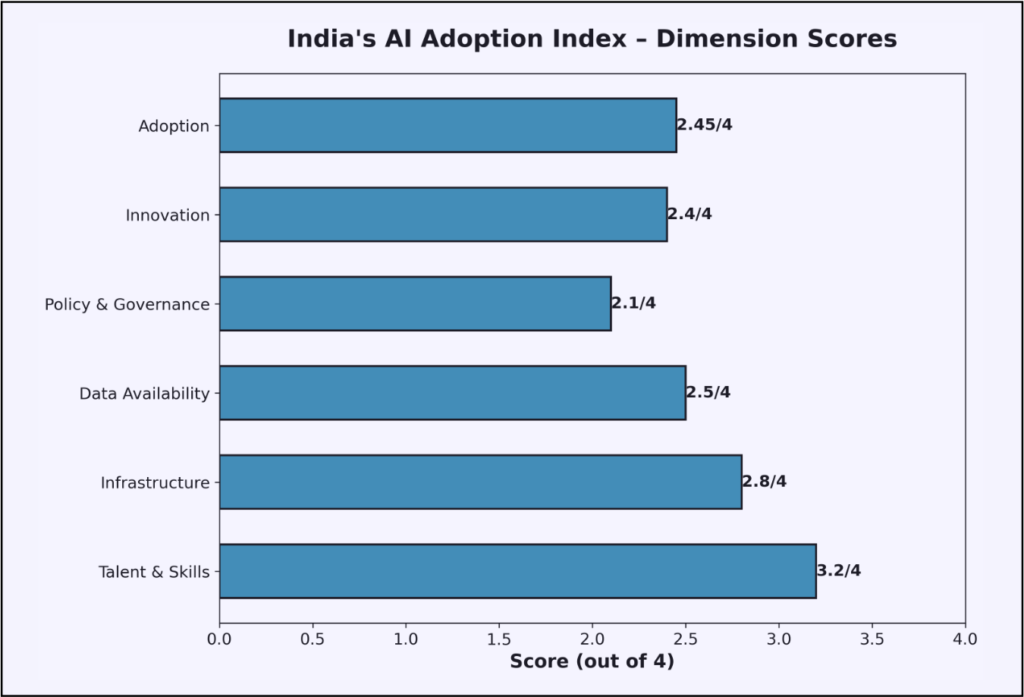
Source: NASSCOM AI Adoption Index Report, in partnership with EY
Is India Ready for the AI Transition?
On raw talent, first, India genuinely punches above its weight. AI skill penetration runs at 2.5 times the global average. This is backed by government support for 500 PhD scholars nationwide. Dozens of AI labs, notably, sit deliberately outside major metro cities. Infrastructure helps considerably here too, since Aadhaar and UPI already exist. These systems provide the rails that AI needs to scale nationally. The talent foundation is genuinely strong.
Compute capacity has grown fast as well, and rightly so. GPU capacity under the IndiaAI Mission jumped from 10,000 to 38,000 units. The longer-term goal, moreover, sits at 100,000 units total. Startup funding climbed sharply too, alongside serious skilling investment. Programmes like FutureSkills PRIME have already trained over 16 lakh people. At the 2026 AI Impact Summit, Ashwini Vaishnaw described even bigger ambitions ahead. He outlined plans to attract up to $200 billion in AI investment. This spans compute, data, and application layers over two years. That figure signals real government ambition, not symbolic commitment alone. The scale of investment is genuinely striking.
On the other hand, governance remains the visible soft spot here. India’s overall AI governance score sits at just 55 out of 100. This trails regional leaders by a meaningful margin. Vernacular AI coverage, similarly, stays thin despite Bhashini’s genuine efforts. Smaller firms, too, continue trailing large enterprises badly in adoption. Rajeev Chandrasekhar, a former junior IT minister, once framed the government’s regulatory instinct plainly. “We will regulate AI as we regulate Web3 or any emerging technologies to ensure they do not harm digital citizens,” he said. That intent is reasonable enough on its own terms. Even so, the current patchwork suggests execution still has real distance left. The gap between intent and execution is real.
Venture investment tells its own version of this uneven story. Funding into Indian AI startups has grown sharply since 2024. As I noted in my blog on National Startup Day in India, the country’s startup ecosystem is increasingly focused on AI-driven solutions that turn ideas into purpose-built ventures. It concentrates heavily in agritech, healthtech, and fintech specifically. Most of that capital, however, still clusters around Bengaluru, Delhi, and Mumbai. Smaller cities receive comparatively little investment despite genuine local talent. Policymakers hope IndiaAI’s Tier-2 and Tier-3 labs can slowly rebalance this. Only sustained funding over several years will show if that hope holds. Geographic concentration remains a real concern.
Energy deserves a brief mention too, since it rarely gets one. Training large AI models needs constant power and cooling infrastructure. India’s data centre footprint, consequently, is expanding fast to meet demand. Some of that power still draws from coal-heavy state grids today. Renewable-linked compute, thankfully, features in the Mission’s longer-term plans. Still, nobody tracks India-specific AI emissions with much real precision. Closing that particular data gap deserves a higher place on the agenda. The environmental footprint is an open question.
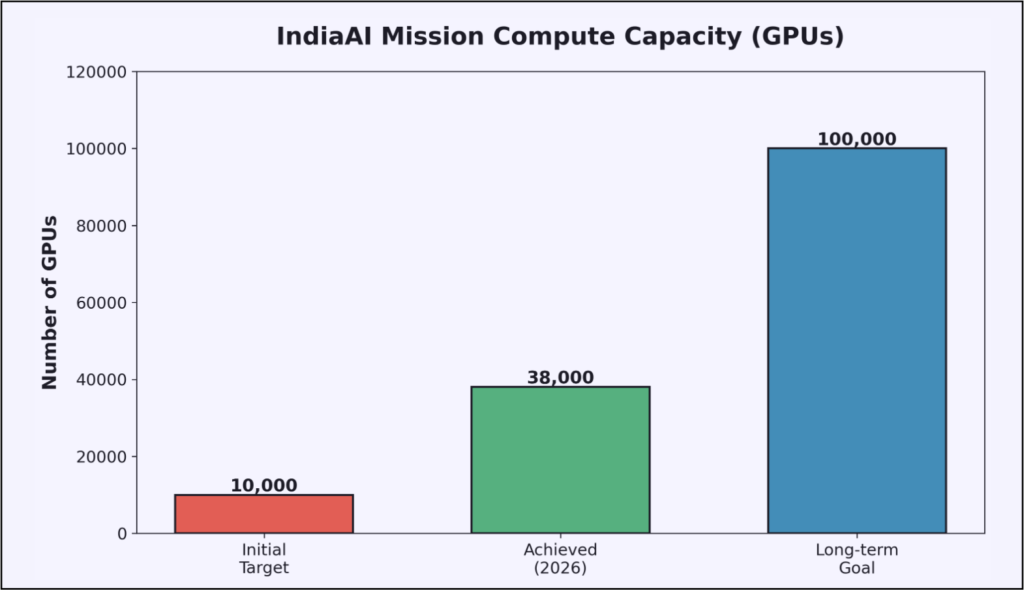
Source: PIB Backgrounder on IndiaAI Mission (2026); India AI Governance Guidelines report
The Human Dimension: AI and Everyday Indians
Numbers matter, but the people behind them matter far more. A student studying algebra with an AI tutor, for instance, gains something real. She gets patient, repeatable explanations in her own language directly. Honestly speaking, this simply wasn’t available at this scale before. She also has to resist letting AI finish her homework outright. That discipline, admittedly, is harder to maintain than it sounds. The trade-offs are personal and daily.
An engineer whose coding tasks are partly automated gains real time back. This frees her for more demanding architectural work instead of scripting. Elsewhere, a farmer receiving pest alerts a few days early can act faster. Agristack-linked advisories make this possible before outbreaks spread across fields. Patchy rural connectivity, unfortunately, still cuts him off at the worst moments. A patient screened using an AI-powered retinal camera benefits too. Her early diagnosis might otherwise have waited months for a specialist visit. These gains are real and tangible.
A small shop owner using AI to draft marketing captions saves real hours. Those hours, previously, disappeared into unpaid administrative work each week. A citizen filing a grievance through a government chatbot gets a faster response. That speed, though, depends on the system understanding her dialect correctly. This remains an open question across many regional languages. None of these situations, individually, feels especially dramatic on its own. Multiplied across a billion people, though, they add up to something real. That something genuinely deserves the word transformation, even alongside real risk. The human stakes are enormous.
What Should India Do Next?
Given everything said above, what would actually help India here? Human oversight needs to stay non-negotiable in health and education specifically. Mandatory expert sign-off should apply before AI content reaches students or patients. Reskilling, meanwhile, deserves serious, sustained funding rather than symbolic announcements. Moving tens of millions of workers requires real training infrastructure, not slogans. The scale of reskilling needed is genuinely massive.
Digital access matters just as much as any classroom mandate on paper. AI curricula shouldn’t launch where basic broadband access still fails regularly. Data protection, similarly, needs firmer enforcement across every sector. Regulators like RBI and SEBI should map AI-specific risks explicitly. After all, general-purpose rules rarely stretch cleanly to cover new technology. Therefore, transparency should guide product design from the very outset. It shouldn’t arrive later as a compliance afterthought bolted on. Prevention beats cure every time.
Smaller firms need genuine, practical support through subsidies and shared platforms. Specifically, public sandboxes can lower their cost of entry meaningfully. Vernacular AI investment needs to accelerate given the market gap. Roughly 40% of India’s market remains underserved by English-first tools. Finally, India needs to track AI’s real-world impact honestly over time. Policy should adjust as evidence accumulates, not freeze around early assumptions. None of this amounts to ideology; rather, it simply reflects what evidence suggests works. The path forward is clear, even if it is demanding.
The Future: AI and India
Three broad futures seem plausible from here, and none cancels the others. First, AI as accelerator would lift productivity across factories, farms, and firms. This works best if governance genuinely keeps pace with adoption speed. Second, AI as disruptor would bring real pain to routine, exposed workers. This risk grows if reskilling and digital access keep lagging behind investment. Both futures are plausible and may unfold together.
Third, AI as a broader societal shift would change daily habits quietly. It would work much like UPI reshaped payments within just one decade. Honestly, all three paths will likely unfold together, side by side. Truthfully, technology alone won’t decide the outcome here. Rather, India’s choices on rollout, rules, and inclusion will decide it instead. The agency lies with policymakers, companies, and citizens.
That’s precisely why this blog stays a Part-1 overview, not a verdict. Future instalments will look closely at AI’s mark on IT, health, education and other sectors which it impacts across India. Frankly, farms and jobs too deserve their own deep dive. Eventually, each topic needs nuance that one wide-angle blog cannot offer alone. AI in India isn’t some distant future waiting politely to arrive. Indeed, it already shapes breakfast-table conversations, farm decisions, and hospital queues today. The gains are real, the risks are serious, and, overall, nothing here feels settled. Accordingly, ExpressIndia.info will keep following this story closely, sector by sector. So, stay glued, because what happens next will matter for nearly everyone.
AIinIndia #DigitalIndia #FutureOfWork #TechForGood #IndiaAIMission