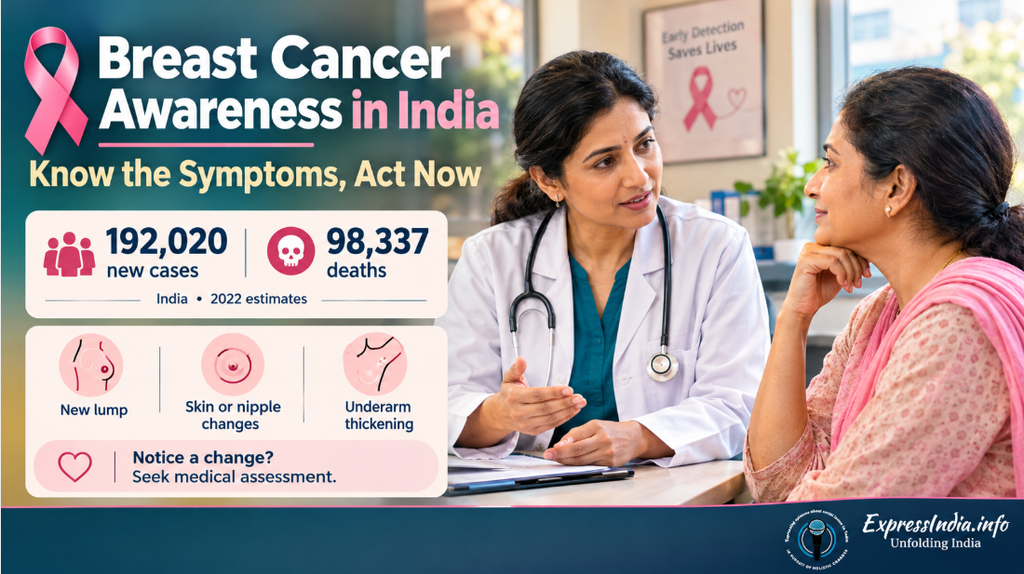
Breast Cancer Awareness begins when a woman notices a change and chooses not to ignore it. A lump, nipple change or underarm thickening does not automatically mean cancer. Yet waiting for pain, reassurance or the “right time” can delay useful answers. A qualified clinician can examine the change and explain the next step. That consultation may bring relief, treatment for a benign condition or timely diagnosis. In every outcome, prompt assessment is better than private worry.
Imagine finding a small, painless lump while getting ready for work. Many people first blame hormones, stress or a poorly fitted bra. That reaction is human, especially when family duties already fill the day. However, breast cancer can be painless in its early stages. Most breast lumps are benign, but symptoms cannot be reliably self-diagnosed. The safest response is calm action rather than panic or postponement.
Breast Cancer Awareness Month: Why October Matters
October is Breast Cancer Awareness Month, and the campaign runs from 1st to 31st October. World Health Organisation (WHO) describes it as a global opportunity to raise awareness and call for action. Its focus includes timely diagnosis and access to quality care for patients. Pink ribbons and walkathons often grab attention, but the larger goal is practical action. Readers can use the month to learn symptoms and encourage someone to seek assessment. Families can also check where nearby screening and referral services are available. Awareness only matters when it leads to examination, diagnosis and treatment without delay.
| Date | Observance | Note |
|---|---|---|
| 1–31 October | Breast Cancer Awareness Month | Global campaign recognised by WHO |
| 13 October | Metastatic Breast Cancer Awareness Day | Highlights Stage 4 disease, late diagnosis, treatment and support |
| 15 October | Global Lobular Breast Cancer Awareness Day | Awareness day for a specific type of breast cancer |
| 16 October | National Mammography Day | A US observance, listed by the National Breast Cancer Foundation |
| 17–23 October | Men’s Breast Cancer Awareness Week | Reminds readers that men can develop breast cancer too |
Sources: WHO (Breast Cancer Awareness Month 2026); India Today (12 October 2026); National Breast Cancer Foundation (2026); Our Cancer Stories (30 September 2026). Observances other than the October month are listed by non-governmental or US sources and are not official Government of India dates.
Across India, hospitals, colleges, charities and community groups usually organise awareness events during October. Pink Ribbon Foundation India describes October as a national campaign of city, college and community events. Its delivery partner, India Turns Pink, lists airport awareness, bus-terminus clinics and community screening camps. In Mangaluru, K S Hegde Medical Academy held the #MoveForHope walkathon on 10th October. Grace Cancer Foundation‘s ninth cancer run was scheduled for 11th October, with runs also reported in Bengaluru, Pune and Delhi. Organisers said every participant helps fund one screening for someone in rural India. Readers should confirm dates, venues and registration directly with organisers before attending any event.
Breast Cancer Awareness: India’s Burden
Indian women are most likely to diagnose breast cancer. International Agency for Research on Cancer (IARC)’s GLOBOCAN 2022 estimates recorded about 192,020 new cases in India. The same dataset estimated 98,337 breast-cancer deaths during 2022. Incidence describes new cases occurring within a specific period. Mortality describes deaths attributed to a disease during that period. These figures are modelled national estimates, not a count from every hospital. Their scale nevertheless shows why awareness, diagnosis and referral deserve urgent public attention.
India’s case numbers are rising alongside population growth and ageing. Urbanisation, improved detection and changing reproductive patterns may also influence trends. Population-level risk factors do not explain why any one person develops cancer. Therefore, the language of blame has no place in breast health reporting. Urban registries often record higher incidence than rural registries. However, lower reported rural incidence may partly reflect gaps in diagnosis and registration. A lower recorded number never means a lower need for services.
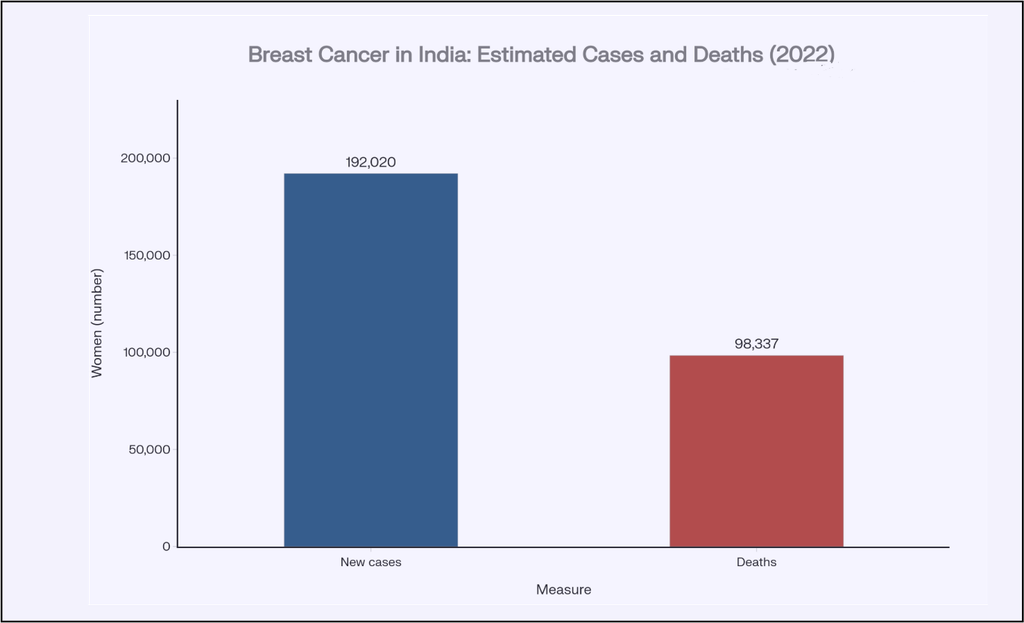
Source: IARC, Global Cancer Observatory: India Fact Sheet, GLOBOCAN 2022 estimates, released 2024.
Caution: These are India-specific modelled estimates, not a complete patient register.
2026 Breast Cancer Awareness Theme: Every Story Is Unique, Every Journey Matters
The 2026 theme, “Every Story Is Unique, Every Journey Matters,” sends a gentle yet powerful message. Indeed, no two people experience breast cancer in exactly the same way. One woman may notice a painless lump, while another sees a subtle skin change. Some reach a clinic within days, whereas others travel far and wait for answers. Treatment plans differ too, because tumour type, stage and personal circumstances shape each decision. Therefore, comparing one person’s journey with another’s can mislead families and deepen anxiety. Respect for individual experience helps replace stigma with patience, dignity and informed support. For a wider look at how patients’ experiences differ across the country, read my blog on how cancer journeys in India are united by their uniqueness.
Know the Symptoms, Act Now serves as this blog’s own editorial message, not an official slogan. Together, the two messages complement each other in a simple, practical way. Every journey may differ, yet the first step often remains the same. Notice a new or persistent change, then arrange assessment with a qualified health professional. Afterwards, complete every referral, whether it leads to reassurance, imaging, biopsy or treatment. Families can support that journey by listening, sharing responsibilities and avoiding blame. In that spirit, awareness becomes less about fear and more about timely, compassionate action.
Breast Cancer Symptoms in Women
A new breast lump is the symptom most people recognise first. Still, breast cancer symptoms in women can involve the skin, nipple, underarm or breast shape. Early disease may cause no pain and sometimes no obvious symptom. Consequently, painless does not mean harmless. At the same time, most lumps and breast changes are not cancer. Only clinical evaluation, appropriate imaging and, when needed, pathology can establish the cause.
Look for the following changes and arrange an assessment if they are new or persistent:
- A new lump, mass or thickened area in the breast.
- A new lump or thickening in the underarm.
- A noticeable change in breast size, shape, contour or symmetry.
- Swelling of all or part of one breast.
- Skin dimpling, puckering, pitting or orange-peel appearance.
- Redness, darkening, warmth, scaling or thickened breast skin.
- A nipple turning inward or a new nipple or areola change.
- Unexplained nipple discharge, particularly spontaneous, one-sided or bloody discharge.
- Persistent, localised pain in the breast or nipple.
A hard or enlarging lump deserves quicker assessment. Bloody discharge, new nipple retraction and rapid skin or breast swelling also need prompt care. Fever with breast redness may indicate infection, but it still needs treatment. A symptom that lasts beyond the usual menstrual pattern should not be ignored. No one should feel embarrassed about seeking help for a breast concern. The clinic exists precisely for these questions.
Breast Cancer Awareness: What To Do Next
A breast change may feel frightening, but a simple action plan reduces uncertainty. Start by resisting internet self-diagnosis and home remedies. Then arrange a prompt consultation with a qualified health professional. A nearby Ayushman Arogya Mandir, Primary Health Center (PHC), district hospital or breast clinic can be a starting point. The clinician will take a history and examine the breast and underarm. Imaging may follow, based on symptoms and examination findings. If an area appears suspicious, biopsy and pathology may be advised.
- Do not panic: Most breast lumps are benign, but assessment matters.
- Book a prompt consultation: Do not wait for pain or visible growth.
- Choose an entry point: Visit an Ayushman Arogya Mandir, PHC, hospital or specialist clinic.
- Complete the examination: Expect a history and clinical breast examination.
- Follow imaging advice: Ultrasound, mammography or both may be recommended.
- Complete biopsy if advised: Pathology normally confirms whether cancer is present.
- Finish referrals: If cancer is diagnosed, proceed to staging and oncology treatment planning.
Screening and diagnosis are not the same thing. Screening is intended for people who do not have symptoms. A person with a new breast lump needs diagnostic evaluation, even if she recently attended a screening camp. A normal mammogram also does not make a new symptom irrelevant. Prompt clinical examination remains essential when the body changes.
Tests That Answer Different Questions
Breast self-awareness means knowing what is normal for your own body. It encourages people to report a change instead of guessing its cause. Formal breast self-examination is a regular, structured check performed at home. It may increase familiarity, but it has not shown a mortality benefit. Therefore, it should not be described as a replacement for clinical screening. Self-awareness is a useful alert system, not a diagnostic method.
A clinical breast examination is performed by a trained provider. Ultrasound uses sound waves and can help assess whether a lump is fluid-filled or solid. Mammography uses low-dose X-rays and may identify masses, distortion or calcifications. Each imaging method has limits, including false-positive and false-negative results. Biopsy removes cells or tissue for pathological examination and usually confirms the diagnosis. The myth that biopsy spreads breast cancer is false.
| Method | What it does | Key limitation |
|---|---|---|
| Breast self-awareness | Helps a person notice a meaningful new change | Cannot diagnose or rule out cancer |
| Breast self-examination | Provides a structured home check | Does not replace professional assessment |
| Clinical breast examination | Trained physical examination of breasts and underarms | May miss small or deep abnormalities |
| Ultrasound | Evaluates a breast change and guides biopsy | Not a stand-alone population screening tool |
| Mammography | Uses X-rays to identify breast abnormalities | Can miss cancers and produce false alarms |
| Biopsy | Confirms diagnosis through tissue examination | Causes brief discomfort but does not spread cancer |
Source: Research brief based on IARC, NCI and American Cancer Society guidance.
Breast Cancer Screening in India
India’s National Programme for Prevention and Control of Non-Communicable Diseases (NP-NCD), includes breast, cervical and oral cancer screening. The programme operates through comprehensive primary healthcare and Ayushman Arogya Mandirs. It targets people aged over 30 for common NCD screening, with breast screening directed at women. India does not operate a uniform, nationwide population mammography programme. Instead, public health services principally use clinical breast examination and referral. That makes follow-up after a suspicious result especially important.
ASHA workers support household outreach, reminders and care navigation. Auxiliary Nurse Midwife (ANM)s and trained female providers can perform clinical breast examinations and refer suspicious findings. Community health officers coordinate care within Ayushman Arogya Mandirs. PHCs and district hospitals connect people to imaging, surgery and pathology where available. Tertiary cancer centres provide staging, multidisciplinary treatment and complex care. The National NCD Portal supports screening, referrals and follow-up across facilities.
Official parliamentary data recorded 16.94 crore breast-cancer screening encounters through July 2026. This suggests large-scale service activity across public facilities. However, it should not be described as 16.94 crore unique women screened. The total does not itself show referral completion, cancer detection rate or treatment completion. Readers need this distinction because a screening event is only the first step. A functioning referral pathway determines whether a concerning finding receives diagnosis and treatment.
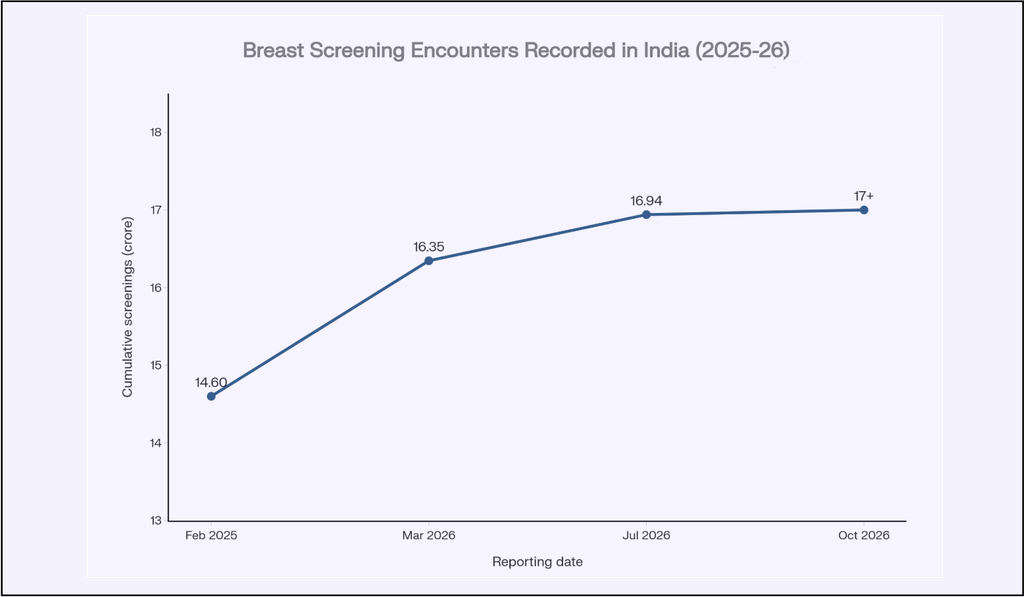
Source: Government of India Parliamentary replies and PIB statement: National NCD Portal data through July 2026; PIB, October 10, 2026.
Caution: These are cumulative screening encounters. They may include repeat encounters and do not establish unique coverage, diagnosis or treatment completion.
Myths That Delay Care
Misconceptions can make a woman wait when she needs clarity. “Only older women get breast cancer” ignores younger patients. “Every lump is cancer” creates panic without evidence. “It does not hurt, so it cannot be serious” delays consultation. “Biopsy spreads cancer” can prevent necessary confirmation. “Alternative remedies can cure cancer” risks losing valuable treatment time. Better information replaces both panic and false reassurance.
| Myth | Evidence-based correction |
|---|---|
| Only older women get breast cancer | Risk rises with age, but younger women can develop breast cancer too |
| Every breast lump is cancer | Most lumps are benign, but new changes need clinical assessment |
| Breast cancer always causes pain | Many breast cancers are painless, especially at early stages |
| A normal mammogram means new symptoms can be ignored | New symptoms still require clinical assessment |
| Biopsy spreads cancer | Biopsy is the established method for confirming diagnosis |
| Self-examination alone is enough | It does not replace clinical examination or diagnostic tests |
| No family history means no risk | Many people diagnosed have no affected close relative |
| Alternative remedies can replace treatment | No alternative remedy replaces evidence-based cancer care |
Source: Research brief; evidence-based guidance from IARC, NCI, Mayo Clinic and the American Cancer Society.
Barriers To Early Diagnosis
Women do not delay care because they do not value their health. Fear, stigma, embarrassment and caregiving responsibilities can all shape decisions. Financial dependence may make an appointment difficult to arrange. Some households lack money for transport, scans, food and accommodation near hospitals. Others travel long distances because biopsy, pathology or radiotherapy services are concentrated in cities. These are system and social barriers, not individual failures.
A 2024 study in central rural India found late presentation among 57.81% of 128 participants. Researchers reported poor awareness, fear, social constraints, alternative treatment and health-system dissatisfaction. This is a regional study, not a national prevalence figure. Another mixed-method study at AIIMS Patna described patients seeing multiple providers before definitive care. Misdiagnosis, weak referral communication and missed follow-up can turn days into months. Better breast cancer screening in India must therefore include navigation, diagnostics and treatment access.
Treatment, Cost and Support
After a confirmed diagnosis, clinicians assess tumour type, lymph nodes, possible spread and relevant biomarkers. Treatment may include surgery, radiotherapy, chemotherapy, hormone therapy or targeted therapy. The treatment plan depends on stage and tumour biology. Therefore, no online article can tell an individual which treatment they will need. Not every person requires chemotherapy, mastectomy or every available medicine. A multidisciplinary oncology team should guide each decision.
A 2024 Tata Memorial Centre cohort of 500 patients reported mean total treatment costs of ₹258,095. Mean out-of-pocket spending was ₹186,461, or 72.2% of the reported cost. A linked analysis found catastrophic health expenditure in 84.2% of participants. It also found distress financing, including borrowing or selling assets, in 72.4%. These findings come from one subsidised Mumbai centre, not the entire country. Costs can differ considerably across public and private facilities.
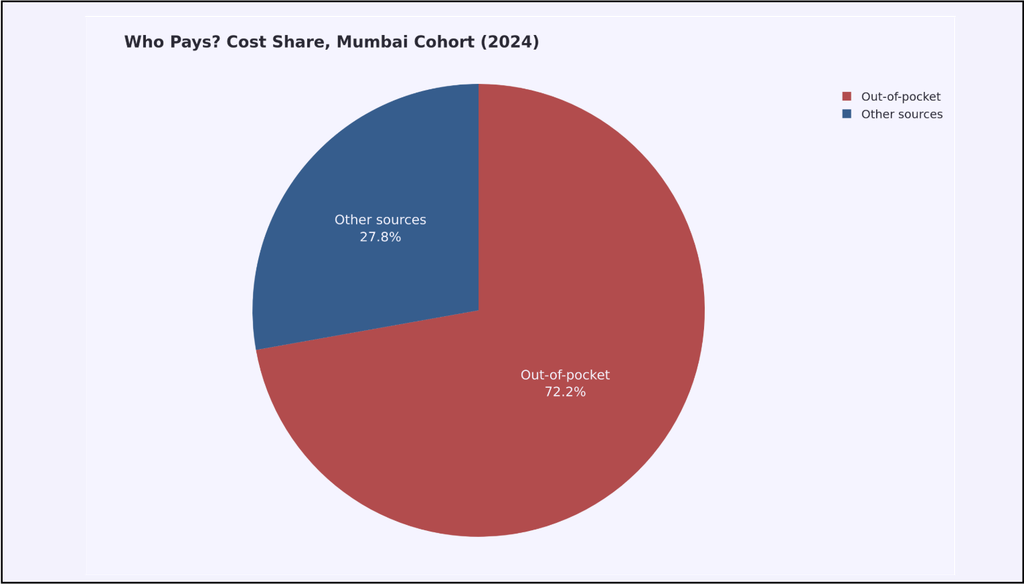
Source: Tata Memorial Centre prospective cohort of 500 patients, published 2024; mean total cost ₹258,095 and mean out-of-pocket spending ₹186,461.
Eligible families should ask an Ayushman Mitra or hospital social worker about AB PM-JAY. The scheme provides up to ₹5 lakh per family annually for eligible families at empanelled hospitals. Eligible poor patients may receive up to ₹15 lakh through the Health Minister’s Cancer Patient Fund. State schemes and charitable support vary, so people should check locally. Keep pathology reports, scans, prescriptions, bills and identity documents organised. Administrative support can reduce repeated travel and prevent lost opportunities for assistance.
Survivorship Needs Support Too
Survivorship begins during treatment, not only after its completion. People may experience fatigue, pain, arm swelling or lymphoedema, reduced shoulder movement and neuropathy. Some face early menopause, sexual-health concerns or altered body image. Others worry about recurrence long after active treatment ends. Follow-up care should address physical recovery, emotional wellbeing and daily functioning. Every oncology team should guide the schedule because follow-up needs differ by diagnosis and treatment.
In one Keralam cohort of long-term survivors, 18.6% reported anxiety and 9.6% reported depression. Those figures should not be treated as a national prevalence estimate. They do illustrate why counselling, psycho-oncology and workplace support matter. Families can help through transport, childcare, medication reminders and patient listening. Constant positive is not required; practical support and honest conversation often help more. Persistent hopelessness, panic or self-harm thoughts require urgent professional support.
FAQs
Is every breast lump cancer?
No. Most lumps and breast changes are benign. However, only a clinical examination, appropriate imaging and sometimes biopsy can establish the cause. A new or persistent breast lump deserves prompt assessment by a qualified health professional.
Can breast cancer occur without pain?
Yes. Many breast cancers are painless, and early disease may cause no obvious symptoms. A painless lump, nipple change or underarm thickening should not be dismissed. Persistent, localised breast or nipple pain should also be assessed.
What should I do after finding a lump?
Arrange a prompt consultation at an Ayushman Arogya Mandir, PHC, district hospital, breast clinic or with a qualified clinician. Do not wait for pain or depend on a screening camp for a diagnosis. The next step may include examination, imaging and biopsy.
Is breast self-examination enough?
No. Breast self-awareness can help someone notice a new change. Formal breast self-examination has not shown a mortality benefit and cannot replace clinical examination, diagnostic imaging or biopsy when a clinician recommends them.
Do I need a mammogram or ultrasound?
The appropriate test depends on your age, symptoms, examination findings and other clinical factors. Ultrasound and mammography answer different questions. A clinician can decide whether one, both or another diagnostic step is needed.
Does an abnormal scan confirm cancer?
No. An abnormal scan identifies an area that needs further assessment. A biopsy and pathological examination are normally required to confirm whether cancer is present and to guide treatment decisions.
Does biopsy make breast cancer spread?
No. Biopsy is the established method for confirming cancer and understanding its features. Routine breast biopsy does not cause breast cancer to spread, although it may briefly cause bruising or discomfort.
Where can someone seek affordable care in India?
Start with an Ayushman Arogya Mandir, PHC or district hospital. Ask about diagnostic referral, AB PM-JAY eligibility, an Ayushman Mitra and hospital social-work assistance. Eligible poor patients may also qualify for HMCPF support.
Breast Cancer Awareness Must End In Action
Breast Cancer Awareness means noticing a change without letting fear take control. It means not waiting for pain, approval or a convenient month. It means seeking qualified assessment and completing each recommended referral. Families can remove practical barriers by sharing work, transport and care responsibilities. Communities can support ASHA workers and challenge myths respectfully. Health systems must make diagnosis, treatment and financial guidance easier to reach. Readers who want the bigger picture of how cancer care in India is changing can explore our wider coverage of treatment access and policy.
Today, take one useful action. Learn what is normal for your body. Encourage someone you love to keep a medical appointment. Save the nearest Ayushman Arogya Mandir or hospital contact. Share verified information rather than frightening rumours.
ExpressIndia.info calls on every family to notice the change, make the appointment and stand beside patients with dignity.
Medical disclaimer: This blog is for general information only and is not a substitute for consultation with a qualified healthcare professional.
#BreastCancerAwareness #BreastCancerIndia #KnowTheSymptoms #EarlyDetection #WomensHealth