International Women’s day 2026 in India is not just another calendar ritual. It is a stress test for our claims about progress, justice, and modernity. As the global theme “Give to Gain” and the UN line “Rights. Justice. Action. For ALL Women and Girls” echo across India, the real question feels brutally simple. Are we truly ready to give women power, not just praise. As I write, I keep asking myself whether my own choices pass that test.
At the same time, International Women’s Day 2026 in India offers rare clarity. It connects data, policies, everyday stories, and the deep importance of International Women’s Day in shaping a fairer future. The day urges us to see that whenever we invest in women empowerment in India, we unlock stronger families, safer streets, and a more resilient democracy. “Give to Gain” becomes more than a slogan; it turns into a practical blueprint. Give education, gain a stronger society; give opportunities, gain real economic growth.
Why Women’s Day 2026 in India matters
A mirror for our national conscience
Women’s day 2026 in India matters because it measures who we are. B.R. Ambedkar said he measured a community’s progress by women’s progress, and that yardstick still hurts when we look honestly. Women are almost half our population, yet they hold only about 13.6% of Lok Sabha seats, with 74 women elected to the 18th Lok Sabha. Jawaharlal Nehru warned that you can tell a nation’s condition by looking at the status of its women; sadly, that x‑ray still shows fractures. Therefore, the importance of International Women’s Day lies in forcing us to read that uncomfortable diagnostic report.
From symbolism to budgets, laws, and lives
Factually, International Women’s Day 2026 in India is backed by concrete policy signals. The Union government highlights that about 9.37% of the Union Budget is now tagged as gender responsive expenditure, across multiple ministries and schemes. Parliament has passed the Nari Shakti Vandan Adhiniyam, promising one‑third reservation for women in future Lok Sabha and state assemblies, even though implementation awaits the next delimitation exercise. These steps formally recognise women’s rights and leadership potential for women. Yet they mean little unless families, workplaces, and local institutions actually share power equitably. Consequently, this Women’s day forces us to connect headline reforms with daily realities
Give to Gain @ Women’s Day 2026 in India
Decoding “Give to Gain” in the Indian context
The global campaign explains that when we give time, resources, and visibility to women, everyone gains – families, markets, and the state. In India, “Give to Gain” lands in a society where unpaid care work, low‑paid informal jobs, and deep safety concerns still define many women’s days. If we give education, we gain a more skilled, confident next generation. Again, if we give opportunities in jobs, credit, and leadership, we gain inclusive economic growth. Moreover, if we give equality, we gain social harmony instead of daily conflict around gender roles.
Linking the theme to women’s empowerment in India
Recent coverage of International Women’s Day 2026 in India stresses that “giving” is not a loss; it is “intentional multiplication” where empowering women multiplies national capacity. When women succeed in education, entrepreneurship, science, and politics, communities grow more resilient. That is exactly what women empowerment in India tries to engineer through schemes, skilling, and representation. A.P.J. Abdul Kalam famously argued that empowering women is a prerequisite for building a good nation, because strong women create strong families and, therefore, strong societies. Give support, gain community progress; the logic is simple, but the execution demands courage.
Progress so far: work, income, and education
Women entering the workforce in larger numbers
Data from the Economic Survey and labour surveys show a clear, though uneven, rise in women’s work participation, which is central to gender equality in India. Female labour force participation has increased from around 23.3% in 2017–18 to about 41.7% in 2023–24, with rural women driving much of this change. One PLFS‑based analysis estimated women’s participation around 33.7% in mid‑2025, still below men’s participation but a substantial improvement from earlier years. More women now appear not only in agriculture and informal services but also in salaried roles and self‑employment. However, many still remain clustered in low‑paid, insecure jobs.
Education gains and the next generation
On the education front, the picture is cautiously hopeful. UDISE+ data show that girls’ gross enrolment ratio in higher secondary education has risen to roughly 57.6%, meaning more girls are staying in school longer. Even as total school enrolment dipped slightly in 2024–25, the share of girls in classrooms increased, especially at higher levels – a quiet revolution. Initiatives like Beti Bachao Beti Padhao, scholarship schemes, and targeted hostel and sanitation facilities have supported this shift. Empowering girls through education strengthens women empowerment in India and ultimately deepens gender equality in India by expanding women’s choices.
Snapshot of women’s progress in India
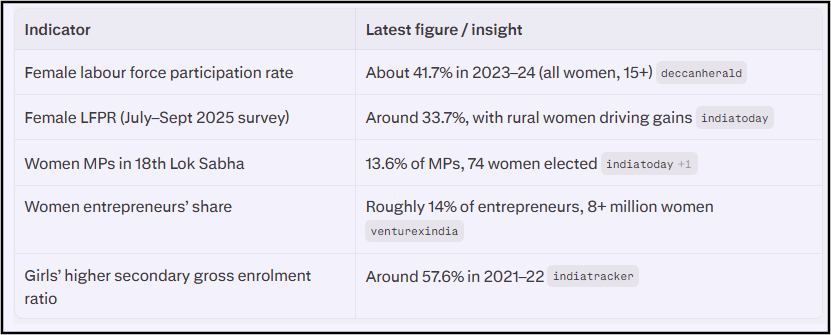
Sources: Given alongside each indicator
These numbers show why the importance of International Women’s Day is not abstract. Each uptick in these indicators reflects countless negotiations at kitchen tables, in panchayat meetings, and inside hiring panels. When we “give” girls schooling, credit, and public voice, we visibly “gain” in these metrics.
Visualising gains around 2025
A quick visual of key gains
If you plotted Women’s Day 2026 in India on a chart, you would see three bars rising together: one for female labour force participation, one for women’s share in Parliament, and one for women entrepreneurs. That is exactly what the bar chart below does – it turns dry percentages into a simple picture of momentum.
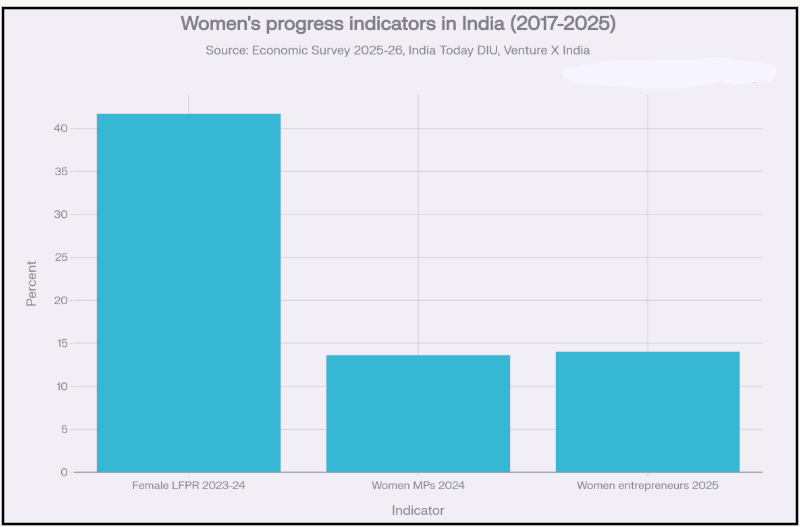
Sources: Economic Survey 2025–26 and PLFS data for female labour force participation in India
Reading the story behind the bars
The chart shows that while none of the bars has reached parity with men, none sits at zero either. Women are increasingly present in economic life, political institutions, and business ownership. Yet the gap between these bars matters. Women’s work participation now approaches the forties in percent terms, while their share as MPs and entrepreneurs still hovers in the teens. For complete gender equality in India, those bars must rise together, not in isolation. That is precisely where “Give to Gain” must focus.
Persistent challenges to gender equality in India
Invisible labour, unpaid care, and safety gaps
Despite progress, gender equality in India remains painfully incomplete. Many women counted as “working” actually serve as unpaid helpers in family farms, shops, or home‑based enterprises. Time‑use studies show that women shoulder a disproportionate burden of unpaid care work – cooking, cleaning, elder care, childcare – while men enjoy significantly more leisure time. Violence against women, from domestic abuse to workplace harassment, persists despite legal protections like the Domestic Violence Act and the POSH framework. In such a context, celebrating Women’s Day 2026 in India without discussing women’s rights would feel dishonest.
Digital divides and intersectional barriers
The digital economy, often praised during International Women’s Day 2026 in India, has its own gendered shadows. Studies and policy analyses note that women, especially in rural and low‑income households, are less likely to own smartphones or have reliable internet access, limiting access to online education, tele‑medicine, and digital banking. Marginalised groups – Dalits, Adivasis, and disabled women – face layered discrimination that cannot be solved by gender‑neutral schemes alone. Any serious discussion of women’s empowerment in India must therefore go beyond averages and address caste, class, and location related issues. Otherwise, we risk empowering only a thin, already privileged slice of women.
Women leaders in India: from Parliament to panchayats
Visible and emerging women leaders in India
One bright spot of Women’s Day 2026 in India is the sheer range of women leaders in India we can now name. From parliamentarians and judges to scientists, artists, and startup founders, women occupy visible positions across sectors. Even though women are only 13.6% of MPs in the current Lok Sabha, their presence shapes debates on safety, health, labour, and women’s rights. At the grassroots, elected women sarpanches and councillors, supported by reservations in local bodies, have improved sanitation, water access, and school functioning in many regions. These leaders demonstrate why International Women’s Day 2026 in India must highlight not only problems but also role models.
Everyday leadership and quiet revolutions
Beyond famous names, women leaders in India include millions of self‑help group members, ASHA workers, Anganwadi workers, teachers, and peer mentors. Schemes highlighted around IWD 2026 – such as Lakhpati Didi, NaMo Drone Didi, She MARTS, and targeted entrepreneurship loans for women, SC and ST communities – aim to turn these women into local economic leaders. NGOs and movements working on women’s rights and safety, from SEWA to many local collectives, show how organised women can change markets and mindsets together. As Adbul Kalam observed, when women are empowered, society becomes more stable and peaceful; leadership, in other words, is itself a form of “giving to gain.”
Why this all shows the importance of International Women’s Day
A yearly audit of promises and progress
Taken together, these stories show the deep importance of International Women’s Day in India. Every March 8th, we audit promises made to women in last year’s speeches, budgets, and press releases. Women’s day 2026 in India checks whether gender‑responsive budgeting has translated into functioning hostels, safe transport, livelihood support, and legal aid. It asks whether new laws on reservation and workplace safety have changed hiring patterns or simply filled slogans in manifestos. Ambedkar’s benchmark – community progress equals women’s progress – hangs over the day like a moral cross‑examination.
Linking personal choices with structural change
At the same time, the importance of International Women’s Day lies in connecting personal behaviour with structural change. The state can legislate women’s rights, but households decide who studies, who works, and who eats last. Companies can publish diversity reports, but line managers decide who receives stretch assignments and who gets sidelined after maternity leave. Media can celebrate women leaders in India, but everyday jokes and comments either support or undermine gender equality in India. Thus, Women’s Day 2026 in India is a reminder that the real battlefield often lies in our living rooms, offices, and WhatsApp groups.
FAQs: International Women’s Day 2026 in India
1. Why is International Women’s Day celebrated?
International Women’s Day is celebrated to recognize the social, economic, cultural, and political achievements of women while also advocating for gender equality and women’s rights across the world.
2. When is International Women’s Day celebrated?
International Women’s Day is observed every year on March 8th, in many countries, including India.
3. What is the significance of International Women’s Day in India?
In India, the day highlights the importance of women’s empowerment, equal opportunities, and recognition of women’s contributions in fields such as education, politics, business, healthcare, and social development.
4. What is the theme of International Women’s Day 2026?
The global campaign theme for International Women’s Day 2026 is “Give to Gain”, which means that when we actively give support, opportunities, and resources to women and girls, everyone gains – stronger communities, fairer economies, and more resilient societies.
5. How can people celebrate International Women’s Day?
People celebrate the day by:
- Recognizing women’s achievements
- Supporting women-led initiatives
- Promoting gender equality
- Participating in awareness events and discussions
6. Why is women’s empowerment important for society?
Women’s empowerment promotes economic growth, social justice, and inclusive development, ensuring that women have equal access to opportunities, education, and leadership roles.
7. How can individuals support gender equality in everyday life?
Individuals can support gender equality by:
- Challenging stereotypes
- Supporting women’s education and careers
- Respecting equal rights and opportunities
- Encouraging women’s leadership
How we can personally “Give to Gain”
Holistic changes for growth and justice
So, what does all this mean? Women’s day 2026 in India invites holistic change – inside our minds, homes, organisations, and policies. Personally, we can share care work more fairly, mentor younger women, and consciously support women‑led businesses and NGOs that advance women empowerment in India. Socially, we can push institutions to implement the Nari Shakti Vandan Adhiniyam swiftly, strengthen enforcement of anti‑violence and workplace safety laws, and demand better data on gender equality in India. Nationally, we can insist that any talk of growth or “Viksit Bharat” treats women’s rights as non‑negotiable, not optional garnish.
A direct challenge to readers
As Nehru said, when women awaken, the family, village, and nation move ahead. Ambedkar had proclaimed that a community’s progress is measured by its women’s progress. On International Women’s Day 2026 in India, the message is clear: Give education → gain a stronger society; give opportunities → gain economic growth, give equality → gain social harmony, give support → gain community progress. My challenge to you is simple. Before this day ends, choose one specific way to “give” to a woman or girl around you – time, mentoring, sponsorship, safety, or a platform. Then, watch how that small act begins to reshape both her life and yours. Because when women rise, we do not lose; we collectively gain a future that finally looks like justice.
ExpressIndia.info has consistently advocated for women empowerment in India through data‑driven stories on gender quality and women’s rights. Our readers can revisit our blogs created with this vision in 2024 and 2025.
#IWD2026 #GiveToGain #WomenEmpowermentIndia #WomensDayIndia #GenderEquality