
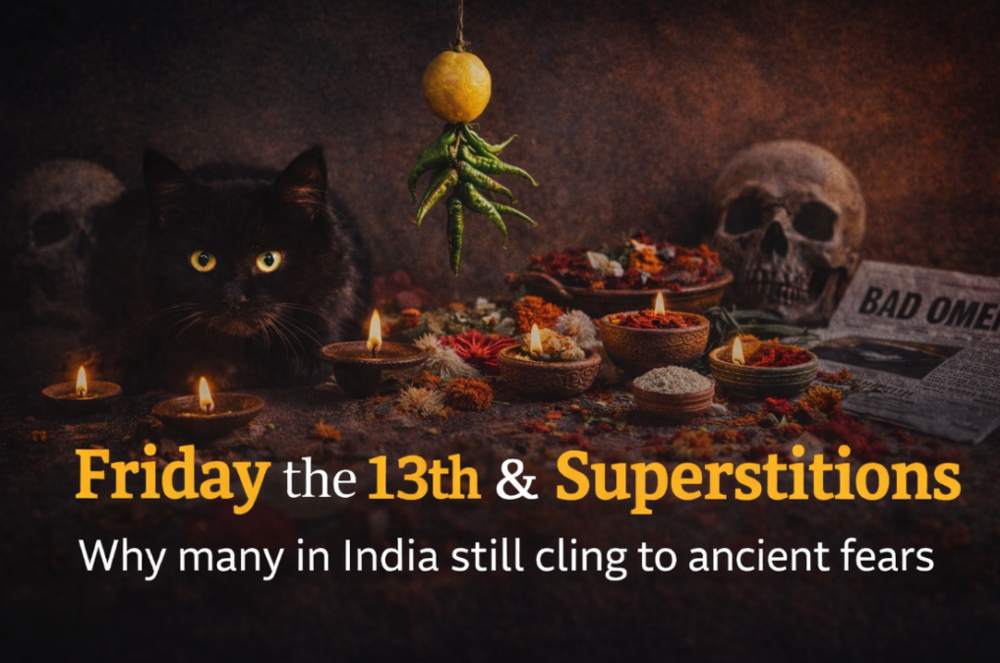
Superstitions in India feel strangely alive even today. This morning, my phone buzzed with a WhatsApp forward: “Happy Friday the 13th! Don’t start anything new today. ” 😀Laughter emojis softened the warning, yet caution lingered beneath. This familiar hesitation perfectly captures superstitions in India on display. We mock omens openly; yet adjust plans quietly “just in case.” We celebrate space missions proudly, but still check for shubh timings before big steps. Friday the 13th collides with Valentine’s weekend this year. Therefore, love and luck share an intriguing spotlight. This updated piece revisits my 2024 blog with fresh cases, data, and perspectives. Stay curious, because your own habits might appear between these lines.
Tomorrow brings roses and proposals, but today carries an imported aura of unease. Global folklore links Friday the 13th to betrayal at a thirteen‑guest dinner and dramatic arrests on that date. Horror films amplified the fear, spreading it through our screens and conversations. Consequently, many Indian high‑rises now skip floor thirteen, labelling it “12A” instead. If not, developers admit that flats on those floors sell slower. News outlets run annual explainers, blending history with local colour. So, an originally Western superstition now resonates comfortably in Indian culture. If you read on, you’ll see how it blends with our homegrown rituals seamlessly.
The Origins of Friday the 13th
Historically, Friday the 13th belongs to European and American folklore. Interestingly, it combines two elements: the number 13 and Friday. Paradoxically, both have been associated with misfortune. In Christianity, the Last Supper featured thirteen guests, including Judas Iscariot, who betrayed Jesus. This event led to a long-standing belief that having thirteen people at a table is unlucky.
In Norse mythology, Loki was the thirteenth guest at a banquet. His arrival caused chaos and death among the gods. This myth contributed to the stigma surrounding the number 13. Additionally, on Friday, October 13, 1307, many Knights Templar faced doom when authorities arrested them. These historical events solidified Friday the 13th as an ominous day across cultures.
Over centuries, buildings in the West quietly removed room thirteen, and airlines skipped row thirteen to calm nervous travellers. Popular culture, especially horror films and novels, amplified this fear and exported it worldwide. Gradually, an imported superstition began speaking in Indian accents and idioms. What started as someone else’s anxiety became part of our own vocabulary.
Interestingly, not all cultures view Friday the 13th negatively! In some places, it is considered lucky! For example, in Italy, people see the number 13 as a symbol of prosperity. Similarly, in certain pagan traditions, Fridays were once associated with love and fertility.
A date that refuses to be just a date
On paper, Friday the 13th is just another square on the calendar. However, for many people in India, it still carries a faint charge of unease. Colleagues half‑jokingly ask whether we should avoid launching campaigns today. Families suggest postponing long journeys or medical procedures by a day. I notice how even those who scoff at superstitions in India sometimes prefer not to tempt fate unnecessarily. This quiet choreography of decisions shows how deeply the date can shape individual human behaviour. It also shows why India’s tryst with superstitions refuses to fade away completely.
As global media seeped into everyday life, Indian news outlets also joined the conversation. On every occurrence of Friday the 13th, they now run explainer pieces – where the fear came from, what the long word “friggatriskaidekaphobia” means, how many such Fridays each year will hold, and so on. Incidentally, this is the second Friday the 13th in 2026 with the last one being in November. Social media trends follow, with hashtags, jokes and lists of “things not to do today.” Real‑estate developers, already used to dealing with local beliefs about Vastu and lucky numbers, quietly removed floor thirteen from many towers. Residents may laugh about it, but the missing button on the lift panel tells its own story. In this way, an originally Western superstition now lives quite comfortably inside Indian urban life.
Common Superstitions in India
India has a rich tapestry of superstitions that influence daily life.
Here are 13 notable superstitions in India:
- Black Cats: A black cat crossing your path often brings bad luck. Many people stop or change direction to avoid this omen.
- Cutting Nails at Night: Many believe cutting nails or hair at night invites misfortune. This belief is so strong that some avoid it entirely.
- Hanging Lemon and Chilies: This practice aims to ward off evil spirits. Many households hang a string of lemon and chilies at their entrance for protection.
- Peepal Trees: People often avoid Peepal trees at night due to fears of evil spirits residing there.
- Itchy Palms: An itchy right palm suggests incoming wealth, while an itchy left palm indicates loss of money.
- Sweeping After Sunset: Sweeping after sunset is thought to sweep away prosperity from the home.
- Wearing New Clothes on Festivals: Many believe that wearing new clothes during festivals brings good luck and blessings.
- Avoiding Certain Numbers: Numbers like 8 and 9 are often considered unlucky by many due to cultural beliefs.
- Crow Droppings Bring Luck: If a crow drops its droppings on you, it’s considered good luck! This superstition suggests that inconveniences lead to good fortune.
- Curd with Sugar Before New Ventures: Eating curd with sugar before starting something new is believed to ensure success.
- Mynah Birds: Spotting one mynah bird brings bad luck; spotting two brings good luck; six means money is coming your way!
- Eclipses Are Inauspicious: During eclipses, people avoid eating or going outside due to fears of bad luck or health issues.
- Tulsi Leaves for Good Luck: Swallowing Tulsi leaves without chewing is believed to bring blessings from goddess Lakshmi.
These beliefs can lead to irrational behaviors and decisions that dictate daily activities and influence social interactions. In fact, superstitions in India most commonly intertwine with religious beliefs, where rituals and omens gain authority from sacred authority rather than empirical evidence. Often, families pass these superstitious beliefs generationally, often without questioning their origins or rationale. Children absorb them naturally, and adults follow them half‑consciously, blending them with modern life. Consequently, superstitions in India blend into daily life and gradually become routine.
Individually, many of these seem harmless, even charmingly eccentric. However, together they reveal how heavily everyday life leans on illogical rules. People schedule tasks around them, modify behaviour and quietly judge others’ choices through these lenses. They act as an invisible operating system for countless households, often stronger than any official instruction. The fact that we can recite them so easily shows how deeply they have been memorised. The fact that we still follow them, despite rolling our eyes, shows how hard they are to uninstall.
Viral fears: superstition in the age of reels and CCTVs
The digital age has not killed superstitions in India; in many ways, it has given it better lighting and a catchier soundtrack. Short‑video platforms host endless series titled “Weird Indian Superstitions,” where creators act out rules from their childhood homes. They demonstrate how grandparents forbid giving things with the left hand, or insist on repeating a bumped head to cancel misfortune. Other channels attempt to demystify rituals such as nimbu‑mirchi, explaining how citrus and chillies repel insects even if they do nothing to spirits. However, videos warning viewers about “cursed lemons” or “energy‑draining objects” also attract huge engagement. Algorithms do not care whether content is skeptical or credulous; they care about watch time. Fear, curiosity and laughter all deliver that in generous doses.
Sometimes, the internet’s gaze turns towards real‑world incidents captured accidentally. A widely shared CCTV clip from 2025 showed a woman sneaking up to her neighbour’s gate at night to throw a lemon‑and‑chilli charm there. The footage looked like a low‑budget horror film directed by the housing society itself. Comments ranged from outrage to dark humour, but almost everyone immediately recognised the intentions. Another report showed similar rituals being performed outside shops and homes, provoking both mockery and anger. These acts are not religious ceremonies; they are attempts to weaponize superstition in very local conflicts. When cameras record them and social media amplifies them, secrecy collapses. Society gets a rare look at how belief is used not just to manage fear, but sometimes to harass, threaten or intimidate neighbours.
When superstition turns savage: 2025’s chilling reminders
Sometimes people say, “Superstitions in India are harmless indulgences; they just make life colourful.” 2025 did a very effective job of disproving that line. In story after story, superstition walked out of dimly lit rooms and straight into prime‑time news. It showed up not as a silly ritual, but as an excuse for violence, neglect and fraud. The most disturbing cases had one common thread: the belief that unseen forces could be controlled through ritual, even at the cost of human life. They did not centre on any particular religion, but on the raw power of fear and rumour. When these stories broke, public anger cut across ideological lines, because cruelty in the name of “belief” is hard to defend.
Three incidents from 2025, in particular, stand out as grim markers in India’s tryst with superstitions:
- Bihar witch‑hunt: five members of a family burnt alive
In July 2025, a village in Bihar erupted into horror when a mob allegedly burned five members of one family alive, accusing them of practicing witchcraft. After a series of illnesses and a child’s death, rumours spread that the family had cast spells on neighbours. Panic hardened into certainty, and certainty into collective violence. National channels ran long segments on the “witchcraft killings,” while newspapers framed it as evidence of a deep‑rooted superstition crisis in the region. Social media reacted with shock and disgust, demanding tougher anti‑witch‑hunting laws and better education in vulnerable communities. The incident showed, in the starkest possible way, how quickly fear of the unseen can turn into a real‑world inferno. - Chhattisgarh money‑doubling black‑magic ritual: three men dead
In December 2025, another story unfolded in Chhattisgarh that sounded almost like a cautionary folktale. A self‑styled tantrik allegedly promised to turn ₹5 lakh into ₹2.5 crore through a special “tantra” ritual at a farmhouse. Three men took part, trusting the black‑magic promise of instant wealth. By the end of the night, all three were dead, reportedly after being given alcohol and drawn into an occult ceremony. NDTV and other media houses covered the case as a deadly mix of greed and superstition, highlighting how the ritual involved lemons, chants and elaborate set‑ups typical of money‑doubling scams. Viewers expressed anger not only at the alleged fraudster, but also at the enduring belief that wealth can be conjured out of thin air by appeasing invisible forces. - Chhattisgarh baiga case: three siblings lost to ritual healing
A month earlier, in November 2025, another tragedy in Chhattisgarh showed a quieter but equally devastating face of superstition. In a tribal family, three siblings died within two days after relatives chose treatment from a traditional healer, or baiga, instead of rushing them to hospital. According to reports, the parents believed the children were under a supernatural influence and sought ritual cures first. By the time they turned to doctors, it was too late. The Times of India described it as a “fatal delay” driven by faith in ritual healing over modern medicine. Public reaction mixed grief with frustration: no one blamed culture itself, but many asked why access, awareness and trust in healthcare were still so fragile that superstition felt safer than science.
Earlier superstition related tragedies that shook India
While 2025 offered painfully fresh reminders, there has been several earlier incidents where superstitions in India triggered nationwide outrage. Each case involved rituals or beliefs – exorcisms, witch‑branding, sacrifices – rather than generic blind faith, and each forced the country to confront how dangerous such ideas can become. Taken together, they show that the 2025 tragedies are part of a longer, disturbing pattern, not random shocks. They also explain why activists and rationalist groups have spent years demanding specific anti‑superstition and anti‑witch‑hunting laws.
Some of the most widely discussed cases in recent times are given below:
- Maharashtra exorcism murder (Sanjay Nagorao Pote case, 2014):
A man in Amravati district killed his uncle’s son during a so‑called exorcism, forcing water into the child’s mouth while trying to drive out a “ghost.” The ritual, rooted in belief about possession, ended in death and drew sharp condemnation in the state. - Indore exorcism deaths (Rajaram and his toddler son, 2019):
In Madhya Pradesh, a father and his two‑year‑old son were beaten to death by family members during a violent exorcism, after relatives became convinced that they were possessed. The images and details that emerged shook viewers and raised urgent questions about unchecked ritual practices. - Anantapur “holy crow” tragedy, Andhra Pradesh (2018):
A family panicked after interpreting a crow’s behaviour as a terrifying omen. As they fled their home in fear, three relatives died in the chaos, turning a simple bird into the centrepiece of a fatal superstition. - Witch‑branding murders in Odisha (2019 and other years):
Several cases in Odisha saw women and their children branded as witches after illness or crop failures in villages, who were then beaten or killed by neighbours. Each time such news surfaced, it sparked anger, protests and renewed demands for strict anti‑witch‑hunting legislation. - Kerala human‑sacrifice case (Elanthoor, 2022):
Two women were murdered in Kerala in a gruesome ritual, allegedly promised by an occult practitioner as a way to gain wealth and prosperity. The case dominated headlines for weeks and was widely described as a “horror story of superstition” in a state otherwise known for high literacy. - Other ritual‑killing and witch‑hunt clusters (2000–2016):
Research aggregating NCRB data highlighted an estimated 2,500 witch‑hunting deaths across India between 2000 and 2016, mainly in states like Jharkhand, Chhattisgarh, Odisha, West Bengal and Assam. The sheer scale turned witch‑hunting from a “rural superstition problem” into a recognised human‑rights issue.
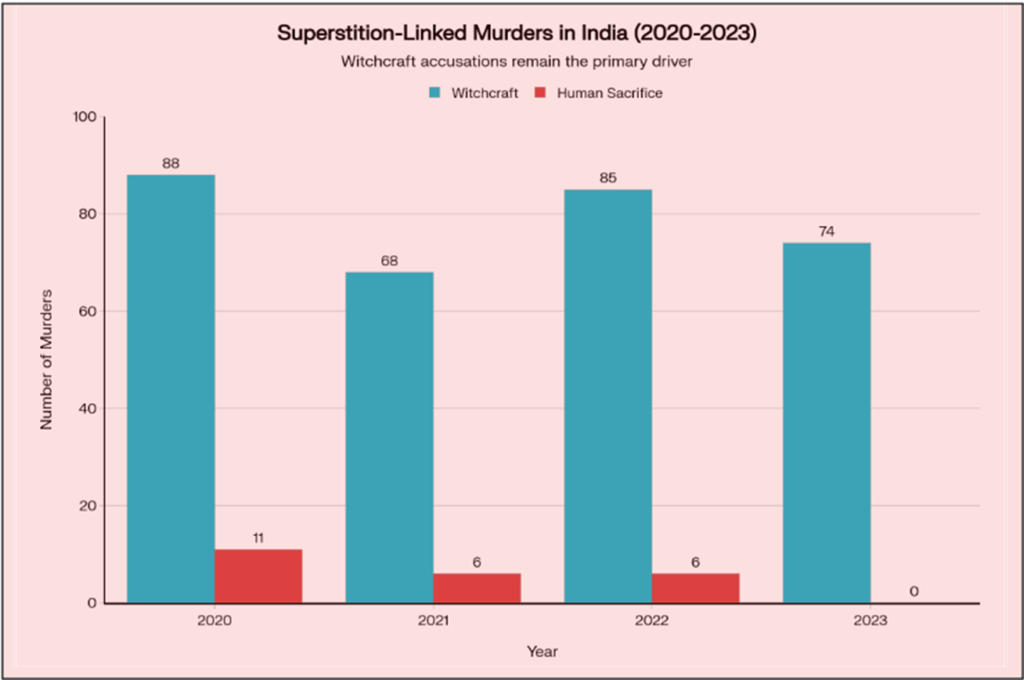
Source: National Crime Records Bureau (NCRB)
What surveys reveal about superstitious beliefs in modern India
Of course, most Indians who follow superstitious practices would never consider violence. Still, national surveys reveal how widespread belief in unseen forces remains even in ordinary life. A 2021 study by the Pew Research Center found that about 70% of Indians believe in fate; 44% believe that astrology influences their lives; around 51% believe in the evil eye; and approximately 40% believe in black magic or witchcraft. Women, rural residents and people with lower formal education tended to report higher levels of such beliefs, but the numbers were significant across all groups. In other words, superstitions in India are not a marginal oddity sitting at the edges of society. It is woven into the mainstream, often overlapping with cultural practices that people cherish.

Source: Pew Research Center
To make this more concrete, imagine the four beliefs as bars on a simple chart:
- Fate – 70%: suggests many people feel core events are pre‑written.
- Astrology – 44%: explains the popularity of horoscopes and muhurats.
- Evil eye – 51%: directly links to nazar rituals, charms and avoidance.
- Magic/witchcraft – 40%: creates space for “miracle” healers and occult consultants.
These numbers do not make India uniquely irrational; many societies show similar patterns. However, they do show how easily belief can step in where institutions feel distant or unreliable. When healthcare, policing or justice seem uncertain, people naturally look for extra insurance in rituals and omens. If we want superstition to stop filling those gaps, we have to strengthen the systems that should occupy them instead.
The Psychological Impact of Superstitions in India
Superstitions significantly affect mental health. They create anxiety and fear about everyday life. For example, individuals may avoid important tasks on Friday the 13th due to fear of bad luck. Dr. Phil Stevens, a retired anthropology professor, states, “Superstitions provide a sense of control over uncertainty.” This statement highlights how people cling to these beliefs for comfort; however, this reliance can lead to harmful consequences. Moreover, confirmation bias strengthens these patterns; minor setbacks get blamed on omens rather than coincidence. Jawaharlal Nehru observed that even scientists sometimes abandon rational thinking in daily life, highlighting superstition’s universal pull. Therefore, what begins as harmless comfort can quietly limit personal freedom over time.
Statistics reveal that around 17% of people experience anxiety related to superstitions like Friday the 13th! This anxiety can hinder personal and professional growth. Moreover, superstitions can lead to avoidance behavior. For instance, someone might refuse to travel or start a new job on this day due to fear of misfortune. Such patterns restrict opportunities and limit personal development. The emotional toll extends beyond individual decisions into social dynamics. Families reinforce these beliefs through shared stories, making questioning feel like disloyalty. Young adults often obey privately while mocking publicly, creating internal conflict. A.P.J. Abdul Kalam emphasised that true progress requires questioning untested claims relentlessly.
The Societal Impact of Superstitions in India
Superstitions in India shape collective behaviour beyond individual choices significantly. Families delay medical treatments, trusting rituals and fake babas over doctors frequently. Entrepreneurs consult numerologists before investments, sometimes ignoring market data. Communities persistently shun certain homes or streets based on omens. Consequently, productivity suffers when capable people avoid “unlucky” opportunities systematically. Educational institutions witness students regularly missing exams on inauspicious dates. Jawaharlal Nehru warned that scientific temper must become societal habit, not occasional virtue. Therefore, what seems like private quirks creates public inefficiencies cumulatively.
Social cohesion paradoxically strengthens through shared superstitions alongside division. Festivals gain colour from rituals everyone understands intuitively. Neighbours bond over nazar protection charms naturally. Moreover, witch-hunting accusations fracture villages catastrophically. Economic scams thrive when blind trust overrides caution collectively. Consequently, societies continuously balance cultural warmth against hidden costs. Progress demands thoughtfully separating harmless tradition from harmful exploitation.
Challenging Superstitions in India with Humour
Humor plays an important role in challenging superstitious beliefs! Light-hearted conversations about common superstitions in India can reduce their power over individuals! For example, asking if anyone has ever seen a black cat bring bad luck can spark laughter rather than fear!
Additionally, memes about Friday the 13th circulate online each year! They add humor to an otherwise ominous day! One popular meme features a cat wearing a witch hat with the caption: “Don’t worry! I’m just here for your bad luck!”
Incidentally, there is a counter‑movement that treats the date almost playfully. Young people post memes, book trips and even schedule weddings on Friday the 13th deliberately. Some see it as a chance to prove that fear has no power over them. Others, like a relative you mentioned earlier, even welcomed babies on that date with a sense of cheerful defiance. These acts do not erase the superstition, but they do puncture its seriousness. The result is a country that laughs and flinches at the same time about superstitions in India. That double response is what makes the topic so fascinating to explore.
To cite an instance from my family, my mom’s brother’s elder son was born on a Friday the 13th, in April,1979 and from what I heard from my aunt, she specifically wanted the delivery to be on that day. Incidentally, their younger son was also born on a 13th, again according to my aunt’s wish. But this time, she was not lucky to get a Friday as well. 😄
How India’s youth and Gen Z are rewriting the script
Every generation inherits superstition, but not every generation treats it with the same reverence. Among India’s youth and Gen Z, attitudes towards superstitions in India are complex and evolving. Many share stories on Reddit and Instagram about odd rules enforced during their childhood – no washing hair on particular days, no food given in sets of three, no nail‑cutting on Tuesdays, and so on. They often tell these stories with humour and mild exasperation, signalling both distance and affection. At the same time, new forms of belief have arrived through global wellness culture. Conversations about “manifesting” outcomes, reading angel numbers like 11:11, and trusting “the universe’s signs” have become surprisingly common. In practice, these trends sometimes replicate old patterns in new language, but at least they are openly discussed and questioned.
There are, however, strong reasons for hope. Studies on numerology and belief among urban youth indicate that higher education and critical‑thinking exposure do reduce blind acceptance, even when people still enjoy rituals culturally. Many students admire figures like A.P.J. Abdul Kalam, who repeatedly urged young Indians to challenge untested claims and to “ask why until you are satisfied.” Rationalist videos debunking miracle cures or ghost stories now circulate widely, often edited into witty reels rather than dry lectures. Classroom discussions, science festivals and citizen‑science projects help children see the difference between tradition and fear. If this curiosity and scepticism continue to grow, India’s tryst with superstitions could slowly downgrade from being a controlling scriptwriter to just a supporting character in future generations.
Towards a gentler, braver India: what needs to change
If India is to move away from harmful superstitions, change has to begin both inside and around us. On the personal side, each of us can start by noticing moments when fear – not facts – drives our decisions. Days like Friday the 13th provide a convenient laboratory; we can deliberately schedule something important and then observe whether anything noteworthy happens. Besides, we can talk with children about why certain rules exist and invite them to test harmless ones scientifically rather than obeying blindly. In addition, we can also respond to fear‑based forwards with questions and credible links instead of silence or instant belief. As rationalist Dr Narendra Dabholkar put it, superstition is often “black marketing in the business of faith,” selling anxiety disguised as spirituality. Refusing to purchase that product is the first simple act of courage.
On the structural side, religious institutions (extremely important but extremely difficult as well), schools, media and law all have crucial roles to play. Education that encourages questioning, small experiments and basic understanding of probability can puncture many myths before they harden into convictions. Newsrooms can cover superstition‑linked crimes as public‑health and justice issues rather than merely sensational spectacles. Carefully drafted anti‑superstition laws, like those in some states, can target exploitative practices and fraudulent miracle claims without intruding on personal belief. Community theatre groups, stand‑up comedians and digital creators can use satire to challenge absurd behaviour while still respecting people’s dignity. Jawaharlal Nehru described scientific temper as “a way of life, a process of thinking,” not a dry academic subject. If we treat it that way, we can honour culture while firmly rejecting superstitions in India intertwined with cruelty, exploitation and fear.
Rewriting our tryst with superstitions
To sum it up, what should we do on this particular Friday the 13th? One option is to treat it as a mildly spooky prelude to the Ides of March (March 15th), useful mainly for themed memes. Besides, having horror‑movie marathons, and if possible, do anything that contradicts superstitions (just to prove a point 😂). Another, more interesting option is to use it as a mirror. It shows how a nation capable of extraordinary scientific achievements still sometimes lets dates, numbers and roadside lemons dictate its confidence. It also shows that the same nation can react with indignation when superstition becomes violent, and with humour when it is merely absurd. Between those reactions lies the possibility of genuine transformation.
Ultimately, India’s tryst with superstitions will not end because any single blog argues against it. Gradually, superstitions in India will fade as millions of small, everyday decisions lean more on evidence and empathy than on omens and anxiety. Also, it will weaken as children learn to enjoy rituals as culture without surrendering their rationale to them. Most importantly, it will lose authority as more of us insist that no ritual justifies harm, and that no date decides our dignity. On this Friday the 13th, perhaps the most radical act is also the simplest one: to live the day fully, kindly and intelligently, without letting fear edit our plans. If a black cat crosses your path today, smile, keep walking, and remember that the only real bad luck would be surrendering your mind to a superstition that never truly deserved it. After all, it might just be your lucky day! Join ExpressIndia.info in breaking India’s superstition cycle today. Together, let’s turn superstitions in India from controlling forces into curious footnotes – starting right now. Will you take the first step? Share this analysis with your WhatsApp groups, challenge one family ritual this week and express yourself by being vocal about it among your family, friends and colleagues 🗣️🎤📢
#SuperstitionsInIndia #FridayThe13th #IndianRituals #WitchHuntIndia #NazarLog
Superstition stems from the fact that human life is unpredictable. We don’t know what will happen next moment or when we will die etc. So in order to sooth the mind, the mind itself discovers some reassurances and warnings.
Superstation exists in all societies all over the world.
But in India it is in great proportions.
“Freedom at mid night” by Larry Collins and Dominque Lapierre shares an important anecdote. India got independence on
The midnight of August 14-15. The original plan was to declare independence on the 15th of August. But it seems some astrologers told that 15th was inauspicious. That is why it was announced on the night of 14th.
So even highly educated people also succumb to these kind of believes.
Look at how many well educated people fall at feet of human Gods. They have lost their rationality, peace of mind and have some guilt feeling inside.
Vastu, astrology were all relevant before the advancement of science. But once science and technology developed we got the real meaning of all the beliefs of vastu and astrology.
Superstation is transferred from parents to children sometimes explicitly and sometimes implicitly.
The basic insecurity of the human mind invents some nocebo effects (opposite of placebo) for our illusion control. evolutionary survival, anxiety reduction etc.
People imbibe these actively or passively during their life time by hearing from people or reading from articles (like the one you have written now).
The broaching of the subject itself should be avoided. In your article you have listed some superstations. A person who reads it may know some of these already; in addition you have provided more trash that will be imprinted subconsciously in the back of his mind.
So, in my opinion you should not have discussed this subject at all.