
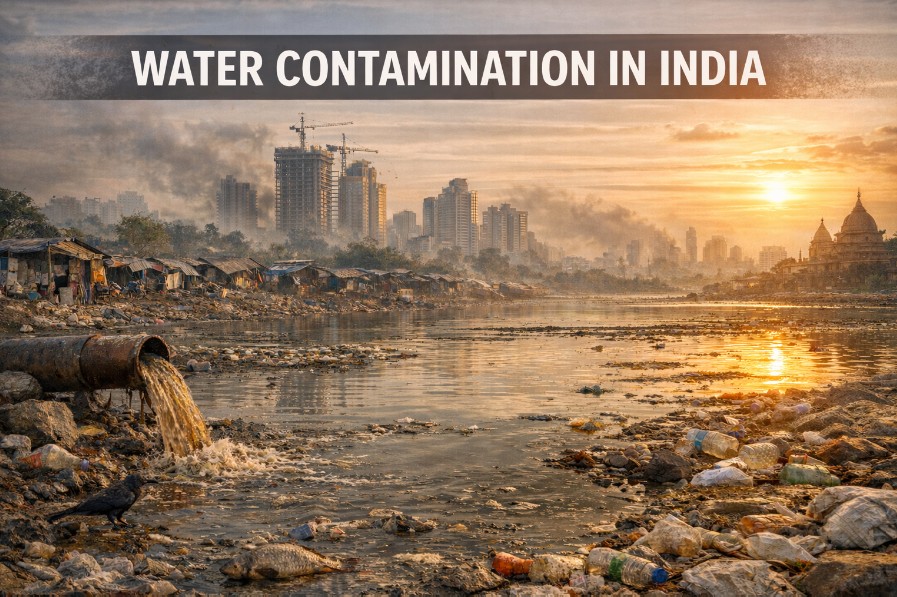
Water no longer feels like a benign backdrop in daily life; increasingly, it feels like a question mark. On December 29th, in Indore, drinking sewage-laced municipal water resulted in sickening around 3000 people and killing 21 before tankers arrived. Water Contamination in India has shifted from a technical issue buried in reports to a lived reality shaping public health, governance, and even personal routines. In other incidents, Delhi was battered with black sewer water, 150 children in Gandhinagar were hospitalised with typhoid, Bengaluru households were ravaged with diarrhoea, and silent poisoning in Bihar accounted for 30,000 arsenic-afflicted villages. When basic hydration becomes Russian roulette, entire societies gamble with their futures. As someone tracking India’s social fault lines, this crisis terrifies me profoundly – not just for the immediate victims, but because it exposes how fragile our survival systems become when governance treats water as an afterthought.
Yet, the real horror burrows far beneath headlines. Indore’s explosive diarrhoea grabbed cameras with groundwater nitrates tainting 56% districts and fluoride excesses in Rajasthan resulting in bone deformations, among other health hazards. Public health experts call unsafe water “India’s most underestimated public health emergency”, perfectly capturing both sudden epidemics and arsenic cancers festering over decades. Over the past year, 5,500 sickened across 26 cities in 22 states from verified tap water contamination alone. Moreover, these documented urban cases likely undercount rural tragedies where communities suffer without making headlines. Therefore, there’s a high chance that your city’s pipes could fail next. Contextually, there’s a high chance that supporting statistics included below will absolutely shake you up.
When Taps Become Weapons: Indore Leads Deadly Parade
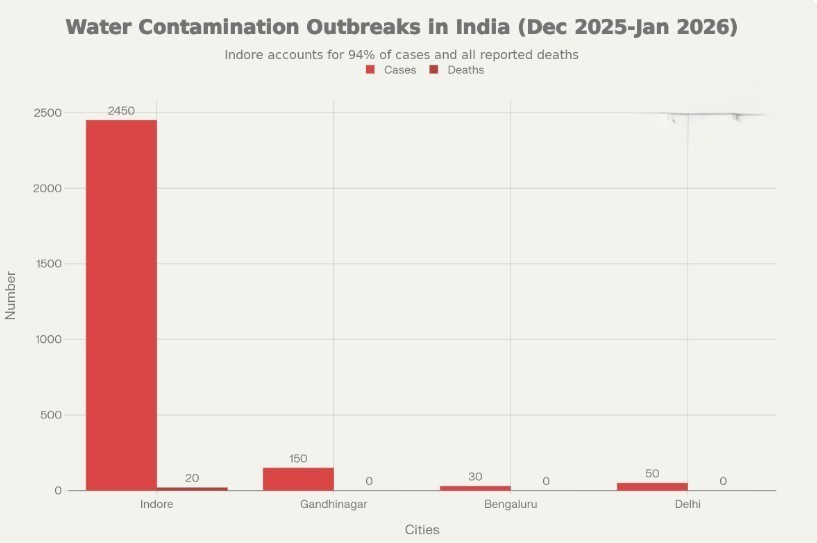
Indore, the cleanest city in India, crystallized this nightmare when untreated sewage infiltrated drinking pipelines through corroded joints exploiting intermittent pressure drops. Diarrhoeal disease pervaded Bhagirathpura neighborhoods, hospitalizing 2,450 – mostly dehydrated children – and killing 21 by January 12th. Schools shuttered, families queued endlessly for tankers, and trust evaporated permanently. One mother’s chilling account haunts me: she boiled street puddles rather than risk filling tap water. Subsequently, officials deployed emergency supplies and repair deadlines, but institutional credibility was shattered irreversibly. In addition, what began as an engineering failure transformed into moral failure entirely.
Meanwhile, parallel disasters unfolded ruthlessly nationwide. Gandhinagar rushed 150 children to hospitals with typhoid in early January via unmonitored community sources preying on young immune systems. Similarly, Bengaluru’s KSFC Layout endured diarrhoea devastating 30 households on January 4th, proving municipal lapses weaponize urban density brutally. At the same time, Delhi residents gaped as black, foul sewer water gushed from government taps, turning affluent morning routines into health gambles. My Delhi friend’s black chai joke ended with an Emergency Room (ER) visit – reality bites harder than sarcasm ever could. Overall, many of our world-class cities had to dapple with the uncomfortable truth regarding water contamination.
Contamination’s Relentless National Footprint Expands
Consequently, Indore’s tragedy amplified horrifying pattern: 5,500 sickened and 34 dead across 26 cities in 22 states from tap contamination last year. However, these urban figures undercount rural carnage where Bihar’s 30,000 arsenic wards and Rajasthan’s fluorosis villages suffer headline-free silently. Furthermore, AMRUT delivers clean water to under 10% of cities, mocking progress claims entirely. In contrast, groundwater – supplying 60% rural and 40% urban India – reveals systemic betrayal: Central Ground Water Board (CGWB) finds nitrates exceeding 45 mg/L in 56% districts, fluoride tainting 9% samples, and arsenic surpassing 0.01 mg/L in 3.55% samples.
Notably, Rajasthan, Uttar Pradesh, Bihar, Punjab, and Assam cluster as contamination epicenters overlapping poverty belts where alternatives barely exist. Personally speaking, while touring Rajasthan’s fluorosis zones recently, I watched a teenager hobble painfully months after the outbreak. Regrettably, high-yield agriculture triumphs by crippling its own farmers via nitrates relentlessly. Additionally, Central Pollution Control Board (CPCB) tracks 296 polluted river stretches failing Biochemical Oxygen Demand (BOD) and coliform standards despite modest decline from 351. In summary, the national footprint staggers recognition.
Acute Epidemics Collide With Chronic Toxin Siege
Undeniably, acute devastation strikes mercilessly: 30 million waterborne cases yearly, 300,000 deaths with children under five hit hardest, overwhelming ICUs with dehydration cascades. In response, Indore families pawned jewellery for IV drips while national wage losses and school absences bleed silently everywhere. Highlighting the graveness of the issue, Justice B.R. Gavai argued in court: “Clean water constitutes a fundamental right to life,” yet taps weaponize pathogens daily. Additionally, waterborne diseases like diarrhoea and typhoid overwhelm understaffed hospitals constantly across cities. As a result, families lose paydays repeatedly causing financial distress. Furthermore, affected communities fracture under repeated sicknesses caused due to contaminated water supply.
Conversely, chronically, arsenic forges skin lesions and various cancers stealthily over decades while fluoride crafts skeletal fluorosis hobbling labourers daily. Likewise, nitrates spawn blue-baby syndrome killing infants subtly across suburbs everywhere. To illustrate, Bihar villages exhibit telltale skin pigmentation issues; in Rajasthan, bones crumble due to mineral overload. I have a doctor friend who treats nitrate-induced blue babies in the suburbs, which is nothing short of dystopia. Ironically, groundwater offers wellness retreats with cancer and crippled limbs being complimentary. In short, why import toxins when aquifers deliver locally? 😓
Urban Catastrophes Dissected With Brutal Honesty
Thoroughly examined, Indore autopsied clinically: Sewage backflow through leaky joints during low pressure – intermittent supply’s classic death trap – obliterated Bhagirathpura. Notably, officials promised deadlines; but eventually residents had to go through nightmares daily. Elsewhere, Delhi decoded brutally: Sewer-supply intersections unexpectedly spawned black water even in elite zones. Clearly, privilege offers zero protection from infrastructure rot spreading due to systemic lapses. Similarly, Bengaluru blueprint exposed: on January 4th, KSFC Layout in Lingarajapuram reported sewage contamination in their drinking water supply. Consequently, this became a major public health concern when a significant number of households experienced symptoms like diarrhoea, stomach infections and other water-borne illnesses after consuming or using the contaminated water. As a result, the tech capital’s celebrated reputation took a beating. Likewise, Gandhinagar has reported a surge in typhoid cases in early January 2026. The outbreak is directly linked to contamination of the municipal drinking water supply. In all, eleven state capitals have compromised on drinking water supply since January 2025, revealing rampant and shocking urban vulnerability in ensuring water security.
From my personal experience, I immediately petitioned RWAs in my locality for water tests and met stonewalling. Sarcastically speaking, world-class cities flowing brown make perfect export models. Undeniably, the collapse in urban infrastructure of essential public utilities deserves ruthless examination. On one hand, 26 cities have documented adverse incidents related to water contamination in drinking water supply in recent times. On the other hand, unreported incidents multiply silently across many regions. As previously mentioned, AMRUT’s expansion bypasses maintenance systematically everywhere leading to serious lapses. As a consequence, infrastructure development becomes pipe dreams without proper execution and regular monitoring. Regrettably, regulators master paperwork overground while pollutants flow freely underground. At their wits end, citizens are left with no choice but to improvise desperately with systemic change eluding them consistently across decades.
Infrastructure’s House of Cards Implodes Systematically
Significantly, 70% urban sewage escapes treatment flooding rivers and aquifers relentlessly while ageing pipes suck contaminants cunningly during pressure drops. Moreover, tanneries, pharmaceuticals, and textiles skirt effluent rules shamelessly as urea overkill nitrates groundwater aquifers. To put things in perspective, “Coverage without quality builds pipelines to illness.” Powerfully put, social activist Vandana Shiva indicts: “Rivers mirror our collective failure.” Plastic being a major pollutant in rivers, on World Environment Day, 2025, the focus was placed on reducing the plastic footprint in our rivers.
Concurrently, illegal connections exacerbate breaches systematically across regions. Subsequently, over-extraction spreads heavy metals and salinity dangerously nationwide. Moreover, municipalities chronically underfund regular maintenance work, compounding the issue. As a result, while government initiatives like AMRUT expands coverage, reliability lags behind disastrously. Additionally, climate change intensifies scarcity, stressing systems further, relentlessly. Furthermore, uncontrolled industrial growth multiplies contamination sources exponentially without proper checks in place. In essence, pipe dreams without effective maintenance leads to public health nightmares. Ultimately, it becomes the responsibility of communities to ensure accountability, relentlessly and publicly.
Poison Reserved Exclusively for the Powerless
Clearly, affluent households deploy RO filters and bottled backups while slums survive on contaminated sludge desperately. To add, Bihar’s arsenic ravages 30,000 wards generationally while in Rajasthan, fluorosis causes brittle bones, largely affecting labourers. Historically, caste discrimination shadows modern water access subtly yet powerfully. As a result, peri-urban colonies endure without alternatives, completely and tragically. Alarmingly, clean water emerges as an ultimate privilege marker in modern India.
Troublingly, contamination maps overlay poverty and caste demographics with uncomfortable precision. As seen often, the right-to-life excludes the powerless, systematically and shamefully. Consequently, inequality weaponizes every single drop flowing through taps. Voices demanding justice grow louder progressively, but to no avail. Nevertheless, structural change lags alarmingly and disconcertedly. From my experience, NGO mapping revealed caste patterns in well access, starkly and disturbingly. In essence, it is appalling to say that social geography determines health outcomes directly and measurably.
Grassroots Rebellion Flickers Against Institutional Darkness
Impressively, housing societies organize tanker deliveries ruthlessly while NGOs litigate and test water quality independently. Besides, RTI warriors unearth administrative cover-ups with media attention highlighting glaring lapses. Furthermore, rural collectives revive traditional wells successfully against overwhelming odds. In addition, communities demand transparency and accountability through social media campaigns. Moreover, youth activists amplify marginalized voices consistently through their endearing endeavors. However, resources constrain scaling significantly leading to volunteering exhausting dedicated activists. Pitiably, the poorest communities access support least consistently across geographies, resulting in being sidelined.
Personally speaking, arsenic-mapping work with a local NGO felt genuinely revolutionary. Simultaneously, systemic barriers frustrated progress repeatedly and painfully. On the positive side, public interest litigation (PIL) forces accountability occasionally through courts. Additionally, awareness campaigns save lives through targeted education, locally. However, inadequate funding limits initiatives unevenly across regions, persistently. Sadly, political will remains dangerously weak nationwide. Therefore, bottom-up efforts beat top-down failures often. Undeniably, citizen pressure matters profoundly everywhere with collective action driving change eventually and undeniably. Intermittent successes inspire others, mostly fence-sitters, to join in and do whatever they can.
Household Defenses Citizens Can Control Directly Now
To ensure water safety, test household water weekly using ₹200 pharmacy kits available nationwide. Furthermore, boil drinking water vigorously for a minimum of one minute, always. Additionally, install certified RO filters blocking 99% contaminants reliably in your drinking water. In addition, chlorination destroys bacteria cheaply and effectively. Likewise, covered storage prevents sneaky recontamination. Moreover, rainwater harvesting supplements supply significantly and is being widely adopted these days. Personally speaking, the rainwater harvesting system in my apartment complex slashed water contamination risks by 80%. However, filters require regular maintenance which I ensure unfailingly in my house. Admittedly, the less fortunate don’t have the luxury of buying high end filters. This is where the government should step in and ensure that water safety is not compromised.
Importantly, recognize symptoms immediately: symptoms like fever, diarrhoea and fatigue demand urgent medical care. Furthermore, alert neighbors during suspected outbreaks rapidly and transparently. In particular, young children and the elderly remain the most vulnerable and should be taken care of without delay. Besides, early detection and prompt medical attention cuts complications considerably and saves lives. On my part, I’ve always generated awareness through various platforms with regards to ensuring water safety. Conversely, systemic neglect continues unabated with household fixes revealing governance failure. Ultimately, individual actions matter yet pale against institutional obligations remaining unfulfilled.
Holistic Revolution Imperative to Prevent Dire Consequences
Undoubtedly, Water Contamination in India indicts systemic complacency calling for redesign of pipes ruthlessly, enforcing rights ferociously, and reviving rivers passionately. If not, it would mean bequeathing a poisoned legacy for generations to come. Without mincing words, Justice B.R. Gavai mandates unequivocally: “Clean water equals fundamental life right always”. Voicing her concern, activist Vandana Shiva elucidates: “Rivers demand collective resurrection duty immediately”. Undeniably, governments must fund maintenance properly while industries embrace zero-discharge reality completely. Additionally, farmers should adopt precision agriculture urgently thereby slashing fertilizer overuse. Moreover, communities should demand accountability relentlessly through petitions and protests. Furthermore, educational campaigns transform behaviours sustainably across generations.
IMMEDIATE ACTION PLAN: First, test water TODAY using the ₹200 pharmacy kits widely available. Second, report leaks NOW via national helpline 1916 operational 24/7. Third, share this analysis WIDELY tagging local leaders. Fourth, petition your MP ASAP using ready online templates. Fifth, join local water quality groups crusading water safety. Economically, clean water saves trillions in healthcare and lost wages annually, across the country. In essence, together we reverse poisoned flows permanently. Your action ignites change. Therefore, act today – tomorrow depends entirely on you. Express your concerns and suggestions in this regard, specific to your locality, to ignite a holistic change towards a nationwide water security. 🎤📢💧
#WaterContaminationIndia #WaterCrisisIndia #PublicHealthEmergency #SafeDrinkingWater #IndiaWaterPollution