Seeing The Invisible India
World NGO Day 2026 in India is not just another observance quietly passing through the crowded calendar. It is a rare invitation to notice the invisible infrastructure of care that moves beneath our noisy politics and booming markets. Behind the metro glass and village dust, volunteers, social workers, lawyers and community organisers keep patching cracks that would otherwise swallow people whole. Their organisations almost never trend on prime‑time debates, yet their work shapes whether a child eats, a worker heals, or a woman speaks. As I look around, I realise how fragile India’s social fabric still is, and how much of its strength now flows quietly through NGOs rather than only through ministries and markets. That is exactly why World NGO Day 2026 in India deserves our undivided, erudite attention.
On the surface, themed days can feel like sentimental wallpaper that we politely acknowledge and then ignore. However, World NGO Day 2026 in India does something more unsettling by asking who really catches those whom the state and market repeatedly overlook, sideline or abandon. It presses us to examine the changing role of NGOs in India, not as generic do‑gooders but as complex actors in democracy, development and dissent. It also forces a sharper question: what does inclusive development in India actually mean if whole districts, communities and identities remain structurally underserved despite thousands of NGOs on paper? By the time you reach the end of this blog, I hope you will not just know more but feel implicated as well.
The 2026 Theme: Restoring Dignity Through Inclusion
From Slogan to Indian ethos
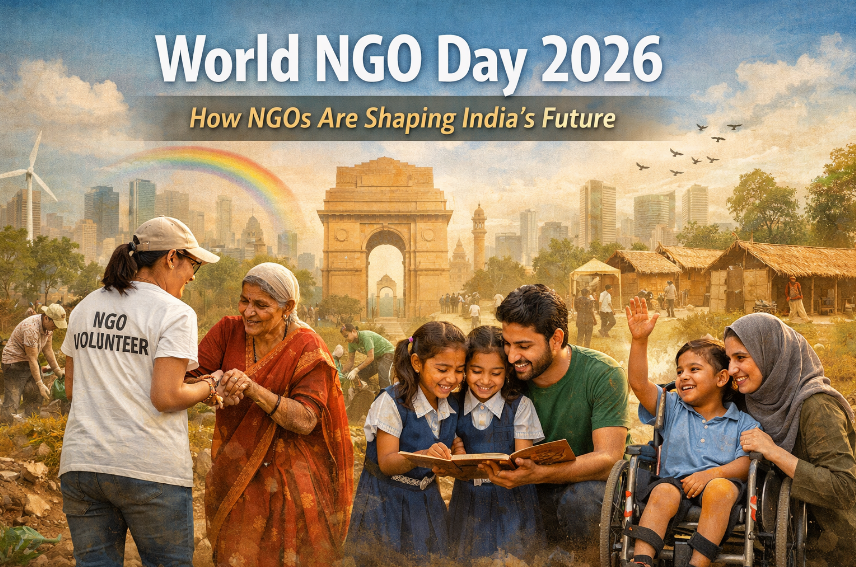
The global messaging for World NGO Day 2026 highlights an insistence on restoring dignity through inclusion, a phrase that sounds deceptively abstract until you test it against Indian streets. Dignity collapses when a wheelchair user meets three flights of stairs at the panchayat office because the building never imagined their presence. It crumbles when a Dalit woman still hesitates at the village well, measuring every step against generations of humiliation. It disappears when a migrant child peers into a classroom from the doorway, welcomed into labour but not into learning. In each of these scenes, NGOs become the awkward questions that refuse to look away, and sometimes the first responders that quietly change the script.
Indian thinkers on dignity and democracy
Long before World NGO Day 2026 in India existed, our own thinkers tied human dignity to democratic survival. B. R. Ambedkar warned that political democracy cannot last where social democracy is absent, reminding us that votes without dignity become empty rituals. Amartya Sen reframed development as the expansion of substantive freedoms, not just the growth of national income figures that comfort economists. A. P. J. Abdul Kalam’s dream of a “developed India” always included villages, not only gleaming corridors of technology parks. When you walk with NGOs into a remote hamlet or a crowded slum, you often see these ideas colliding with stubborn reality; and that collision, uncomfortable as it is, is precisely the significance of this year’s theme for India.
India’s NGO Landscape: Scale, Diversity And The Role Of NGOs In India
How many, how varied
India now hosts one of the world’s largest and most diverse NGO ecosystems, a sprawling archipelago of organisations that defy easy caricature. A national study in 2009 estimated roughly 3.3 million registered organisations across the country, suggesting there is almost one NGO for every 400 people. More recently, the government’s NGO Darpan portal lists over 3,26,000 registered entities, from large national brands to tiny community‑based societies and trusts. Some run schools in conflict‑affected belts, others manage health camps in underserved districts, still others specialise in research, legal aid or environmental defence. Taken together, they illustrate how the role of NGOs in India now stretches from last‑mile service delivery to policy advocacy, from humanitarian relief to social innovation.
What they actually do, beyond labels
Labels like “non‑profit” or “civil society” flatten this complexity and hide texture. In practice, NGOs in India run bridge schools for children who have never seen a blackboard, accompany waste‑pickers to negotiate better wages, help farmers shift to climate‑resilient crops, and support survivors of violence through counselling and courtrooms. Youth‑led groups harness digital tools to mentor first‑generation college aspirants, map local air‑pollution hotspots, or crowdfund for life‑saving surgeries. Human Rights‑based organisations document custodial torture, challenge unlawful demolitions, or teach communities to use information and social‑security laws effectively. When you step back, you realise that inclusive development in India increasingly flows through these overlapping networks of organisations, not just through official schemes.
Who Benefits: People Behind The Programmes
Villages, towns and megacities
To understand World NGO Day 2026 in India, we must move from institutional maps to human faces. In rural belts, NGOs bring primary healthcare through mobile clinics, train frontline workers, and accompany pregnant women to facilities that would otherwise feel intimidating and distant. They support farmer collectives setting up water‑saving irrigation, revive traditional seeds, and experiment with climate‑resilient cropping patterns. In small towns, NGOs run after‑school centres, scholarship programmes and mentoring circles for young people whose parents never crossed a school gate. Within megacities, organisations manage community kitchens, night shelters, legal‑aid desks at labour camps, and helplines for domestic workers or street children. For many of these citizens, the first experience of being seen and heard arrives not from a state office, but from an NGO doorway.
Children, women and marginalised identities
The picture deepens further when you trace work through identities, not only through geography. Child‑rights groups fight child labour and trafficking, protect street children, and work to reduce the staggering learning losses worsened by disruptions in schooling. Women’s organisations nurture self‑help groups, support survivors of domestic and caste‑based violence, and help women negotiate fairer wages and safer workplaces. Dalit, Adivasi and Muslim‑led organisations create spaces where communities can articulate their own priorities instead of being spoken for. Disability‑rights groups demand ramps, accessible information, inclusive classrooms and meaningful employment, pushing accessibility from token gesture to systemic obligation. Through these layered efforts, the role of NGOs in India becomes not merely charitable but profoundly political, because it rearranges who has voice, visibility and bargaining power.
Gaps, Silences And The Limits Of NGO Action
Where even active NGO belts fall short
It would be dishonest, however, to treat World NGO Day 2026 in India as a simple success parade. Many structural injustices remain largely untouched or only superficially addressed even in districts crowded with organisations. Enduring caste violence, the persistence of manual scavenging, and entrenched segregation rarely receive the long‑term, multi‑level work they demand. Mental‑health services outside major cities remain thin, stigmatised and under‑funded, leaving millions to cope in silence. Climate migration, coastal erosion and slow‑onset disasters often attract short project cycles but little sustained investment in community resilience. NGOs can mitigate and highlight these crises, but they cannot by themselves rewrite the structural code that produces them.
Geographies of neglect
Funding patterns deepen these gaps further by rewarding visibility and convenience over vulnerability and need. IndiaSpend’s analysis of recent CSR data shows that companies spent about ₹34,000 crore on CSR in a single year, yet nearly three‑fourths of district‑level CSR flows into just 193 districts, many of which already perform relatively well on development indicators. Only three of India’s fifty‑four high‑poverty districts appear among the top CSR destinations, which means that the places most in need of strong, well‑resourced NGOs often see the fewest. When we talk about inclusive development in India in such a context, we must acknowledge that inclusion currently has a postcode. World NGO Day 2026 in India, therefore, is not only about celebrating NGOs that exist, but also about noticing where they do not.
India’s NGO And CSR Snapshot
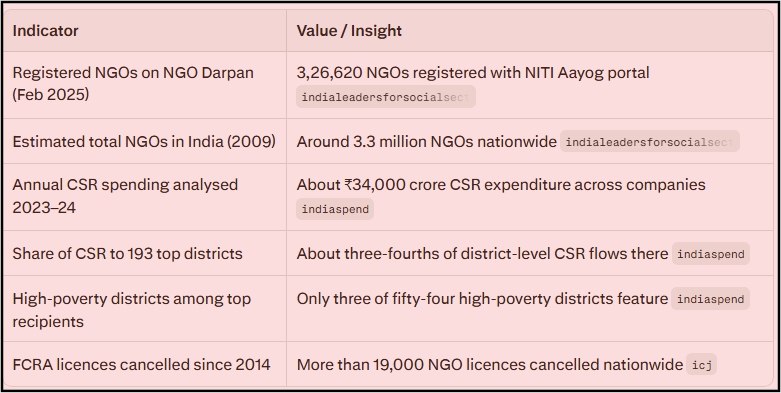
Source: NITI Aayog NGO Darpan; IndiaSpend CSR DataViz; ICJ briefing on FCRA
Reading the numbers with care
For a serious reader, these figures are not mere trivia but a quiet indictment that sits behind World NGO Day 2026 in India. India does not suffer from a shortage of registered entities; it suffers from a shortage of resources and freedoms in the places and sectors that need them most. When over 19,000 NGOs lose foreign‑funding licences under the Foreign Contribution Regulation Act (FCRA), the chill extends far beyond those individual organisations and into the communities they served. When three‑quarters of CSR money clusters in districts that already attract investors and media attention, the role of NGOs in India risks reinforcing existing hierarchies instead of disturbing them. Numbers, in other words, expose what rhetoric about “inclusive growth” often conceals.
Money, Law And The Squeeze On Civic Space
Uneven CSR and fragile institutions
Behind many NGO stories lies a more technical but crucial narrative about who receives money, under what conditions, and with what strings attached. Recent sector analyses note that large companies increasingly route CSR through their own foundations or government‑linked channels, which can leave independent, community‑based groups struggling for access even when they are legally compliant and demonstrably effective. Many smaller organisations lack the legal, financial and technological capacity to navigate complex eligibility criteria, documentation requirements and reporting systems. Reports highlight that a majority still operate without robust digital tools or licensed software, making them more vulnerable to both error and suspicion. In such a landscape, even well‑designed policies may, in practice, privilege institutions that already enjoy visibility and networks.
FCRA and the politics of permission
On the legal front, the FCRA has become one of the most contested pieces of legislation shaping civil society in India. Since 2014, authorities have cancelled over 19,000 FCRA registrations, affecting organisations working on health, education, environment and human rights. A detailed briefing by the International Commission of Jurists argues that the law, as interpreted and applied, stifles critical voices and undermines freedom of association. When an environmental organisation loses its ability to receive funds, a village fighting pollution can lose a crucial ally; when a legal‑aid group shuts down, survivors of violence can lose representation. As Ambedkar warned, democracy without the right to organise and agitate risks slipping into what he called “a grammar of anarchy” in reverse: order without justice. Therefore, any honest reflection on inclusive development in India must include the politics of who is allowed to help.
CSR Distribution Across Districts
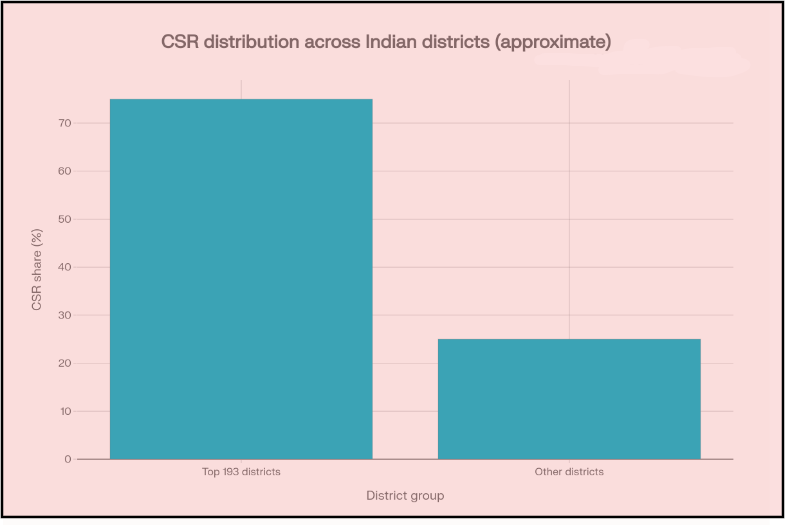
Source: IndiaSpend DataViz on how India’s CSR spending is distributed across districts
What the chart quietly says
This simple bar chart, though minimal, captures one of the most important messages of World NGO Day 2026 in India for policy‑minded readers. When roughly seventy‑five percent of district‑level CSR flows into 193 districts and the remaining quarter trickles across hundreds of others, many of India’s poorest communities start the development race several laps behind. NGOs working there must then rely on thinner, more precarious streams of domestic philanthropy or overstretched government grants, which in turn weakens their ability to hire, train and retain competent staff. In that sense, the geography of money silently redraws the geography of hope.
Youth, Technology And New Possibilities
A different kind of citizen
Despite these constraints, World NGO Day 2026 in India also spotlights remarkable new energy, especially among younger Indians who see citizenship as something practised daily rather than displayed only on polling day. Youth‑led organisations now routinely use Instagram, short videos and storytelling threads to recruit volunteers, raise funds through UPI and crowdfunding platforms, and report back to supporters with unusual transparency. In Hyderabad, for example, one volunteer‑driven NGO works across thirty‑nine locations in fifteen states alongside more than two hundred CSR partners and tens of thousands of donors, showing how a small team can orchestrate a surprisingly wide coalition. Similar experiments in other states pair technologists with social workers to build dashboards that track learning levels, health indicators or climate risks in real time. These ventures do not replace the state, but they nudge it by generating evidence and demonstrating feasible alternatives.
Reimagining development as participation
Philanthropy reports from Bain, Dasra and others suggest that domestic giving is rising, both among high‑net‑worth individuals and among middle‑class donors who now treat monthly contributions as part of their financial planning. As Amartya Sen has argued, development is ultimately about expanding the capabilities people have to lead lives they value; in today’s India, NGOs and their supporters often act as the hinge between constitutional promises and everyday possibilities. When a young professional donates a small sum every month to fund paralegals in a tribal belt, or when a data scientist volunteers weekends to clean and visualise health records, inclusive development in India stops being a slogan and becomes an incremental, cumulative practice. Abdul Kalam frequently spoke of moving from “complaining” to “contributing” citizens; that shift, if taken seriously, could itself be one of the most profound legacies of World NGO Day 2026 in India.
NGOs, Rights And India’s Democratic Imagination
More than service providers
Many NGOs in India do not run schools or clinics at all; instead, they occupy the less glamorous but absolutely essential terrain of rights defence and institutional accountability. Civil‑liberties groups investigate custodial deaths, challenge unlawful detentions and train citizens to use legal tools effectively. Environmental organisations question projects that threaten forests, rivers or coastlines without adequate safeguards or consultation. Minority‑rights groups monitor hate speech and hate crimes, document patterns and advocate for fairer policing and prosecution. Their work rarely appears in CSR brochures, yet it is crucial for keeping democracy from hardening into majoritarian comfort.
Imagining a fearless India
Rabindranath Tagore’s famous aspiration for a country “where the mind is without fear” and the head is held high still feels painfully aspirational for many Indians whose daily reality includes harassment, discrimination or violence. When rights‑based NGOs accompany them to courts, commissions or media forums, they are in effect building the scaffolding for that fearlessness. Nehru’s notion that democracy must be a habit of questioning, not merely a ritual of voting, also resonates here; NGOs that ask uncomfortable questions about power, prejudice or policy live out that habit. On World NGO Day 2026 in India, it is worth remembering that without these sometimes unpopular, often embattled organisations, the constitutional promise of equality, liberty and fraternity would ring even hollower than it already does.
What This Day Asks Of Each Of Us
From spectator to participant
For erudite readers who track policy debates and social trends, it is tempting to treat NGOs as an object of analysis rather than a field of engagement. World NGO Day 2026 in India gently but firmly challenges that distance. The question is no longer whether NGOs matter – they clearly do – but whether we will support the ones that align with our values in thoughtful, sustained ways. That might mean giving up the comfort of one‑off festival‑time donations in favour of smaller but regular contributions, offering professional skills to organisations that cannot afford consultants, or simply staying with one cause long enough to understand its complexity.
Practical, personal steps
Corporates can examine whether their CSR portfolios reinforce existing geographic and institutional biases or intentionally correct for them by backing smaller, grassroots partners in high‑poverty districts. Citizens can push back, politely but firmly, against narratives that paint all NGOs as foreign‑controlled or anti‑development, recognising instead the nuanced and varied role of NGOs in India. Writers, teachers and content creators can lift stories from unsung corners, shifting the spotlight away from a handful of famous names to the wider ecosystem. As each of us adjusts our habits – of giving, of listening, of speaking – the phrase inclusive development in India begins to acquire muscle and memory rather than merely appearing in government documents.
Driving India’s Future, Together
Beyond celebration, toward responsibility
At its best, World NGO Day 2026 in India is not a festival of self‑congratulation for the sector, but a sober stock‑taking for the republic.
The state designs laws and policies; markets drive innovation and allocate capital; yet NGOs often translate rights into real remedies and abstract statistics into human stories. They stand beside those who would otherwise be erased from graphs and speeches, insisting that development be judged by lives transformed, not only by indices improved. If their space shrinks through hostile laws or skewed funding, India does not merely lose a set of organisations; it loses crucial instruments for self‑correction.
Shaping a more just tomorrow
Ultimately, the future that World NGO Day 2026 in India points toward will not be built by NGOs alone. It will be shaped by how citizens, institutions and communities choose to recognise, support and sometimes challenge them. Ambedkar’s call for social democracy, Sen’s emphasis on freedoms, Tagore’s dream of fearlessness and Kalam’s vision of participatory citizenship all converge here, demanding more from each of us than detached admiration. If we respond with informed generosity, human solidarity and sustained engagement, then NGOs can truly help drive India’s future toward a more dignified and inclusive horizon; and perhaps, in years to come, this day will feel less like a reminder of unfinished work and more like a celebration of how far we have collectively travelled.
World NGO Day 2026 in India is a reminder to move from admiration to alliance – by volunteering time, giving regularly to a credible organisation, lending your skills, or simply amplifying work that would otherwise stay invisible. ExpressIndia is already in talks with NGOs in India across sectors like education, health, gender justice, rural development, environment, animal welfare, social welfare, urban development, labour rights and democracy to highlight their initiatives, extend public solidarity, and build a stronger culture of support; as these collaborations unfold, I invite you to pick at least one concrete way to back their efforts and help drive India toward a more just and dignified future.
#WorldNGODay2026 #NGOsInIndia #SocialImpactIndia #InclusiveDevelopment #SupportNGOs