
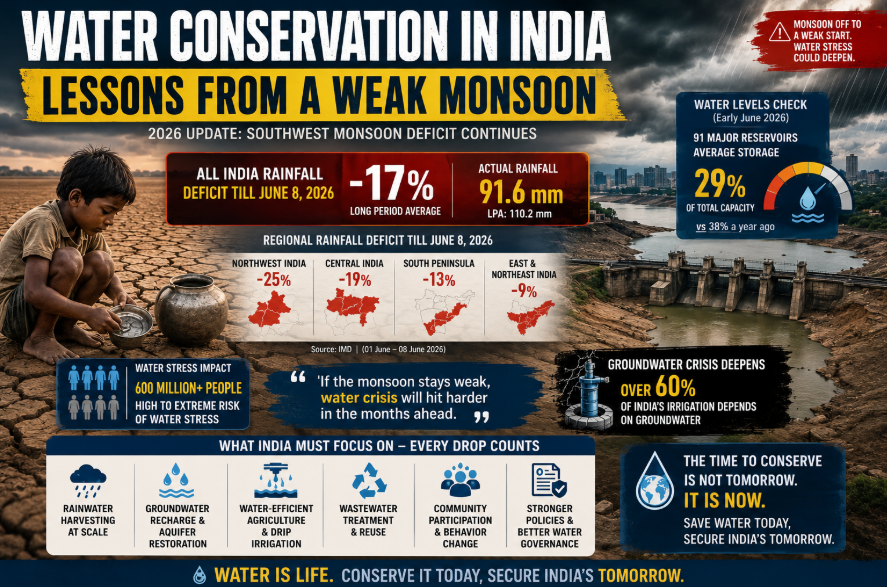
Water conservation in India suddenly feels less like an NGO slogan and more like a national emergency. I say this as someone who has spent months tracking policy briefs, IMD bulletins, and drought headlines. This year, the story writes itself, because the rains simply refused to show up on time. And that absence has forced ministries, farmers, and city dwellers to rethink what water security actually means.
Why This Weak Monsoon Demands Water Conservation In India
India’s southwest monsoon in 2026 has been unusually stingy, and the numbers back that up starkly. As per IMD data reported by India Today, the country closed June with a 40 percent rainfall deficit, receiving just 99.5 mm against a normal of 165.3 mm. Reuters independently confirmed this, calling it the fifth driest June since 1901, with rainfall running 39.8 percent below the long-term average. Consequently, water conservation in India has shifted from a seasonal talking point to an urgent policy priority. Meanwhile, IMD’s seasonal outlook, revised downward to 90 percent of the Long Period Average (LPA), warns of a 60 percent probability of deficient rainfall overall.
What makes this deficit sting even more is the contrast with recent history. Just last year, in 2025, the monsoon delivered about 108 percent of the LPA, filling reservoirs and easing pressure across most states. Therefore, this year’s sudden reversal feels jarring rather than gradual. Analysts note that India has faced deficient monsoons in 13 of the past 18 years through 2018, so volatility itself is not new. However, the speed of this year’s swing – from surplus to scarcity within a single season – has caught planners somewhat off guard.
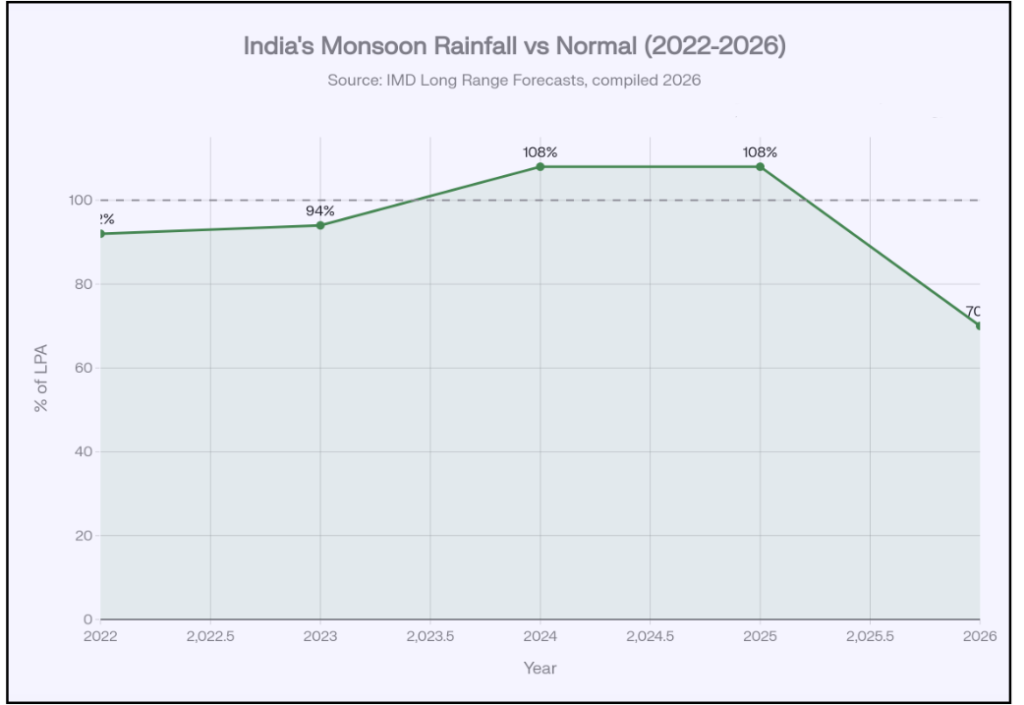
Source: IMD Long Range Forecasts, compiled 2026
Region-Wise Damage: Where Water Conservation In India Matters Most
Not every part of India suffered equally, and that unevenness matters enormously for policy design. IMD’s June breakdown shows central India hit hardest, with a 50 percent deficit, followed by east and northeast India at 40 percent. Northwest India recorded a 31 percent shortfall, while the south peninsula fared comparatively better at 27 percent below normal. Gujarat suffered the worst state-level deficit at 82 percent, with Chhattisgarh and Jharkhand also badly affected. Meanwhile, pockets like Ladakh, Sikkim, and West Bengal actually recorded surplus rainfall, illustrating how fractured India’s monsoon geography has become.
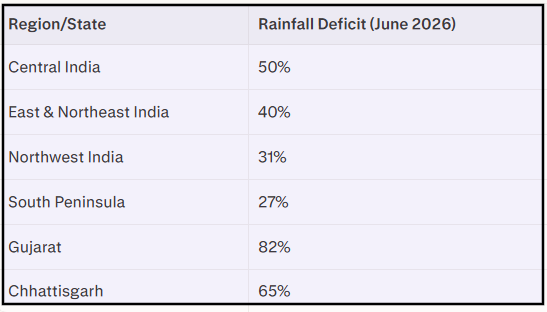
Source: IMD data via India Today, June 2026
This chart isn’t just a compilation of data; it explains why a one-size-fits-all conservation policy simply won’t work. Odisha’s farmers face a different crisis than Gujarat’s urban planners, and Punjab’s groundwater troubles differ sharply from Kerala’s coastal concerns. Consequently, effective water conservation in India must be hyperlocal, blending state-specific data with national frameworks. Otherwise, resources get misallocated, and the districts that need help most end up waiting longest.
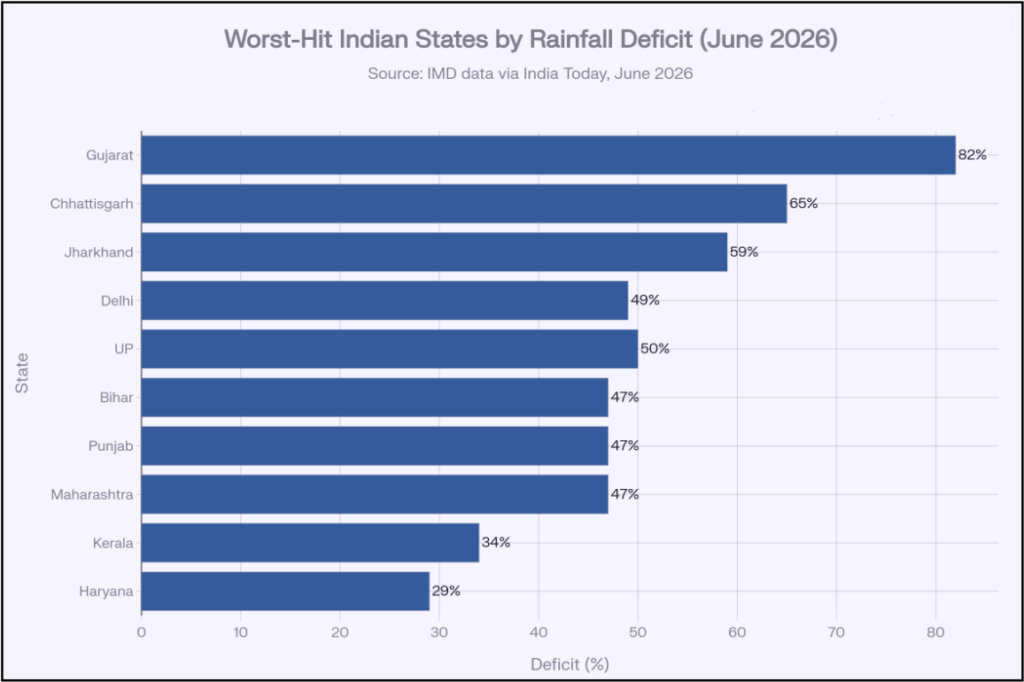
Source: IMD data via India Today, June 2026
The Weather Science Behind India’s Vanishing Rains
Understanding why the monsoon faltered helps explain why conservation efforts alone cannot fix everything. Meteorologists point to developing El Niño conditions, which typically weaken monsoon circulation over the Indian subcontinent. Additionally, a shifted westerly jet stream clashed with the easterly jet that normally powers monsoon uplift, effectively choking rain-bearing systems. Weak low-pressure systems over the Bay of Bengal, an unfavourable Madden-Julian Oscillation phase, and active Western Disturbances compounded the problem further. In plain terms, the monsoon’s usual “engine” simply lost horsepower this year.
Longer-term climate research adds a sobering layer to this picture. Studies suggest an 8 to 20 percent decline in India’s summer monsoon rainfall over recent decades, particularly across the north. Frequent droughts since the early 2000s appear linked to accelerated groundwater depletion, not merely to bad luck in any single year. So while 2026 feels unusual, scientists argue it fits a worrying long-term pattern rather than standing as an isolated anomaly. That distinction should reshape how policymakers frame water conservation in India going forward.
Farms, Taps, and Prices: The Human Cost Unfolding
Beyond charts and forecasts, this deficit is squeezing real livelihoods right now. Kharif sowing in 2026 is lagging by roughly 12 to 22 percent compared to last year’s bumper season. Government agencies have activated contingency plans across more than 315 districts, nudging farmers toward less thirsty crops like millets and pulses instead of paddy. Reservoir storage, meanwhile, sits at about 26 percent of capacity as of late June, down sharply from 36 percent a year earlier. Naturally, economists worry this squeeze could push up food prices, particularly for pulses and oilseeds, later this year.
Cities are feeling this too, not just villages. Mumbai has already restricted water use for swimming pools and construction sites amid tightening supplies. Uttar Pradesh’s Chief Minister ordered officials to prioritise drinking water and “turn water conservation in India into a mass movement,” pushing pond rejuvenation and hand-pump repairs statewide. As Shabnam, a community member in water-stressed Nuh, Haryana, put it after check dams were built there: “Earlier, our wells would dry up by October. Now, water lasts till the next monsoon”. Her simple observation captures exactly what’s at stake nationwide right now.
Groundwater’s Slow Bleed: A Crisis Beyond Rainfall
Even without this year’s deficit, India’s groundwater story would be alarming enough on its own. Research led by IIT Gandhinagar shows groundwater reserves in north India declining by roughly 1.5 cm annually over the past 50 years. During severe drought years, that depletion can accelerate to 10 to 15 percent almost overnight. Climate projections warn that a 10 to 15 percent drier monsoon combined with warmer winters could push depletion rates up by 6 to 20 percent. Clearly, water conservation in India cannot remain a monsoon-season conversation; it needs year-round institutional attention.
This structural stress explains why even 2025’s surplus monsoon didn’t fully solve India’s water problems. District-level data revealed clusters of deficit zones persisting even in that “good” year, especially across parts of eastern and central India. Rajendra Singh, widely known as India’s “Waterman” for reviving rivers through traditional water harvesting, has long argued that rainfall abundance means little without storage and recharge infrastructure. His decades of work with Tarun Bharat Sangh, which built over 10,000 johads and revived five rivers in Rajasthan, proves this point vividly. Water falling from the sky, in other words, is only half the equation.
Government Response: Reactive Scrambling Or Real Reform?
Policymakers, to their credit, haven’t stayed silent this time around. The Prime Minister directed key ministries to prepare contingency plans as the deficit widened toward 35 percent by early July. The Finance Ministry’s June economic review flagged water buffers as potentially “at the top of the list” for national priorities. Agriculture officials, working alongside Indian Council of Agricultural Research (ICAR), drafted district-specific plans covering crop shifts, alternative sowing windows, and repairs to ponds and check dams. These moves suggest genuine urgency, though critics argue such planning should happen every year, not just during visible crises.
Still, some structural reform signals are emerging alongside emergency responses. Economic reviews are pushing for agricultural pricing reforms that discourage water-guzzling crops like sugarcane and paddy in water-stressed zones. Meanwhile, the nationwide Jal Shakti Abhiyan: Catch the Rain campaign continues expanding, having enumerated roughly 24.24 lakh water bodies and established over 670 Jal Shakti Kendras since 2021. Sunita Narain, environmentalist and Director General of the Centre for Science and Environment, has repeatedly emphasised that India’s water crisis is fundamentally a governance crisis, not merely a rainfall problem. Her framing resonates strongly with this year’s unfolding events.
Grassroots Solutions Worth Scaling Nationwide
Amid the gloom, some genuinely inspiring local success stories deserve wider attention. In Gadchiroli district, Maharashtra, IAS officer Avishyant Panda has driven thousands of water conservation and irrigation projects, future-proofing water security for over a million residents before crisis struck. Similarly, in Jodhpur, Rajasthan, traditional water harvesting structures called nadis capture roughly 65 percent of catchment runoff, recharging groundwater by around 180 mm annually compared to areas without them. Researchers estimate scaling these structures could harvest an additional 12 to 15 million cubic metres of rainwater yearly. These aren’t theoretical proposals; they’re proven, measurable interventions already working on the ground.
Rooftop rainwater harvesting in schools offers another replicable model worth celebrating. In Anantapur, Andhra Pradesh, such systems ensure clean drinking water while turning children into conservation advocates. As one school principal noted, “My students now ask their parents to build rainwater systems at home”. This ripple effect – from classroom to household – demonstrates how education and infrastructure can reinforce each other beautifully. Ultimately, these grassroots stories prove that India already possesses the knowledge needed; what’s missing is consistent scaling and political will.
What Must Change: Personal, Societal, And Policy Action
So where does this leave us, practically speaking? At a personal level, households can adopt rainwater harvesting, fix leaking taps, and choose water-efficient appliances without waiting for government mandates. Communities, meanwhile, should revive traditional structures like johads and tanks, especially in drought-prone belts across Rajasthan, Maharashtra, and Bundelkhand. Policymakers, for their part, must institutionalise water buffers the same way India maintains food and fuel reserves, rather than treating conservation as an annual afterthought. Crucially, agricultural pricing reform needs to actively discourage water-intensive crops in genuinely water-stressed regions.
Water conservation in India, ultimately, cannot remain someone else’s responsibility – not the government’s alone, nor farmers’, nor city residents’. This weak monsoon has exposed uncomfortable truths about groundwater overuse, uneven governance, and reactive rather than anticipatory planning. Yet, it has also revealed genuine solutions already working in Gadchiroli, Rajasthan, and Haryana villages. If India treats this year as a wake-up call rather than a one-off inconvenience, the lessons could reshape water policy for decades. The rains may have disappointed us this year, but our response to that disappointment is entirely within our control.
At ExpressIndia.info, we believe informed citizens drive real change – so join us in tracking India’s water story, sharing these insights, and demanding accountability from every level of governance before the next monsoon fails us.
WaterConservationIndia #MonsoonCrisis2026 #SaveWaterSaveIndia #GroundwaterCrisis #ClimateActionIndia