
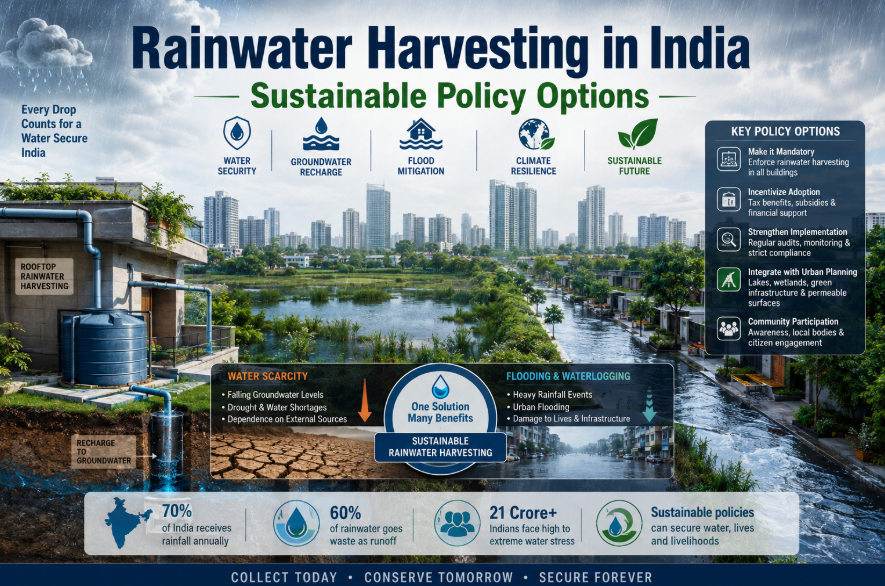
Rainwater Harvesting in India feels urgent this monsoon, as heavy downpours and urban flooding keep exposing weak water management. Currently, we are in mid-monsoon as I write this blog. This monsoon has once again shown how quickly rain can become both a flood and a missed opportunity for water security. Indeed, Assam and Kerala have seen heavy rain and floods lately after a sluggish start to the south-west monsoon. Meanwhile, parts of central India still wait for rain. Clearly, this unevenness reveals an uncomfortable truth about our monsoons and how we approach them. Simply put, India does not lack water; it lacks strategy. So, let’s treat Rainwater Harvesting in India as governance, not as a chore. Honestly, isn’t it odd that heavy rain still brings tanker queues?
Every intense monsoon now raises the same question: why does so much rain still drain away instead of strengthening India’s water future? In the sections ahead, I will trace what government has built effectively. Also, I will flag where it has stumbled quietly. Then, we will explore sustainable policy options for the future. First, we will look at hard numbers and honest gaps. Next, we will study flood science and global lessons too. Notably, Singapore, Australia, and the Netherlands all offer something useful. Frankly, my goal here is proof over slogans. By the end, you will see where Rainwater Harvesting in India stands. Ultimately, you will also see where sustainable urban development must head next.
India’s Water Paradox: A Tale of Two Postcodes
Picture this: In Guwahati, the Brahmaputra has swallowed a highway, and a family is ferrying a refrigerator to higher ground by boat. Four hundred kilometres away, in a district of Rajasthan that received barely a third of its normal rainfall, a farmer is measuring his borewell water with the grim precision of a man rationing morphine. Incidentally, both are victims of exactly the same problem: India cannot decide whether it has too much water or too little, and so, magnificently, it has arranged to have both – simultaneously, and largely by policy neglect rather than meteorological cruelty.
This is the paradox at the heart of Rainwater Harvesting in India: a country that receives roughly 3,880 billion cubic metres (BCM) of rain annually retains barely half of it for use, while 22% of its groundwater assessment blocks are classified as over-exploited or critical. We are, in effect, a civilisation drowning in some corners and dying of thirst in others. The problem is not rainfall alone, but our failure to capture it. Policy, infrastructure, and enforcement have not kept pace with the climate. Every intense monsoon now raises the same question: why does so much rain still drain away instead of strengthening India’s water future?
Current Policy Landscape: Rainwater Harvesting in India Today
Over the last decade, the Union government built a layered water policy. At its centre sits Jal Shakti Abhiyan: Catch the Rain. This yearly drive urges every district to “catch the rain, where it falls, when it falls.” Again, in 2026, a new drive was launched called Jal Sanchay Jan Bhagidari. It frames groundwater recharge as a people’s movement. Alongside these government initiatives, Atal Bhujal Yojana runs local recovery work too. Currently, it covers seven water-stressed states. Meanwhile, AMRUT 2.0 funds urban groundwater recharge and stormwater management. Besides, MGNREGA quietly does the heavy lifting too. In fact, nearly a fifth of its rural budget targets water conservation. On the legal side, building codes already mandate rooftop systems. Accordingly, any plot above 100 square metres must comply. Likewise, every new government building must comply too.
On the legal side, building codes now require rooftop systems widely. Specifically, any plot above one hundred square metres must comply. Likewise, every new government building must comply too, at least on paper. However, states have not simply waited for Delhi’s lead. Instead, Tamil Nadu made rooftop tanks compulsory well before most neighbours acted. Specifically, it enforces this by refusing water and sewer connections outright. Similarly, Kerala, Karnataka, Rajasthan, Maharashtra, and Delhi all followed with local rules. Notably, Madhya Pradesh even offers a small land tax rebate.
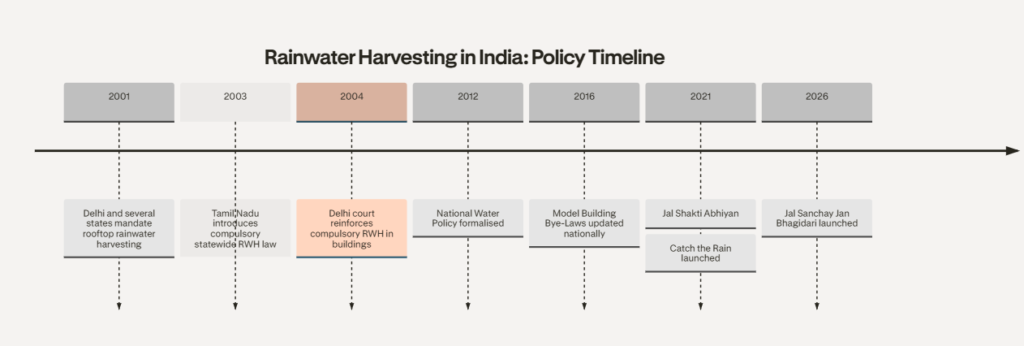
Source: PIB Government of India press releases; Model Building Bye-Laws, 2016.
Why Rainwater Harvesting in India Matters Right Now
Let me be blunt about the need, since policymakers rarely are. Clearly, water shortage is not some distant, slow-moving glacier problem. Instead, it is a live emergency playing out this very monsoon. Today, India remains the world’s largest user of groundwater. Currently, hundreds of districts sit classified as critical or overused. Admittedly, these labels sound dry until you meet the people behind them. So, farmers drill ever deeper into water layers that took ages to fill.
Similarly, climate shifts are only sharpening this need further still. Notably, rainfall patterns have grown clearly erratic across recent monsoon seasons. Sometimes, regions log record downpours while others record painful gaps. Recently, reservoir storage across major dams sat below eighty percent of normal. That is despite decent rainfall arriving in several states at once. Therefore, Rainwater Harvesting in India is not a green nicety. Ultimately, it is a hedge against a climate that keeps missing appointments.
The Systems View: Why Rain Becomes Ruin
Here, it helps to see the whole broken machine at once. Below, is the loop that turns rain into a puzzle.
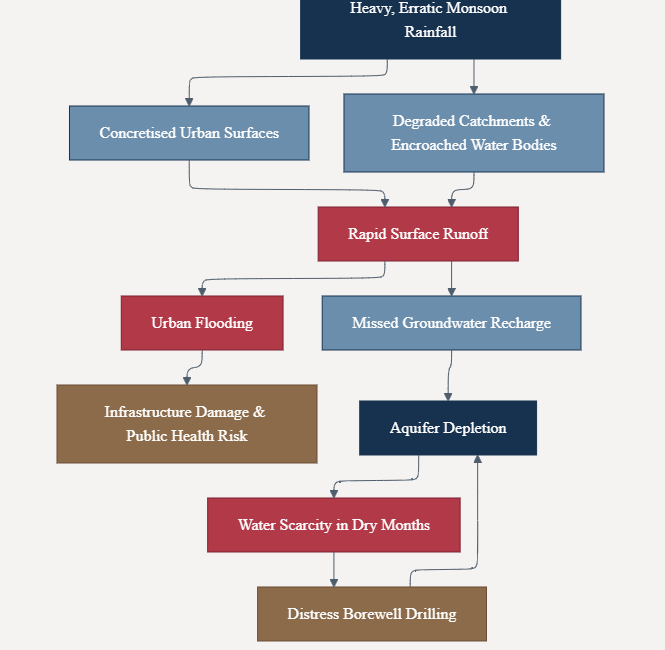
Source: Author’s synthesis based on CGWB and PIB groundwater data.
Notably, flooding and drought share the exact same root cause. Essentially, rain falls fast, concrete blocks it, and runoff simply flees. So, that runoff floods streets instead of quietly refilling water layers below. Fittingly, Rainwater Harvesting in India steps into this loop at multiple points. Specifically, it slows runoff, which directly cuts flooding downstream. Meanwhile, it feeds recharge, which directly cuts dry-season shortage. This is exactly why water scientists treat it as a systems fix. Ultimately, it is not a fancy rooftop add-on for wealthy homeowners.
What Is Working: Real Reasons for Cautious Hope
Numbers rarely lie, and here they truly inspire some hope. Specifically, India’s 2025 report shows annual groundwater recharge at 448.52 BCM. Steadily, that figure has climbed across recent assessment cycles nationwide. Under Jal Sanchay Jan Bhagidari, roughly 39.6 lakh recharge works now stand done. Currently, officials count 1.42 crore rainwater recharge structures across the country. Notably, Atal Bhujal Yojana’s own study found real, clear groundwater gains. Consequently, water levels rose across a strong majority of watched blocks.
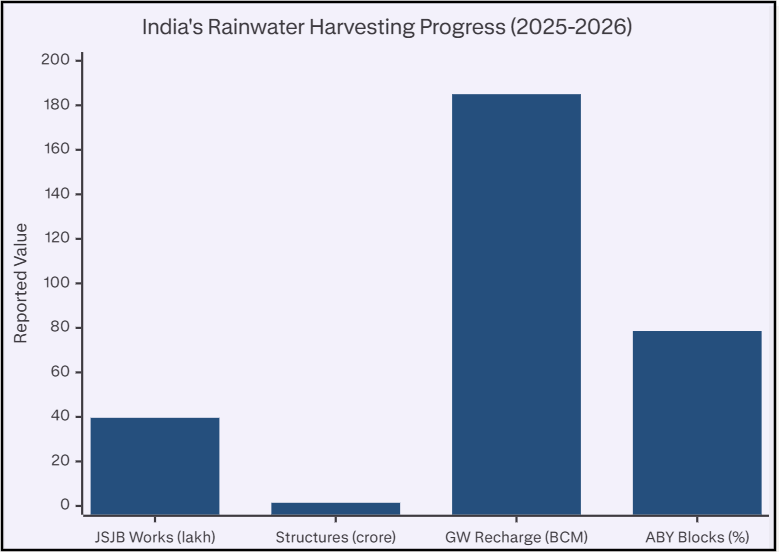
Source: PIB Government of India press releases, 2025–2026.
As a matter of fact, cities too, are shifting slowly but visibly from pure drainage thinking toward genuine water-body stewardship. AMRUT 2.0’s Water Body Rejuvenation component is restoring nearly 1.21 lakh acres of urban lakes, ponds, and wells; its Shallow Aquifer Management arm has mapped 870 sites and prepared 539 project plans across 75 cities. Chennai’s partial groundwater recovery after the 2000s crisis is widely credited to its early, strictly enforced rooftop mandate. As Dr APJ Abdul Kalam once told the nation: “we need to build check dams, develop watersheds, desilt ponds and rivers, clear the inlets and outlets to the ponds and water bodies and recharge the wells.” That advice is decades old, yet it still reads like a precise blueprint for exactly what these successful pockets are doing now.
The Policy Scorecard: Grading the States
Rather than take official pronouncements at face value, here is a comparative scorecard built from documented legal mandates, incentive structures, and observed compliance:
| State | Rule in Place? | Incentive Offered | Body in Charge | Compliance Grade |
|---|---|---|---|---|
| Tamil Nadu | Yes | Land tax rebate | Municipal Corporations | A |
| Rajasthan | Yes | Urban incentives | State Groundwater Board | B+ |
| Delhi | Yes (court-backed) | Land tax rebate | Delhi Jal Board, DDA | B |
| Maharashtra | Partial | Farm subsidies | Urban Local Bodies | C+ |
| Karnataka | Not required | None | GBA | D |
Source: State building bye-laws and municipal notices, compiled from public legal review.
Honestly, the pattern here is not subtle at all. Clearly, states pairing firm rules with rewards beat those relying on goodwill. Notably, Karnataka’s not-required status gives the weakest result on this list. Frankly, that should embarrass a state home to a major tech hub. Ultimately, Rainwater Harvesting in India clearly works best with teeth attached.
Where the Gaps Are: Why Checks Still Fail
Here, honestly, I must sound a bit less cheerful. Most rooftop mandates rely on approved building plans rather than genuine post-construction audits; few cities systematically inspect whether a sanctioned tank was actually built, let alone whether it still functions. Reviewers of state bye-laws repeatedly note that building permissions are rarely withheld and penalties, though written into law, are almost never collected. A rule nobody enforces is really just a well-worded suggestion. Rural implementation faces its own particular bottleneck around funding, capacity, and follow-through. One government circular flagged that of 29.16 lakh sanctioned MGNREGA water-related works, only 10.80 lakh were completed or even ongoing – leaving roughly 18 lakh works stuck on paper, waiting for panchayats with the capacity to execute them.
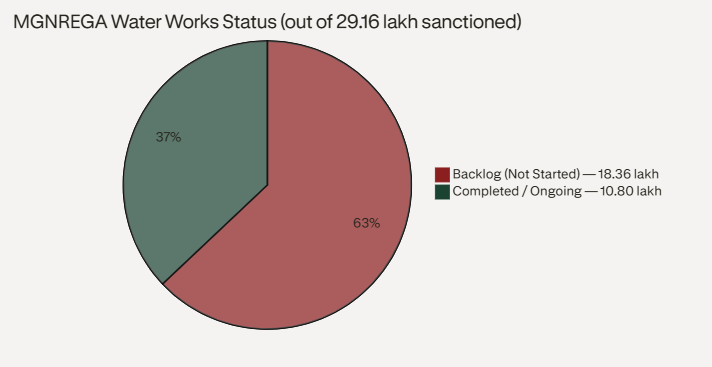
Source: Ministry of Rural Development / MGNREGA circular data.
Urban flooding continues to recur in Chennai, Bengaluru, and Guwahati because stormwater is still largely treated as a nuisance to be drained away through “grey” infrastructure, not a resource to be slowed, stored, and infiltrated. Fragmented responsibilities between drainage departments, urban planning authorities, and Jal Shakti agencies mean nobody truly owns the outcome. Until India measures success by working structures rather than sanctioned budgets, this gap between policy and pipeline will keep widening.
SWOT: India’s Rainwater Harvesting Governance
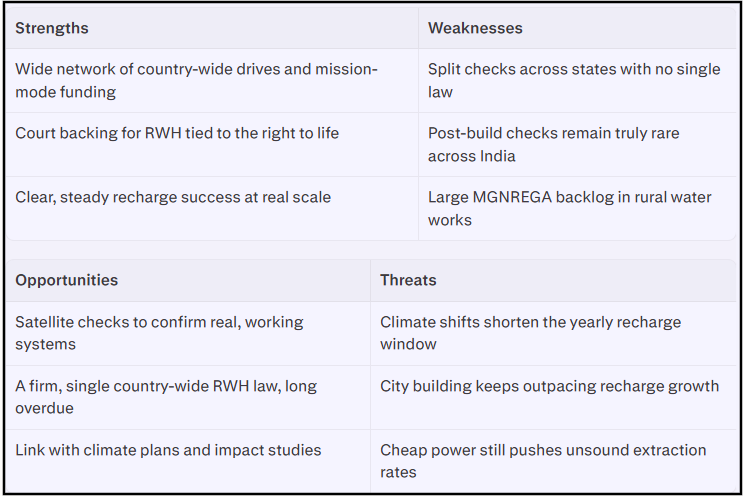
Myth Versus Truth on Rainwater Harvesting in India
Myth: India simply doesn’t get enough rain to fix this crisis.
Truth: India gets roughly 3,880 BCM of rainfall most years. That is more than enough, in total, to meet demand. The real crisis is one of capture, not low supply.
Myth: Rooftop rainwater harvesting is a fancy, upper-middle-class hobby only.
Truth: Pilot studies found real water quality gains within single monsoon cycles. This is a health result, not a lifestyle add-on.
Myth: Building codes have already fixed this whole problem nationally.
Truth: Neither the National Water Policy nor most bye-laws create binding duty. Rules exist; real teeth mostly do not exist yet.
Flood and Climate Resilience: From Drains to Sponges
Here’s a thought worth a pause. Could the very rain that floods Guwahati also refill its drying wells elsewhere in the state? Urban hydrology research says yes, provided we design cities as sponges rather than funnels. Case studies from Chennai, Bengaluru, and Guwahati confirm that large-scale rooftop and surface-runoff harvesting measurably lowers flood peaks while boosting recharge. Chennai’s M.S. Swaminathan Park absorbs over 90 percent of on-site runoff and stores roughly 30 million litres of rainwater, easing pressure on nearby drains and strengthening climate resilience for the surrounding neighbourhood.
Climate change sharpens this urgency across flood-prone states like Assam and Kerala, where rainfall intensity keeps rising even as dry spells lengthen elsewhere – both extremes punishing weak infrastructure equally. AMRUT 2.0 now permits cities to divert stormwater drains into clean water bodies, blending detention with recharge in one motion. Prime Minister Narendra Modi captured this dual purpose neatly when he said: “the better India manages rainwater, the lesser the country’s dependence on groundwater.” That single sentence quietly links water scarcity and urban flooding as two faces of one coin, not separate problems requiring separate ministries.
International Lessons for Rainwater Harvesting in India
No nation has cracked this puzzle fully, admittedly, even wealthy ones. Still, a few offer genuinely useful lessons worth a close look. Singapore treats caught rainwater as one of four national taps. Its ABC Waters code legally forces on-site runoff checks everywhere. Australia’s Water Sensitive Urban Design links planning law to whole water cycles. Real case studies there show rain tanks meeting solid home demand.
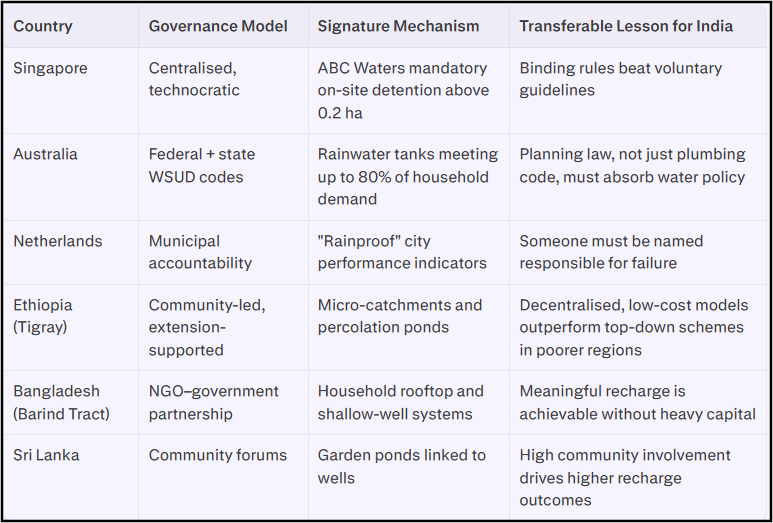
Source: PUB Singapore, WSUD Australia policy documents, Utrecht University research portal (illustrative comparison, not an official index).
The Netherlands teaches a slightly different lesson about strict duty. Dutch towns set clear, public goals for flood-service levels. They also name exactly which body answers for any failures. None of these nations match India’s scale or setup, clearly. What India can truly borrow, though, is one shared idea. Firm, measured, results-based rules simply beat soft, easy nudging everywhere. The pattern across the Global South cases is unambiguous: decentralised, community-owned systems with light-touch institutional support consistently outperform centrally imposed, unenforced mandates. India, oddly, has been trying to import Singapore’s centralism without importing Singapore’s enforcement discipline – the worst of both worlds.
Sustainable Policy Options for Rainwater Harvesting in India
So, what should government prioritise next, in real terms? First, watershed restoration and catchment protection deserve far greater MGNREGA and Jal Shakti funding – check dams and contour trenches work quietly yet effectively. Second, managed aquifer recharge should scale using shallow aquifer maps already generated under AMRUT 2.0’s pilot programme. Third, cities need sponge-city and Water Sensitive Urban Design principles written directly into master plans and local building codes, boosting climate resilience at scale. Fourth, lakes, wetlands, and floodplains need firm legal protection from encroachment, not just periodic desilting drives after headlines fade.
Fifth, green infrastructure – bioswales, detention parks, permeable pavements – should become standard urban furniture, not occasional showpieces. Sixth, GIS and satellite monitoring can finally shift focus from counting structures to verifying which ones actually function. Seventh, administrative coordination between Jal Shakti, Housing Affairs, and disaster-management agencies needs real clarity, not overlapping mandates. Eighth, occupancy certificates should genuinely depend on functioning rainwater harvesting systems, turning a paper rule into an enforceable one. As Waterman of India, Dr Rajendra Singh, has long argued: “communitisation, not corporatisation of water.” These reforms work best when panchayats and residents co-own them, not merely comply with them on paper.
| Problem | Policy Response | Why It Matters |
|---|---|---|
| Urban flooding | On-site storage, sponge-city design | Cuts peak runoff at source |
| Groundwater depletion | Recharge shafts, small pits | Restores water layers over time |
| Enforcement gaps | Checks, satellite tools, permit links | Turns paper rules into real action |
| Fragmented governance | Single, named duty chain | Cuts institutional drift and delay |
Economic and Social Payoff of Getting This Right
Beyond hydrology, this is also a money story. Floods cost cities crores in damaged roads and homes; tankered water costs households real money each summer. Strong groundwater recharge cuts both bills at once, while better stormwater management lowers repair costs for drains and roads. Farmers gain too, since recharged aquifers support irrigation during dry spells, and public health improves as flooded areas breed fewer disease outbreaks.
Crucially, this is not a cost centre; it is an investment. Every rupee spent on check dams saves many more in flood relief. Healthy aquifers reduce the need for costly desalination or long-distance water transfers, and cities practising sound stormwater management see better property values nearby. Framing rainwater harvesting this way helps secure long-term budgets and builds the political will needed for real enforcement.
A Phased Policy Roadmap for Rainwater Harvesting in India
Short term (0–12 months): Mandate post-monsoon structural audits for all existing RWH installations; make occupancy certificates conditional on verified, functioning systems; pilot satellite-based rooftop compliance checks in five major cities.
Medium term (2–5 years): Draft and pass a model national RWH law with binding force, superseding the current patchwork of state bye-laws; link AMRUT 2.0 and Smart Cities funding explicitly to measured groundwater and flood-resilience outcomes, not just structures built; integrate RWH into all Environmental Impact Assessments for new construction.
Long term (5–10 years): Embed rainwater harvesting into India’s climate commitments to unlock climate finance; institutionalise decentralised, community-owned recharge models as the default rural implementation unit rather than the exception; achieve nationwide GIS-verified compliance reporting integrated with property tax systems.
Water as the Quiet Infrastructure of National Ambition
Let me end where I began, with the family in the boat and the farmer at his borewell — because they are not two separate stories about two separate Indias. They are the same story, told from opposite ends of the same broken pipe. Rainwater Harvesting in India cannot stay a monsoon-season afterthought forever. It is the quiet base beneath every larger country-wide goal. That includes food safety, city livability, and real climate strength. The rain, still, keeps coming on schedule every single year. Meanwhile, the only open question is whether our systems finally learn to catch it.
None of this needs new science or unproven tools, in truth. The pilots and proof now exist in real number. What we need now is simple, steady system discipline instead. The rain, magnificently, keeps arriving on schedule. The only genuinely open question is whether our institutions will finally learn to catch it. So, here is my question for you, dear reader, plainly. Which pond or well near your home needs care this monsoon?
On behalf of ExpressIndia.info, we believe India’s next monsoon can mean gain, not ruin, if sound policy finally matches ambition with accountability.
#RainwaterHarvestingIndia #JalShaktiAbhiyan #GroundwaterRecharge #ClimateResilience #SustainableUrbanDevelopment