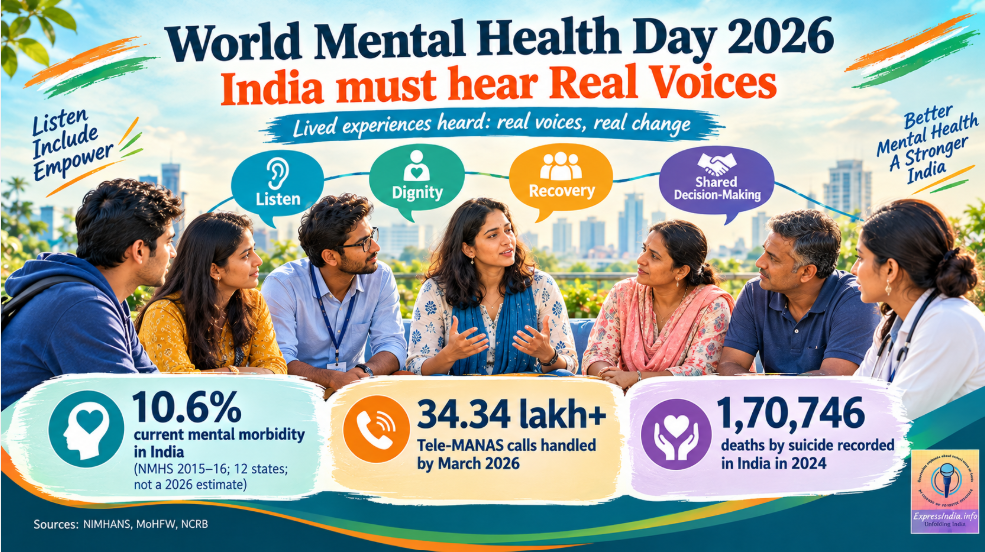
Mental Health Day arrives every 10 October, and I still wince at its ritual choreography. Posters bloom, hashtags trend, and somebody inevitably lights a ceremonial lamp. Honestly, I once believed that sheer visibility could dissolve decades of stubborn silence. Experience, however, taught me a harsher lesson about performative empathy. Institutions adore a brave story, yet they rarely hand over the pen. This year, the official theme refuses to let them off lightly. World Mental Health Day 2026 demands “Lived experiences heard: real voices, real change.”
What distinguishes those who hear from those who use them? Notably, World Health Organisation (WHO) observes that people are often asked to share stories but excluded from decisions (Hindu Business Line, 4 October 2026). Stay with me, because the answer changes how we judge every campaign. Along the way, I will test numbers, helplines, Tele-MANAS and the Mental Healthcare Act 2017. Some findings will comfort you, while others will irritate you productively. Eventually, we will reach a blueprint you can start using right away.
Mental Health Day Is a Test of Power
Let me define the ladder first, because vocabulary often hides power. Awareness tells the public that distress exists. Storytelling lets someone describe it, frequently at personal cost. Consultation asks for opinions, though authorities may ignore every answer. Co-design shares authority over goals, budgets and delivery. Accountability, finally, publishes results and gives people a route to demand repair.
WHO’s regional consultations insist that lived experience deserves value and compensation equal to other professional expertise. Furthermore, its framework helps governments co-create policies, programmes and services with affected people. Participation must remain continuous, safe and inclusive, never a tick-box ritual. I find that standard wonderfully inconvenient for lived experience mental health advocacy. A panel appearance, therefore, proves nothing unless someone can alter a budget line. Who actually signs the order?
A Mental Health Day Reality Check on the Numbers
Now brace yourself for an awkward admission about our data. India’s flagship estimate still comes from the National Mental Health Survey, with fieldwork in 2015–16 covering 34,802 adults in 12 states (NIMHANS, 2016). It found current mental morbidity of 10.6% and lifetime morbidity of 13.7% (WHO India profile). Those figures describe diagnosed disorders, including substance use, not everyday stress. Metro cities showed 13.5%, rural areas 6.9% and non-metro urban areas 4.3% (PIB, 2024). Consequently, nobody should present this survey as a 2026 prevalence estimate.
The survey also excluded people in shelters and similar institutions. Treatment gaps run between 70% and 92%, depending on the disorder. Likewise, Parliament heard in March 2026 that India has 4,309 registered clinical psychologists, while psychiatrist availability in survey states ranged from 0.05 to 1.2 per lakh. Officially, national workforce numbers are not centrally maintained. Surveys on stress, such as Ipsos’s 2024 finding that about one in two urban Indians felt stress affecting daily life, measure feelings rather than diagnoses. Loneliness, burnout and grief matter too, yet they differ from disorders.
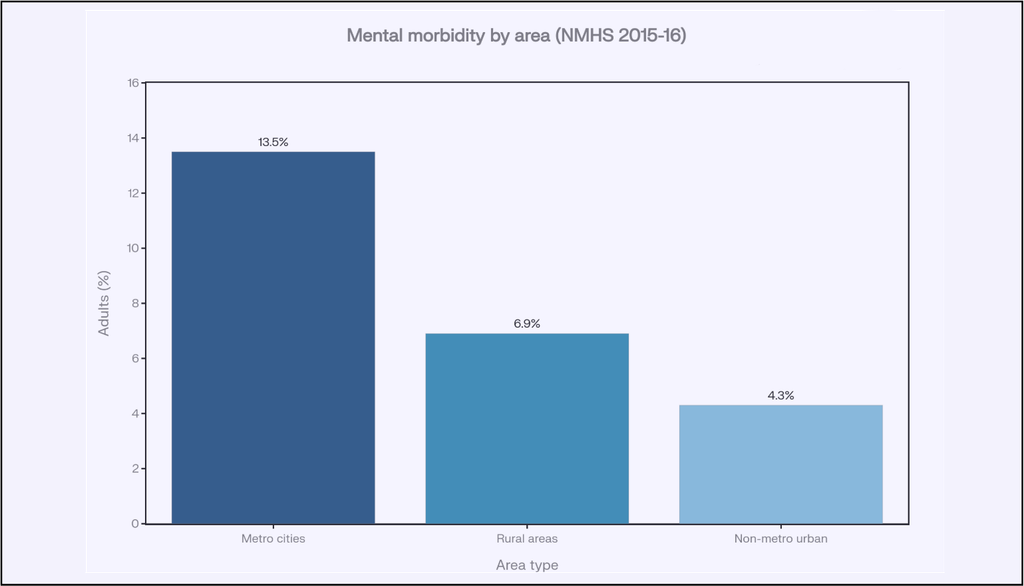
Source: NIMHANS, National Mental Health Survey 2015–16, as summarised by PIB, 8 October 2024. Data are over a decade old and cover 12 states.
What Lived Experience Mental Health Work Teaches Us
Numbers cannot tell me what helps, so I turned to practice. In public facilities, peer-support volunteers helped service users shape recovery plans and ran weekly Maitri groups (Peer support for mental illness in India, 2018). Bapu Trust’s community model uses “experts by experience” and a zero-coercion, rights-based approach (Bapu Trust annual report, 2023–24). Mariwala Health Initiative‘s queer peer-support work, meanwhile, treats lived experience as knowledge while training participants in ethics and boundaries. Mental Health Support Foundation links lived experience with livelihood inclusion. Each programme reports its own results, so independent evaluation still matters.
Dr Kavita Arora, an adolescent psychiatrist, told PTI that people who have used services, alongside caregivers, “can help identify what works, where the gaps are”. Caregivers in Chennai described stigma, exclusion and loneliness, although some also found meaning. Suicide-loss survivors in a 2025 study valued shared narratives, gathered with careful consent. I refuse to polish anyone’s pain into inspiration. One person never represents a whole diagnosis. Mental health stigma in India thrives when we forget that.
Students: Pressure Is Not Personal Failure
Here comes the uncomfortable bit, and I promise no sensationalism. NCERT’s 2022 survey of 379,013 school students found anxiety about studies, examinations and results rising at the secondary stage. Those were self-reported perceptions, not diagnoses. A Kota study found high academic stress in 44.45% of coaching students against 3.33% of non-coaching peers (Industrial Psychiatry Journal, 2023). Nevertheless, 180 students cannot represent a nation. Parental expectation, bullying, online comparison and job uncertainty clearly mingle.
NCRB recorded 14,488 student deaths by suicide in 2024, or 8.5% of the total (NCRB, ADSI 2024, via The Wire). No single cause explains those deaths. Meanwhile, policy has multiplied: the 2024 coaching guidelines and the Supreme Court’s January 2026 directions emphasise counselling, confidentiality and reporting. Announcements, however, differ from implementation. Students deserve qualified counsellors, referral pathways, anti-bullying channels, supervised peer support and independent complaint routes. Who audits any of it?
Workplaces: Silence Is Not Safety
Next, consider the office where everyone says, “I’m fine.” An Indian interview study of 15 people found stigma, fear of job loss and weak confidentiality blocked disclosure (BMC Public Health, 2024). Keralam’s survey of 1,548 young workers found 77.8% worked eight to twelve hours daily (Kerala State Youth Commission, 2025). Admittedly, that survey covers one state. Gig workers face income instability and deactivation threats (NHRC consultation, 2024). A meditation app cannot repair that.
Employee assistance programmes help only when workloads, harassment and management behave decently. WHO and ILO guidance targets psychosocial risks such as excessive workloads and poor support. Employers should therefore train managers, protect confidentiality, allow accommodations and report aggregate data without identifying anyone. Contract and gig workers need coverage too. I would also separate counselling records from appraisal files. Silence is not psychological safety; it is fear wearing a tie.
Families, Stigma and the Loneliness Gap
Families, bless them, remain India’s largest unofficial mental-health service. Sometimes they also silence the person they love. Deepika Padukone observed that parents avoid counsellors out of worry about what society may think, and that some families will not allow help. Mental health stigma in India travels through marriage worries, job fears, moral judgement and “be strong” lectures. Older adults with mental disorders face an estimated 84% treatment gap (NMHS analysis, 2025).
Men often hear that feelings signal weakness. Women facing violence need safety and legal support alongside counselling. LGBTQIA+ people need affirming, peer-led spaces, while migrants, homeless people and people with psychosocial disabilities need services built around their lives. Dr Pratima Murthy, NIMHANS director, links stigma to the assumption that we must control our mental state “100% of the time”. Nevertheless, family involvement must never erase consent. Mental health stigma in India shrinks when care respects the person first.
A Helpline Must Lead Somewhere
Tele-MANAS deserves credit and scrutiny. Launched on 10 October 2022, it had 53 cells across 36 states and union territories by 3 March 2026. The service runs in 20 languages and has handled more than 34.34 lakh calls. Callers can dial 14416 or 1800-891-4416. However, calls are not unique users, completed treatment or recovery. As the digital arm of the District Mental Health Programme, Tele-MANAS lives or dies by referrals.
| Tele-MANAS (status at 3 March 2026) | Figure |
|---|---|
| Launch date | 10 October 2022 |
| Cells | 53 |
| States and UTs covered | 36 |
| Languages | 20 |
| Calls handled since launch | 34.34 lakh+ |
| Helplines | 14416; 1800-891-4416 |
Source: Ministry of Health and Family Welfare, Lok Sabha reply, 20 March 2026.
Tele-MANAS widens first contact, particularly across distance and stigma. Yet, it cannot supply continuing therapy, medication follow-up, emergency care, rehabilitation or housing. Each district should field a psychiatrist, clinical psychologist, social worker and nurse, while 25 Centres of Excellence are sanctioned for training. Budget 2026–27 also proposes NIMHANS 2.0 in northern India (PMC, 2026). Will districts actually fill those posts?
Rights on Paper, Participation in Practice
The Mental Healthcare Act 2017 promises remarkable rights. It protects dignity, community living, non-discrimination, confidentiality, access to records and free legal aid. Independent adults can give informed consent, write advance directives and name nominated representatives. The law took effect on 29 May 2018. Grievances travel to the establishment and then to Mental Health Review Boards.
However, practice disappoints. A September 2026 tracker found only 16 states had formed Review Boards and only eight had issued state regulations. Merely seven of 36 states and union territories had constituted state authority funds. A rights-based law means little unless people can understand, exercise and enforce those rights. Do people receiving care sit on review panels, and do their complaints change anything? Under the Mental Healthcare Act 2017, those answers deserve publication.
Suicide Prevention in India: Responsible Framing
Now, it’s time for some hard facts, and I will tread gently through them. NCRB recorded 1,70,746 deaths by suicide in 2024, a rate of 12.2 per lakh, slightly below 2023’s 1,71,418 (NCRB, ADSI 2024, via The News Minute). Inadvertently, police-recorded data can miss or misclassify deaths. Statistically, men accounted for 1,25,449 deaths, women for 45,245 and transgender people for 52. Further, daily-wage earners numbered 52,910, and people aged 18–45 formed 65.6% of cases. Suicide prevention in India begins with honest data, yet statistics describe vulnerability, never single causes.
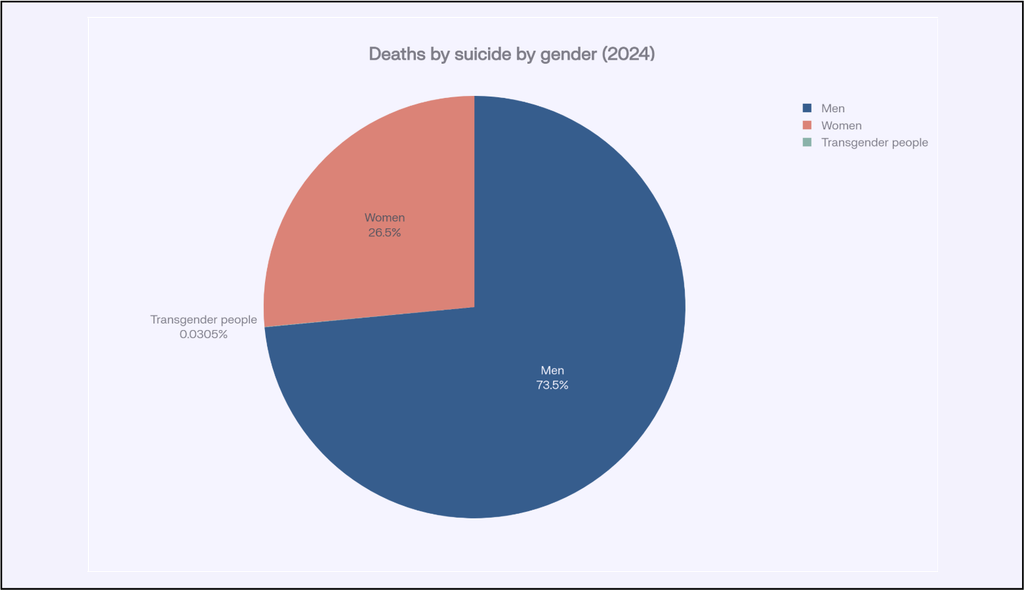
Source: NCRB, Accidental Deaths and Suicides in India 2024, via The Week, 8 June 2026. Police-recorded data.
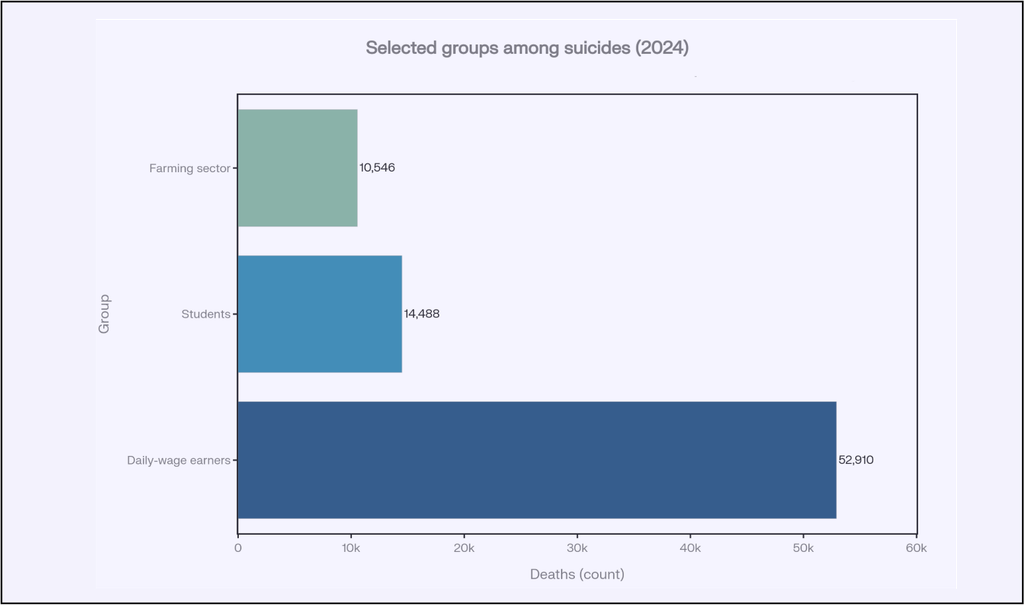
Source: NCRB, ADSI 2024, via The Wire, 10 May 2026 and 30 August 2026 reports. Groups overlap and do not sum to the total.
Suicide emerges from interacting social, economic, psychological, relational and institutional pressures. The National Suicide Prevention Strategy, launched on 21 November 2022, targets a 10% cut in suicide mortality by 2030 against 2020. It sets milestones for surveillance by 2025, district services by 2027 and school curricula by 2030. Journalists should skip methods and locations, avoid single-cause stories, write “died by suicide” and include help information. Suicide prevention in India also needs recovery stories, which protect.
What a Real Mental Health Day Would Change
So what would genuine change look like? Governments should pay lived-experience representatives, publish district dashboards for vacancies, medicines and waiting times, and activate Review Boards. Schools must employ qualified, confidential counsellors, while employers assess psychosocial risks. Clinicians should explain options and honour consent. Tele-MANAS must track completed referrals, not merely calls. Primary-care integration, local languages and workforce expansion complete the list, and NGOs can keep peer and caregiver groups thriving.
Individually, I can listen without diagnosing, ask what help someone wants and share verified helplines. If someone may be in immediate danger or unable to stay safe, contact Tele-MANAS at 14416 or 1800-891-4416, seek urgent help at the nearest emergency department, or contact local emergency services. This Mental Health Day, demand a seat, a salary and a signature for people with lived experience. Share this article, question your institution and ask who holds the pen.
ExpressIndia.info stands firmly with every voice that India has delayed hearing.
#MentalHealthDay #WorldMentalHealthDay2026 #RealVoicesRealChange #TeleMANAS #SuicidePreventionIndia