
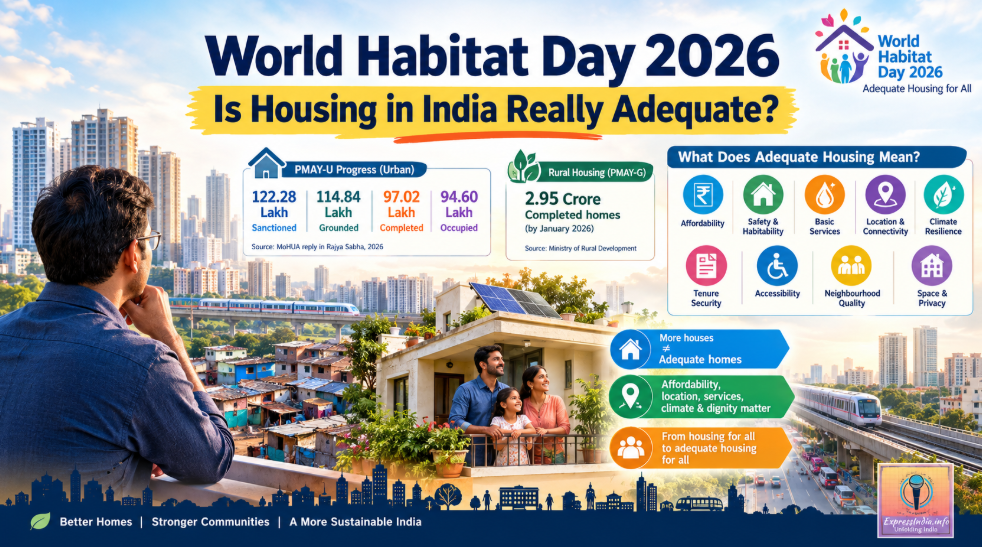
Housing in India has become a paradox I cannot stop thinking about. On 5 October 2026, the world marked World Habitat Day under the theme “Adequate Housing for All“. Meanwhile, Parliament learned that 94.60 lakh of 97.02 lakh completed urban homes stand occupied (MoHUA, January 2026). Besides, rural India added roughly 2.95 crore completed PMAY-G homes by that same timeframe as per Ministry of Rural Development. So why does the celebration still feel incomplete to me? Frankly, a house can exist without ever becoming a home. Stay with me, since a tin-roofed room in Delhi holds the answer. Such rooms can bake at 35–40°C indoors, according to Mongabay India’s 2025 reporting.
Over the next minutes, I will walk you through fifteen uncomfortable questions. First, we will celebrate genuine achievements without any cynical sneering. Then, we will examine prices, distances, heatwaves, and the missing paperwork. Along the way, Chhattisgarh, Tamil Nadu, and Odisha will surprise you pleasantly. Meanwhile, a few statistics may make your chai go cold. Ready to test whether adequate housing is a reality or merely rhetoric?
Housing in India: A House Is Not Always a Home
First, consider the grand total, which genuinely impresses me every single time. Since 2015, PMAY-U has sanctioned 122.28 lakh urban homes and completed 97.02 lakh. Meanwhile, rural India added roughly 2.95 crore completed PMAY-G homes by January 2026. Together, these schemes suggest nearly 3.9 crore homes since 2015–16, though definitions differ. However, a Parliamentary committee found about 46 percent of completed partnership and in-situ homes empty. Its verdict was blunt: unoccupancy defeats the Mission’s purpose, as ThePrint reported in December 2024.
Admittedly, the 46 percent figure covers only one subset of the programme. By contrast, the 94.60 lakh occupied figure spans the entire urban portfolio. Therefore, I refuse to compare the two percentages carelessly in one breath. Still, both numbers teach me the same lesson about completion versus dwelling. Notably, MoHUA itself admitted that incomplete services and distance from livelihoods keep some allottees away. Next, I will show how adequate housing, not arithmetic, should define success.
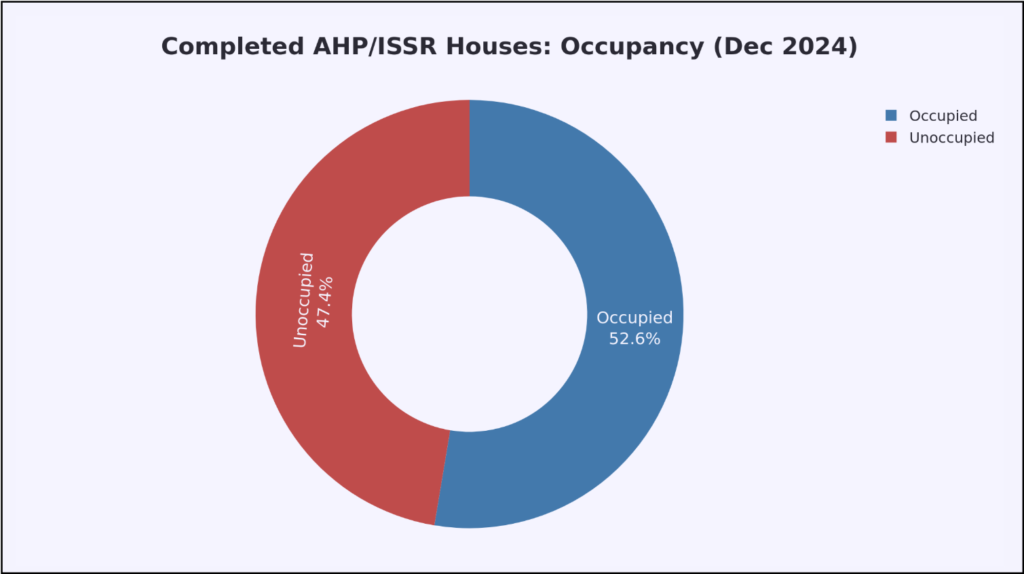
Source: Parliamentary Standing Committee on Housing and Urban Affairs, as reported by ThePrint (10 December 2024). 4.59 lakh of 9.69 lakh completed units were unoccupied. The occupied segment (5.10 lakh) is my subtraction.
What Adequate Housing Really Means
Fortunately, the United Nations gives us a sturdy yardstick for judging any home. UN-Habitat and Office of the United Nations High Commissioner for Human Rights (OHCHR) list tenure security, affordability, habitability, accessibility, services, location, and cultural fit. Moreover, UN-Habitat’s 2024 framework adds sustainability as an eighth dimension worth measuring. In India, I would stretch that dimension to cover heat, floods, and cyclones. As the joint submission puts it, being adequately housed is not merely about physical shelter. Consequently, a roof alone never qualifies, however many ribbons officials cut at inaugurations.
Indian policy already nods toward this wider idea, at least on paper. For instance, PMAY-U 2.0 encourages water, sewerage, ramps, Anganwadis, rainwater harvesting, and solar systems. Likewise, the National Transit Oriented Development (TOD) Policy favours compact, mixed-use neighbourhoods near mass transit. Yet, dashboards still celebrate sanctioned, grounded, and completed units far more loudly. Thus, adequate housing remains a broader promise than any unit count can capture. Keep that promise in mind, because the next section tests our patience.
The Positive Story of Housing in India
Housing for All deserves a fair hearing here, and I will give it generously. Indeed, PMAY-G sanctioned 3.86 crore rural homes and targets 4.95 crore by March 2029. Furthermore, an assessment of 1,382 rural beneficiaries found better safety, health perceptions, and life quality. Meanwhile, PMAY-U 2.0 began on 1 September 2024 and targets one crore families. Its four verticals cover construction, partnership projects, rental housing, and interest subsidy. Naturally, awards followed, with Andhra Pradesh topping PMAY-U 2.0 and Bihar winning two honours.
Women also feature prominently, which pleases me as a reader of dry statistics. Under PMAY-U 2.0, over 6.31 lakh homes went solely to women beneficiaries. However, a title in a woman’s name does not guarantee real control. Technology helps too, since six Light House Projects tested alternative construction systems nationwide. Likewise, Tamil Nadu’s World Bank-backed programme delivered roughly 15,000 green-certified affordable housing units. Similarly, Chhattisgarh won recognition for land reservation that freed space for 25,413 homes. Chief Minister Vishnu Deo Sai calls a pucca house “a foundation for a better future.”
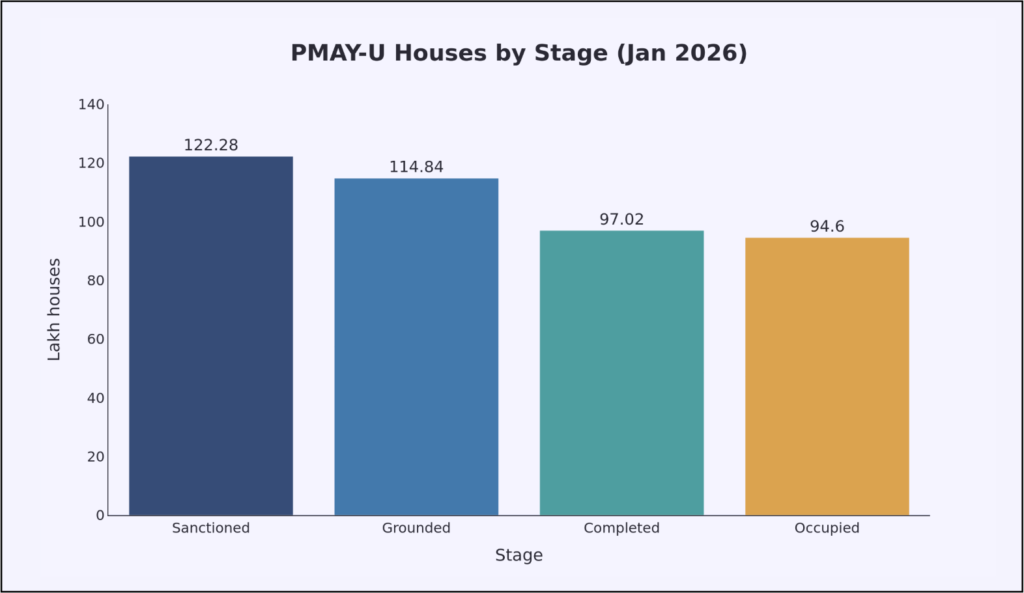
Source: Ministry of Housing and Urban Affairs, reply in Rajya Sabha (status as of 22 January 2026).
Housing in India’s Affordability Squeeze
Prices, unfortunately, climb faster than most salaries, and the data confirms it. National Housing Bank (NHB)’s index rose 7.5 percent in Q4 FY2024–25, with all eight major metros gaining. Bengaluru led at 13.1 percent, while Kolkata and Chennai followed with roughly nine percent each. Meanwhile, a Mumbai EMI swallowed about 48 percent of income in early 2025. Ahmedabad, by contrast, needed only 18 percent, which looks almost heavenly. Of course, averages flatter reality, since stressed households never qualify for loans.
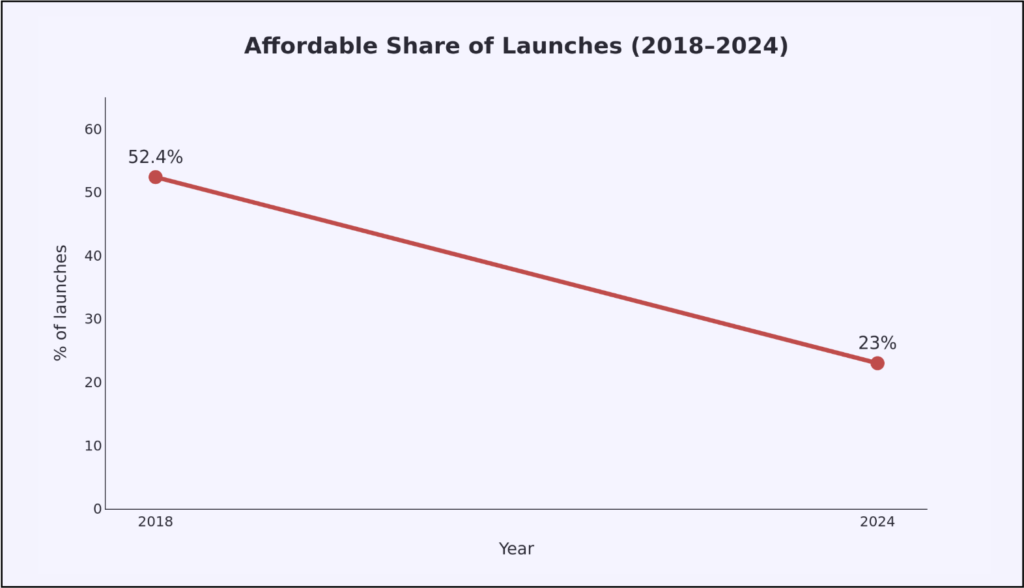
Households earning below ₹10 lakh per annum bought homes costing 17.6 times their annual income. Consequently, affordable launches shrank from 52.4 percent in 2018 to 23 percent in 2024. Indeed, homes under ₹40 lakh formed merely 12 percent of Q2 2025 launches. Therefore, affordable housing often stays affordable only on brochures, never in bank statements. Informal workers face a harsher wall, because irregular income defeats formal credit scoring. Still, no national series links incomes to rent, EMI, and transport costs.
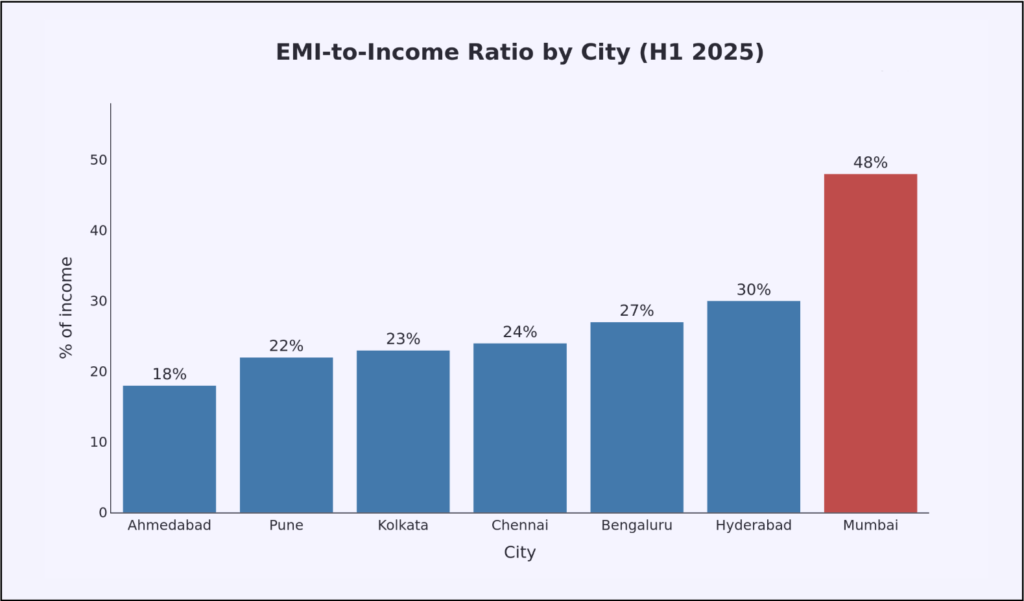
Source: Knight Frank India Affordability Index, H1 2025 (via Hindustan Times and PTI). Delhi-NCR is left out because its price and affordability series differ in scope.
Source: CII and Knight Frank India, “Affordable Housing in India” (2024), top eight cities.
| City | Annual price change, Jan–Mar 2025 |
|---|---|
| Bengaluru | 13.1% |
| Kolkata | 9.6% |
| Chennai | 9.0% |
| Pune | 6.8% |
| Ahmedabad | 6.1% |
| Mumbai | 5.9% |
| Hyderabad | 4.8% |
| Delhi | 2.9% |
Source: National Housing Bank, RESIDEX press release for Q4 FY2024–25.
The Location Paradox: Cheap but Distant
Picture me handing you keys to a spotless flat forty kilometres from work. Would you rejoice, or would you quietly calculate bus fares and lost evenings? Indeed, MoHUA told Parliament that some allottees refused to move because livelihoods and networks mattered. In Delhi’s Savda Ghevra resettlement colony, water, sewerage, schools, and transport lagged behind relocation. Similarly, a Punjab evaluation flagged peripheral sites and weak transport links, though findings stay local. Such evidence reminds me that cheap housing in India often hides expensive daily journeys.
True affordability, I argue, equals rent or EMI plus transport, utilities, and lost time. Therefore, a cheap peripheral flat can cost more than a cramped central room. MoHUA’s TOD policy proposes mixed-use homes within roughly 500–800 metres of mass transit. Moreover, Delhi’s TOD policy could add up to a million affordable homes, MoHUA says. Nevertheless, India publishes no housing-plus-transport affordability index to test such promises. Without it, planners rarely see the hidden bill families pay each morning.
Rental Housing: The Forgotten Half of Housing for All
Ownership-first policy quietly excludes mobile workers who need flexible, short-stay homes. Migrants, students, working women, and informal workers rarely plan thirty-year mortgages. Fortunately, PMAY-U 2.0 finally promoted Affordable Rental Housing into a full vertical. It covers migrants, industrial workers, working women, and the homeless, using conversions or dormitories. Therefore, governments can retain land and adjust tenant eligibility as jobs change. That flexibility suits fast-changing cities far better than rigid ownership schemes.
Tamil Nadu offers a glimpse of ambition worth watching closely. Its 2025–26 budget committed roughly US$30 million to 22 housing projects. Furthermore, it aspires to establish affordable-rental partnerships in every district. Its Shelter Fund also backs industrial-worker and student housing with green certification. Nevertheless, I found no frequently updated national count of informal rooms or rents. Without that baseline, rental housing policy flies half-blind through monsoon clouds. So, what happens to those who cannot rent or buy?
Slums, Informality and Honest Upgrading
Informal settlements persist because they offer what distant colonies cannot. Entry costs stay low, jobs stay close, and social networks stay intact. However, MoHUA’s dialogue cited older data showing 43 percent of slum households lacked in-home water. Another 44 percent of those households lacked an internal toilet, the same document noted. Notably, India also lacks a recent, universally accepted national slum count. Consequently, any confident slum statistic deserves my suspicion and yours.
In-situ upgrading sounds wiser than relocation, yet execution decides everything. Reportedly, nearly 70 percent of completed in-situ rehabilitation houses stood unoccupied in December 2024. Moreover, only 1.84 lakh homes came through that vertical, against 15.65 lakh through partnerships. Savda Ghevra shows the other failure, where relocation traded one deprivation for another. Hence, slum removal and inadequacy removal are not twins, whatever the press releases say. I back in-situ upgrading by default, reserving relocation for demonstrably unsafe sites.
Climate-Resilient Housing Under 45°C
Climate risk lands hardest on the cheapest roofs, and 2024 proved it. Thirty-seven Indian cities crossed 45°C that summer, according to Mongabay India’s reporting. Inside tin-roofed homes, average indoor temperatures can reach 35–40°C, experts explain. Furthermore, a Delhi study found that each extra degree cut informal workers’ earnings by 14 percent. Thus, heat becomes simultaneously a housing problem, a health problem, and an income problem. Waterlogging compounds the misery, since nine of fifteen Ahmedabad localities showed it in one study.
Fortunately, modest fixes exist, and some cost surprisingly little money. Cool roofs in Ahmedabad cut peak indoor temperatures by roughly 1–1.5°C. Odisha’s owner-driven programme built over 16,000 disaster-resilient houses with mason training and insurance. Similarly, PMAY-U 2.0 requires partnership projects to include rainwater harvesting, solar systems, and plantations. Still, a code-compliant building can remain thermally cruel and floodplain-bound. Hence, climate-resilient housing must mean site-level risk screening, not merely structural certificates.
| Programme or place | What it did | Reported result |
|---|---|---|
| Light House Projects (Chennai, Rajkot, Indore, Lucknow, Ranchi, Agartala) | Tested six alternative construction technologies | More than 1,000 homes each; five projects inaugurated by July 2025 |
| Tamil Nadu Housing and Habitat Development Project | Applied resilient-design frameworks and green certification | About 15,000 affordable units delivered |
| Odisha owner-driven reconstruction | Added mason training and multi-hazard insurance | More than 16,000 disaster-resilient houses |
| Ahmedabad cool-roof study | Raised roof reflectivity in informal housing | Peak indoor temperature lower by about 1–1.5°C |
Sources: PIB and MoHUA (2025); World Bank (2026); IIHS; Sustainable Social Development journal (2024).
Housing in India Without Habitat
A house without water is a sculpture, not a home. Housing in India often counts a unit complete before trunk infrastructure arrives. For example, a CAG audit in Karnataka found homes empty without water, sewerage, or electricity. Rural India fares no better, since 56 percent of 961 Bihar PMAY-G homes lacked toilets. Meanwhile, AMRUT reports 2.03 crore tap and 1.50 crore sewer connections over ten years. Yet, such totals cannot prove that every new colony received services on time.
Responsibility fragments, and that fragmentation hurts residents every single day. Housing agencies finish walls, while other departments promise pipes, clinics, and roads “someday”. Consequently, convergence becomes a comforting word that nobody owns or delivers. I would ask three questions of every colony before applauding it. Does water flow daily through taps, do clinics open every day, and can ambulances enter the premises? Only then does a completed unit deserve to be called a habitat.
The Middle-Class Housing Paradox
Sympathy rarely flows toward the middle class, yet its squeeze is real. Indeed, homes under ₹75 lakh slid from nearly 60 percent of top-seven-city sales in 2021 to 32 percent in 2025. Meanwhile, a small Mumbai-region flat rose from ₹17 lakh in 2019 to ₹26 lakh. Furthermore, 95 percent of surveyed buyers in that region relied on home loans. Therefore, one missed salary can unsettle an entire household’s carefully balanced budget. Imagine me explaining that arithmetic to a couple earning ₹10 lakh yearly.
That couple sits just above PMAY-U 2.0’s ₹9 lakh middle-income ceiling. Consequently, they face three bad options: rent centrally, buy far away, or live with parents. Each option quietly taxes education funds, health insurance, or emergency savings. Admittedly, no national series tracks these trade-offs, so the damage stays invisible. Thus, an affordable EMI may hide a fragile family balance sheet. Is affordable housing for the middle class becoming a myth in big cities?
| Annual household income | Home price as a multiple of annual income |
|---|---|
| Below ₹10 lakh | 17.6 times |
| ₹10–50 lakh | 5.6 times |
| Above ₹50 lakh | 4.1 times |
Source: Knight Frank India, Beyond Bricks: The Pulse of Home Buying (2025), survey of 1,629 recent homebuyers.
Quality Versus Quantity
Counting is easy, and perhaps that explains our addiction to it. Sanctioned, grounded, and completed units dominate dashboards, while lived outcomes hide in footnotes. However, PMAY-U’s own impact study covered only about 200 beneficiaries in four towns. Therefore, evidence on resident satisfaction remains thin, however glossy the brochures look. Notably, the January 2026 parliamentary reply did report occupancy, which I applaud. Next, we should make that habit the rule rather than the exception.
I propose a two-tier dashboard that keeps unit counts but adds adequacy outcomes. Specifically, it should track occupancy, affordability burden, service reliability, commute burden, and tenure security. Likewise, it should record climate exposure, livability, and resident satisfaction after one and then after five years. UN-Habitat’s 2024 framework already offers a ready template for such measurement. Naturally, India still needs more homes, so I would never discard construction counts. Quantity deserves respect, but only when quality walks beside it.
The Data Problem
Data on housing in India counts units far better than it measures how well people live. For instance, we lack a current census-quality picture of tenure, overcrowding, and housing materials. Similarly, official statistics rarely capture informal rentals, shared tenancies, or rising rents. Moreover, a water connection counts even when supply arrives intermittently. Finally, vacancy figures for different portfolios get conflated, which muddies every debate. Post-construction outcomes, like return migration to slums, rarely get published at all.
I would add four indicators to begin fixing this blind spot. First, publish housing-cost burden: rent or EMI, maintenance, and utilities as income shares. Second, add a housing-plus-transport burden that includes median commute time for workers. Third, score functional services like daily water, drainage, waste collection, and electricity reliability. Fourth, track occupancy at six months, one year, and five years. Climate exposure and tenure security deserve equal places on that dashboard.
What Should India Do Next?
Diagnosis without prescription bores me, so here is my agenda for Housing in India. Each step below rests on evidence discussed above, and not wishful thinking. Delhi’s TOD policy offers one live test of this agenda. Moreover, ordinary citizens can push each reform through ward meetings and RTI queries. Therefore, read the list as a citizen’s checklist, not merely a ministerial one. Let me begin with the ten moves that matter most.
- Adopt an Adequate Housing Dashboard alongside sanctioned and completed unit counts.
- Declare a project complete only when water, sewerage, drainage, and power work.
- Publish resident surveys at six months, one year, and five years.
- Reserve transit-adjacent public land and floor area for EWS, LIG, and rental homes.
- Scale affordable rental housing near factories, hospitals, campuses, and stations.
- Prefer in-situ upgrading, with tenure rights and services, over distant relocation.
- Require heat, flood, and cyclone risk screening before approving any project.
- Lease, rather than sell, scarce public land to keep homes affordable.
- Allow cash-flow-based lending and rent histories for informal workers.
- Fund maintenance through sinking funds before allotting multi-storey flats.
Notably, the Union Minister of State for Housing and Urban Affairs, Tokhan Sahu said “World Habitat Day stresses inclusive communities and sustainable urban development.” Such words matter only when budgets, land, and accountability follow them. Consequently, I would watch for measurable commitments rather than inspiring adjectives. Will states publish occupancy and service data within the next year? That single answer will reveal how serious “Housing for All” truly is. I will keep asking, and I hope you will too.
The India Housing Paradox
Here is my formulation: India can build a house faster than the habitat around it. Nearly 3.9 crore completed homes now exist, yet affordable housing launches keep shrinking. Prices rose in all eight major metros, while the affordable launch share fell over half. Meanwhile, some finished homes sit empty while families queue elsewhere for shelter. Heat, floods, and distance then convert shelter into a daily gamble. Thus, Housing for All faces scarcity of habitat, not scarcity of structures.
Dark humour helps me here, because spreadsheets never complain about leaking taps. A completed unit is an administrative achievement, whereas a connected home is a social outcome. Likewise, UN-Habitat insists that adequacy spans tenure, services, location, and sustainability, not shelter alone. Consequently, applause for delivery must travel together with scrutiny of outcomes. Do you now see why the paradox refuses to disappear? Only better measurement and better habitat can finally dissolve it.
Redefining Housing in India: Your Move
I believe that Housing in India must now guarantee adequate housing for not only every family, but every citizen. Equally, those homes must feel dignified, connected, climate-resilient, inclusive, and livable. As Minister Tokhan Sahu noted, environment and development are “complementary,” not rivals. Therefore, Housing for All must stop meaning just four walls and start meaning a house that breathes life. Housing in India will be truly adequate when families/individuals can afford their homes. They should also reach work without much ado, find water and health care continuously, and stay safe from the elements and otherwise.
Personally, you can start small, and I believe that small acts matter. First, ask your ward councillor whether local projects publish occupancy and service data. Second, back rental housing reform, mixed-income neighbourhoods, and shaded, well-drained streets in your locality. Socially, demand that governments publish adequacy dashboards and fund maintenance before allotting any flat. Meanwhile, employers can fund worker housing, and developers can reserve affordable housing near jobs. On your part, please share this blog, tell me what your neighbourhood lacks, and demand adequacy, not plain arithmetic.
ExpressIndia.info stands firm: a roof counts only when it shelters a whole life. That means safe walls, running water, a reachable job, a school nearby and a monsoon or heatwave that does not become a crisis.
HousingInIndia #WorldHabitatDay2026 #AdequateHousing #HousingForAll #PMAY
1 thought on “World Habitat Day 2026: Is Housing in India Really Adequate?”