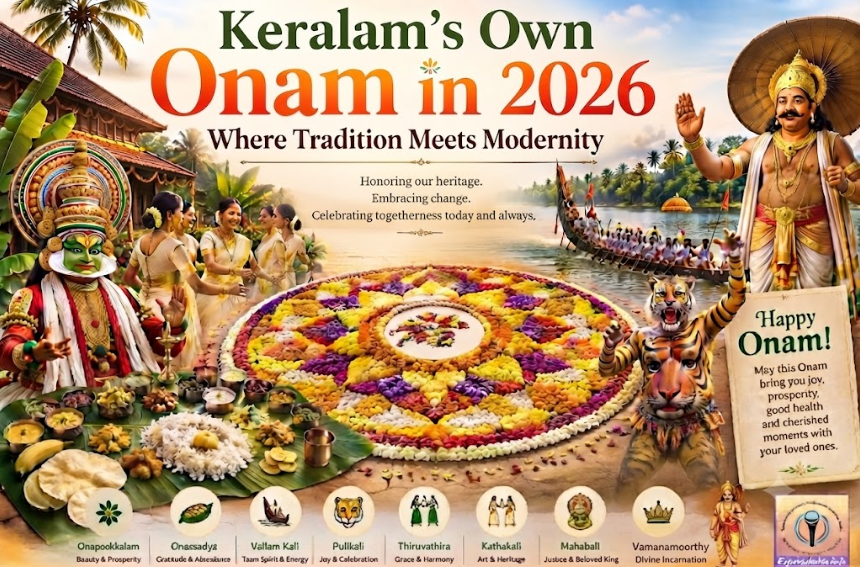
Happy Onam 2026 to every reader across Keralam and the wider world! This year carries a special weight beyond the usual festivities. Kerala has formally become Keralam, its historic Malayalam name, following Parliament’s approval and Presidential assent. Amid this historic milestone, the state’s grandest festival returns with full colour and fervour. Pookkalam carpets bloom at doorsteps, Onasadya aromas drift from kitchens, and Pulikali dancers prepare their tiger paint. Mahatma Gandhi once said that unity in diversity is not a slogan but a lived experience. Nowhere does that ring truer than during Onam in Keralam.
This blog builds on an earlier piece I wrote, Onam in 2025: How Kerala Blends Culture with Modernity, which explored the festival’s timeless charm. This year, though, the story is genuinely new. A state has been renamed, government schemes have expanded, and diaspora celebrations have grown larger than ever. Let us explore how this festival honours the old while embracing the unmistakably new.
Keralam: A Name Restored, A Legacy Reaffirmed
In a historic legislative moment, Parliament passed the Kerala (Alteration of Name) Bill, 2026. The Lok Sabha cleared it on 11 August, and the Rajya Sabha followed a day later. President Droupadi Murmu gave her assent on 17 August 2026, making the change official. The state’s constitutional name now reads Keralam in the First Schedule. This restores the Malayalam-language name long used by locals themselves. For a festival rooted in indigenous identity, the timing feels remarkably poetic. This year’s festival becomes the first major celebration held under this restored name.
The renaming carries symbolic weight beyond mere paperwork. It reflects a broader assertion of linguistic and civilisational heritage. Administrative structures remain unchanged, but the gesture resonates deeply with Malayalis. Keralam’s own Onam, therefore, takes on added significance this year. Every Pookkalam (floral decoration) laid and every Onasadya (traditional Onam meal served on a banana leaf) served now honours a name reclaimed. Tradition, in this sense, has quietly rewritten a small piece of history too.
Onapookkalam: The Floral Signature of Onam
The Onapookkalam remains the festival’s most recognisable visual signature. Families begin with humble arrangements on Atham day each year. By Thiruvonam, elaborate concentric floral patterns cover entire courtyards. Marigold, chrysanthemum, and jasmine blend into intricate, symmetrical designs. Many households now favour biodegradable, pesticide-free flowers over imported varieties. This shift reflects growing environmental consciousness within Kerala’s cultural practices. As APJ Abdul Kalam once remarked, “India’s cultural traditions reflect its deepest civilisational values”. The Pookkalam embodies exactly that sentiment, blooming fresh each festive season.
Beyond home courtyards, competitive Pookkalam contests draw thousands of participants statewide. Schools, colleges, and residents’ associations organise elaborate design competitions annually. Winning entries often span several metres, depicting mythological scenes or national motifs. This artistic tradition keeps younger generations engaged with heritage in tangible ways. It also transforms a quiet ritual into a vibrant, communal spectacle.
Oonjaalaattam and Thumbi Thullal: Onam’s Gentle Rituals
Beyond floral art, Onam preserves gentler, more intimate customs too. The Oonjaal, a decorated swing, hangs from courtyard trees or verandas each Onam season. Children and young women swing together, singing traditional Onapattukal (Onam songs) joyfully.
Thumbi Thullal remains a rarer, more evocative ritual performed mainly by women. One woman sits centrally, holding a thumba flower, while others sing around her. Gradually, she begins to shake and sway, entering a trance-like state. This custom, though fading in cities, survives in pockets of rural Keralam. Thiruvathira, a graceful clap-dance performed in circles, often accompanies these gatherings too.
Onasadya and Onakkodi: Feast and Festive Attire
No account of Onam is complete without the legendary Onasadya feast. This vegetarian banquet features over twenty-five dishes served on banana leaves. Coconut, jaggery, and fresh vegetables come together in remarkable culinary harmony. Interestingly, Onasadya varies noticeably across Kerala’s fourteen districts. Thiruvananthapuram favours boli with pal payasam, a distinctly sweet combination. Kozhikode and Kannur often include non-vegetarian dishes like fish and chicken curry. Alappuzha prides itself on a signature fish curry unique to its backwaters. Malappuram’s sadya includes velutha curry, a seasoned buttermilk preparation found nowhere else.
Onakkodi, the tradition of wearing new clothes, complements the feast beautifully. Families gift fresh mundu, kasavu sarees, and traditional attire before Thiruvonam. This custom symbolises renewal, prosperity, and the harvest’s abundant blessings. Together, Onasadya and Onakkodi anchor the festival’s sensory and emotional core. Modern families increasingly order sadya online, yet the ritual’s spirit remains untouched.
District-Wise Onasadya: A Gastronomic Trail
Kerala’s culinary diversity truly shines in the preparation of the Onasadya. Kollam’s sadya famously includes fish curry from Ashtamudi Lake’s morning catch. Kozhikode households rarely skip varutharacha chicken, cooked in dry-roasted coconut paste. Kannur and Kasaragod favour meaty fish fry, often pomfret or king fish. Thalassery adds pulincurry, a tangy winter-melon preparation unique to the Malabar belt. Pathanamthitta’s koottucurry swaps chickpeas for yam and raw plantain, a subtle but telling variation. Valluvanadan households insist on puli inji, a sweet-and-sour tamarind paste, on every leaf. These regional quirks prove Onasadya is less a fixed menu than a living, evolving tradition.
Onam 2026 – Key Dates and Government Holidays
| Festival Milestone | 2026 Date | Significance |
|---|---|---|
| Atham (festival begins) | Around 16–17 August 2026 | Pookkalam-making begins; ten-day countdown starts |
| Thiruvonam (main day) | Wednesday, 26 August 2026 | Grand sadya, Onakkodi, Mahabali’s symbolic return |
| School holidays | 22–30 August 2026 | Extended break declared by the state government |
| Kerala public holiday window | 25–28 August 2026 | First to Fourth Onam observed statewide |
Sources: Kerala government notifications, Mathrubhumi, Madhyamam
Note: A few diaspora calendars list Thiruvonam as 28 August 2026 based on differing nakshatra calculations; Kerala’s official calendar and government holidays confirm 26 August as the primary date.
Pulikali, Vallamkali, and the Ten-Day Extravaganza
The ten-day festivities begin with Atham and build steadily toward Thiruvonam. Each day carries its own rituals, deepening anticipation across households. Pulikali, the vivid tiger dance, remains among Onam’s most theatrical spectacles. Performers paint their bodies as prowling tigers and dance through crowded streets. This folk art form, native to Thrissur, draws massive crowds annually. Vallamkali, the traditional snake boat race, electrifies Kerala’s backwaters equally. Rowers chant in rhythm as elongated boats slice through calm waters.
Beyond these marquee events, temple visits, shopping sprees, and cultural programmes fill the calendar. Athachamayam, the ceremonial procession marking Atham, kicks off festivities in Thrissur. Kaikottikali, a graceful clap-dance performed by women, adds gentle rhythm to gatherings. Personally, I find myself torn between nostalgia for grander celebrations past and today’s efficient, compact versions. Yet, even scaled-down Onam retains its emotional core intact.
Beyond marquee spectacles, local clubs and residents’ associations organise their own Onam festivities and games enthusiastically. Vadamvali, or tug-of-war, remains the season’s most beloved community contest. Villages and housing societies also revive Kuttiyum Kolum, Uri Adi, and Lemon-and-Spoon races. Kerala’s tourism department even sponsors public Thiruvathira and Pookkalam competitions with cash prizes. Diaspora clubs replicate this spirit too — associations like SUMA in the US host their own Onam Games featuring tug-of-war, chess, and traditional Onakalikal (Onam games).
Traditional vs Modern Onam, 2026 Edition
| Traditional Onam | Modern Onam |
|---|---|
| Handmade Pookkalam using fresh flowers | Digital or eco-friendly Pookkalam designs |
| Home-cooked Onasadya on banana leaf | Delivered sadya or inventive fusion menus |
| Kasavu saree and mundu as everyday wear | Fashion-forward outfits with traditional touches |
| Large joint-family feasts and temple rituals | Smaller gatherings, virtual meetups, online sharing |
| Local Pulikali and Vallamkali attendance | Livestreamed cultural events for distant families |
Sources: Vedantu, Manorama Online, Kerala Tourism
Government Initiatives: Making Onam 2026 Colourful and Inclusive
This year, Keralam’s government has rolled out an unusually wide array of festive support measures. The state sanctioned roughly ₹253 crore for market intervention and free Onam kits. Around 6.09 lakh Antyodaya Anna Yojana (AAY), or yellow card, households receive these subsidised kits. Each kit contains rice, wheat, and essential provisions in an eco-friendly cloth bag. Officials are even considering extending special rice distribution by another month. Government employees and pensioners received a festival bonus of ₹4,500 this year. Staff also became eligible for an Onam advance of up to ₹20,000.
Beyond financial support, Kerala Tourism launched an ambitious Onam Tourism Week from 24 to 30 August. Thiruvananthapuram hosts over 340 programmes across 35 venues, involving 8,000 performers. Chief Minister V D Satheesan inaugurated the week at Nishagandhi auditorium. Vice-President C P Radhakrishnan is set to grace the closing ceremony. Tourism Minister P C Vishnunadh also unveiled “Be a Malayali for a Day,” letting visitors try Pookkalam-making, Onasadya cooking, and traditional art forms firsthand. This experiential initiative positions Onam as a global cultural attraction, not just a local celebration. Additionally, the government’s Integrated Tourism Project aims to sustain these celebrations well beyond this single festive week.
Onam and Mollywood: The Festive Box-Office Season
Onam season doubles as Malayalam cinema’s biggest box-office window each year. In 2026, Vismaya Mohanlal’s debut film Thudakkam opened the season on 7th August. Prithviraj Sukumaran’s action thriller Khalifa, directed by Vysakh, released on 20th August.
Nivin Pauly and Mamitha Baiju’s Bethlehem Kudumba Unit followed on 21st August, adding a warm family drama to the mix. Besides, among major Onam Malayalam movie releases, Dulquer Salmaan’s I’m Game will release on 3rd September. This annual clash of releases has become as much an Onam ritual as Pookkalam or Vallamkali itself.
How the Malayali Diaspora Celebrates Onam Worldwide
Onam’s spirit now stretches far beyond Keralam’s borders, embraced enthusiastically abroad. In the United Arab Emirates, Dubai’s Kerala Muslim Cultural Centre organises large-scale Onasadya gatherings. Al Nasr Leisureland typically hosts thousands for communal feasts and cultural programmes. Abu Dhabi’s Kerala Social Centre runs one of the Gulf’s longest-standing Onam traditions. Sharjah’s Malayali Samajam adds another vibrant hub within the wider UAE community.
Across the United States, roughly 300,000-plus Malayalis celebrate with remarkable enthusiasm each year. New York and New Jersey host Kerala Samajam events featuring Sadya and Pookalam contests. Texas cities like Dallas and Houston see Onasadya tickets sell out weeks ahead. California’s Bay Area even organises Pulikali processions, a rare sight outside Kerala. Atlanta’s Malayalee Association runs one of the largest Southern US gatherings annually.
Meanwhile, the United Kingdom’s Malayali communities concentrate around London, Leicester, and Birmingham. Leicester, with its dense Malayali population, hosts one of Britain’s biggest Onam events. Birmingham pairs its Onasadya with Kaikottikali performances for added cultural flavour. In Australia, the Sydney and Melbourne communities often shift Sadya to Saturday due to time-zone differences. Malaysia’s Malayali diaspora, one of the world’s oldest, has celebrated Onam in Kuala Lumpur for over a century. Singapore’s Malayalee Association, one of the region’s oldest, anchors celebrations at Kallang each year. As Swami Vivekananda once affirmed, culture rooted in spirituality carries an immortal, borderless quality. Onam’s global spread across these varied nations validates that very claim vividly.
Why Onam in 2026 Still Shines
Most importantly, this festival’s strength lies in its remarkable inclusiveness across faiths. It welcomes every community into one shared, joyous celebration each year. Its worldwide spread has connected Malayalis across continents, reaffirming identity and belonging. Equally significant, Onam stimulates real economic activity for farmers, artisans, and retailers. Brands, too, increasingly build festive campaigns around authentic cultural storytelling rather than mere discounts.
Additionally, cultural visibility flourishes as Kathakali, Pulikali, and Vallamkali captivate wider audiences. Families maintain meaningful connection through both traditional and digitally adapted formats. Government support this year, from bonuses to tourism initiatives, amplifies the festival’s reach further. Altogether, this festival remains a powerful marker of pride, unity, and Malayali identity.
Drawbacks vs Positives of Present-Day Onam
| Drawbacks | Positives |
|---|---|
| Environmental damage from non-sustainable practices | Inclusivity that unites diverse communities together |
| Alcohol misuse and associated health risks | Global diaspora celebrations reinforcing shared unity |
| Financial strain caused by overspending pressures | Government kits and bonuses easing festive costs |
| Tourism’s superficial focus and commercialisation | Enhanced cultural visibility through Tourism Week |
| Weakening of traditional family and community ties | Adapted family bonds through virtual celebrations |
| Generational disconnect and fading ritual depth | Renewed pride in festivities celebrated worldwide |
Sources: Vedantu, Kerala Tourism, government press releases
Political and commercial pressures occasionally risk diluting the festival’s sacred meaning. Folk artists sometimes face exploitation within brand-driven commercial events too. Still, these challenges have not diminished Onam’s broader cultural resonance. If anything, growing awareness around sustainability and fair representation continues improving matters.
Quick FAQs on Onam and Keralam in 2026
Is Kerala officially called Keralam now? Yes, President Murmu’s assent on 17 August 2026 made it official.
When is Thiruvonam in 2026? Kerala’s official calendar and government holidays confirm Wednesday, 26 August 2026.
What government benefits are available this Onam? Free kits for AAY households, a ₹4,500 bonus, and up to ₹20,000 advance for state employees.
Do NRIs celebrate Onam differently? Yes, many diaspora communities adjust Sadya timing to local time zones and weekends.
Tradition Amid Modern Life’s Challenges
Ultimately, the title of this piece asks a genuine question worth answering honestly. How does tradition endure when modern life pulls families in countless directions? The answer lies in adaptation rather than resistance to inevitable change. Digital Pookkalam designs, delivered Sadya, and livestreamed Vallamkali all represent thoughtful compromise. None of these dilute the festival’s essence; they merely reshape its delivery.
Grandparents still teach Pookkalam patterns to grandchildren, even over video calls sometimes. Expatriate families still gather for Onasadya, even if served on plates instead of leaves. Pandit Madan Mohan Malaviya once observed that India’s unity flows from one unbroken culture. Onam in 2026, celebrated as Keralam’s own festival, proves that current remains genuinely unbroken. Tradition, it turns out, survives not by resisting modernity but by befriending it wisely.
On behalf of ExpressIndia.info, we wish every reader a Happy, Prosperous, and Truly Blessed Onam in 2026. 🏵️🎊🌴💕
Onam2026 #KeralamOnam #OnasadyaFeast #OnamCelebrations #HappyOnam2026