
🪳A Word That Lit a Fire
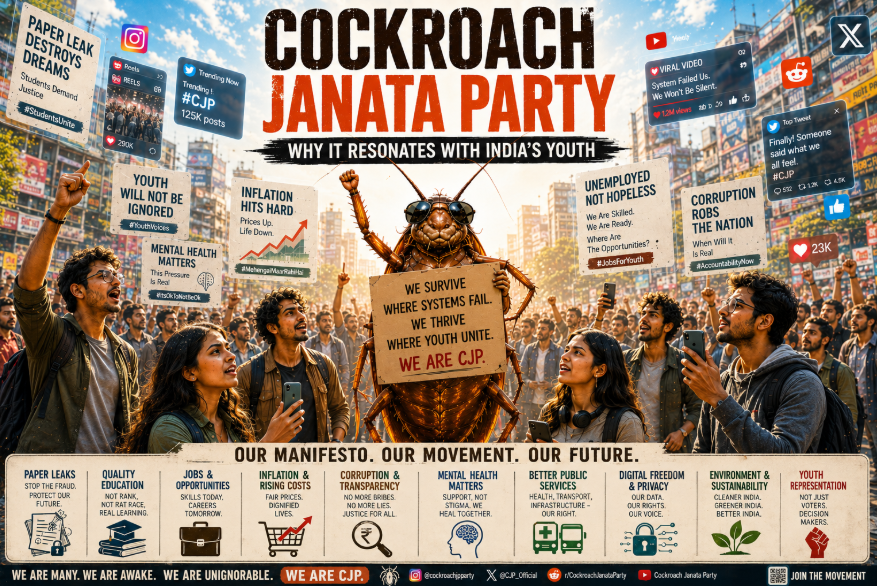
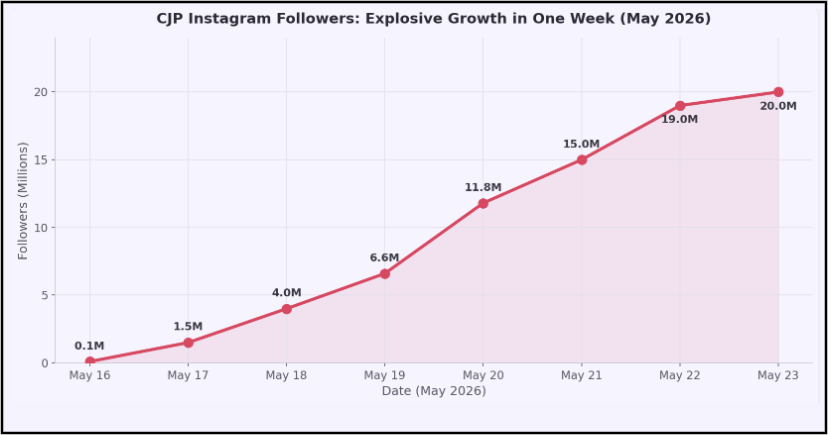
The Cockroach Janata Party (CJP) is, quite possibly, the most unlikely political movement India has ever seen. Think about it – a satirical outfit, named after one of the world’s most despised insects, amasses more than 22 million followers in barely one week on their official Instagram page. I remember scrolling through Instagram on May 16 and watching numbers climb by the minute. Something big, I immediately sensed, was happening. A single remark from one of India’s highest judicial offices had detonated a generational explosion. Suddenly, millions of young Indians were proudly calling themselves cockroaches – and the establishment did not know what hit it.
What you are about to read is not just a story about a meme movement. It is, in reality, a mirror held up to India’s battered youth ecosystem. Behind every cheeky hashtag lies a genuine, pressing cry for accountability, opportunity, and dignity. So, fasten your seatbelt – because this is one of those rare moments in Indian social history where satire and substance collide spectacularly. And trust me, the cockroach is far from done scurrying.
The Remark That Sparked a Revolution
When a Courtroom Comment Goes Viral
On May 15, 2026, the Chief Justice of India, Surya Kant, made a remark that nobody expected. During a Supreme Court hearing over a lawyer’s bid for Senior Advocate designation, the CJI reportedly said: “There are youngsters like cockroaches, who don’t get any employment or have any place in the profession.” He also referred to certain individuals as “parasites of society who attack the system.” News outlets picked up the quotes instantly, framing them as a sweeping dismissal of unemployed youth. Social media erupted within hours, and outrage spread faster than a wildfire in summer. India’s Gen Z did not mourn – they mobilised.
The very next day, CJI Surya Kant issued a written clarification, stating his remarks had been “misquoted” and were specifically directed at individuals entering professions with “fake and bogus degrees” – not at the country’s unemployed youth in general. He expressed being “pained” by the reports, calling them “totally baseless,”. Moreover, he stressed that every young Indian “inspires” him as a “pillar of a developed India.” However, the clarification arrived too late to douse the fire. India’s youth had already embraced the insult, transformed it into an armour, and were marching forward under a brand-new, cockroach-emblazoned banner.
The Cockroach Janata Party Is Born
One Google Form, Twenty Million Followers
On May 16, 2026 – exactly one day after the courtroom remark – political communications professional and meme creator Abhijeet Dipke launched the Cockroach Janata Party on Instagram. Membership criteria? Be “unemployed, lazy, chronically online, and able to rant professionally.” It was satirical, self-deprecating, and absolutely spot-on. Within days, the account crossed 6.6 million followers. By May 20th, it had surpassed major established political parties on Instagram. By May 22nd, it had reached an astonishing 20 million followers – turning a satirical Google Form into India’s most-talked-about social movement.
“The youth of India has largely vanished from the mainstream political discourse,” Dipke told Reuters. “Nobody is talking about us. Nobody is listening to our issues or even trying to acknowledge our existence.” This simple, honest statement explains everything. X withheld the CJP’s Twitter account in India after receiving a legal request – a move that paradoxically poured rocket fuel on the movement. As the hashtag #MainBhiCockroach trended across Instagram, X, and LinkedIn, a new generational identity was born – built not on shame, but on radical, resilient pride.
Source: Reuters, CNN, ABC News, Hindustan Times
India’s Gen Z: The “Cockroach” Generation
Who Are These Young Indians, and Why Are They So Angry?
Let us talk about the real story behind the Cockroach Janata Party – the economic context that made it inevitable. According to official PLFS data (IHD–ILO), India’s youth unemployment rate (ages 15–29) stood at 10.2% in 2023–24 – already the highest across all age groups. By March 2026, it had jumped sharply to approximately 15.2%, with female youth unemployment reaching a staggering 17.7%. These are not abstract numbers – they represent real graduates clutching degrees, staring at locked doors, while cost-of-living soars and wages stagnate. Inflation, gig-economy insecurity, and rising education costs have deepened a crisis of precarity that this generation carries silently every single day.
Former Rajya Sabha MP Priyanka Chaturvedi noted on X: “That a social media-created idea of CJP has taken the GenZ imagination by storm is a sad reflection of them losing hope in most of the current opposition parties.” This is precisely the frustration the movement channels. Young Indians feel invisible – not just to those in power, but to an entire political class that seems allergic to addressing genuine youth concerns. They see competitive exams as rigged, institutions as unaccountable, and mainstream media as captured. Consequently, when a satirical cockroach waved a banner for them, they did not laugh – they signed up by the millions.
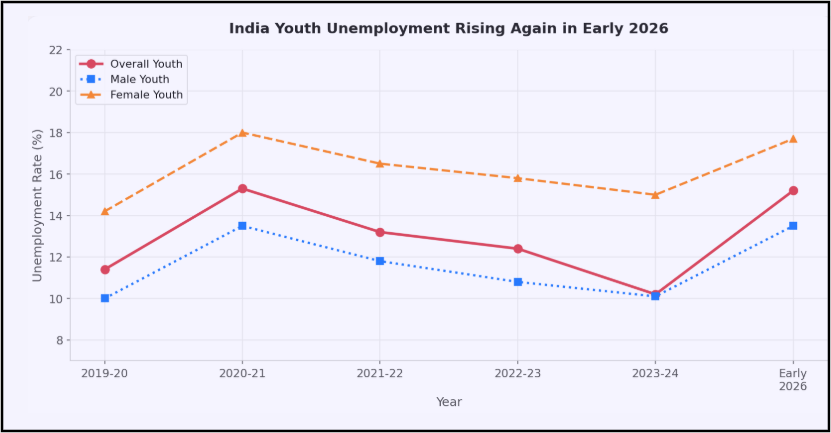
Source: Periodic Labour Force Survey (PLFS), Ministry of Statistics & Programme Implementation, Government of India; IHD–ILO
joint analysis (2023–24 data); early 2026 figures from independent labour market analysis based on PLFS quarterly data.
Cockroach Janata Party‘s Five Demands: More Than Just Memes
A Manifesto That Means Business
Here is where the Cockroach Janata Party stops being funny and starts being formidable. The Cockroach Janata Party‘s five-point manifesto is laser-focused on systemic reform, framed in plain language that resonates with every frustrated young Indian. First, CJP demands a complete ban on post-retirement Rajya Sabha nominations for retiring Chief Justices, targeting what critics see as a culture of political reward for judicial conduct. Second, it demands the Chief Election Commissioner face severe legal accountability if valid votes are deleted from electoral rolls – born from widespread fears of disenfranchisement. Third – and this is a demand close to my heart – it calls for 50% reservation for women in Parliament and the Union Cabinet, going beyond the existing 33% Women’s Reservation Act.
The fourth demand calls for revoking licences of media outlets owned by major corporate conglomerates, addressing the youth’s deep distrust of what they bluntly call “lapdog media.” The fifth demands a 20-year ban on elected representatives who switch parties after winning – a powerful blow against “resort politics” that mocks voter mandates. Beyond these five, CJP has also called on CBSE to scrap re-checking fees (labelling them “blatant corruption”) and launched an active campaign over the NEET-UG 2026 paper leak. As Dipke himself declared to India Today: “This is a movement to strive for an ideal India where the judiciary, Election Commission, and media remain neutral and independent.” Clearly, this cockroach has teeth.
📋 Cockroach Janata Party‘s 5-Point Manifesto at a Glance
| Demand | Issue Addressed |
|---|---|
| Ban Rajya Sabha nominations for retiring CJIs | Judicial independence |
| Legal accountability for Election Commissioner over deleted votes | Electoral integrity |
| 50% women’s reservation in Parliament & Cabinet | Gender parity in governance |
| Revoke licences of corporate-owned media | Media freedom & independence |
| 20-year election ban on party-defecting elected reps | Anti-defection & voter mandate |
Source: CJP manifesto, Times of India, CNN (May 2026)
NEET and the Education Crisis: The Last Straw
When the System Betrays Its Own Future
The NEET-UG 2026 paper leak was, for many young Indians, not merely a scandal – it was the breaking point of a generation. Over 22 lakh aspirants had spent years, often their entire adolescent lives, preparing for a single examination that decides medical college admission. The government ordered a re-examination after acknowledging lapses, but for millions, the damage was already irreversible. Cockroach Janata Party founder Dipke launched an online petition demanding the Union Education Minister’s resignation, framing the leak as a “system failure” that had shattered institutional trust. In interviews, he cited student suicides and severe mental health crises linked to examination pressure, describing NEET and CBSE controversies as symptoms of a broken education system in urgent need of root-and-branch reform.
Celebrated social activist and political scientist Dr. Yogendra Yadav has long argued: “When institutions fail students repeatedly, they don’t just lose an exam – they lose faith in the republic itself.” The CJP amplified exactly this sentiment – a generation tired of systemic betrayal, demanding that exam integrity be treated as a fundamental right, not a luxury. Additionally, the movement has targeted CBSE’s re-checking fee structure as “blatant corruption,” highlighting how the education system extracts money at every step from students who can least afford it. Furthermore, the movement’s virtual Gen Z convention and growing online petition base signal a community finding its collective voice – transforming individual hurt into organised, non-violent civic pressure.
Setting the Record Straight: Who Are the Real Followers?
The Misinformation Battle Cockroach Janata Party Did Not Expect
Almost predictably, as the Cockroach Janata Party grew, so did the attempts to discredit it. A viral claim emerged – amplified by prominent political figures – that “49% of CJP’s Instagram followers are from Pakistan, while only 9% are from India.” On the surface, this sounds alarming. However, here is the verified truth: founder Abhijeet Dipke immediately shared a screen recording of Instagram analytics, revealing that 94.7% of the audience was from India. The US accounted for 1%, the UK 0.7%, Canada 0.6%, and UAE 0.6%. Pakistan and Bangladesh did not appear in the top six countries at all. Fact-checking platform Alt News independently obtained the same data and confirmed the Pakistani-majority claim was completely false.
Hindustan Times similarly reported approximately 94% of CJP’s audience as Indian. Dipke’s response was equally powerful: “Why is a Union Minister labelling Indian youth as Pakistani?” This battle over follower origins is deeply instructive – it illustrates how digital movements face coordinated misinformation campaigns designed to delegitimise youth voices. Importantly, it also underscores the crucial role of media literacy: the ability to verify before you share is no longer optional; it is a civic responsibility. The cockroach, it turns out, is also quite good at debunking nonsense.
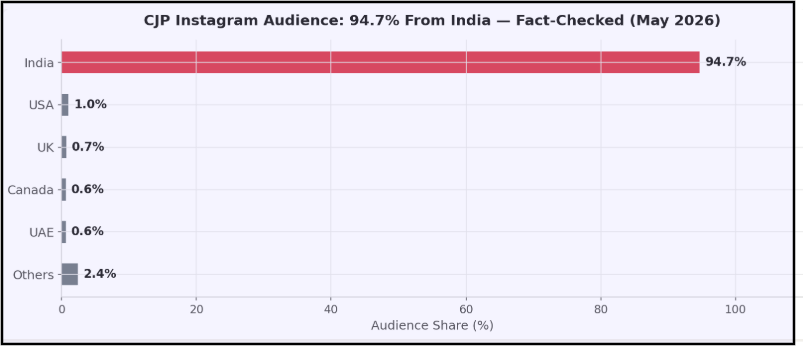
Source: Instagram Analytics screen recording shared by CJP founder Abhijeet Dipke (May 2026); independently verified by Alt News
fact-check and corroborated by Hindustan Times (May 21–22, 2026).
What India Can Learn from Bangladesh, Sri Lanka, and Nepal
A Cautionary Tale – Not a Roadmap for Chaos
Let me be absolutely clear: the Cockroach Janata Party has not called for a revolution, nor has it incited violence or anarchy. However, the parallels with neighbouring countries deserve serious, sober analysis. In Bangladesh (2024), student protests against government job quotas escalated into a nationwide uprising that forced Prime Minister Sheikh Hasina to flee the country. Besides, in Sri Lanka (2022), the “Aragalaya” movement, fuelled by economic collapse and corruption, saw crowds overrun the presidential palace and trigger the president’s resignation. Also, in Nepal (2025), Gen Z protests against a social media ban escalated into a mass uprising, resulting in the Prime Minister’s resignation. In every case, the common thread was identical: youth unemployment, economic mismanagement, entrenched corruption, and political elites that dismissed young voices until it was too late.
India’s situation is structurally different. Its federal democracy, multi-party system, and functioning electoral institutions create far more resilience than the centralised systems that collapsed elsewhere. Cockroach Janata Party founder Dipke himself explicitly rejected such comparisons, stating: “The youth of India understand their constitutional rights and will express their dissent through peaceful and democratic means.” Analysts across BBC, Reuters, Al Jazeera, The Guardian, and CNN have framed the CJP as a satirical, youth-driven, internet-first movement that signals deep discontent – but is not yet an organised revolutionary force. Nevertheless, the lesson from South Asia is unmistakable: when legitimate grievances are ignored long enough, memes can become movements, and movements can become something far harder to contain.
The Institutional Response: Courts, Critics, and Platforms
Power Meets Parody – and Blinks First
The establishment’s response to the Cockroach Janata Party has been telling. India’s Supreme Court, on May 25th, 2026, refused an urgent hearing on PILs filed against Cockroach Janata Party. CJI Surya Kant himself said: “There is no such grave urgency. We will see” – and told lawyers, “Don’t take it so sentimentally.” The bench acknowledged concerns about “commodification of constitutional proceedings” but listed the matter in the normal course. Simultaneously, CJP’s X account was withheld in India, reportedly in response to a legal demand – raising pointed questions about digital rights and freedom of expression.
Notably, what has not happened is equally significant: no formal security designation, no Election Commission statement on party registration, and no nationwide social media ban. Actions have been limited to individual ministerial statements, PILs, and platform-level restrictions – all of which have paradoxically amplified the movement’s reach. Three separate trademark applications have been filed for the Cockroach Janata Party brand on India’s Trade Marks Registry, suggesting the “cockroach” brand is already commercially and legally significant. In the end, the institutional response has been less a wall and more a megaphone.
The Road Ahead: From Memes to Meaningful Change
What Every Young Indian – and Every Citizen – Can Do Now
So, where does the Cockroach Janata Party go from here? Its immediate plans include a virtual Gen Z convention, an active NEET accountability petition, and continued digital campaigns around its five core demands. Volunteers have already dressed as cockroaches in symbolic clean-up drives in several cities. However, the movement’s long-term impact depends entirely on whether it can translate online energy into sustained civic participation. Viral moments are ephemeral – but institutional change is built through consistency, coalition-building, and constructive engagement with the systems one seeks to reform.
Here is what the CJP’s manifesto implicitly argues – and what I passionately believe: every individual has a role in this social reformation. Consider these holistic steps toward personal growth and collective impact:
As an individual:
- Verify information before sharing – media literacy is your most powerful tool
- Learn your constitutional rights: the right to vote, the right to information, and the right to petition
- Support credible, independent journalism that holds institutions accountable
- Invest in continuous skill development and mentor peers in your community
- Engage constructively in public discourse, both online and offline
As a community:
- Demand transparent, regular accountability from elected representatives
- Advocate strongly for gender parity in all public institutions
- Create safe, non-violent spaces for youth to express dissent and propose solutions
- Verify your name on electoral rolls and participate fully in every election
- Support youth-led civic initiatives, social enterprises, and accountability journalism
The cockroach survived the dinosaurs. It does not need a palace to thrive – and neither does India’s youth. They are resilient, resourceful, and remarkably clear-eyed about what needs to change. The Cockroach Janata Party may or may not evolve into a formal political force. However, the movement it represents – a generation demanding accountability, dignity, and a seat at the table – is absolutely here to stay. What do YOU think? Does the Cockroach Janata Party represent a genuine turning point for India’s youth, or will it fade like other viral trends? Share your thoughts in the comments below. And if this resonated with you, share it with a young Indian who needs to read it today. 🪳
At ExpressIndia.info, we believe every cockroach has a story worth telling – share this blog, join the conversation, and be the voice that makes India’s institutions listen.
#CockroachJanataParty #MainBhiCockroach #IndiaYouthMovement #GenZIndia #SocialAccountabilityIndia
now it needs an open street action by the youth.
they have had enough.
CJP was right trigger at the right time.