
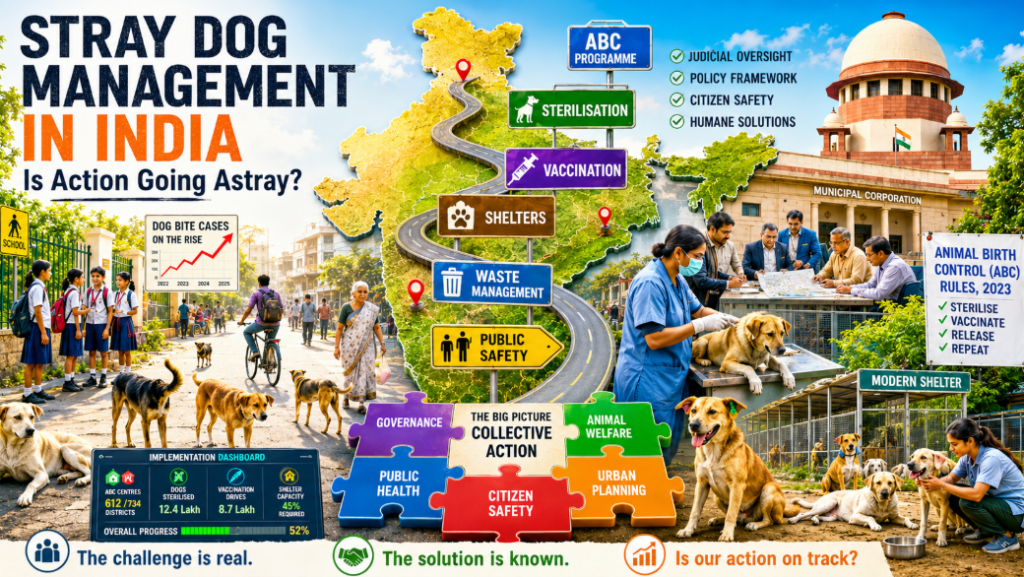
A Nation Running Scared on Its Own Streets
Stray dog management in India has reached a constitutional crisis point – and honestly, it took a six-year-old’s death to get us here. On July 28, 2025, the Times of India ran a headline that stopped India cold: “City Hounded by Strays, Kids Pay Price.” Behind that headline was a small girl in Delhi, dead from rabies after a stray dog bite. Without waiting for anyone to file a petition, India’s Supreme Court took suo motu cognisance – an extraordinary step that signals an extraordinary emergency. Consequently, the nation found itself at the centre of the most significant judicial intervention on public safety in recent memory. So, here is the question I keep asking: if the laws already exist, why are millions of young Indians still running from dogs on their way to school and back?
India currently carries approximately 36% of global rabies mortality – the highest share in the world, driven overwhelmingly by dog bites. Estimates put India’s free-roaming dog population at 60–62 million, making it one of the largest in the world. In 2024, India recorded 3.7 million dog-bite incidents and 54 confirmed rabies deaths – and those are only the documented cases. On May 19th, 2026, the Supreme Court stray dog judgment 2026 was already citing 4.8 lakh new bite cases and 42 deaths in just the opening months of this year. Meanwhile, dog bite deaths in India remain massively under-reported. Clearly, something has gone badly, dangerously astray – and this blog traces exactly why, and exactly what changes now.
The Legal Crisis: From a Headline to a Landmark Verdict
Stray Dog Management in India Enters the Courtroom
The Supreme Court’s journey from a newspaper report to a nationwide framework unfolded across ten intense months. On August 11th, 2025, the Court issued its first major order, directing Delhi, MCD, NDMC, Noida, Ghaziabad, Gurugram, and Faridabad to remove stray dogs from all localities and barring re-release after treatment. Within eleven days, however, the bench reconsidered and on August 22nd, modified the order, acknowledging it was “too harsh.” Accordingly, sterilised and vaccinated dogs could return to their localities – except rabid or aggressive ones – while feeding was restricted to designated zones, permanently banning unregulated street feeding. The Animal Birth Control Rules in India remained the operative framework throughout, even as the Court recalibrated its approach.
The pivotal November 7th, 2025 interim order escalated the matter to every state and union territory. Instantly, all institutional premises – schools, hospitals, bus stands, railway stations, and sports complexes – became dog-free zones, with all dogs to be shifted to shelters permanently. The compliance deadline was October 27th, 2025, and the result was humiliating for Indian governance: only two of twenty-eight states filed affidavits on time. The Court, bluntly furious, summoned Chief Secretaries for November 3rd, 2025 – and within days, all states scrambled to comply, many citing five-year cumulative sterilisation totals rather than active, current programmes. Dr. Krithika Srinivasan, a professor of political ecology, told the Indian Express in February 2026 that “the issue of stray dog management in India is not simply about dogs versus people – it is about the systemic failure of governance, and governance alone,” framing the crisis with surgical precision.
📊 Data snapshot: India’s dog bite burden, 2024–2026
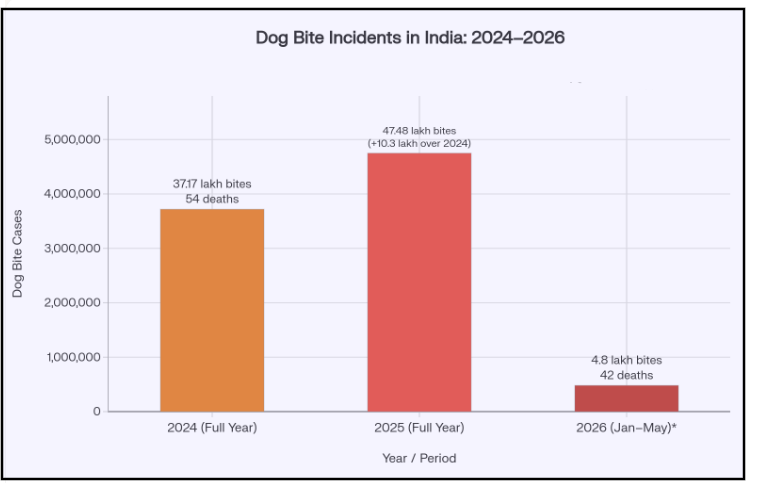
Source: National Centre for Disease Control (NCDC), IDSP data via RTI; Supreme Court Judgment May 19, 2026. *2026 data is partial (January–May only); number of deaths in 2025 is not officially published and hence not included here
The Final Judgment: May 19th, 2026 – A Turning Point
On May 19th, 2026, the Supreme Court delivered the most decisive order yet on stray dog management in India. Notably, the bench upheld the Animal Birth Control (ABC) Rules, approved the Animal Welfare Board of India (AWBI) SOP, and refused to dilute its earlier directions. Furthermore, it created a two-tier judicial monitoring framework — every High Court in India must register suo motu proceedings on stray dog management, with states filing compliance affidavits by August 7th, 2026, and High Courts submitting consolidated reports to the Supreme Court by November 17th, 2026. Additionally, the Court directed at least one functional ABC centre per district, mandatory availability of anti-rabies vaccines at district hospitals, and permanent non-release of dogs removed from institutional premises. Officials acting in good faith now receive protection from FIRs, while deliberate non-compliance attracts contempt proceedings. Indeed, for the first time in India’s history, stray dog management in India is a constitutionally supervised, personally accountable public health obligation.
The key directions from the May 19th, 2026 judgment deserve a clear summary, because each one carries legal teeth. The Court ordered all states to ensure that no stray dog remains on school or hospital premises. Additionally, it directed that sterilisation clinics, shelters, and vaccination camps must function continuously – not just during court hearing seasons. Furthermore, the National Highways Authority of India (NHAI) received specific directions to address stray cattle causing road accidents on national highways. Together, these directions transformed dog bite deaths in India from a public health statistic into a judicial accountability marker. Consequently, every Commissioner and Chief Secretary in India now bears personal responsibility for the outcome.
The Law Exists. So Why Has Implementation Failed?
Infrastructure: The Hollow Core of Stray Dog Management in India
India’s legal architecture for stray dog management in India is not the problem – the failure to implement it is. The Prevention of Cruelty to Animals Act, 1960 prohibits cruelty, while the Animal Birth Control Rules in India (ABC Rules 2023) mandate the Capture-Sterilise-Vaccinate-Release (CSVR) model for all urban stray dogs. World Health Organization (WHO) and World Organisation for Animal Health (WOAH) both endorse mass sterilisation plus anti-rabies vaccination as the only humane long-term solution. Moreover, a July 2025 joint advisory from the ministries of Animal Husbandry, Housing & Urban Affairs, and Panchayati Raj directed all states and Urban Local Bodies (ULBs) to map dog populations, set up ABC facilities, and coordinate with health departments on rabies control. Clearly, the framework is sound. The foundation, however, is deeply missing.
The ground reality is stark and frankly embarrassing. Approximately only 76 accredited sterilisation centres operate across India’s ~776 districts – meaning roughly 90% of districts have no functional ABC centre at all. Even progressive states like Kerala publicly admitted they lacked sufficient shelter capacity after the November 2025 order. Delhi, meanwhile, told the Court that shelters “have yet to be constructed” at the scale required. Consequently, the Court repeatedly described ABC implementation under the Animal Birth Control Rules in India as “fragmented, sporadic, and underfunded.” Subsequently, states submitted five-year cumulative sterilisation totals to appear compliant, effectively masking the absence of any continuous, systematic programme. Meanwhile, dog bite deaths in India continued to mount in the background.
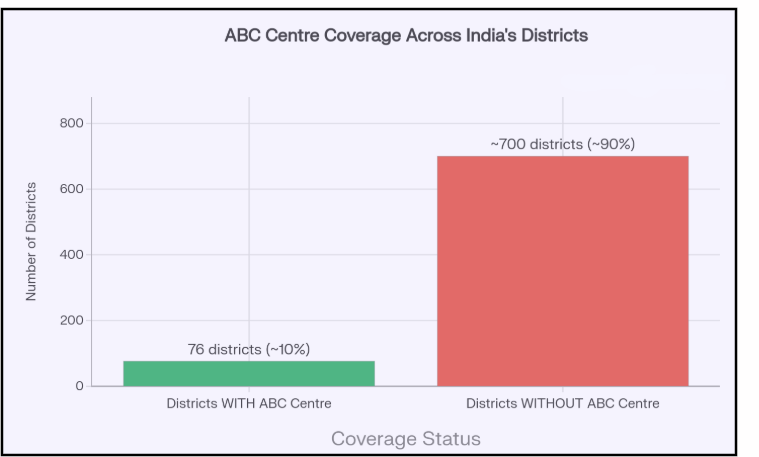
Source: Futura Sciences, April 2026. India has approximately 776 districts; only ~76 have accredited sterilisation centres
Budget Failures, Political Resistance, and the Waste Management Link
Behind the infrastructure gap lies a chronic budget failure at the ULB level. Most ULBs never adequately allocated funds for ABC programmes, treating sterilisation as a residual budget line rather than a public health necessity. Staff shortages, the lack of trained veterinarians, and absent record-keeping systems compounded every problem. Furthermore, political resistance added another costly layer: some leaders and animal rights advocates aggressively opposed relocation orders, creating years of litigation delays. The Supreme Court stray dog judgment 2026 directly overrides all of this, giving the Animal Birth Control Rules in India unambiguous, unified legal precedence. Local resistance, however, as the Court acknowledged, remains an active threat to implementation on the ground.
India has also consistently ignored the upstream driver of its stray dog crisis: unmanaged waste. Open garbage dumps sustain far more stray dogs than any street naturally can. Effective stray dog management in India therefore requires solid waste management reforms running in parallel with ABC – a link that policy rarely acknowledges and budgets rarely reflect. The result is a vicious cycle: more waste attracts more dogs, more dogs produce more bites, more bites generate court orders, court orders produce panic compliance, and then the cycle resets. Until India addresses this crisis at its source, sterilisation drives will always fight an uphill battle against an endlessly self-replenishing problem.
State Report Card: Heroes, Laggards, and the Uncomfortable Truth
Stray Dog Management in India: The Honour Roll
Encouragingly, several states have demonstrated that implementation is entirely possible when political will exists. Kerala leads the nation: it filed detailed compliance affidavits early, runs statewide campaigns with Mission Rabies, and in March 2026 rolled out five portable mobile ABC units – essentially mobile surgical theatres – with ₹2 crore allocated. Notably, the first unit at Nedumangad proved the concept: sterilisation does not require expensive permanent infrastructure. Uttar Pradesh submitted the largest numerical record to the Court – 5,32,687 dogs sterilised, dewormed, and vaccinated across 630 ULBs over five years – and released fresh funds for ABC centres in 10 more districts in May 2026.
Meanwhile, other states have also stepped up in meaningful ways. Telangana established 23 municipal-level sterilisation centres, integrating rabies vaccination into the process from the start. Guwahati and Assam together sterilised 24,067 dogs and vaccinated nearly 30,000 via a productive NGO partnership – proving that municipal-NGO collaboration delivers results. Furthermore, CM Bhagwant Mann of Punjab responded within days of the May 19 judgment, publicly pledging that “Punjab govt will strictly follow in letter and spirit the Supreme Court order given on May 19, 2026,” launching a statewide campaign while explicitly banning indiscriminate killing. Notably, Punjab committed simultaneously to enforcing the ABC model – proving that robust compliance and animal welfare are not mutually exclusive.
Mumbai’s BMC approved ₹23 crore to nine NGOs targeting 45,000 sterilisations annually – even while acknowledging that without acceleration, Mumbai’s stray population could reach 4.48 lakh by 2033. Bengaluru’s BBMP achieved approximately 60% sterilisation coverage of 65,041 dogs in its North zone, and opened a new 500-dog shelter at Dasarahalli. Delhi’s MCD sterilised 54,623 dogs between April and September 2025. Chennai’s GCC sterilised 3,500 dogs in a four-month pre-judgment drive. Rajasthan covered 5,516 schools, 974 hospitals, and 258 bus stands under its affidavit, with 27,858 dogs sterilised. Together, these figures show what stray dog management in India can look like when it is genuinely prioritised.
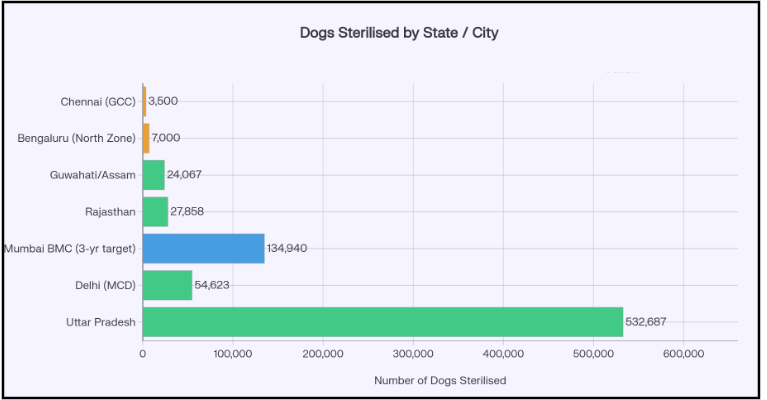
Source: Supreme Court Compliance Affidavits, November 2025. Green = cumulative sterilisations; Blue = 3-year planned target; Orange = recent drives
⚠️The Laggards: Where August 7th, 2026 Becomes a Reckoning
Not every state has earned its compliance badge. Bihar drew sharp judicial criticism for filing vague affidavits without clear sterilisation numbers or concrete infrastructure timelines. Delhi, despite its sterilisation numbers, lacks the shelter infrastructure to house dogs removed from institutional areas – a critical gap the Court noted expressly. Jaipur operates just one ABC centre at Jaisinghpura Khor, with capacity for roughly 100 dogs, in a city of several million people. Most extraordinarily, both Lakshadweep and Manipur submitted affidavits claiming zero stray dog populations – claims that experts have treated with deep scepticism, given the complete absence of credible census data to support them. Consequently, these claims should be read as administrative convenience, not demographic reality.
The pattern across laggard states is strikingly consistent: affidavits drafted for courts, not for communities; data presented without infrastructure to back it. The Animal Birth Control Rules in India place clear, non-negotiable responsibilities on every municipal body. Accordingly, the August 7th, 2026 High Court deadline is not merely a bureaucratic milestone – it is a moment of civic reckoning. Citizens, Resident Welfare Associations (RWAs), journalists, and public health advocates should treat this date as a benchmark against which every promise in every state affidavit gets tested. Furthermore, the Court’s contempt warning is not rhetorical: non-compliance by any officer can trigger personal liability. Dog bite deaths in India do not pause for bureaucratic delays.
| State / City | Action Taken | Scale | Status |
|---|---|---|---|
| Kerala | Mobile ABC units + Mission Rabies | 5 portable units, ₹2 cr | ✅ Proactive |
| Uttar Pradesh | Sterilisations across 630 ULBs | 5,32,687 (5 years) | ✅ Proactive |
| Mumbai BMC | 9-NGO contracts, ₹23 cr | 45,000/yr target | ✅ Proactive |
| Telangana | 23 municipal sterilisation centres | City integration | ✅ Proactive |
| Bengaluru (BBMP) | Drives + 500-dog shelter | 60% N. zone coverage | 🔄 Ongoing |
| Delhi MCD | Sterilisation drive Apr–Sep 2025 | 54,623 dogs | 🔄 Ongoing |
| Punjab | Post-judgment enforcement campaign | Statewide, ongoing | 🔄 Ongoing |
| Bihar | Late, vague affidavit | No sterilisation data | ❌ Laggard |
| Jaipur | 1 ABC centre (~100 dogs) | City of millions | ❌ Laggard |
| Delhi (shelters) | Shelters “yet to be constructed” | Critical infrastructure gap | ❌ Laggard |
Source: SC Compliance Affidavits, Nov 2025; India Today, May 2026; New Indian Express, May 2026
What the Judgment Really Says: The Legal Backbone
Your Constitutional Right to Walk Without Fear
The Supreme Court stray dog judgment 2026 makes one constitutional argument that is both powerful and underreported by mainstream media. The Court held that Article 21 – the right to life and personal liberty – includes the right to move freely in public spaces without a constant fear of dog attacks. Citizens should not, the Court pointedly observed, have to “outsprint stray dogs to exercise their right under Article 21.” Consequently, stray dog management in India is no longer a municipal housekeeping function – it is a fundamental rights obligation, making every Chief Secretary and Commissioner personally accountable for non-compliance. Additionally, the judgment upholds the Animal Birth Control Rules in India and the AWBI SOP without modification, affirming that all state action must occur strictly within this humane, science-based framework.
Beyond Article 21, the judgment introduces two nuanced principles worth understanding closely. First, tortious liability for feeders: any person or organisation feeding stray dogs within institutional premises can now face legal liability in tort for injuries those dogs cause – particularly if they resist lawful removal or refuse ABC coordination. Feeders must register undertakings with municipal bodies. Second, euthanasia is permissible only in three strict documented conditions: confirmed rabies, an incurable painful illness, or demonstrated dangerous aggression toward humans – and only when performed by a registered veterinarian with full documentation. Notably, simple public discomfort or the mere presence of a non-aggressive dog does not qualify. Any local body misusing this clause to authorise illegal killings directly violates the judgment’s express terms.
The Controversy: An Honest Look at Both Sides
The False Binary of Safety vs Compassion
The debate around this verdict has, predictably, divided India into two noisy camps. On one side, public safety advocates and parents demand aggressive street-clearing. On the other, animal welfare organisations call the relocation mandate “neither humane nor practical”, arguing that shelter capacity is so catastrophically inadequate that forced relocation amounts to death via overcrowding. Former Union Minister and animal rights activist Maneka Gandhi placed herself firmly in the second camp, saying the orders are “unworkable” and pointing to six months of state non-compliance as her evidence: “Not a single ABC centre has been made. Not a single shelter has been made. Nobody has done what they said, because they cannot.” Accordingly, her critique deserves serious engagement – though it targets implementation failure, not the Animal Birth Control Rules in India themselves.
Experts, however, consistently argue that this entire debate rests on a false binary. Effective ABC plus Anti-Rabies Vaccination is simultaneously pro-human and pro-animal: it reduces bites, eliminates rabies, stabilises dog populations, and avoids cruelty. Research confirms that sterilising at least 70% of a local dog population and sustaining that coverage is the scientific tipping point at which population growth halts. Most Indian cities remain far below this threshold. Furthermore, commentaries from multiple independent outlets flag a disturbing misuse trend: illegal dog killings being justified by misquoting the Supreme Court stray dog judgment 2026, even where dogs are neither rabid nor aggressive. Consequently, clarifying that euthanasia is a narrow, veterinarian-supervised exception – not a general licence – is the most urgent public communication task facing both government and civil society right now.
What the World Can Teach India
Countries That Eliminated Dog-Mediated Rabies – and How
The global experience offers lessons India cannot afford to ignore. Sri Lanka and Bhutan have made measurable, sustained progress on dog-mediated rabies reduction through WHO-aligned mass vaccination and sterilisation campaigns – achieving results that India, with vastly greater resources, has not yet matched. In contrast, Turkey and Romania mixed ABC with periodic culling, with poor animal welfare outcomes and only mixed public health results. Eastern European data repeatedly shows that dog populations rebound rapidly when food availability from open waste is not simultaneously addressed – confirming exactly what holds India back. Additionally, India’s own Kerala culling episode in the 2000s produced a short-term drop followed by a full rebound – a lesson the Animal Birth Control Rules in India were specifically designed to address.
WHO’s “Zero by 30“ roadmap – eliminating dog-mediated human rabies by 2030 – is India’s stated national commitment. India currently lags behind countries that have already virtually eliminated this disease, largely because ABC coverage remains uneven, post-exposure prophylaxis (PEP) access in rural areas is poor, and anti-rabies immunoglobulins are unavailable in many district hospitals. Encouragingly, the Supreme Court stray dog judgment 2026 directly addresses this: states must now ensure immunoglobulin and vaccine stocks at every district hospital. For the first time, rabies prevention infrastructure has become a judicial compliance metric – not just a health ministry aspiration. Consequently, every dog bite death in India from this point forward raises the question: was PEP available at the nearest district hospital? If not, who is accountable?
What You Must Do: Citizen Action as the Real Last Line
Turn Knowledge Into Civic Power
Here is the truth most blogs won’t tell you: the Supreme Court’s judgment is only as strong as citizens make it. Every direction, every deadline, every contempt warning rests entirely on someone watching, documenting, and reporting. Accordingly, the most powerful immediate action any reader, RWA member, or civic group can take is to ask one direct RTI question to their municipal body: “Where is the ABC centre your affidavit promised, and how many dogs has it sterilised this month?” File it through the Central Government’s RTI portal or your State’s designated authority. Subsequently, the answer – or, indeed, the silence – will reveal everything about your city’s commitment to stray dog management in India. Each High Court across India is now registering suo motu cases on this issue, and every citizen has the right to intervene, submit factual notes, or assist as an amicus.
Responsible dog feeding is now also a legal framework matter – and feeders genuinely have a powerful role to play. Feed only at designated municipal feeding zones, register with the ULB, and coordinate actively with ABC teams. Citizens who feed regularly and formally can become invaluable partners in vaccination tracking, turning compassion into systematic data. Additionally, municipal complaint portals and helplines, mandated under ABC-related directions, provide channels for logging non-compliance and tracking response times. Furthermore, if your school, hospital, or bus stand still has dogs roaming freely after August 7, 2026, that is a documented compliance failure you can bring before your High Court’s suo motu bench. Meanwhile, dog bite deaths in India continue every single day – making civic engagement not optional but urgently necessary.
Building a System, Not Just Obeying a Judgment
Stray dog management in India will not improve through court orders alone. Sustainable, humane, and effective change demands a complete district-level ecosystem: a functional ABC centre, adequate shelters, ward-level feeding zones, trained veterinary staff, continuous vaccination drives, real-time bite surveillance, and one clear nodal officer accountable to the High Court’s suo motu bench. Research establishes firmly that sustaining 70% sterilisation coverage of any local dog population is the scientific tipping point; below this threshold, populations rebound relentlessly. Simultaneously, solid waste management reforms must accompany ABC – because garbage and open dumps are the primary reason stray dog populations remain so large across urban India. As Bengaluru-based animal welfare advocate Himanshi Varma put it, “What matters most is that our dogs are vaccinated, sterilised, and treated humanely – alongside ensuring that no child in India has to fear walking to school,” capturing precisely what genuine progress must look like.
The holistic changes that can genuinely transform stray dog management in India – and our own civic character – include:
- Waste management reform: Eliminate open garbage dumps, the primary reason carrying capacity remains so high.
- National dog census: Create a unified, district-wise census to enable evidence-based resource allocation.
- Permanent ABC funding: Move from panic-driven budget releases to dedicated annual ABC line items in every ULB budget.
- Kerala’s portable ABC model, replicated nationally: No state should cite missing permanent infrastructure as an excuse any longer.
- Community caretaker registration: Formally register and train dog feeders as partners in vaccination tracking.
- Mandatory PEP access at every district hospital: The Supreme Court stray dog judgment 2026 has already directed this – citizens must now monitor its delivery.
- Civic literacy campaigns: Educate citizens on responsible feeding, bite-reporting protocols, and their RTI rights.
For each of us personally, this crisis offers a growth opportunity: to move from passive distress to active civic accountability, from online outrage to filed RTIs, and from indifference to informed engagement. Social change begins when enough individuals decide that governance failure is their problem to solve, not just the government’s responsibility to explain away. The August 7, 2026 deadline is the moment of truth. Watch your district – and make sure someone is watching for every child who walks to school.
At ExpressIndia.info, we believe safer streets and kinder governance begins with informed citizens — so stay alert, ask hard questions, and hold every local authority accountable.
✅Share this blog. Ask your local Municipal Corporation today: where is your ABC centre?
#StrayDogManagement #DogBitesIndia #AnimalBirthControl #RabiesAwareness #PublicSafetyIndia
People in higher echelons ilk of Menaga Gandhi, CUPA, PETA who never walk on the streets unescorted during the nights do not know or experienced the real problem of strays.
Even ABC does not help. All ownerless dogs must be eliminated.
Government do not do it. The pharma companies that sell Rabipur takes care of the persons in the in the health ministry.
Meanwhile our children who go to school or paly in the streets fall victim.