
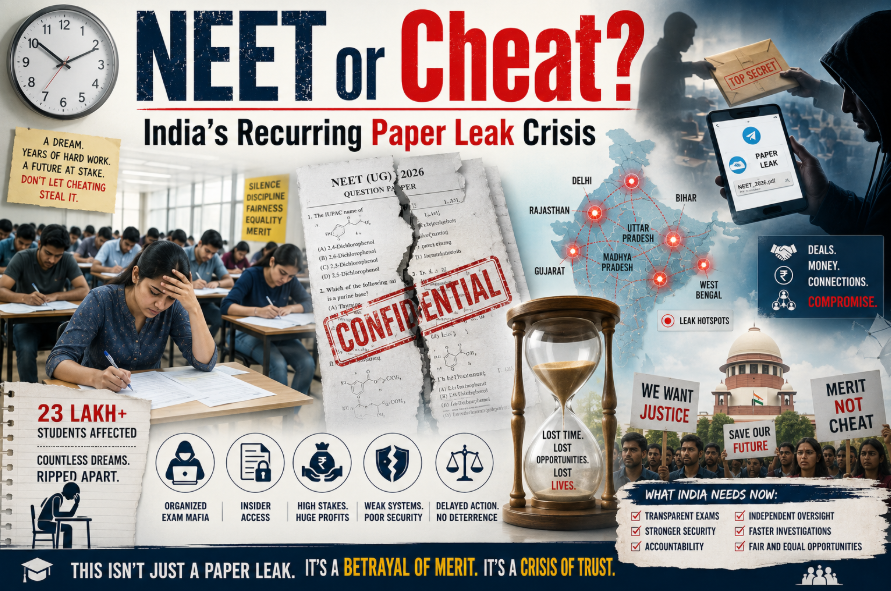
The NEET paper leak 2026 did not begin with a CBI arrest or a government press release. It began with a teacher in Sikar, Rajasthan, who received a handwritten “guess paper” from his landlord on the evening of 3rd May – the very day 2.28 million students across India sat for the most consequential exam of their young lives. He compared it with the actual question paper. The match was undeniable. He filed a complaint. And with that, one of India’s most damaging examination scandals in recent memory began to unravel.
I find it striking that India can land a spacecraft on the Moon, build the world’s most used digital payments platform, and produce some of the sharpest minds in global technology – yet we cannot protect one question paper from being handwritten, scanned, and sold on WhatsApp. That paradox is not accidental. It is a symptom of something far deeper than a single exam irregularity. The NEET paper leak 2026 is not just a news story. It is a mirror held up to the state of meritocracy in India – and what it reflects is deeply unsettling.
Handwritten. Scanned. Sold: How NEET Paper Leak 2026 Unfolded
The National Testing Agency(NTA) conducted NEET-UG 2026 on 3 May across more than 5,000 centres in India, with approximately 22–23 lakh candidates appearing for the exam. The NTA declared beforehand that the exam ran under a “full security protocol” – GPS-tracked vehicles, AI-assisted CCTV, biometric verification of candidates, watermarked question papers, and 5G jammers at every centre. Impressive on paper. And then, well, there was the actual paper.
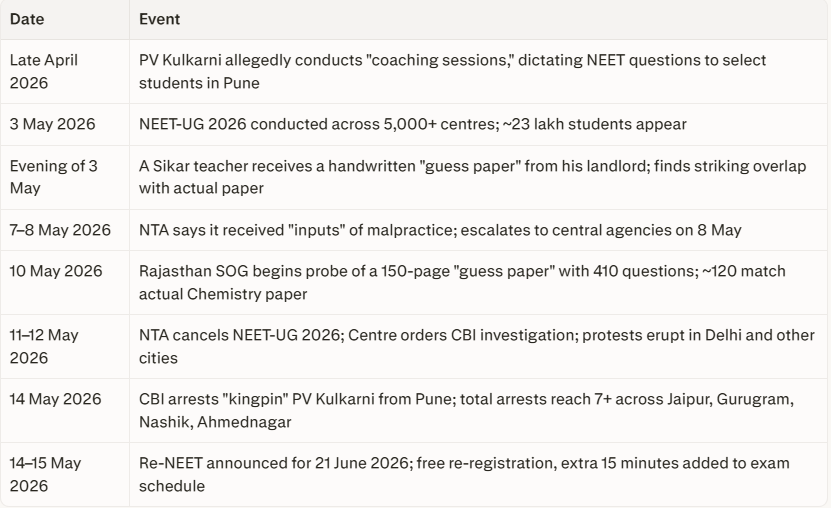
Investigators later pieced together what had happened in the last week of April – a full week before the exam day. P.V. Kulkarni, a Chemistry lecturer who had been part of NTA’s question paper-setting committee, allegedly gathered select students at his Pune residence under the cover of “special coaching classes.” He dictated NEET questions, multiple-choice options, and correct answers. Students wrote them in notebooks. The CBI, which arrested Kulkarni on 14th May as the case’s “kingpin,” confirmed that these handwritten notes “exactly tallied” with the actual NEET-UG 2026 paper used on 3rd May.
Another accused, Rajasthan-based Dinesh Biwal, allegedly scanned a handwritten copy and converted it into a digital PDF in Nashik. Coaching centres and hostel networks in Sikar then shared the PDF with students. Subsequently, it cascaded through WhatsApp and Telegram groups – including an alleged network called “Private Mafia” with nearly 400 members. Middleman Manisha Waghmare helped route students to Kulkarni; investigators found approximately ₹10 lakh flowing through 21 different bank accounts linked to her. The paper allegedly sold for as little as ₹50,000 via Telegram and as high as ₹30 lakh in the final retail chain from Maharashtra to Rajasthan – a mark-up that any startup founder would envy, if the product were not stolen futures.
The NTA cancelled the exam on 11–12th May entirely. The authorities have now handed the case over to the CBI. The NTA announced the re-exam for 21 June 2026, with free re-registration and fresh admit cards. For 23 lakh students, the calendar reset. The anxiety did not.
NEET UG 2026 Exam – Timeline of a Scandal
Sources: NDTV, Economic Times, ANI, Times of India, Indian Express, BBC (May 2026)
Not the First Time: India’s Recurring Paper Leak Crisis
Here is a number that should make every Indian citizen pause: 65. That is the minimum count of major examination paper leaks recorded across India between January 2019 and June 2024, according to an India Today Open-source intelligence (OSINT) data analysis – affecting 19 states and dozens of competitive exams. Not 6. Not 16. Sixty-five. And then 2026 added another to this heap.
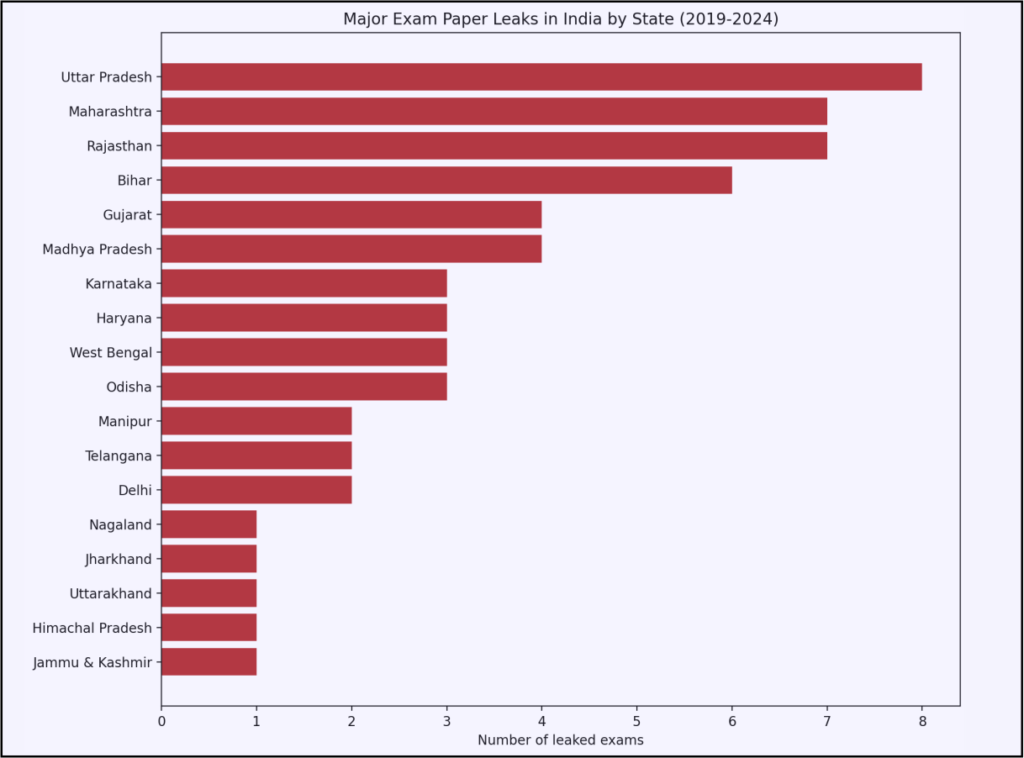
The state-wise pattern is revealing. Uttar Pradesh leads with 8 documented leak incidents, followed by Rajasthan and Maharashtra with 7 each, Bihar with 6, and Gujarat and Madhya Pradesh with 4 each. This is not random distribution. These are the same states that also happen to have the most intense coaching cultures, the highest competition for limited government seats, and the most active organised crime networks at the intersection of politics and education. The NEET paper leak 2026 fits this pattern precisely – originating in Maharashtra (Pune), amplified through Rajasthan (Sikar), and touching students across multiple states.
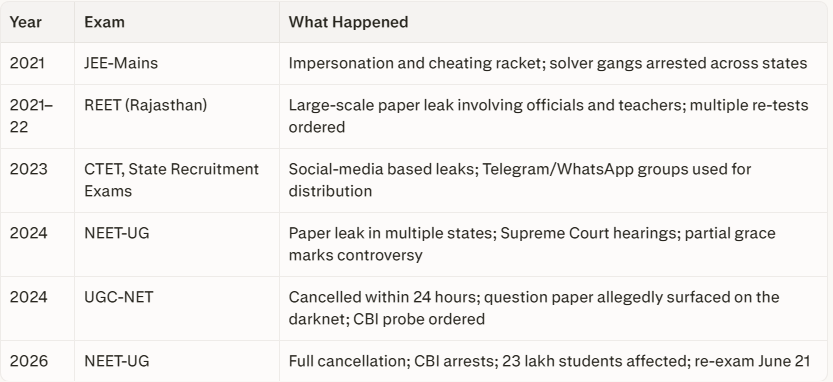
Major Exam Paper Leaks in India – A Timeline of Shame (2019–2026)
Source: India Today OSINT data analysis (2019–2024); NDTV, Economic Times, BBC (2026 updates)
State-wise Paper Leak Incidents (2019–2024)
Source: India Today, “India saw 65 exam paper leaks since 2019: Data analysis” (June 25, 2024)
The Exam Mafia in India: A Business Model Built on Broken Dreams
The phrase “exam mafia in India” might sound like a film title. Regrettably, it is an accurate description of a well-organised, multi-state criminal ecosystem that has professionalised the theft of examination integrity. Think of it as a franchise model – with regional operators, digital distributors, pricing tiers, and risk management strategies. The NEET paper leak 2026 exposed how sophisticated this network has become.
The business model works in four interlocking layers. At the top sits an insider – someone with legitimate access to question papers or answer keys, like PV Kulkarni. Below the insider are brokers and middlemen – local actors who connect the source to coaching institutes and hostel networks, as Manisha Waghmare allegedly did in this case. The third layer consists of distribution hubs – coaching towns like Sikar, Kota, and Patna, where “guess papers” are laundered as premium study material. And at the base, digital channels – Telegram groups, WhatsApp networks, and even darknet forums – enable rapid, scalable distribution.
Pricing is tiered: ₹50,000–75,000 for a bulk Telegram-distributed question set, ₹2–5 lakh for a more personalised package, and up to ₹30 lakh for “guaranteed” access in high-stakes exams. The FAIMA — Federation of All India Medical Association — captured the gravity of this ecosystem when it warned that repeated lapses “expose serious weaknesses in the system entrusted with conducting one of India’s most crucial examinations,” demanding a time-bound investigation and exemplary punishment for all involved.
Who Really Pays? The Human Cost of the NEET Paper Leak 2026
The CBI tracks money trails. Newspapers track arrests. But who tracks the mental health of an 18-year-old in Lucknow who spent two years of her life preparing, sat for the NEET-UG 2026 exam on 3rd May, finally exhaled – and then saw the cancellation notice nine days later? I have been thinking about her since I read the Indian Express account of exactly such a student: the severe anxiety, the insomnia, the emotional breakdown that followed. Psychiatrists cited in that report explain that NEET aspirants live in prolonged stress, and sudden cancellation triggers “acute stress” – shock, helplessness, and burnout, all at once, with no safety net in sight. The NEET paper leak 2026 has intensified exam stress in India, making it even more important to understand how students can cope with pressure and recover emotionally.
Beyond mental health, the NEET paper leak 2026 inflicts a savage economic blow. Most NEET aspirants spend two to four years in dedicated preparation, often in paid coaching centres in cities away from home. Families – particularly from lower-middle-class and rural backgrounds – sell jewellery, take loans, or redirect household savings to fund this preparation. A cancellation does not just waste one exam attempt. It doubles the financial burden: another year of coaching fees, hostel rent, and opportunity costs, in exchange for only a free re-registration form. As student groups across the country marched holding placards reading “Doctor Degree on Sale,” they were not just protesting a leak – they were articulating a generation’s rage at a system that punishes honesty and rewards access to networks. Student groups united with one message: “NEET is not just an exam – it’s years of sacrifice, pressure, and mental trauma for every student.”
The Institutional Rot: Why NTA Exam Reform Cannot Wait
Let us be honest with ourselves. The NTA was created to professionalise national examinations, eliminate the chaos of multiple state-level tests, and deliver a standardised, credible process. In principle, that was a sound idea. In practice, the NEET paper leak 2026 is at least the third major NTA-era scandal – after NEET-UG 2024 and UGC-NET 2024 – suggesting that centralisation without accountability is not a solution but a larger, more efficient vulnerability.
The Radhakrishnan Committee report – prepared after the 2024 NEET controversy and headed by former ISRO chief K. Radhakrishnan – had specifically recommended overhauling NTA’s governance, strengthening question bank security and digital audit trails, and reviewing logistics at printing, transport, and storage stages. Yet, Economic Times reporting on the NEET UG 2026 leak notes that many of those recommendations remained unimplemented at the time of the NEET-UG 2026 exam. I keep asking: if the recommendations were on the shelf, why were they not on the exam floor?
In response to the 2026 catastrophe, the United Doctors Front has filed a petition in the Supreme Court seeking nothing less than dissolution of the NTA in its present form, describing the NEET-UG 2026 exam fiasco as a “systemic and catastrophic failure” and demanding a court-monitored statutory testing body with zero-leak integrity. The Supreme Court itself, in the 2024 NEET case, had already stated: “One thing is clear – questions were leaked. Sanctity of the exam was compromised.” That observation has aged into an indictment.
Can Technology Fix the NEET Paper Leak Crisis?
The government and NTA are reportedly examining a hybrid or partially digital exam model to prevent future leaks. This is a genuinely promising direction – but only if pursued with clarity about what technology can and cannot do. NTA’s existing security architecture for NEET-UG 2026 was already impressive on paper: GPS-tracked vans, watermarked papers, AI-assisted CCTV, biometric verification, 5G jammers. The NEET paper leak 2026 happened anyway, because technology secured the paper in transit – but not the human at the source. PV Kulkarni was inside the system. No GPS tracker monitors a question paper-setter’s memory.
Having said that, stronger technological architecture can dramatically raise the cost and difficulty of insider leaks. The Staff Selection Commission (SSC) offers a promising model: it now uses an AI-powered content authoring tool that dynamically generates question papers from a large pre-approved question bank just 15 minutes before the exam, using strong encryption and digital signatures. No official can see the final paper until minutes before the exam begins. Decryption requires correct digital keys, and the architecture follows a “zero-trust” cybersecurity model.
For NEET and other NTA exams, the proposals on the table include end-to-end encrypted digital delivery unlocked only at exam centres with multi-party keys, zero-trust access control with independent audit logs, and AI-driven analytics to flag statistically abnormal score clusters – the kind that suggest leaked papers circulating within a coaching hub. This is an NTA exam reform that actually addresses root causes, not just optics. However, without equally robust institutional accountability and independent oversight, even the smartest digital system becomes just another box to hack – or bribe your way around.
Holistic Solutions and the Road Ahead: Reclaiming Meritocracy in India
Technology is necessary but not sufficient. Rebuilding meritocracy in India after the NEET paper leak 2026 demands a much broader transformation that addresses the systemic, social, and personal dimensions of the crisis together. At the institutional level, India needs NTA exam reforms that decentralises authority, mandates external audits, and creates a parliamentary statutory body for national examinations with real independence.
Authorities must enforce the Public Examinations (Prevention of Unfair Means) Act, 2024 with urgency. Its provisions for 5–10 years of imprisonment and ₹1 crore fines for organised exam crimes should be backed by fast-track courts so they become real deterrents, not dormant clauses. Lawmakers must formalise whistleblower protection so the next teacher in Sikar does not fear retaliation for doing the right thing, and multi-attempt examination models can help reduce the winner-take-all pressure that pushes desperate families toward leaked papers.
At the personal and social level, reform begins with each one of us. Students must refuse to join leak networks, parents must value resilience over shortcuts, and citizens must demand public dashboards tracking paper leak investigations from FIR to conviction. Educators and professionals should mentor first-generation aspirants and support mental health resources in the coaching ecosystem, because India’s demographic dividend can only thrive on trust, fairness, and equal opportunity.
At ExpressIndia.info, we believe that every honest student deserves a fair exam, a fair system, and a future built on merit, not manipulation. If this blog resonated with you, please share it with a student, parent, or teacher in your network. Tag someone who needs to read this. And tell us in the comments: what is the one reform you believe India’s exam system needs most urgently? Your voice matters – and right now, so does every honest mark.
#NEETPaperLeak2026 #NTAReform #ExamMafiaIndia #MeritocracyInIndia #StopPaperLeaks