
A Crisis We Can No Longer Ignore 🚨
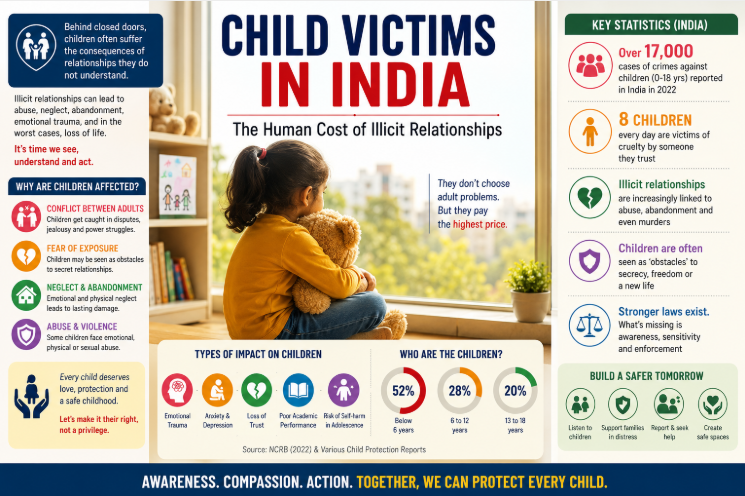
Child victims bear the heaviest cost of India’s growing illicit affair crisis. I open with a simple question: what kind of love demands a child’s death? In 2026, that question is no longer rhetorical. Across India, toddlers and young children are being killed deliberately by a parent’s new partner or lover. I find this deeply troubling because the pattern is now visible. These are not stranger crimes. The threat sits inside the home, beside the child, wearing trust like a mask. So today, I want us to face this truth directly. Then, I want us to think about what we can do next.
I believe awareness is the first step toward protection. Every case here is verified through mainstream Indian reporting. Every statistic comes from credible national sources. As we move through the evidence, hold one thought close. Every child in these stories had a name, a family, and a future. Arshid liked being carried by his grandmother. Vennela called her father every evening. Neither child got the chance to grow up.
💔 Two Faces of a Nationwide Tragedy
Nedumangad, Keralam: Baby Arshid’s 91 Injuries
In late May 2026, Ashkar rushed 18-month-old Arshid to a hospital in Panavoor, Keralam. By the time the doctors got there, it was already too late to save the child. The toddler was declared dead at SAT Hospital, Thiruvananthapuram soon after. The post-mortem then revealed a horror: 91 injuries on a baby’s body, including seven fractured ribs, skull bleeding, burn marks on his genitals and foot, and chest injuries from repeated stamping. Ashkar confessed he had decided to kill Arshid three months earlier. He viewed the child as an obstacle to his relationship with Akhila. Akhila, meanwhile, admitted she watched the beatings and said nothing. Both were arrested – Ashkar for murder and Akhila for abetment, with the SC/ST (PoA) Act also invoked.
What makes this case especially gut-wrenching is the failure of every safety net around the child. A viral video had already shown Arshid with plaster casts on both arms. The grandmother had approached police with concerns about Ashkar’s threats and the child’s injuries. Yet, the warnings were dismissed as bicycle accidents and hot-water mishaps. A child who screamed through broken bones was failed repeatedly – by the system, by the community, and by the adult he trusted most.
Bengaluru, Karnataka: Five-Year-Old Vennela’s Silent Cry
On 24 March 2026, five-year-old Vennela was found dead in Bengaluru’s Seegehalli neighbourhood under suspicious circumstances. Her mother, Priyanka, a 39-year-old advocate, had rekindled a relationship with Mohan G, a college friend and realtor, while separated from her husband, Praveen. The post-mortem revealed assault and suffocation. Investigators found that Vennela had been smothered, reportedly inside a car, by Mohan. Priyanka gave contradictory accounts of her daughter’s death. Investigators also probed whether Vennela’s darker complexion made her unwanted in Priyanka’s new life.
Priyanka initially absconded, moving between Mysuru and a farmhouse in Sakleshpur, before police arrested her in June 2026. Mohan was arrested as the prime accused. What disturbs me most is the coldness of the act. This was not impulsive rage. It was planned concealment by an educated professional who understood legal systems well. The case also took nearly three months to be formally treated as murder. That delay itself shows how easily such cases can drift before justice begins.
📊 The Pattern Is National, Not Regional
Documented Cases Across India (2023–2026)
These are not two isolated incidents. They are two visible peaks of a larger pattern. Below is a table of verified cases from 2023 to 2026 where a child was killed because they were seen as an obstacle to a parent’s illicit relationship.
| Year | State | Victim Age | Accused | Method | Motive (as stated by police) | Status |
|---|---|---|---|---|---|---|
| 2026 | Kerala | 1.5 yrs | Mother’s live-in partner + mother | Stamping, beating, burns | Obstacle to their relationship | Both arrested; SC/ST Act invoked |
| 2026 | Karnataka | 5 yrs | Mother’s live-in partner + mother | Assault, suffocation | Relationship + alleged complexion bias | Both arrested; murder case registered |
| 2026 | UP (Meerut) | 7 yrs | Mother’s lover | Lured, abducted, murdered | Obstacle to their relationship | Accused arrested; mother questioned |
| 2026 | UP (Meerut) | 6 yrs | Mother + lover | Murder | Mother conspired with lover | Both arrested; murder + conspiracy charges |
| 2026 | Maharashtra (Pune) | 6 yrs | Mother + live-in partner | Head banged; drowned in bucket | Obstacle to new relationship | Arrested after in-laws alerted police |
| 2025 | Telangana (Medak) | 2 yrs | Mother + lover | Murdered; body buried | Obstacle to their relationship | Case registered; investigation ongoing |
| 2023 | UP (Noida) | 8 yrs | Mother + neighbour | Strangulation | Child discovered mother’s illicit act | Multiple accused, including mother, arrested |
Sources: India Today, Times of India, NDTV, Republic World, New Indian Express, Deccan Herald (2023–2026)
Seven documented cases in under four years. Seven children. Seven perpetrators who used the word “obstacle” – or its exact equivalent. I find it morally staggering that the language of convenience has entered child murder.
When “Love Affairs” Kill: NCRB Data Context 📉
National data show the same moral drift. NCRB’s 2022 Crime in India report shows that love affairs are the third largest motive for murder in India. India Today’s National Crime Records Bureau (NCRB) analysis recorded 3,031 murders linked to love affairs out of 29,193 total murders in 2020 – about 10.4 percent. These are not marginal figures. They show how frequently relationship conflict turns lethal.
Crimes against children are rising sharply too. NCRB data for 2023 recorded 1,77,335 cases of crimes against children, a 9.2 percent jump from 2022, with a rate of 39.9 per lakh children. A long-term analysis found crimes against children have risen nearly tenfold since 2005. Yet, NCRB still does not separately classify child murders by whether a parent’s lover or live-in partner was the killer. That silence in the data is itself a policy failure.
🧠 Why Does This Keep Happening?
Urbanisation, Isolation, and Weak Guardrails
I believe this crisis grows in the gaps created by modern urban life. Rapid urbanisation has weakened the community guardrails that once checked family behaviour. A nuclear family in a high-rise apartment has fewer watchful eyes around it. No aunt asks difficult questions. No neighbour notices bruises for long. Adults can pursue parallel relationships with less social friction than before. Consequently, children become easier to hide, isolate, or silence.
The stigma around divorce also deepens the danger. Many women cannot leave marriages openly. Therefore, they hide new relationships rather than pursue clean legal separation. That secrecy creates pressure on the child, the parent, and the new partner. The child then begins to look like a problem to manage. In that pressure cooker, dehumanisation becomes easier. And once a child becomes a “problem,” violence often follows.
Digital Affairs and the Speed of Danger 📱
Several cases began on smartphones. A woman in northwest Delhi killed her five-year-old daughter in 2024 to marry a man she met on Instagram. The Noida 2023 case involved an affair with a neighbour that the child accidentally discovered. I find this pattern alarming because digital platforms compress the path from attraction to crisis. An affair that once took time now erupts quickly through messages and secret meetings.
Digital relationships also lack social anchoring. Consequently, they can become intense, possessive, and hidden. When a new partner wants exclusivity and a child remains from a prior relationship, the child can start to feel like an obstacle. Unlike older community-based affairs, these are harder to detect early. So intervention often comes too late.
The Psychology of the “Obstacle Child” 🔬
Criminologists describe many of these killings as instrumental violence. The child is not attacked because of personal hatred. The child is removed because they block a relationship. In Nedumangad, Ashkar planned the killing months in advance and tortured Arshid over time. In Pune, a mother allegedly drowned her six-year-old after banging his head on a wall. These were deliberate acts, not flashes of emotion.
As Enakshi Ganguly of HAQ has observed, the child is most vulnerable when adults place their desires above the child’s right to live. I find that warning painfully accurate. These perpetrators do not see a child. They see an obstacle in the path of desire. That dehumanisation builds through possessiveness, secrecy, and silence. Once everyone stays quiet, the child stands alone.
🔍 The Mother’s Role: The Hardest Conversation
When Protection Fails
I will not soften this point: in most documented cases, the biological mother is either a co-accused, an abettor, or a witness who fails to act. In Nedumangad, Akhila admitted she watched Ashkar beat Arshid and did nothing. In Noida, a mother allegedly strangled her own eight-year-old son. In Meerut, a mother allegedly conspired with her lover to kill her six-year-old son. In Pune, the mother herself joined the killing. These are not rare exceptions. They form a pattern within the pattern.
Several forces push mothers toward this catastrophic failure of duty. Economic dependence on the new partner creates fear of abandonment. Prior domestic violence can distort judgment and self-protection. Social stigma around divorce and extramarital relationships in India adds shame and secrecy. Some women may also feel trapped by coercive control from the new partner. None of this excuses the crime. But it helps explain why the child becomes disposable.
How the Law Sees Maternal Filicide
India has no separate law for child murder linked to illicit relationships. Courts instead use general murder, abetment, and evidence-destruction provisions. Cases involving torture and premeditation usually attract severe charges. However, sentencing still varies widely across states and judges. There is no standard legal lens for this specific kind of filicide.
Justice Madan B. Lokur has argued that child protection in India remains illusory until the state moves from complaint-driven action to prevention-driven action. I agree with that diagnosis. In maternal filicide cases, the child has no voice and no time. The system must anticipate danger before the child disappears. Sadly, in India, the response is only after the damage is already done.
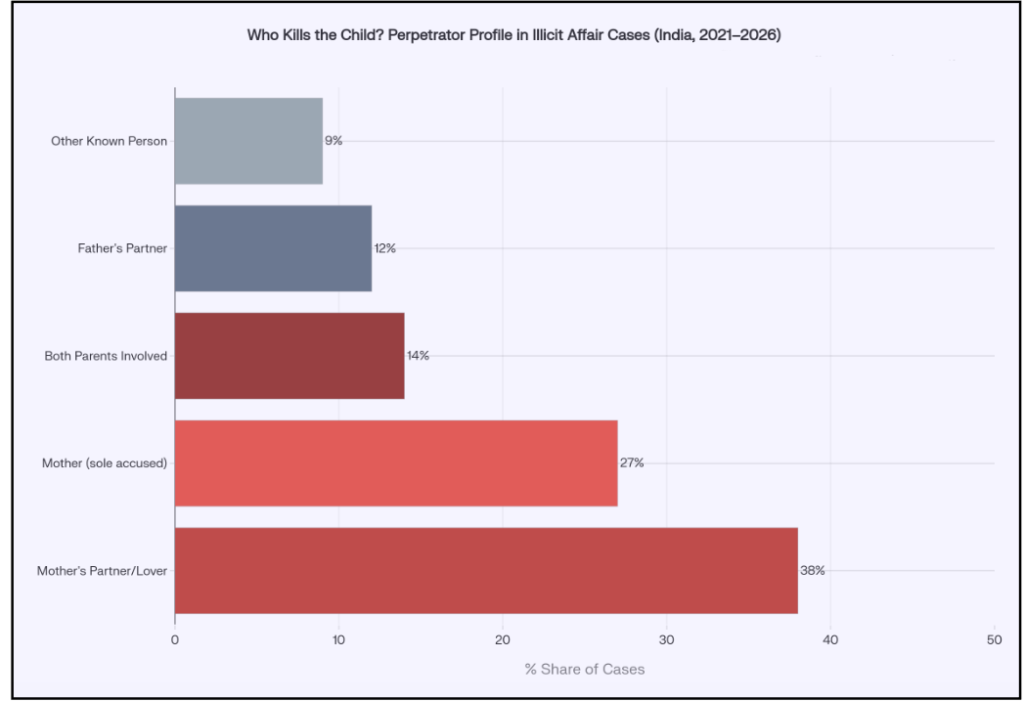
Sources: India Today, Times of India, NDTV, Republic World, New Indian Express, and Deccan Herald case analyses (2021–2026)
⚖️ A Framework That Looks Good on Paper
India’s Child Protection Laws: Strong Words, Weak Action
India’s child protection framework is impressive on paper. The Protection of Children from Sexual Offences (POCSO) mandates child-friendly procedures and strict penalties for sexual offences. The Juvenile Justice Act creates Child Welfare Committees in every district. Mission Vatsalya, CHILDLINE 1098, and Women’s Helpline 181 complete the architecture. However, almost all of it is reactive. It responds to complaints and crises. It does not proactively identify at-risk children living in danger.
Mandatory reporting also remains uneven. Under POCSO, people who know about a sexual offence must report it. For physical abuse and neglect, the duty is far weaker and less enforced. So a neighbour who sees repeated bruises may feel helpless or afraid to act. A teacher may assume the family knows best. This is how warning signs vanish into silence.
When Warning Signs Are Ignored 🚦
The Nedumangad case shows how every safety net failed together. The grandmother warned police. A viral video showed Arshid with plaster casts. Doctors treated several injuries over time. Still, no one stitched the signs together quickly enough. In Pune, it was the in-laws who finally alerted police after noticing injuries. In both cases, the child was not saved by the system. Concerned relatives saved the day – and even then, too late in one case.
By contrast, countries like the UK and Australia use multi-agency safeguarding protocols. A suspicious injury in a young child can trigger automatic review by hospitals, police, and social workers. India still lacks that integrated response. Child Welfare Committees are also underfunded, understaffed, and overloaded. Meanwhile, crimes against children keep rising faster than protection systems can adapt.
📈 What the Numbers Show
Key Data Points
- Total crimes against children in 2023: 1,77,335.
- Year-on-year increase from 2022 to 2023: 9.2 percent.
- Crime rate in 2023: 39.9 per lakh children.
- Murders linked to love affairs in 2020: 3,031 of 29,193 murders.
- Share of murders linked to love affairs in 2020: 10.4 percent.
- Love affairs’ rank as murder motive in NCRB 2022: third.
Source: NCRB Crime in India Reports (2019–2023); India Today Data Intelligence Unit; mainstream case analyses (2021–2026)
These numbers matter because they prove the problem is structural. The pattern is not anecdotal, but measurable.
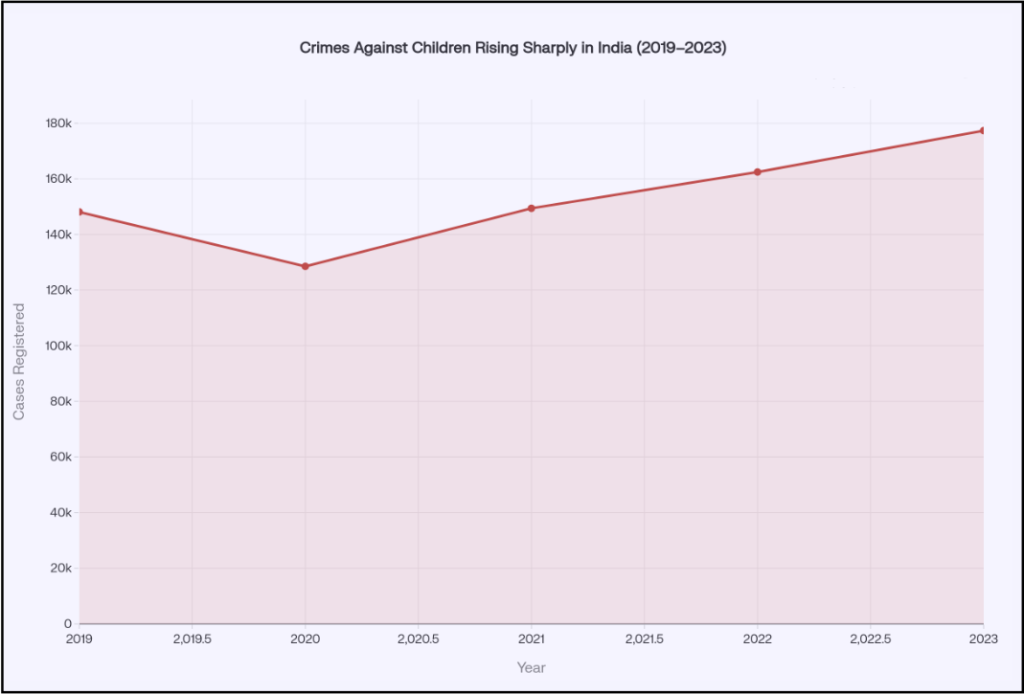
Source: NCRB Crime in India Reports (2019–2023)
🛡️ What Must Change Now
Personal and Social Responsibility
I believe change begins closest to home. If you know a child living with a new partner in the household, pay attention. Notice bruises that keep reappearing. Notice a child who suddenly stops talking. Notice fear around one adult in the home. These signals matter. A grandparent’s alarm is not “family drama.” It may be life-saving intelligence.
We also need to destigmatise legal separation. When divorce becomes socially acceptable, adults are less likely to hide new relationships. Secrecy creates danger. Open separation is still painful, but it is safer for children than hidden attachments. Families must stop forcing people to “adjust at any cost.” Sometimes that cost is a child’s life.
Policy and Systemic Reform 🏛️
I want to be specific here because vague reform language helps no one. First, mandatory reporting must extend to severe physical abuse, not only sexual offences. Second, India needs multi-agency safeguarding protocols that automatically link hospitals, schools, police, and Child Welfare Committees. Third, NCRB must classify child murders by victim-perpetrator relationship and motive. What is not counted cannot be fixed.
Fourth, Mission Vatsalya and the Integrated Child Protection Scheme need stronger budgets and accountability. Fifth, fast-track courts should handle child murder cases with trained prosecutors. Sixth, counselling services should be accessible for parents in unstable or coercive relationships. These steps will not solve everything overnight. However, they would reduce the chances that a child becomes an “obstacle” in a violent adult relationship.
Every Child Deserves to Be More Than Someone’s Problem 🌟
Child victims in India carry a burden no child should ever carry. They are not dying in accidents. They are being erased by adult decisions, adult secrecy, and adult cruelty. I have shown you the cases of Arshid and Vennela. I have shown you the wider pattern in Meerut, Pune, Medak, Noida, and Delhi. I have shown you the NCRB data that turns shock into evidence. And I have shown you the legal and social gaps that let this happen again and again.
So here is what I ask of each of us. Save CHILDLINE 1098 in your phone. Use it the moment you suspect a child is in danger. Share this story in your groups without turning it into gossip. Talk to your children about safe adults and safe spaces. Ask your elected representatives what their district Child Welfare Committee has actually done this year. Stay alert, stay vocal, and stay unwilling to look away. The next child who might be called an “obstacle” is alive somewhere right now.
🔴 ExpressIndia.info condemns, in the strongest possible terms, every act of violence against a child in the name of adult desire, convenience, or love. A child is never an obstacle. A child is a life – complete, irreplaceable, and sacred. We stand firmly with every child victim and pledge to keep exposing this crisis until India’s children are truly safe.
📞 Act Now — Helplines
- 🆘 CHILDLINE: 1098
- 👩 Women’s Helpline: 181
- 🚨 Police Emergency: 112
- 🏛️ NCPCR: ncpcr.gov.in | complaint.ncpcr.gov.in
#ChildVictimsInIndia #ProtectOurChildren #IllicitAffairsMurder #ChildSafetyIndia #ExpressIndiaInvestigates