
The System That Was Supposed to Fix Everything
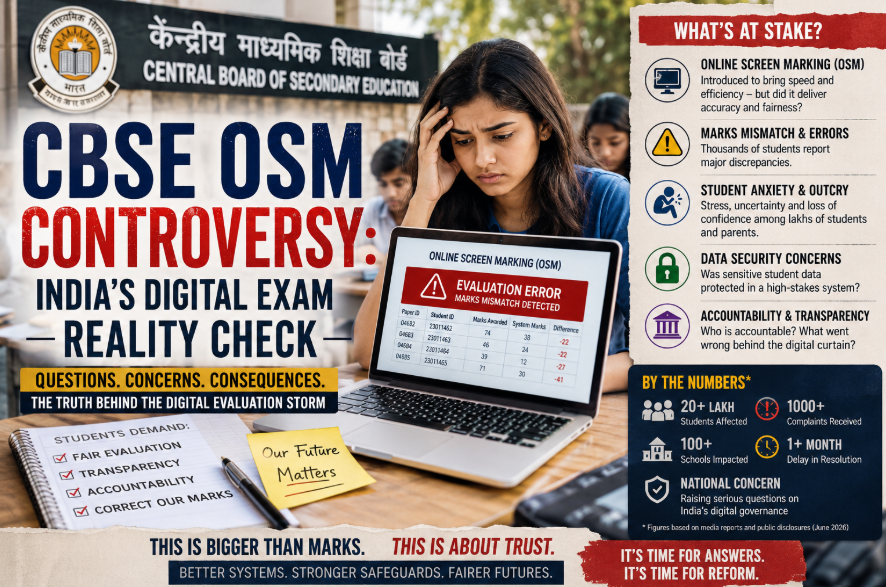
🚨 The CBSE OSM Controversy didn’t begin with a scandal – it began with a promise. In 2026, CBSE rolled out its On-Screen Marking system (OSM) to 2.28 million Class 12 students, pledging faster results, zero totalling errors, and greater transparency. Consequently, the exact opposite followed: blurred scans, portal crashes, cybersecurity breaches, and procurement questions shook India’s largest school board to its foundations. I find it hard to believe that a board managing millions of futures could deploy an untested digital system at national scale without a robust safety net. Moreover, the CBSE OSM Controversy didn’t just expose technical gaps – it laid bare a governance culture that routinely prioritises timelines over student welfare.
Strikingly, the controversy went viral not because of a whistleblower inside CBSE, but because millions of students simply opened their result PDFs and gasped. Furthermore, a Class 12 student named Vedant Shrivastava described staring at a blurred, illegible scan of what was allegedly his Physics answer sheet – a sheet that showed marks deducted for questions that bore no examiner annotations whatsoever. Notably, the 2026 pass percentage of 85.2% – the lowest in seven years – wasn’t just a statistic. Above all, it was a signal that something had gone deeply, systemically wrong. I believe this story deserves more than outrage – it demands analysis, accountability, and, crucially, reform.
What Is OSM? The Technology Behind the CBSE OSM Controversy
🔑 On-Screen Marking is an elegantly simple idea that education boards execute at terrifying scale. Under the On-Screen Marking system India follows, education boards first collect physical answer booklets from exam centres across the country. Next, high-speed scanners digitise every page, anonymise them with dummy numbers, and upload them to a secure image server. Examiners then log into a dedicated application, select their allotted scripts, and enter question-wise marks into on-screen fields. Consequently, the software auto-calculates totals and removes the traditional human totalling errors that have plagued board exams for decades. Moreover, controllers can monitor evaluators’ progress in real time, reassign scripts, and generate item-level performance analytics.
Evidently, the concept has global credibility. Furthermore, major UK exam boards – AQA, OCR, Edexcel, Cambridge International – have used large-scale on-screen marking for GCSEs and A-levels for years, often at the individual question level. Research commissioned by Ofqual found that OSM reduces clerical errors and enables tighter quality control. However, it also increases cognitive workload for examiners unfamiliar with digital workflows. In contrast, India’s CISCE board introduced a hybrid digital-pen system as early as 2016, combining physical marking with digital mark capture. Remarkably, CBSE chose to leap directly to full-scale digital evaluation without a phased rollout – and without, it appears, adequately stress-testing what happens when the system breaks. The CBSE OSM Controversy is, in part, the story of what that gamble cost 2.28 million students.
🔍 CBSE OSM Controversy: A Timeline of Failures
🤔 How does a system designed to protect students end up harming them? The answer, as the CBSE OSM Controversy shows, lies in a chain of decisions that began over a year before anyone saw a result. In early 2025, CBSE floated a tender to outsource OSM services for Class 12 answer-script scanning and digital evaluation. Meanwhile, student researcher Sarthak Sidhant would later allege – using publicly available PDFs – that tender conditions were modified between earlier and final versions in ways that allegedly relaxed blacklisting, eligibility, and performance requirements. By December 2025, CBSE awarded the contract to a relatively lesser-known firm called Coempt Eduteck, just 66 days before announcing the nationwide OSM rollout on February 9, 2026. Consequently, many examiners reportedly received formal notice of the new OnMark platform only days before the evaluation window opened – a detail that, in hindsight, explains much of what followed.
The Class 12 exams proceeded in traditional pen-and-paper format through February and March 2026, after which approximately 40 crore pages of answer scripts were scanned and uploaded to the OnMark platform. CBSE declared results on 13th May 2026 – an 85.2% pass rate, the lowest in seven years, with steep drops in Physics, Chemistry, Biology, and Mathematics. Moreover, the portal for verification, photocopies, and re-evaluation opened around 19th May and crashed within hours. By 23-24th May, complaints about blurred scans, missing pages, and unchecked answers flooded X, Instagram, and YouTube. Shockingly, students shared screenshots of the portal quoting erroneous fees of ₹69,420 for re-evaluation. Furthermore, by 2nd June, CBSE Chairman Rahul Singh and Secretary Himanshu Gupta had been transferred. Consequently, Delhi High Court issued a formal notice on 8th June 2026, with the matter listed for hearing on 12th June 2026.
CBSE OSM Controversy – Complete Timeline of Key Events
| Date | Event | Significance |
|---|---|---|
| Early 2025 | CBSE floats OSM tender | Sets procurement process in motion |
| December 5th, 2025 | Contract awarded to Coempt Eduteck (₹25.39 cr) | Just 66 days before nationwide rollout announcement |
| February 9th, 2026 | Nationwide OSM rollout announced | Examiners given little lead time |
| Feb–Mar 2026 | Class 12 exams conducted (pen-and-paper) | ~40 crore answer pages scanned subsequently |
| 13th May 2026 | Results declared; pass% = 85.2% | Lowest in 7 years; science subject drops alarming |
| 19th May 2026 | Re-evaluation portal opened | Crashed within hours of launch |
| 23–24th May 2026 | Complaints go viral on social media | Blurred scans, mismatches, wrong fees exposed |
| Late May 2026 | Whistleblowers Sarthak Sidhant & Nisarga Adhikary go public | Tender and cybersecurity angles emerge |
| 29th May 2026 | CBSE penalises Coempt Eduteck | Show-cause notice issued to vendor |
| 2nd June 2026 | Chairman Rahul Singh & Secretary Himanshu Gupta transferred | New Chairman: Lokhande Prashant Sitaram |
| 2nd June 2026 | S. Radha Chauhan inquiry committee formed | Report due ~2 July 2026 |
| 8th June 2026 | Delhi High Court issues formal notice | Hearing held on 12th June 2026 |
Source: Compiled from NDTV, Times of India, The Wire, India Today, 2026
⚖️ Delhi High Court Speaks: Justice, but Not at the Cost of Admissions
🚨 The Delhi High Court’s June 12 hearing delivered the CBSE OSM Controversy‘s most consequential judicial moment yet, and its verdict offered 1.6 lakh students a hard, uncomfortable truth. Petitioners asked the Court to reopen the re-evaluation and verification portal, arguing that tens of thousands of students had already lost access because repeated crashes, payment failures, and technical errors hurt them, not CBSE. Consequently, the bench declined the plea because reopening the portal at this stage would delay final results. Furthermore, the Court said that any further delay in result processing would push back college admissions and could harm an even larger group of students. Strikingly, the judgment put the wider student population – including those waiting for admissions – ahead of those still seeking portal access, while still refusing to let CBSE off the hook. At the same time, the Court issued a formal notice and demanded a detailed explanation for how the system failed so badly in the first place.
What strikes me most about this ruling is the impossible choice it exposed: two kinds of student harm, both born from the same institutional failure. Moreover, the hearing made clear that the Delhi High Court is not closing the matter; it is shifting from procedural relief to systemic accountability. Notably, CBSE must now answer for the scan failures, portal crashes, erroneous fee displays, and vendor performance — or lack of it. Equally important, the Court’s concern about admission timelines showed that the re-evaluation results, expected in July 2026, already sit dangerously close to university deadlines. Disturbingly, for JEE-qualified students whose board marks fell below cut-offs because of alleged evaluation errors, every day without corrected marks brings them closer to a missed seat. Nevertheless, the ruling sets one crucial precedent: the CBSE OSM Controversy now sits firmly under judicial scrutiny, and CBSE can no longer wait for the storm to pass.
CBSE OSM Controversy – Scale of Failures and Student Impact
| Failure Type | Scale | Student Impact |
|---|---|---|
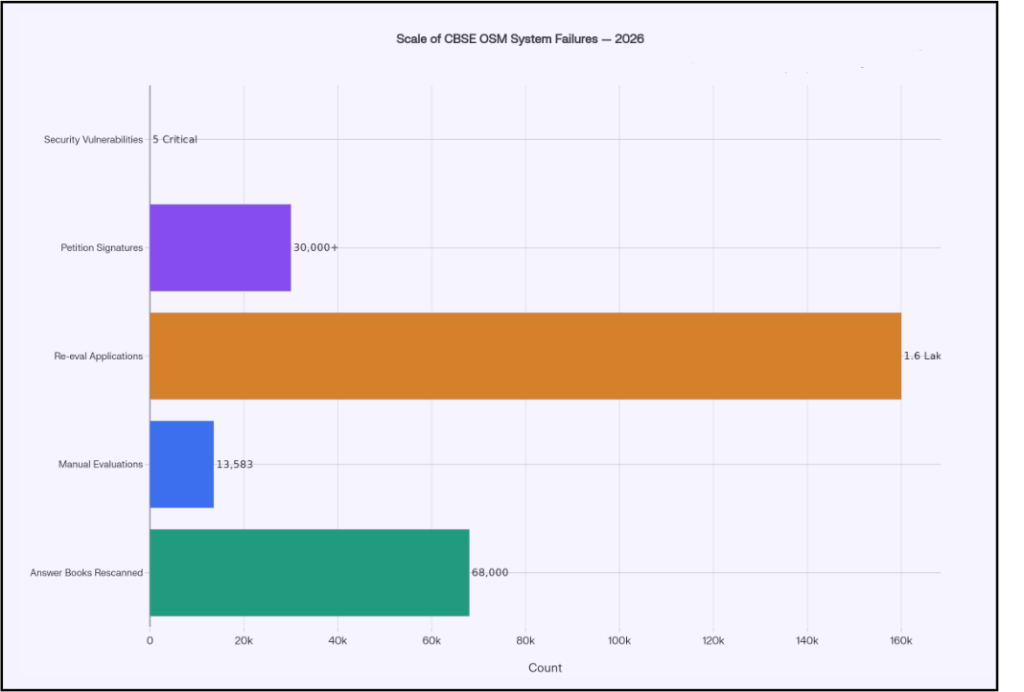
| Answer books rescanned | 68,000 | Poor image quality delayed trust in the system and raised doubts about marks. |
| Manual evaluations outside OSM | 13,583 | Examiners had to rescue scripts that the digital process could not handle. |
| Re-evaluation applications | 1.6 lakh+ | Massive demand showed widespread student distrust after results. |
| Erroneous fee display | ₹69,420 | Students faced payment confusion and portal-level absurdity. |
| Security vulnerabilities found | 5 critical flaws | Students feared data exposure and account misuse. |
| Petition signatures | 30,000+ | The controversy became a coordinated student grievance movement. |
| States with major complaints | 5+ | The problem was not localised; it spread across multiple regions. |
Sources: CBSE official statements, NDTV, Hindustan Times, Times of India, 2026
Blurred Pages, Crashed Portals, and Shattered Dreams
🚨 1.6 lakh students applied for re-evaluation by the time the portal closed on 7th June 2026. That number alone should make every education policymaker pause. The CBSE Class 12 digital evaluation failures fell into several distinct and damaging categories. First, blurred or unreadable scans: students received answer copies where handwriting was so dark or smeared that individual words were indecipherable, raising obvious questions about how examiners could have marked them at all. Worryingly, missing pages surfaced in multiple cases – students insisted they had written answers that simply did not appear in the scanned PDFs. Beyond that, instances emerged where fully attempted long-answer questions carried no examiner annotations. Yet, marks were still deducted, directly contradicting OSM’s core promise of step-wise marking.
Equally alarming, the CBSE re-evaluation 2026 portal became its own disaster zone. Students who managed to reach the payment gateway encountered an erroneous fee display of ₹69,420 – an amount that would be laughable if the stakes weren’t so high. Meanwhile, 68,000 answer books required rescanning due to poor image quality, while 13,583 were ultimately evaluated manually outside the OSM pipeline entirely. Consequently, the system that was supposed to eliminate human error ended up requiring more human intervention than the old method. I cannot help but ask: if the pilot tests revealed scan quality issues in Delhi – as reported by Times Now – why did CBSE still deploy at full national scale? Disturbingly, at least 23 confirmed cases of answer-sheet mismatches emerged, where students received someone else’s paper entirely. The CBSE OSM Controversy had crossed from inconvenience into injustice.
Sources: The Wire, Sarthak Sidhant’s research blog, media investigations, 2026
The Tender Scandal: Who Won the Contract – and How?
😏 Apparently, CBSE decided the best way to handle the most consequential evaluation in a student’s life was to award the contract – 66 days before rollout – to a company that allegedly benefited from quietly rewritten eligibility rules. That is not satire. That is, according to student researcher Sarthak Sidhant and corroborating media investigations, what the India digital exam governance record appears to show. Sidhant, a Class 12 student himself, published a meticulous blog comparing older and newer versions of CBSE’s OSM tender documents, alleging that blacklisting criteria, minimum-experience conditions, and performance-linked penalty clauses were relaxed or removed in the final version. Remarkably, his findings were picked up by NDTV, Times of India, and India Today – not because he was a seasoned journalist, but because his document audit was simply that precise. Critics allege that these modifications disproportionately favoured Coempt Eduteck over larger, more experienced IT firms, including TCS, which had also reportedly participated in the bidding process.
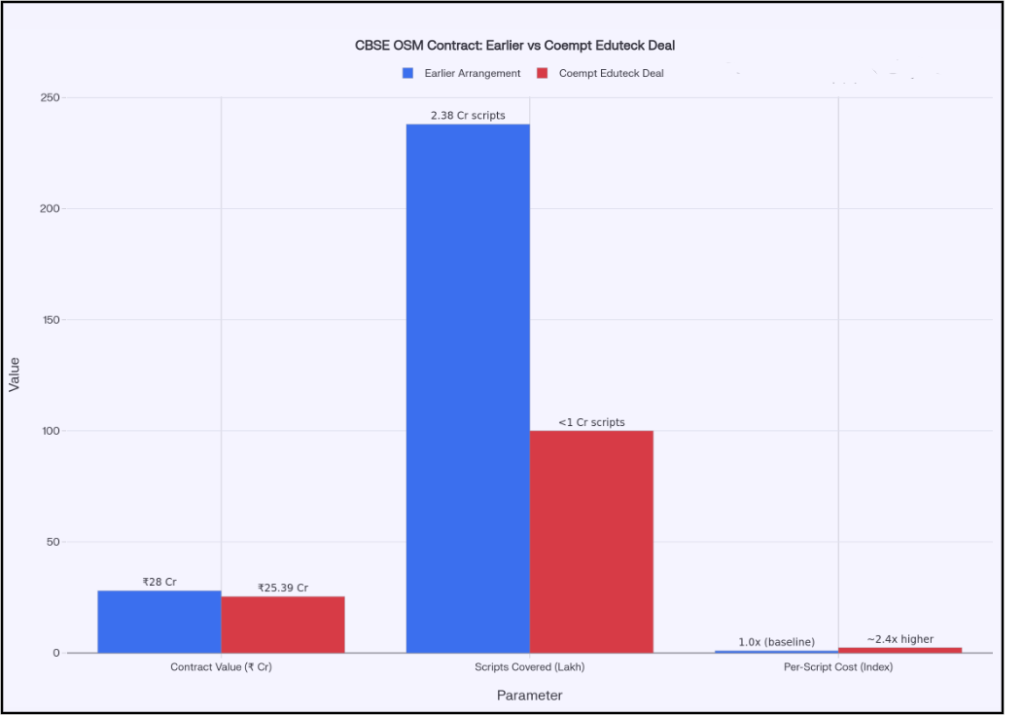
The Wire’s analysis of the financial terms adds another troubling layer. Under the earlier arrangement, CBSE paid approximately ₹28 crore to scan 2.38 crore scripts – roughly ₹11.8 per script. Under the Coempt Eduteck deal, the board paid ₹25.39 crore for fewer than one crore answer books – implying a per-script cost of approximately ₹25.4, more than double the earlier rate. Consequently, taxpayers paid significantly more per script for a system that delivered significantly less reliability. Notably, the Ministry of Education subsequently sought a detailed report from CBSE on the tender criteria, contract award, and performance monitoring – a step that implicitly acknowledged that standard due diligence may not have been adequate. Nevertheless, CBSE maintained publicly that all procedures were followed. The S. Radha Chauhan one-member inquiry committee was formed on 2nd June 2026 with a report due around 2nd July. Importantly, it will need to answer this question with far more specificity than CBSE’s public statements have offered so far.
Sources: CBSE official statements, NDTV, Hindustan Times, Times of India, 2026
🔐 CBSE OSM Controversy Meets Cybersecurity: Hack Without Warning
💡 Here is something that should fundamentally alter how you think about the CBSE OSM Controversy: the most serious warnings came not from inside CBSE, but from a 19-year-old sitting at a laptop. Nisarga Adhikary, an ethical hacker, identified at least five critical vulnerabilities in CBSE’s OSM/OnMark portal as early as 25th February 2026 – three months before the results were even declared. Consequently, he reported every one of them to CERT-In and separately to CBSE. The vulnerabilities he described included weak authentication flows prone to OTP bypass, endpoints that could manipulate examiner privileges, hard-coded or predictable passwords, and pathways that could allow attackers to view or potentially alter assigned answer scripts. As Adhikary later told NDTV: “I reported these vulnerabilities in February. Nobody listened until the damage was done.” What makes this admission devastating is not just the indifference – it is the timeline. Furthermore, CBSE was warned before a single answer book was evaluated online.
Subsequently, Adhikary demonstrated one exploit publicly by playing the “Bad Apple” meme within a CBSE portal interface – a demonstration that combined technical proof with the kind of dark humour that only a teenager can pull off. Moreover, subsequent reporting by Gulf News and others described a misconfigured cloud server that allegedly exposed some answer-sheet and question-paper data, though the full extent of that exposure remains under investigation. Cyber activists approached the National Human Rights Commission, arguing that alleged data exposure violated student rights and India’s Digital Personal Data Protection Act, 2023. Strikingly, CBSE eventually acknowledged “identified vulnerabilities” linked to the vendor’s OnMark portal and claimed they had been contained – but released no detailed technical report. By extension, the CBSE OSM Controversy is also a serious data governance story. What is more, Adhikary’s vindication arrived on 10th June 2026, when IIT Kanpur’s C3iHub hired him as an OSINT and Threat Intelligence Engineer – a fitting epilogue for someone the system tried to ignore.
🎓 The Human Cost: Students Caught in a Digital Storm
The CBSE OSM Controversy always had a human face – and it looked like every Class 12 student who opened their result on 13th May and felt the floor drop. Consider the documented case of students who had cleared JEE – India’s most competitive engineering entrance – only to discover their board marks had fallen below university cut-offs because of evaluation anomalies. Consequently, the temporal mismatch between re-evaluation timelines (results expected July 2026) and admission deadlines has left thousands of students in an agonising limbo. Worryingly, the re-evaluation process – theoretically a safeguard – became its own ordeal: portal crashes made applications nearly impossible to submit; high initial fees created financial barriers; and blurred re-evaluation copies gave students little confidence that the system would correct itself. For young people dealing with post-exam anxiety, this spiral of administrative failure on top of academic uncertainty has been psychologically crushing. Obviously, exam stress among Indian teenagers is already reaching alarming proportions.
Protests broke out across Delhi, Nagpur, Maharashtra, Karnataka, and Jharkhand, five states with concentrated complaint clusters. Furthermore, more than 30,000 students signed a petition that demanded comprehensive re-evaluation and ministerial accountability. Notably, Al Jazeera covered the story as part of a broader pattern of youth frustration with India’s exam governance. Meanwhile, parents described how their children relived the stress of the exam itself – this time not to pass it, but to prove they had. Remarkably, on 26th May 2026, Education Minister Dharmendra Pradhan eventually acknowledged the scale of distress and said, “I take moral responsibility for the inconvenience caused to students,” a rare admission that implicitly confirmed the failures were neither minor nor imagined. However, moral responsibility changes little without structural accountability for a student who has already missed an admission deadline because the system blurred an answer sheet beyond recognition.
Governance on Trial: Is This an Isolated Failure?
🤔 Is the CBSE OSM Controversy a one-off disaster, or is it a symptom of a deeper pathology in how India governs its digital public infrastructure? I have been watching Indian exam controversies for years, and the pattern is unmistakable. The NEET exam paper leakexposed nearly identical governance failures: ambitious digitisation goals, opaque procurement, rushed deployment, and inadequate internal oversight. Consequently, what CBSE attempted with OSM was not inherently wrong – digital evaluation is the future, as the government correctly maintains. Nevertheless, the execution reflected a governance culture that prioritises the optics of modernisation over the mechanics of it. Pilot runs in Delhi reportedly revealed scan quality issues and examiner adaptation gaps months before the national rollout. Still, CBSE proceeded without a phased or hybrid deployment model. This is not incompetence in isolation; it is institutional overconfidence at scale.
The India digital exam governance failure here connects to a broader accountability gap. Furthermore, without full public disclosure of evaluation criteria, contract performance metrics, and security audit reports, citizens cannot assess whether CBSE selected or managed its vendor responsibly. In contrast, the UK’s Ofqual maintains a publicly accessible framework for digital assessment standards, and Cambridge Assessment has documented years of phased on-screen marking adoption across subjects. As the New Indian Express editorial board pointedly observed on 3rd June 2026: “CBSE must answer hard questions posed by the OSM controversy.” What is more, the political response itself has been revealing – transferring top officials is a signal of accountability, but it is also a way of containing the story without changing the system. Beyond that, one is tempted to compare this pattern of performative accountability to what we explored in our satirical examination of the Cockroach Janata Party – where institutional theatre substitutes for genuine reform. The CBSE OSM Controversy will be judged not by who was transferred, but by what was actually fixed.
🛠️ CBSE OSM Controversy: Reforms India Cannot Afford to Ignore
The CBSE OSM Controversy has produced a rare moment of genuine reform pressure – and wasting it would be a tragedy. Across petitions, court filings, and media analysis, a coherent reform agenda has emerged that goes far beyond technical patches. First and most immediately, the government must ensure that re-evaluation results arrive before university admission deadlines – a logistical imperative that is also a basic justice obligation. Furthermore, the S. Radha Chauhan inquiry committee must produce a report that is fully public, not a document that quietly circles internal desks. Moreover, an independent audit of the Coempt Eduteck tender – conducted by a body entirely outside CBSE’s supervisory chain – is the minimum credibility threshold for restoring institutional trust. Notably, the IIT expert panel already convened signals the right instinct, but its mandate, timeline, and reporting structure must be made transparent.
The deeper structural reforms are where the real work lies. India needs, urgently, the equivalent of the UK’s Ofqual – an independent, arm’s-length body that sets CBSE Class 12 digital evaluation standards and audits examination boards without political interference. Equally important, any future digital exam system must undergo third-party security audits before deployment, not after a teenager publicly demonstrates its vulnerabilities. Strikingly, the On-Screen Marking system that India adopts going forward should follow a phased model: pilot with limited subjects, scale with verified scan quality, deploy nationally only after two full cycles of independent review. Furthermore, the government has rightly stated that “OSM is the future” – and I agree. However, what I disagree with is deploying the future on students who had no say in the experiment. Above all, procurement transparency – published tender criteria, scoring matrices, and post-award performance dashboards – must become non-negotiable for any public digital contract of this scale.
CBSE OSM Reform Roadmap – From Current Gap to Recommended Action
| Reform Area | Current Gap | Recommended Action | International Model |
|---|---|---|---|
| Phased Rollout | National deployment without adequate piloting | Pilot per subject → 2-cycle review → national scale | Cambridge Assessment (UK) gradual adoption |
| Procurement Transparency | No public tender scoring or performance metrics | Publish criteria, scoring, and post-award dashboards | Central procurement portals (UK, Australia) |
| Independent Oversight Body | CBSE self-regulated; no external standard-setter | Establish Ofqual-equivalent for Indian exam boards | Ofqual (UK) |
| Cybersecurity Mandate | No documented pre-deployment security audit | Mandatory third-party pen-test; CERT-In certification | NCSC (UK) standards for critical infrastructure |
| Grievance Redressal | Portal crashes; high fees; delayed re-evaluation | Time-bound process; proactive correction statistics | Australian ATAR review model |
| Vendor Accountability | Performance clauses allegedly softened | Reinstate strong penalty clauses; blacklisting criteria | European public procurement directives |
Sources: Education policy analysts; Cambridge Assessment; Ofqual (UK); NDTV; New Indian Express, 2026
Fix the System or Fail the Future
The CBSE OSM Controversy is, at its heart, a story about what happens when the state digitises without accountability. Consequently, fixing this requires action at three distinct levels – not press conferences, not transfer orders, but structural, measurable, time-bound change. At the individual level, students and parents must exercise every right available: file RTI applications demanding tender documents and audit reports; document grievances with screenshots; join petitions; and write directly to their Members of Parliament. Furthermore, educators must refuse to be complicit in rushed digital deployments – flagging concerns formally and publicly when pilot results don’t justify national rollout. Strikingly, Nisarga Adhikary – a 19-year-old who did exactly what every responsible citizen should do – reported vulnerabilities, was ignored, and was ultimately vindicated by IIT Kanpur. His story is an example, not an exception.
At the institutional level, CBSE and the Ministry of Education must deliver: a public inquiry report from the S. Radha Chauhan committee by 2nd July; an independent tender audit; a mandatory cybersecurity framework for all national exam digital systems; and a phased OSM roadmap for 2027 that has been reviewed by the IIT expert panel and subjected to public consultation. At the social level, the CBSE OSM Controversy must shift India’s relationship with digital public infrastructure accountability permanently. Moreover, we as a society must stop treating systemic failures in education as technical glitches and start treating them as governance crises that demand consequences. The India digital exam governance standard cannot remain – as it has been – a race to deploy rather than a commitment to protect. Looking ahead, the inquiry committee report, and the re-evaluation results expected in July will each be a test of whether this system has the capacity to correct itself. I, for one, am watching this unfold very closely, because what happens next will reveal whether the system has learned anything at all.
At ExpressIndia.info, we believe no student’s future should ever depend on a rushed system that was not tested with enough care, transparency, or accountability. If India wants a digital exam future that deserves public trust, it must prove that technology serves students first — not the other way around.
📢 Express your opinions in the Comments. Share this blog. Write to your MP. File an RTI. Demand that re-evaluation results reach students before admission deadlines. And above all – hold this system accountable.
#CBSEOSMControversy #CBSEClass12 #OnScreenMarking #IndiaEducationFail #DigitalIndiaReality