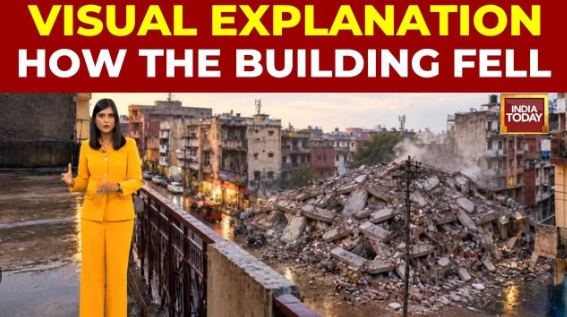
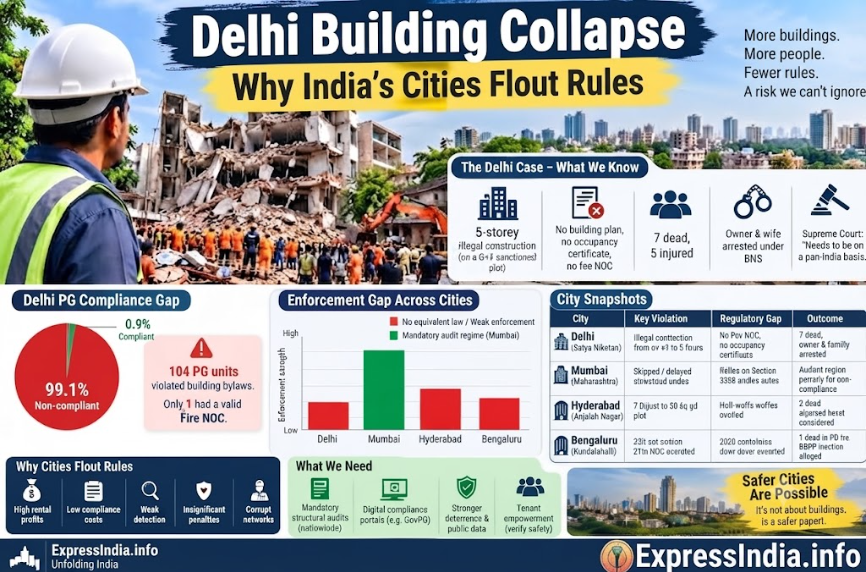
The Satya Niketan Building Collapse headlines hit my feed on a lazy Sunday afternoon, and I confess I froze mid-scroll. I watched a grainy video. A five-storey hostel folded into dust within seconds. This happened in Satya Niketan, barely a stone’s throw from Delhi University’s South Campus. Seven young people never walked out of that rubble, and five others carried injuries that will outlast the news cycle. I kept asking myself an uncomfortable question that Sunday: how many more Satya Niketans exist quietly across India right now? This Delhi building collapse is less a freak accident. It is more a mirror India desperately needs to look into.
Something about the scale of denial struck me hardest. I doubt I was alone in that reaction. Officials rushed in with condolences. Arrests followed within hours. Yet, nobody seemed shocked that a building had ballooned illegally from one sanctioned floor to five. I found myself thinking hard. If this can happen barely a kilometre from one of India’s most prestigious universities, what chance do less-watched neighbourhoods stand? Bengaluru’s IT corridors, Hyderabad’s Gachibowli belt, and Mumbai’s ageing housing stock all carry their own quieter versions of this exact story. Illegal construction, it turns out, is less an exception. It is more an unspoken business model across urban India. PG safety rarely factors into that calculation at all. Delhi has faced this reckoning before, from the deadly railway stampede that exposed similar administrative foresight failures and unchecked crowd density.
The Delhi Building Collapse: What We Actually Know
Let me walk you through the confirmed facts first, because speculation has already run wild enough on social media. The collapsed structure in Satya Niketan stood on a modest fifty-to-fifty-five square yard plot. Decades ago, it was sanctioned only as ground-plus-one, under a resettlement scheme. Somewhere along the way, four additional floors appeared without any fresh sanction. A humble home slowly turned into a densely packed boys’ PG called Hostel Daze. Police investigation has now pinned down exactly what triggered the collapse: three truckloads of debris were dumped into the basement to level it with the ground floor during renovation, and on the day of collapse, workers removed a ground-floor wall that had been obstructing space meant for a shop. One investigating officer put it plainly: “The building could not withstand the load after the wall was removed and ultimately collapsed.” That single sentence turns weeks of speculation about this Delhi building collapse into a police-confirmed sequence of cause and effect.
What is confirmed about this Delhi building collapse, though, paints a damning picture no matter how the final forensic report reads. The Municipal Corporation of Delhi (MCD) admitted this much in its own preliminary findings. None of the paperwork existed for this building: no sanctioned plan, no occupancy certificate, no fire NOC. Delhi Police registered an FIR under Bharatiya Nyaya Sanhita sections covering culpable homicide. They arrested owner Hariram along with his wife Urmila within days, and a Delhi court remanded the couple to 14 days of judicial custody. The net has since widened. Their son Mahesh, labour contractor Sanoj Kumar, and PG operator Sudhanshu Lovneesh were all produced in court and handed two more days in police custody for further questioning. Justice Ahsanuddin Amanullah heard related petitions before the Supreme Court. He remarked that “it has to be on a pan-India basis.” That single line signalled something huge. This Delhi building collapse might reshape building law nationwide, not just in one neighbourhood.
Doesn’t that phrase “pan-India basis” make you pause for a second? I certainly paused when I first read it, because it suggested something larger than routine outrage. As of today, September 10th, the Supreme Court has actually ruled on this question. A bench of Justices Amanullah and R. Mahadevan decided against transferring the case away from the Delhi High Court, noting that “things have started moving” and that the High Court should keep monitoring compliance at short intervals instead. The matter now returns on September 15th, when Delhi and Lucknow’s civic authorities must submit fresh compliance affidavits. Suddenly, this single collapse felt less like an isolated horror story. It felt more like the opening chapter of a truly national reckoning, one the courts are now actively supervising rather than merely discussing.
Why India’s Cities Flout Building Rules So Brazenly
Here comes the part I find truly infuriating yet strangely logical once you follow the money. Landlords across student hubs like Mukherjee Nagar, GTB Nagar, and Satya Niketan discovered this long ago. Converting an ordinary home into a paying-guest facility multiplies rental yield dramatically. Crucially, current Delhi regulations do not even require a dedicated PG licence for most such conversions. This hands landlords a free pass to densify without proportionate oversight. I keep circling back to one particular statistic. It really stunned me. A post-collapse survey found 104 PG units violating building bylaws in the area. Yet, only a single one possessed a valid Delhi Fire Services NOC. Ninety-nine point something percent non-compliance is not an anomaly at that point; it is now the norm.
Money explains most of this illegal construction, but weak deterrence explains why nobody bothers changing course. Consider Mumbai. A mandatory structural audit there costs a housing society somewhere between fifteen and fifty thousand rupees. That is a fairly small sum against years of rental income from an overstuffed building. Compliance costs stay low, detection probability stays lower, and penalties, when they finally arrive, rarely bite hard enough to matter. Architect Arzan Sam Wadia reflected on Mumbai’s skyscraper boom in his old middle-class neighbourhood of Tardeo. He observed that “a large share of these buildings, maybe 60 to 75 percent, are going up in places that would not meet globally accepted planning and urban design standards.” That single admission came from someone who designs landmark towers abroad. It should worry every resident of a dense Indian city.
Bengaluru offers its own darkly creative twist on this same playbook. Investigations into the city’s PG “slums” revealed something calculated. Developers deliberately construct buildings just under the twenty-one-metre threshold. Crossing that line would trigger mandatory fire-safety NOCs under Karnataka’s amended Fire Force Act. Hyderabad’s Gachibowli and Kondapur belt tells an even more audacious version of this story. Unauthorised seven-storey buildings rise on plots as tiny as fifty square yards. Tech workers desperate for affordable beds fill these towers purely out of necessity. Hyderabad Disaster Response and Asset Protection Agency (HYDRAA) officials didn’t mince words about this pattern. They warned that such structures posed “serious risk,” purely because tenant demand from IT staff made overbuilding too profitable to resist. Isn’t it almost poetic, in the darkest possible sense? India’s most modern industries keep housing themselves inside the country’s most reckless buildings. The Delhi building collapse merely gave this old problem a fresh, tragic headline.
The Regulatory Maze Versus Ground Reality
Building bye-law provisions exist in abundance across Indian cities, yet somehow tragedy keeps finding fresh loopholes to exploit. Delhi’s building approvals technically fall under the Municipal Corporation of Delhi. Fire safety sits with Delhi Fire Service Rules from 2010. Structural compliance rests on Unified Building Bye-Laws dating to 2016. Officials probing the Satya Niketan loophole found something almost comically handy for violators. Buildings up to seventeen-and-a-half metres avoid high-rise classification entirely. Owners then cram far more residents inside than any legitimate residential unit would ever house. A legal explainer on Delhi’s PG safety rules noted this bluntly. Many such establishments operate “in the guise of guest houses,” specifically to dodge fire-NOC obligations altogether. This same pattern of weak, state-by-state regulation shows up in daycare centers across India, where only four states have dedicated rules at all.
Enforcement gaps, however, hurt far more than clever legal loopholes ever could. The Supreme Court itself made a scathing observation back in July 2026. It noted that authorities were conducting mere “face-saving exercises.” Builders got arrested, yet officials who allowed violations to flourish stayed untouched. Justice Amanullah pointedly remarked on this failure. High Court orders had restrained construction in certain areas. Yet, “rampant work was done in collusion with MCD.” That sentence alone should make every taxpayer distinctly uncomfortable. MCD’s own Standing Committee Chairperson, Satya Sharma, admitted today that staff shortages had previously delayed action on complaints, even as she announced that immediate orders had now gone out to act on years-pending cases. “We don’t want any such accidents in future,” she told reporters, which is exactly the kind of admission that should have arrived years before seven people died, not after. Hyderabad’s Cyberabad authorities had reportedly issued halt-work notices on dangerous buildings months before collapse, yet construction simply continued regardless. Bengaluru’s civic body similarly issued a demolition order back in 2023 against an unauthorised PG building. Residents later reported that nobody ever executed it. A fatal fire eventually did the job instead.
City Snapshots: A Truly Pan-India Pattern
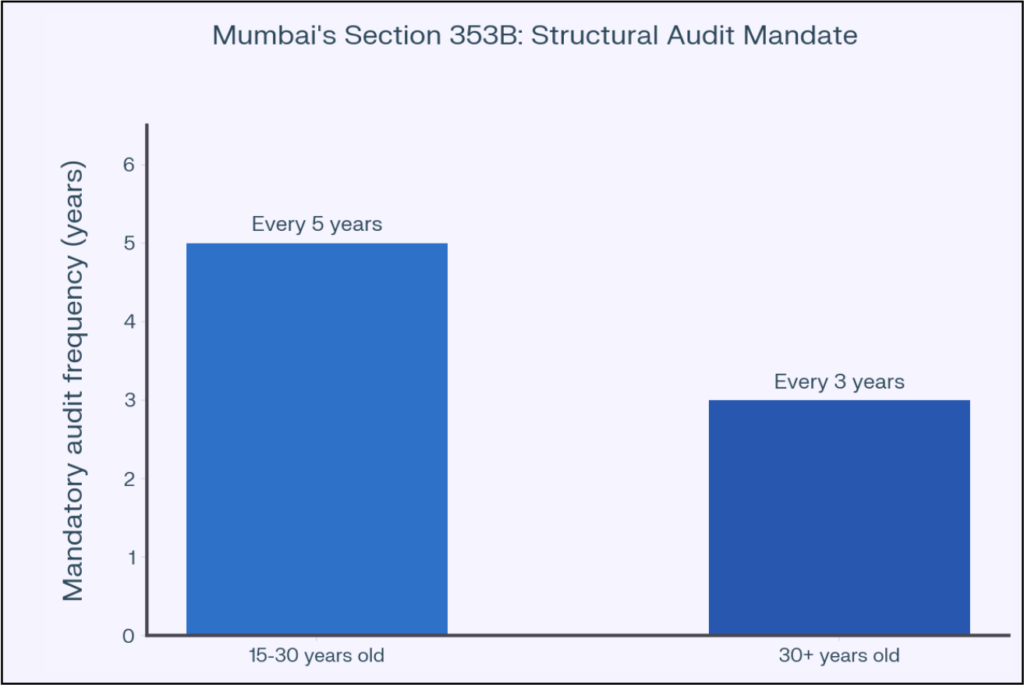
Delhi’s Satya Niketan cluster is not some tragic exception within an otherwise well-regulated capital. Student-dense pockets across Mukherjee Nagar, GTB Nagar, and Kamla Nagar share the exact same DNA. Illegal floors keep stacking atop modest resettlement-era plots. In the days since this Delhi building collapse, MCD has launched a crackdown spanning all twelve of its zones, targeting unauthorised construction and structurally unsafe buildings citywide, while the Delhi government ordered the collapsed structure itself demolished as “dangerous and ruinous” under the DMC Act and sealed several other fifth-floor additions nearby. Meanwhile, Mumbai’s regulatory approach differs sharply from the rest. Section 353B of its municipal act mandates structural audits every five years for buildings between fifteen and thirty years old. That timeline tightens to every three years beyond that threshold. Buildings failing these audits receive classifications ranging from dangerous to safe. The municipal commissioner stays empowered to recover repair costs directly from reluctant owners.
Hyderabad and Bengaluru, unfortunately, complete this grim national quartet rather thoroughly. An illegal seven-storey structure in Anjaiah Nagar collapsed in August 2026. Two workers died on a plot that never received any municipal permission whatsoever. HYDRAA responded decisively, demolishing an adjacent illegal hostel housing roughly seventy residents and suspending a town-planning officer for good measure. Bengaluru’s Kundalahalli fire in December 2025 killed a twenty-three-year-old engineer. He lived inside a PG lacking basic PG safety clearances. Residents say complaints had gone ignored since 2021. Doesn’t this Delhi building collapse pattern, repeated across four wildly different cities, suggest something structural rather than merely local negligence?
| City (Case) | Key Violation | Regulatory Gap | Documented Outcome |
|---|---|---|---|
| Delhi (Satya Niketan) | Illegal expansion from G+1 to five floors; basement filled with debris, wall removed | No fire NOC, no occupancy certificate | 7 dead; 5 people arrested; building ordered demolished |
| Mumbai (Maharashtra) | Skipped or delayed structural audits | Compliance relies on Section 353B enforcement | Legally mandated audit regime with utility-disconnection penalty |
| Hyderabad (Anjaiah Nagar) | Seven floors on a 50 sq-yard plot | Halt-work notices ignored for months | 2 dead; adjacent hostel demolished |
| Bengaluru (Kundalahalli) | Built just under 21m NOC threshold | 2023 demolition order never executed | 1 dead in PG fire; BBMP inaction alleged |
Sources: The Hindu, Telegraph India, The New Indian Express, Times of India, Tribune India, ThePrint, Moneycontrol, HYDRAA press notes, MCGM public notices, TheSouthFirst (compiled September 2026)
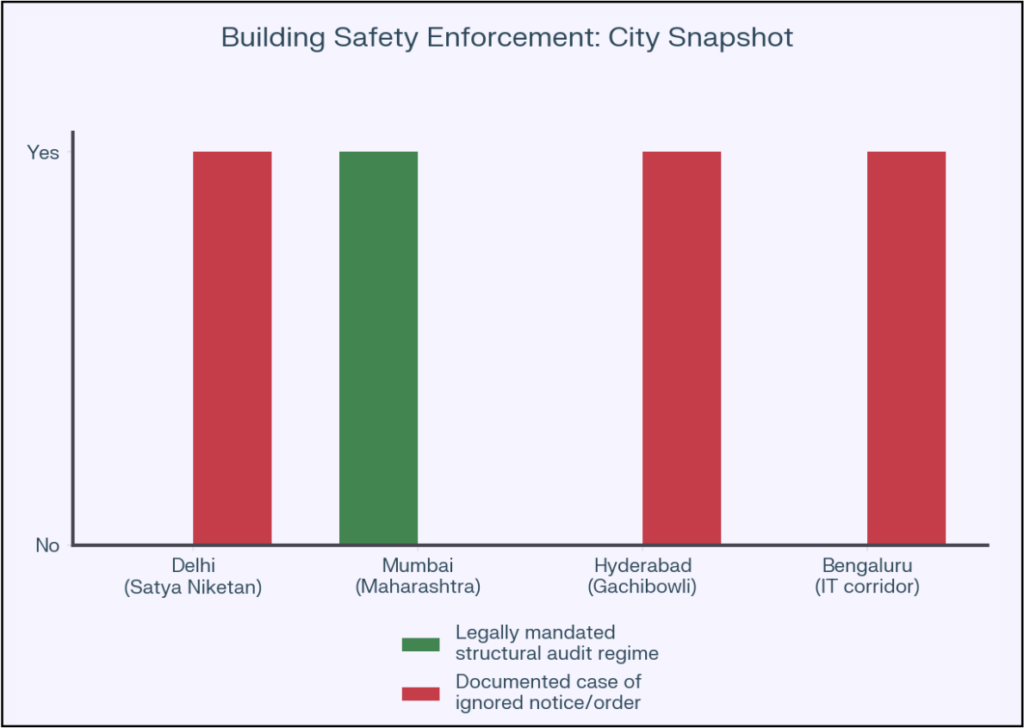
The bar chart below visualises this same enforcement gap across all four cities at a glance.
Sources: The Hindu (Satya Niketan collapse coverage); Telegraph India (Delhi PG safety loophole report)
Mandatory Structural Audits: The Reform Nobody Wants to Fund
Mumbai already proves that mandatory structural audits work reasonably well when paired with real enforcement teeth. Extending Section 353B-style structural audit obligations nationwide would close this exact gap. Such a law should cover PGs, hostels, schools, and nursing homes regardless of building age. This Delhi building collapse site at Satya Niketan operated invisibly for decades precisely because no such law existed. Delhi’s own post-collapse policy conversation already includes a draft bill. This Paying Guest Accommodation Regulation and Safety Bill would finally require registration alongside structural and fire clearances. I truly believe this single reform, properly funded and staffed, could prevent more deaths than any number of post-tragedy arrests ever will.
Money, predictably, remains the sticking point everyone quietly avoids discussing. City bodies across India routinely underfund their building-inspection teams, and MCD’s own Standing Committee Chairperson admitted as much today when she cited staff shortages as a reason enforcement had lagged. A skeleton staff ends up tracking thousands of properties at once. Pairing mandatory audits with dedicated retrofit financing would help enormously. Soft loans or redevelopment schemes could give reluctant owners a genuine path toward compliance, rather than continued denial. Otherwise, we simply repeat this exact cycle every few years. We mourn loudly, then forget quietly, until the next Delhi building collapse forces our attention back.
The chart below visualises this gap clearly. It shows how far Mumbai’s audit mandate extends, compared to most other Indian metros still operating without any equivalent structural safety law.
Source: MCGM (Municipal Corporation of Greater Mumbai) public notice on compulsory structural audits under the Mumbai Municipal Corporation Act, Section 353B
Digital Compliance, Deterrence, and Tenant Empowerment
Single-window digital portals could truly transform how India tracks PG safety and building compliance, provided anyone actually builds and maintains them properly. Delhi’s proposed GovPG portal could truly help here. If it later integrates building-plan approvals, occupancy certificates, and fire NOCs into one searchable database, it could flag high-risk properties automatically. Nobody would need to wait for tragedy to expose them. Such a system would also let parents verify a PG’s safety credentials before their children move in. That single feature would close an information gap that currently leaves families just guessing. Imagine a QR code outside every PG door. It could link directly to that building’s audit history. Such a small intervention might change parental peace of mind overnight.
Deterrence, meanwhile, needs far sharper teeth than India currently deploys against violators. The Supreme Court already warned it intends to fix “personal responsibility on officers” rather than merely apprehending builders after each disaster, and its decision today to keep the Delhi High Court actively supervising compliance, with a fresh review due September 15th, suggests the judiciary intends to hold that line rather than let the issue fade from attention. Blacklist repeat violators. Suspend careless officials fast. Publish zone-wise enforcement data. Together, these steps would turn rare, headline-grabbing punishment into something truly predictable. Only then does compliance stop feeling optional and start feeling inevitable.
The pie chart below captures just how stark Delhi’s PG compliance gap really looks in practice.
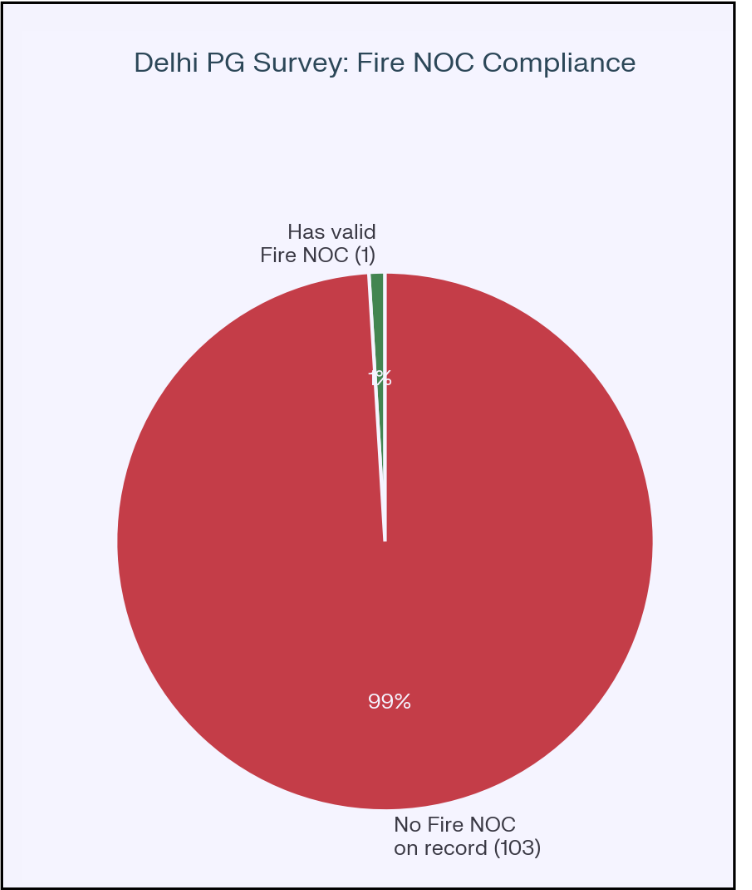
Source: NewsBytesApp report on the proposed Delhi Paying Guest Accommodation Regulation and Safety Bill, 2026, which cited a post-collapse survey finding 104 PG units in the Satya Niketan area violating building bylaws, with only one holding a valid Delhi Fire Services NOC.
What Should We All Actually Measure?
Numbers matter a great deal here. Vague promises rarely survive contact with a slow-moving bureaucracy. Consider tracking a few key numbers here. Audit coverage rates across ageing buildings matter greatly. So do complaint-to-action timelines and PG licensing status under any new regulatory regime. Track zone-wise enforcement statistics too. Count how many officials actually face suspension for ignoring obvious building bye-law violations. MCD’s own five-officer suspension after Satya Niketan, and its freshly launched twelve-zone crackdown, offer two such benchmarks worth watching closely over the coming weeks. Publishing these figures regularly, city by city, would finally let citizens hold authorities accountable between tragedies rather than only immediately after one.
Delhi Building Collapse: The Verdict We Cannot Ignore
Seven families in Satya Niketan will never receive their loved ones back. No number of arrests changes that outcome. Even the strongest court ruling cannot change it either. I refuse to treat this Delhi building collapse as some isolated tragedy. It wasn’t just one greedy landlord, and it wasn’t just one unlucky building either. Evidence from Mukherjee Nagar to Kondapur to Kundalahalli proves something larger. This represents a deeply systemic failure. Profit consistently outran safety, and detection remained rarely likely throughout. That is not misfortune; that is a system functioning exactly as its perverse incentives designed it to function. It echoes a now-familiar script in India’s governance failures, one this site traced closely during the 2026 NEET paper leak, where systemic laxity was exposed only after public outrage forced accountability.
So, what should every reader of this Delhi building collapse story personally do with this uncomfortable realisation? Verify your own building’s fire NOC and structural audit status today, rather than assuming this Delhi building collapse could never repeat itself near you. Report illegal construction the moment you spot it and push your local municipal body publicly for zone-wise enforcement data. Support Delhi’s proposed PG safety regulation bill, and follow the Supreme Court’s September 15th compliance review closely, since that date will show whether today’s promises translate into real audits and real sealings. This Delhi building collapse handed India a truly rare policy window; let’s not squander it through collective amnesia once headlines fade.
On behalf of ExpressIndia.info, I make you one promise. We will keep tracking every proposed reform, and we will not stop until India’s cities finally build the safety culture their residents deserve.
#DelhiBuildingCollapse #SatyaNiketan #IllegalConstructionIndia #StructuralAuditsIndia #UrbanSafetyIndia