
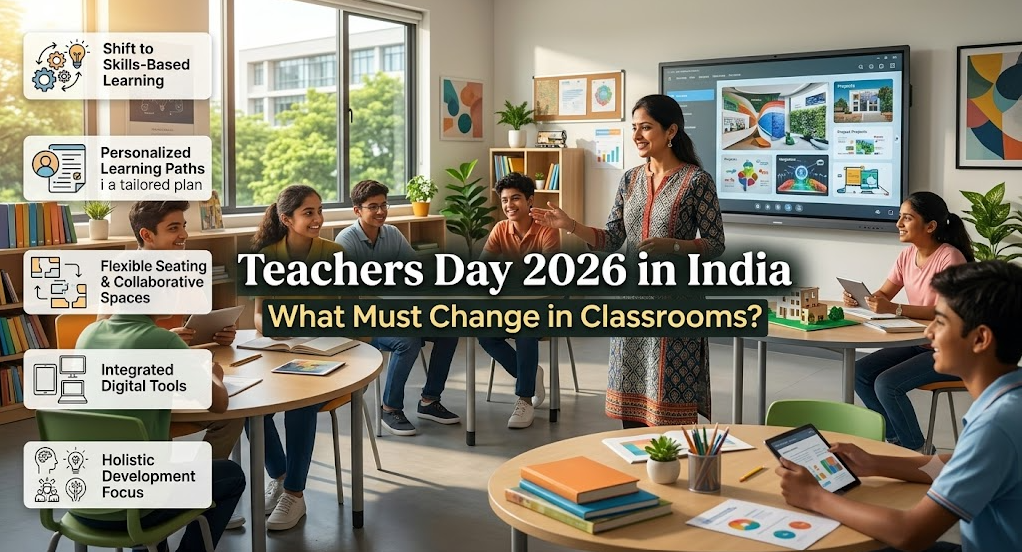
I still remember the chalk dust settling on Ms. Indirani’s sari as she wrote yet another equation on a cracked blackboard, and I still wonder why that memory feels more like infrastructure than nostalgia. Teachers Day 2026 in India arrives this year with President Droupadi Murmu honouring 48 school teachers at Vigyan Bhawan. Alongside them, 21 higher-education and polytechnic faculty members will also be felicitated. It is a beautiful ritual, and frankly, I enjoy watching it every year on TV during the news broadcast at the end of the day, something that I religiously adhere to.
But somewhere between the flower garlands and the short documentaries, I keep asking an uncomfortable question. Are we honouring exceptional teachers? Or are we quietly avoiding the systemic mess surrounding the other one crore of them? That tension is exactly why Teachers Day 2026 in India deserves more than a WhatsApp forward with a Dr. Radhakrishnan quote. This piece digs into what the data, the courts, and the classrooms are actually telling us about Indian teachers today, and what must change before next September rolls around.
Teachers Day 2026 in India: Beyond Flowers, Cards and Speeches
Every year on 5 September, India pauses to celebrate the birth anniversary of Dr. Sarvepalli Radhakrishnan, the philosopher-statesman who, upon becoming President, gently declined a personal birthday tribute and asked instead that the day be dedicated to teachers everywhere. That single act of humility, rooted in what would later inform NEP 2020‘s own reverence for teachers, is the reason your school assembly still hums with speeches today. He himself set the tone for what followed, once remarking that “teachers should be the best minds in the country,” a standard India has spent decades trying, and often failing, to institutionalise.
Consequently, the 2026 edition of Teachers Day in India carries fresh symbolism. The 48 educators who will be honoured today come from 27 states, seven Union Territories and six central government organisations. The group includes 26 men and 22 women, all selected through a rigorous three-stage district-state-national process. Meanwhile, 21 faculty members from universities and polytechnics receive parallel recognition through the Rashtriya Puraskar Portal. Short documentaries will showcase their work, and the event streams live across Ministry of Education channels.
Here’s the paradox, though. These 48 individuals represent barely a rounding error against India’s actual teaching workforce, which now exceeds one crore. Coverage of the ceremony repeatedly calls the selection process “rigorous, transparent and online,” and I don’t doubt that for a second. Yet, the deeper story isn’t the podium; it’s everyone standing outside the auditorium, teaching without electricity, without colleagues, and sometimes without a permanent salary. That’s the story this blog wants to tell.
Teachers Day 2026 in India: A Changing Profession
Let’s start with the good news, because there genuinely is some. UDISE+ 2024-25 data confirms that India’s school teacher count crossed one crore for the first time ever, reaching 1,01,22,420, up 6.7% from 94,83,294 in 2022-23. A subsequent release in July 2026 pushed that figure further, to 1,02,73,020. Analysts rightly call this a “historic milestone.” Pupil-teacher ratios have improved dramatically alongside it. They now stand at 10 for Foundational, 13 for Preparatory, 17 for Middle, and 21 for Secondary stages. All four sit comfortably inside NEP’s recommended ceiling of 30:1.
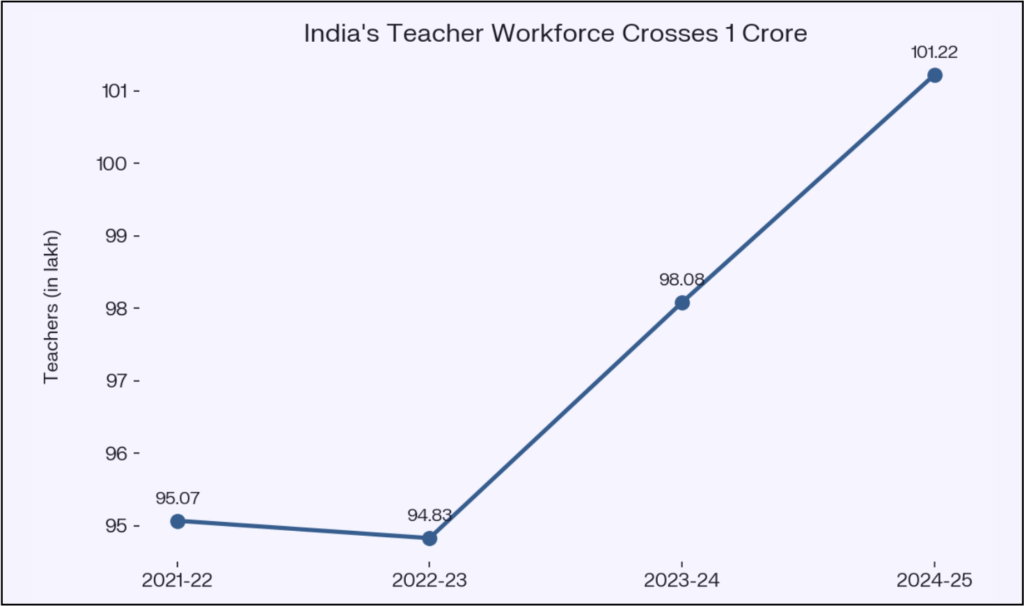
Source: UDISE+ 2021-22 to 2024-25, Ministry of Education
However, aggregate numbers have a habit of flattering reality. Buried inside that same UDISE+ dataset sits a far less comfortable statistic: 1,04,125 single-teacher schools, collectively serving more than 33 lakh students. Picture that for a second. One human being, teaching every subject to every grade, in one room, often without a colleague to relieve them even during illness. Reports based on parliamentary and UDISE+ data further note that shortages cluster heavily in states like Bihar, Jharkhand and Madhya Pradesh, frequently in rural and economically disadvantaged pockets.
So which story is true? Honestly, both are, simultaneously. India has more teachers than ever, and yet distribution remains lopsided enough that a national average can mask a village-level crisis. Therefore, the real question for Teachers Day 2026 in India isn’t “how many teachers do we have.” It’s simpler and harder than that. Where are they? And can the children who need them most actually reach them?
The Teacher Shortage Isn’t Simply About Numbers
Numbers rarely lie, but under NEP 2020’s ambitious targets, they do enjoy hiding things. A Parliamentary Standing Committee on Education tabled its 368th report recently. It found roughly 10 lakh sanctioned teaching posts vacant across India’s school system. These gaps span state-run schools, SSA-funded institutions, and even elite central schools. Sanctioned posts rose from 63,26,207 in 2023-24 to 69,85,760 in 2024-25. Vacancies simultaneously climbed from 9,59,148 to 9,82,662. This proves that adding posts on paper solves nothing without recruitment on the ground.
| Indicator | 2023-24 | 2024-25 |
|---|---|---|
| Sanctioned teaching posts | 63,26,207 | 69,85,760 |
| Vacant posts | 9,59,148 | 9,82,662 |
| Single-teacher schools | — | 1,04,125 (serving 33+ lakh students) |
Source: Parliamentary Standing Committee on Education, 368th Report; UDISE+ 2024-25
Astonishingly, this crisis doesn’t spare India’s best-resourced institutions. Kendriya Vidyalayas and Jawahar Navodaya Vidyalayas are often held up as public-education success stories. Yet, they report between 30 and 50 percent vacancy rates. This forces widespread reliance on contractual staff despite repeated committee objections. The committee didn’t mince words either. It warned that vacancies are “worsening day by day” due to retirements and the absence of a permanent recruitment policy. A March 2026 deadline for permanent appointments has now been set. Ending contractual hiring altogether was also urged.
Nevertheless, raw vacancy counts still understate the problem, and this is where genuine education reform India needs must go deeper than headline numbers. Consider the layered reality: a school might show “adequate” teacher numbers on a government portal while functionally lacking a Physics teacher, a Hindi teacher, or anyone qualified to run competency-based assessments. Bihar alone reportedly carries over 2.08 lakh vacancies at the elementary level. Single-teacher schools compound this further, since one person simply cannot deliver subject-specific depth across five grades simultaneously. Ultimately, India’s shortage isn’t just a headcount problem; it’s a distribution, deployment and depth problem rolled into one.
Are We Training Teachers for 2026, or for 2006?
Now we arrive at the section I find most revealing. NEP 2020 envisions a genuinely modern teacher: someone trained through a four-year integrated B.Ed. programme, guided by National Professional Standards for Teachers, and committed to 50 hours of Continuous Professional Development (CPD) every single year. That CPD, per NCERT’s own guidelines, is meant to cover foundational literacy and numeracy, competency-based assessment, inclusive education and digital tool usage, not rote memorisation techniques from another era.
Indian teacher training, at its best, looks exactly like this. Some institutions have genuinely embraced this. Kendriya Vidyalaya Sangathan replaced its old six-year, 21-day in-service course entirely. It now runs a structured annual CPD calendar instead. That calendar splits 30 offline hours and 20 online hours across themes ranging from experiential learning to mental health. That’s a real, tangible shift in Indian teacher training, and I want to give credit where it’s due.
But scale that story nationally, and the cracks widen considerably. Economic Times Education recently observed that “curriculum reform has moved faster than teacher preparation, even though teacher quality remains the single biggest determinant of classroom outcomes”. Public expenditure on education still sits at roughly 2.7% of GDP. NEP’s own target was 6%. Universal foundational literacy, originally promised by 2025, has now slipped to 2026-27 under NIPUN Bharat. ASER 2024 shows just 23.4% of Grade 3 students achieving reading proficiency — a sobering reminder that even as NEP 2020 promises universal foundational literacy by 2026-27, nearly three out of four children in India’s primary classrooms still cannot read at grade level.
Meanwhile, parliamentary reviews flag serious staffing shortages inside NCTE itself and across District Institutes of Education and Training, the very bodies meant to deliver this training. This is the crux of Indian teacher training in 2026. Union Education Minister Pralhad Joshi captured the stakes precisely. He said “educational quality rests on the competence and empathy of our teachers.” He also urged responsible AI use that doesn’t replace human values. So, is Indian teacher training built for 2026 classrooms, or merely repackaging 2006-era workshops with a shinier NEP label? The honest answer, right now, sits somewhere uncomfortably in between.
AI in the Classroom: Will AI Replace Teachers?
Frankly, I think that’s the wrong question for Indian teacher training entirely, and Indian classrooms have already moved past it. A Bharti Airtel Foundation survey found that 83.2% of teachers surveyed had already used AI tools, with 34.5% using them regularly and another 42.4% experimenting occasionally while verifying outputs. That’s not a distant future scenario; that’s this morning’s lesson plan and today’s student engagement strategies in action. Government-backed education reform India is racing to keep pace too. The IndiaAI Mission has committed over ₹10,300 crore across five years. CBSE now offers a 15-hour AI module starting Class VI. It has also added an optional AI subject for Classes IX to XII.
Used well, AI genuinely strengthens student engagement strategies inside crowded classrooms. Teachers are leaning on it for lesson planning, personalised practice exercises, automated feedback on objective assessments, and translation support across India’s many languages. Used carelessly, though, it invites real trouble. Four risks stand out clearly:
- Hallucinated facts can slip into lesson content unnoticed.
- Students may over-rely on AI-generated answers, quietly eroding academic integrity.
- Plagiarism becomes harder to detect and easier to justify.
- Data-privacy risks emerge when student information flows through unvetted external platforms.
This isn’t hypothetical — we’ve already seen how rushed tech rollouts, like CBSE’s recent digital exam fiasco, can amplify classroom chaos when preparation lags behind ambition. Here’s the uncomfortable part: teacher-focused AI training remains scattered and inconsistent, even as classroom adoption races ahead, creating exactly the gap NITI Aayog and education researchers keep warning about. Minister Joshi’s call for “responsible AI use” without sacrificing human values is the correct instinct, but instinct alone doesn’t build a national training pipeline. The better question for Teachers Day 2026 in India, therefore, isn’t whether AI replaces teachers. Rather, it’s whether teachers get trained fast enough to supervise AI instead of being quietly outpaced by it.
The Teacher’s Role Beyond Academics
Somewhere along the way, “teacher” stopped meaning just “subject expert,” and NEP 2020 practically demands this expansion, and any honest education reform India pursues must reckon with it. The policy frames school education holistically, weaving in socio-emotional development, civic responsibility, arts and sports integration alongside academic rigour. CPD frameworks now explicitly include inclusive education and the mental health and wellbeing of both students and teachers as focal training themes, effectively asking educators to double as informal counsellors. Incidentally, teachers today aren’t just delivering lessons; they’re often the first to notice a student buckling under exam stress, anxiety, or the kind of systemic pressure we’ve previously unpacked on this platform.
Think about what this actually demands of one person. Teaching algebra in the morning. Deploying student engagement strategies to spot a struggling child by afternoon. Guiding a confused teenager through career choices by evening. Modelling digital citizenship throughout the day. Policy documents increasingly describe teachers as “facilitators of learner-centred, collaborative learning” rather than rote-driven instructors, which sounds wonderful on paper. Yet, nobody has meaningfully redesigned student engagement strategies or workload to accommodate this expanded mandate, which brings us neatly to the next uncomfortable truth. When exam integrity collapses — as we saw in the NEET paper leak crisis — teachers become the emotional shock absorbers for students whose futures suddenly feel uncertain
Teachers Themselves Need Support
Who, exactly, supports the supporter? It’s a question Teachers Day 2026 in India rarely asks aloud, yet the data practically screams it. Alongside nearly 10 lakh vacant posts, roughly 95,000 Indian schools still lack functional electricity. Another 5.42 lakh schools have no functional computers at all. This severely limits any teacher’s ability to deploy the digital tools policymakers keep championing. Parliamentary reports additionally confirm that teachers remain frequently diverted into non-teaching administrative work, despite NEP’s explicit recommendation to minimise exactly that.
Effective student engagement strategies cannot survive under-resourcing; committee summaries warn, quite bluntly, that demanding high performance from low-support environments is simply unsustainable. Student frustration matters here too. One report on “Gen Alpha” grievances noted that these complaints directly “echo gaps documented in the government’s own data.” That link ties classroom disappointment straight back to systemic under-resourcing rather than individual teacher failure. Support, in other words, isn’t a bonus for teachers; it’s the precondition for everything else this article has discussed. Without addressing workload, infrastructure, and career progression together, expecting transformed classrooms is simply wishful thinking dressed up as policy.
The Government-School and Private-School Divide
It’s tempting to turn this into an ideological slugfest, but the Economic Survey 2024-25 data resists easy villains. India’s school system serves 24.8 crore students across 14.72 lakh schools with 98 lakh teachers. Government schools make up 69% of that total. They enrol 50% of students while employing 51% of teachers. Private schools, meanwhile, account for 22.5% of schools, enrol 32.6% of students, and employ 38% of teachers.
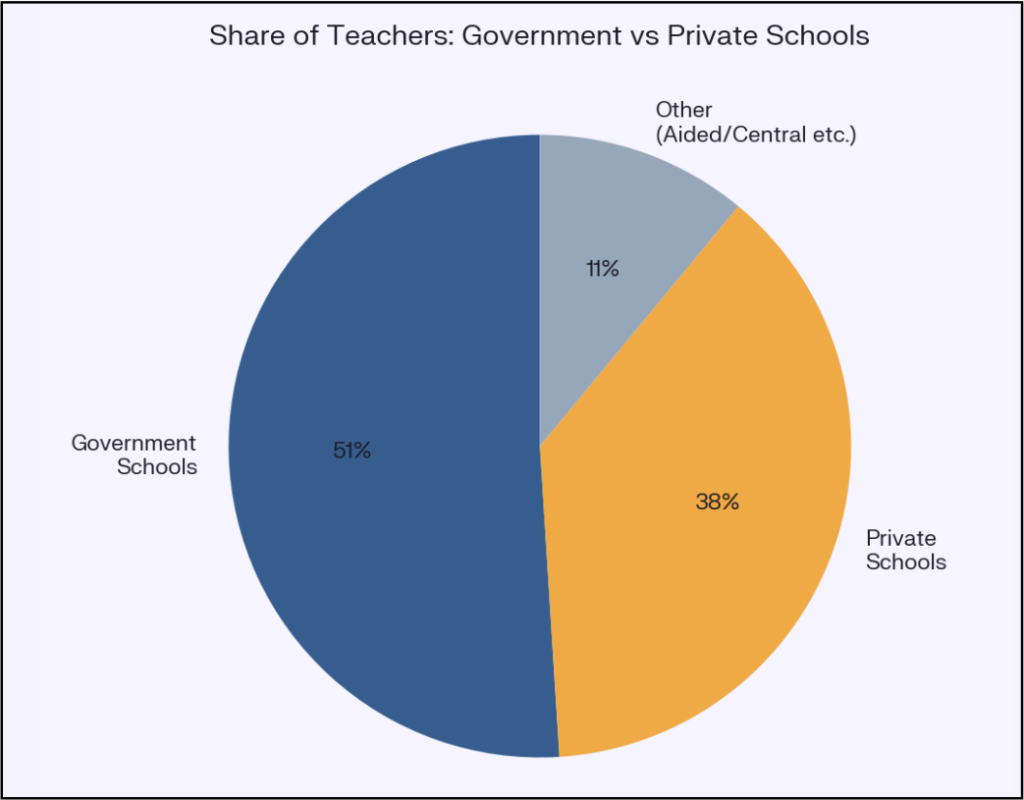
Source: Economic Survey 2024-25, based on UDISE+ 2023-24
These aren’t just percentages under NEP 2020; they represent two genuinely different working realities. Government-school teachers typically navigate multi-grade, multilingual classrooms while simultaneously implementing NEP schemes like NIPUN Bharat, PM SHRI and PM POSHAN, often with limited technology on hand. Private-school teachers, conversely, face intense exam-performance pressure and brand-reputation expectations from parents, albeit typically with steadier device access and connectivity. Neither situation is easy, and pretending one side has it entirely figured out does a disservice to both. What India genuinely needs is structural parity in training, technology access and accountability through sustained education reform India can measure, not another round of government-versus-private point-scoring.
Teachers Day 2026 in India: Seven Reforms That Matter
Enough diagnosis; let’s talk prescriptions for education reform India, because criticism without solutions is just complaining with better formatting. Based on the evidence assembled above, here are seven reforms India needs urgently.
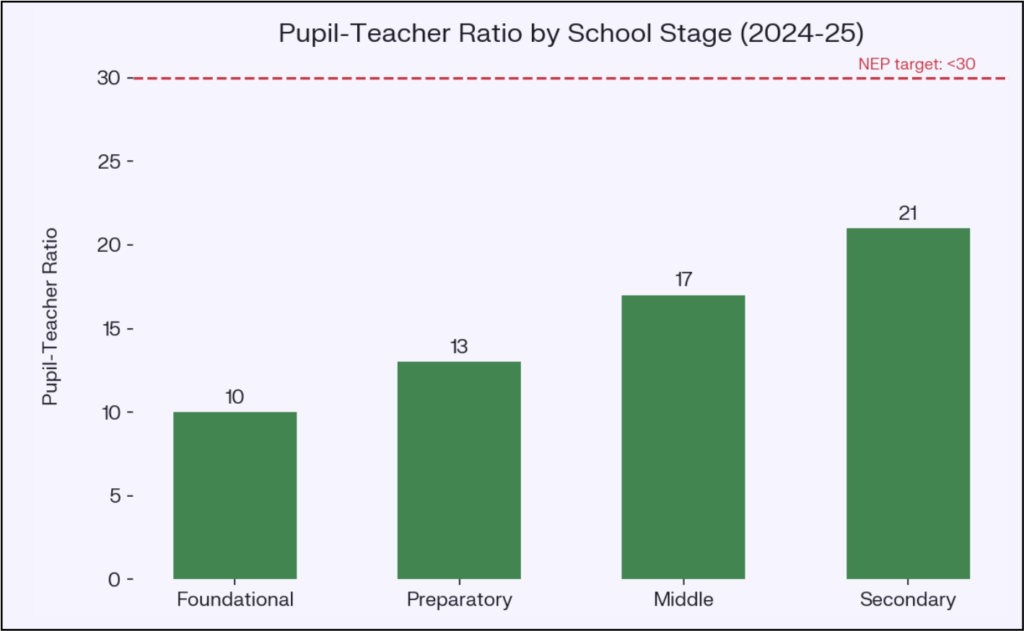
Source: UDISE+ 2024-25, Ministry of Education
- Fill vacancies faster and permanently. With roughly 10 lakh posts vacant, the Parliamentary Committee’s March 2026 deadline for permanent recruitment must be enforced, not merely recommended, and contractual hiring should end for good.
- Deploy teachers by actual subject and regional need. Concentrated vacancies in states like Bihar demand targeted deployment, not blanket national averages that mask local emergencies.
- Make CPD genuinely practical, not compliance theatre. KVS’s calendarized 50-hour model offers a workable template; scale it, don’t just mandate it on paper.
- Build structured AI and digital-literacy training for teachers. With 83.2% already experimenting with AI, formal, safety-conscious training must catch up immediately, not eventually.
- Cut non-teaching administrative burdens. NEP already recommends this; states simply need to implement dedicated administrative support so teachers can, well, teach.
- Strengthen teacher-education institutions and accountability. The Supreme Court delivered a significant judgment in September 2026. It upheld NCTE’s authority to demand annual Performance Appraisal Reports from Teacher Education Institutions. The court called this accountability measure entirely legitimate. It even described NCTE’s regulatory duties as “perhaps the highest of all the duty-bearers”. That ruling should extend downstream, tightening quality control across every DIET and training college in the country.
- Pair professional autonomy with measurable accountability. NEP’s own National Professional Standards for Teachers offer a ready-made framework; states should use it to reward classroom innovation, not just exam-score compliance.
Together, these seven steps move India from applauding individual excellence toward building something bigger. They point toward systemic, lasting education reform India can be proud of. That shift is precisely what Teachers Day 2026 in India should ultimately stand for.
Teachers Day 2026 in India: A Provocative Closing Question
Here’s where I’ll be direct with you, reader to reader. Dr. Radhakrishnan believed teachers should be “the best minds in the country,” and Dr. APJ Abdul Kalam went further, insisting that “there is no other profession in the world that is more important to society than that of a teacher”. Both men treated teaching as national infrastructure, not seasonal sentiment. Yet India still budgets, staffs, and trains its teaching workforce as though it were an afterthought squeezed between highway projects and telecom towers.
This isn’t just an education story; it’s part of the same youth-led accountability wave that recently forced governments to listen, from classroom grievances to the CJP led street protests. So, here’s my closing question, and I genuinely want you to sit with it. Roads and 5G towers get multi-year funding commitments and public accountability dashboards. Why don’t the one crore-plus professionals shaping every future engineer, doctor, and policymaker in this country get the same seriousness? Teachers Day 2026 in India shouldn’t end with a card and a candle; it should end with a checklist, a deadline, and a budget line that actually holds.
If this piece made you pause even for a moment, do one concrete thing today. Write to your local school administration or MLA asking about vacancy status in your district. Or share this piece with a teacher you respect. Better still, thank a teacher by naming the exact thing they changed in your life. Small, specific gratitude compounds faster than generic tributes ever will.
On behalf of ExpressIndia.info, here’s to a Teachers Day 2026 in India that finally treats its educators like the infrastructure they truly are, not the decoration we’ve reduced them to.
#TeachersDay2026 #TeachersDayIndia #NEP2020 #EducationReformIndia #IndianTeachers