
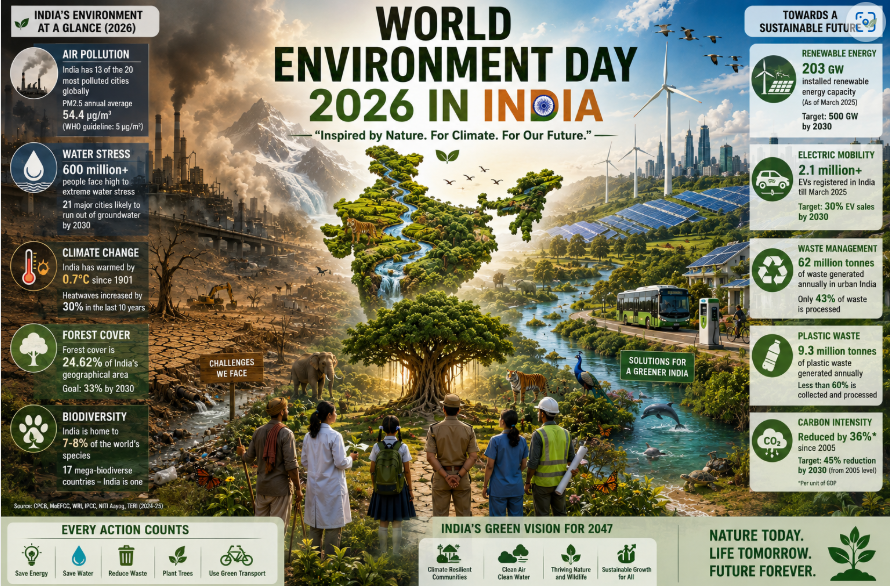
World Environment Day 2026 and India’s climate test
World Environment Day 2026 asks a direct question: is India truly climate ready? The official theme, “Inspired by Nature. For Climate. For Our Future.”, together with the campaign call #NowForClimate, makes one point unmistakable: nature is not a decorative concern, but the foundation of climate resilience and human survival. The global commemoration is being hosted by the Republic of Azerbaijan in Baku, yet the urgency of this message feels especially sharp in India, where heatwaves, floods, toxic air, waste pressure, and ecological stress have become part of ordinary life. 🌍
I find this year’s message extremely relevant because it links climate action with ecological restoration in a way that speaks directly to India’s current reality. Forests, wetlands, rivers, mangroves, and living soils are not scenic extras; they are protective systems that support water security, food systems, public health, and livelihoods. The deeper question, therefore, is not whether India should act, but whether it can act quickly enough, fairly enough, and intelligently enough to protect both vulnerable communities and the ecosystems that keep them alive.
India’s climate reality in 2026
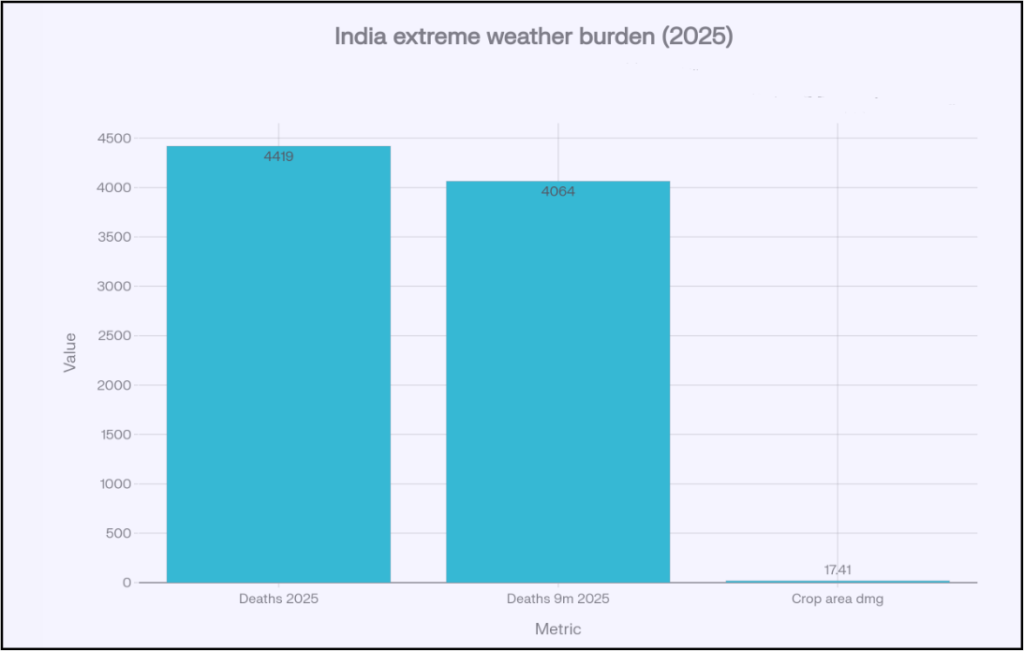
The State of India’s Environment 2026 report gives the crisis a hard numerical edge. In 2025, extreme weather struck on 99% of days, the highest level in four years, spanning heatwaves, cold waves, heavy rain, floods, and storms. Those events caused 4,419 deaths and damaged about 17.41 million hectares of crop area, sharply increasing pressure on agriculture, rural livelihoods, and food security. Himachal Pradesh recorded the highest number of extreme-weather days, while Kerala and Madhya Pradesh also saw serious stress. ⚠️
The same report warns that global warming is likely to breach 1.5°C, which means every additional fraction of warming may intensify droughts, rainfall shocks, crop losses, and strain on public systems. That turns climate change from a future concern into a present governing reality. I feel these figures should not remain buried in policy papers; they should influence budget priorities, public-health preparedness, disaster planning, urban design, and environmental law enforcement.
India’s climate stress snapshot
| Indicator | Latest figure | Why it matters |
|---|---|---|
| Days with extreme weather in 2025 | 99% | Climate shocks are now near-daily realities |
| Deaths from extreme weather in 2025 | 4,419 | The crisis is already costing lives |
| Crop area damaged | 17.41 million hectares | Rural livelihoods and food systems are under strain |
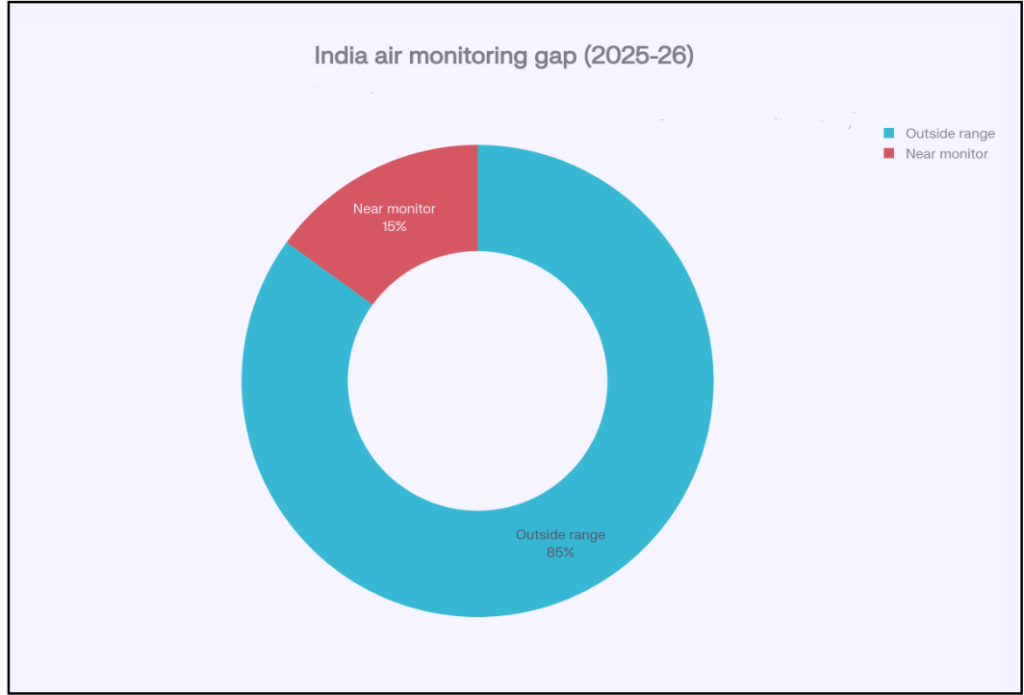
| Population near a monitoring station | 15% | Only a small share of Indians live near continuous monitoring |
| Population outside measurable air-quality coverage | 85% | Pollution in most regions remains unseen in official data |
| Annual solid waste generated | Over 620 lakh tonnes | Waste systems face severe pressure |
Sources: Centre for Science and Environment, State of India’s Environment 2026; Indian Express coverage of SWM Rules 2026
Heatwaves, extreme weather, and social emergency
Heatwaves have become one of India’s most punishing climate realities. Centre for Science and Environment (CSE) notes that extreme events now affect almost every day of the year, showing that climate shocks have become the new normal rather than isolated emergencies. Another CSE–Down To Earth analysis found a 48% rise in deaths due to extreme weather in 2025, with 4,064 fatalities in just nine months. Incidentally, Maharashtra suffered the most crop damage during that period. These numbers are not only meteorological markers; they also reveal labour insecurity, public-health stress, and widening inequality. 🔥
The burden falls hardest on those who cannot escape exposure: farmers, street vendors, construction workers, delivery workers, and low-income families living in fragile housing. Heat, flood, and storm risks therefore operate as labour-rights issues and health issues as much as environmental ones. As a matter of fact, I think India’s climate readiness will depend on whether institutions shift from post-disaster relief to pre-disaster resilience, especially in workplaces, early-warning systems, city design, and public services.
Sources: Centre for Science and Environment, State of India’s Environment 2026; Down To Earth reporting
Air pollution and invisible inequality
India’s air pollution crisis remains one of the country’s most unequal environmental failures. Only 15% of India’s population lives within 10 km of a continuous air-quality monitoring station, while 85%—more than 1.2 billion people—remain outside measurable coverage. Monitoring remains concentrated in larger cities, leaving smaller towns, industrial belts, and peri-urban regions undercounted and often politically neglected. That makes air pollution not only a health crisis, but also a crisis of visibility, representation, and environmental justice. 🌫️
The policy signal is equally troubling. The Union Budget 2026–27 allocated ₹1,091 crore for pollution control, down from ₹1,300 crore the previous year, even as concern over toxic air continues to deepen. When low-income communities breathe polluted air that is not even measured, environmental governance becomes structurally unequal. Delhi’s air pollution crisis has long shown how environmental harm and social inequality often grow together. Clean air, therefore, is not a premium urban amenity; it is a basic public right that must be monitored, funded, and enforced across the country.
Sources: Centre for Science and Environment, State of India’s Environment 2026; Union Budget 2026–27 coverage
Air pollution monitoring gap
| Metric | Figure | Implication |
|---|---|---|
| Population near a continuous monitoring station | 15% | Limited geographic coverage |
| Population outside measurable range | 85% | Most pollution exposure remains hidden |
| Pollution-control budget 2026–27 | ₹1,091 crore | Funding has fallen despite a worsening crisis |
Sources: Centre for Science and Environment, State of India’s Environment 2026; Union Budget 2026–27 coverage
Water stress, floods, and fragile landscapes
Water now reaches India through extremes. Some regions face deepening scarcity, while others face more intense floods, landslides, and rainfall shocks. The State of India’s Environment 2026 report stresses that climate change is increasing both the frequency and intensity of floods and calls for a shift from post-disaster relief toward pre-disaster resilience planning. That distinction matters because relief responds after damage, while resilience helps prevent damage before it happens. 💧
Altered monsoon patterns and rising temperatures are contributing to more intense rainfall events, floods, and landslides, with serious consequences for roads, homes, farming, and local economies. Wetlands, lakes, floodplains, and groundwater recharge zones must therefore be treated as essential infrastructure rather than expendable land. When these systems weaken, the shock ripples through homes, farms, and cities, making climate adaptation harder, costlier, and less equitable.
Water-risk priorities
| Risk | Current trend | Best response |
|---|---|---|
| Floods | More frequent and intense | Flood-risk mapping and resilient planning |
| Landslides | Rising in vulnerable regions | Slope-sensitive land use and early warnings |
| Urban water stress | Increasing in cities | Rainwater harvesting and lake restoration |
Source: Centre for Science and Environment, State of India’s Environment 2026.
Waste, plastic, and the circular turn
India generates over 620 lakh tonnes of solid waste every year, placing immense pressure on landfills, local bodies, and already strained civic systems. The new Solid Waste Management Rules 2026 aim to replace the old “collect and dump” model with a circular economy approach, with zero waste to landfill as a long-term direction. Key features include mandatory four-stream segregation, higher landfill fees, environmental compensation for non-compliance, and a centralised portal for tracking the entire waste lifecycle. ♻️
Yet, waste reform will matter only if it changes behaviour and institutions on the ground. Proper implementation can reduce plastic leakage into rivers, cut landfill pressure, and improve public health. Moreover, it can create more dignified systems for waste pickers and informal recyclers if they are integrated rather than erased. World Environment Day 2025 showed how seriously India needed to confront plastic pollution (click the link to read my blog from last year). In fact, this year’s push toward circular waste management builds naturally on that momentum. Waste is not only about disposal; it is also about how cities manage growth, how citizens manage responsibility, and whether environmental reform includes social justice.
Waste transition table
| Old model | New model | Expected result |
|---|---|---|
| Collect and dump | Segregate, track, recover | Less landfill pressure |
| Linear disposal | Circular economy | More reuse and less leakage |
| Invisible waste labour | Formal integration | Better livelihoods and dignity |
Sources: Indian Express coverage of SWM Rules 2026; CSE-linked reporting on India’s waste systems
Biodiversity, communities, and conflict
India’s biodiversity crisis also has a human face. About 60 million people now live within tiger landscapes across 20 states, and expanding settlement pressure has increased human–wildlife conflict. In many forest-edge regions, the issue is not simply wildlife behaviour but weak landscape planning. Adivasi and tribal communities often live closest to these stress zones and face resource insecurity, livelihood pressure, and displacement risks alongside conservation pressures. 🌱
That means conservation cannot succeed through exclusion alone. It needs inclusive landscape planning, buffer management, local participation, and policies that protect both habitats and the people who live around them. When environmental governance treats forest communities as obstacles instead of partners, conflict rises and ecological outcomes worsen. Project Cheetah and Project Lion are aimed at restoring historic natural habitats and boosting biodiversity. A climate-ready India will need a biodiversity policy that is also a social policy, and conservation that respects justice as much as ecology.
India’s climate pledges and the implementation gap
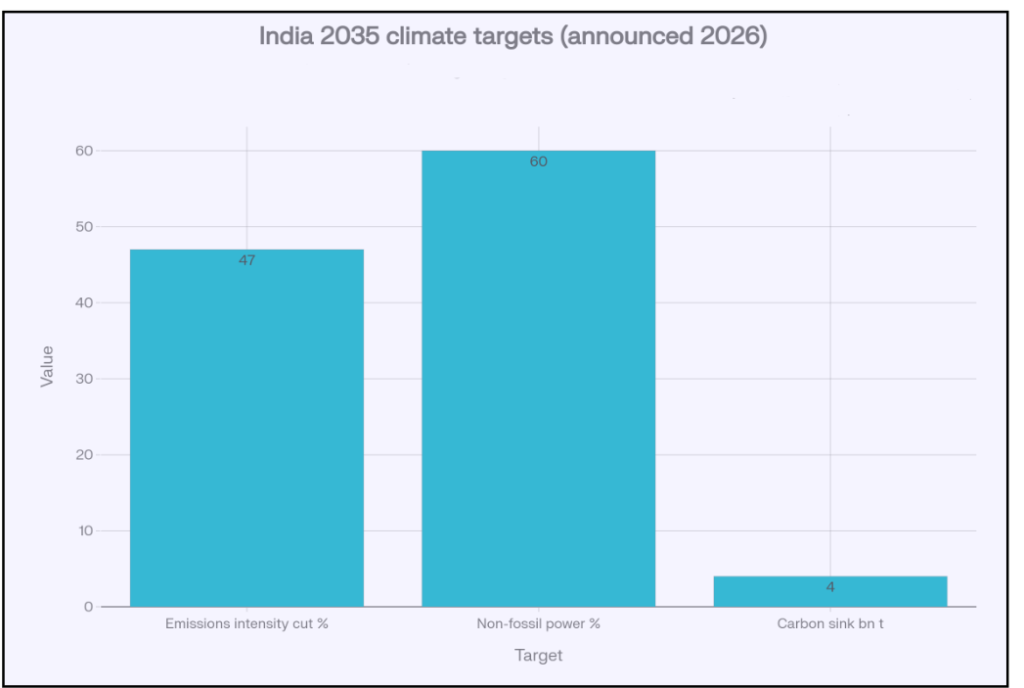
India has strengthened its formal climate commitments. In March 2026, it announced a new 2031–2035 Nationally Determined Contribution under the Paris Agreement. The new pledge targets a 47% reduction in emissions intensity of GDP by 2035 compared to 2005, a 60% share of non-fossil sources in installed electricity capacity by 2035, and expanded forest and tree cover capable of absorbing up to 4.0 billion tonnes of CO₂-equivalent by 2035. These are substantial goals, and they show that India recognises the scale of the transition ahead.
Sources: Government of India climate pledge coverage; WRI statement on India’s new NDC
The challenge lies in implementation, finance, and institutional follow-through. One estimate suggests India needs around USD 300 billion annually in climate-related investment through 2030 to stay on a credible transition pathway. Missions such as Green Hydrogen, PM Surya Ghar, PM Kusum and LiFE point toward solutions, but adaptation, pollution control, and local resilience still lag in many regions. India’s climate future will therefore depend not only on what it promises internationally, but on what it funds, builds, and enforces domestically.
India’s 2035 climate target summary
| Target | Figure | Why it matters |
|---|---|---|
| Emissions-intensity reduction | 47% by 2035 | Signals stronger mitigation |
| Non-fossil electricity share | 60% by 2035 | Speeds the clean-power transition |
| Forest and tree carbon sink | Up to 4.0 billion tonnes CO₂e | Strengthens nature-based mitigation |
Sources: Government of India climate pledge coverage; WRI statement on India’s new NDC
What actually works: holistic solutions for a climate-ready India
The most credible climate solutions are often the least glamorous. The State of India’s Environment 2026 report points to wetland restoration, reconnecting rivers with floodplains, groundwater recharge, rainwater harvesting, and lake restoration as practical interventions that can reduce flood risk and strengthen water security. Programmes such as MISHTI show how mangrove restoration can protect coastlines while supporting livelihoods. Nature-based solutions are not symbolic gestures; they are essential climate infrastructure, especially in a country confronting both heat stress and hydrological instability.
The same logic extends to clean energy, transport, and urban design. India’s 60% non-fossil power target implies faster solar and wind expansion, while the Green Hydrogen Mission and PM Surya Ghar can support a broader energy transition. Electric buses and greener mobility can reduce emissions and improve urban air at the same time, while climate-resilient roads, drains, and housing can make cities better able to handle heat and heavy rainfall. I honestly feel that the strongest path forward is not one grand solution, but a layered strategy that combines ecology, infrastructure, public policy, and community action.
Holistic solutions table
| Solution | Benefit | Example |
|---|---|---|
| Wetland restoration | Flood buffering and carbon storage | Urban and rural lake revival |
| Mangrove restoration | Coastal protection and livelihoods | MISHTI |
| Rooftop solar | Cleaner household energy | PM Surya Ghar |
| Green hydrogen | Decarbonising hard-to-abate sectors | National Green Hydrogen Mission |
| Electric buses | Lower emissions and cleaner air | Delhi e-bus deployment |
Sources: CSE State of India’s Environment 2026; Government of India climate missions and policy reporting
The changes India must embrace now
So, is India climate ready? Not yet. But it can become ready if it stops treating ecology as a side issue. World Environment Day 2026 asks India to answer a difficult question honestly: can development and ecology move together? The answer is yes, but only if policy stops treating nature as a sacrifice zone. India must protect forests, wetlands, rivers, coasts, and soils because they are not obstacles to growth; they are the basis of resilient growth. It also means acknowledging who pays the highest price today. Farmers, labourers, tribal communities, children, and low-income urban residents face the hardest climate shocks.
To sum it up, the call to action is simple in my opinion. Support climate-smart public policy. Demand better monitoring and better budgets. Push for cleaner transport, waste segregation, and nature-based resilience. Choose less wasteful routines at home, in schools, and in workplaces. Practice smaller, cleaner, more responsible daily choices. And insist that India’s 2047 aspirations include not just prosperity, but livability, fairness, and ecological sanity. If India wants a greener and more prosperous future, it must make that future fair. It must protect the rivers, forests, wetlands, and soils that support life. It must also protect the people who live closest to environmental risk. If India wants a green future, it has to build one now.
At ExpressIndia.info, we believe India’s climate future must be built on urgency, justice, and collective action – because protecting nature is ultimately protecting our shared tomorrow.
#WorldEnvironmentDay2026 #IndiaClimateCrisis #ClimateActionNow #BeatPlasticPollution #ClimateResilienceIndia