
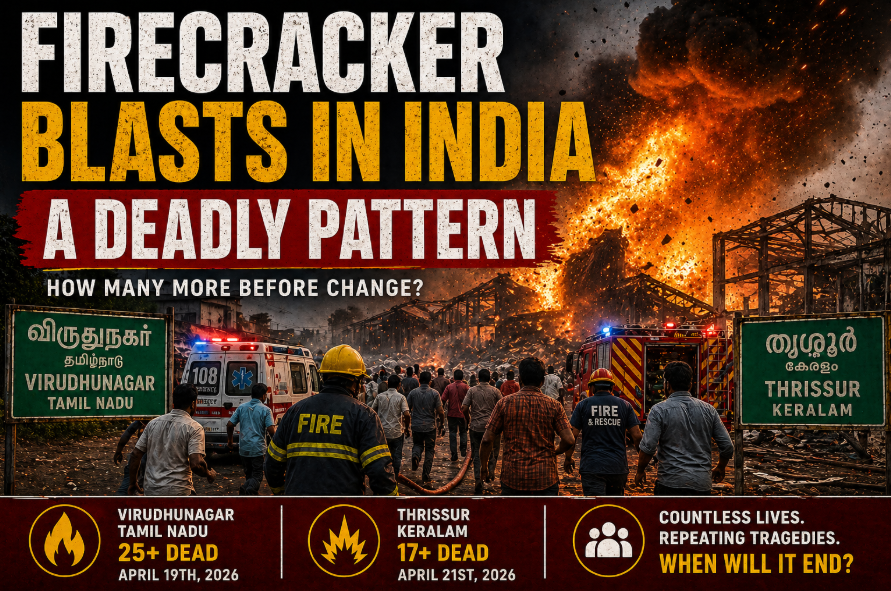
Firecracker Blasts in India keep returning like a dreadful incident that keeps haunting. Each time, I hope it is the last explosion I will read about. Yet, April 2026 brought two more brutal reminders: Virudhunagar in Tamil Nadu and Thrissur in Keralam. When factories/storage units blow up within three days of each other, can anyone still call them “accidents”? Or are we finally ready to admit that a deadly pattern has been hiding in plain sight?
As I watched the news, one thought refused to leave me. These blasts are not random sparks; they are the predictable outcome of how India manufactures, regulates, and consumes fireworks. The pattern spans Virudhunagar, Thrissur, Andhra Pradesh, and even older memories like the Puttingal temple tragedy in Kollam district, Keralam. So, in this blog, I want to walk with you through that pattern, step by step. Along the way, I will ask uncomfortable questions, share harsh numbers, and still search for hopeful solutions. After all, if we do not connect the dots now, when will we?
Firecracker Blasts in India: Why 2026 Feels Different
A deadly cluster of explosions
Firecracker blasts in India took a chilling turn in April 2026. In Virudhunagar district of Tamil Nadu, a licensed fireworks factory exploded, killing around 25 workers within minutes. Just two days later, another blast at a firecracker unit in Mundathikode, Thrissur district of Keralam, killed at least 17 people during preparations for Thrissur Pooram. These incidents echoed an earlier 2026 blast in Andhra Pradesh that reportedly killed 28 workers in another fireworks facility. When lethal blasts repeat across three states in one season, we cannot hide behind the word “rare” anymore. Instead, we must ask why licensed units keep turning into mass-casualty sites.
A manufacturing hub built on risk
To understand this pattern, we must look at where India’s fireworks come from. Analysts estimate that the Virudhunagar–Sivakasi belt produces close to 90% of India’s firecrackers, employing around 0.8 million people, many of them poor women and migrant workers. On paper, factories follow the Explosives Act and Explosives Rules, with technical licensing by Petroleum & Explosives Safety Organization (PESO) and separate approvals under local factory laws. In practice, investigations show that many units run with overcrowded sheds, excess workers, and unsafe storage of chemicals and finished crackers together. Recently, the National Green Tribunal and the Indian Medical Association both flagged these repeated blasts as a public-health and governance failure, not just industrial misfortune. Firecracker blasts in India therefore expose structural cracks in our regulatory architecture.
Mapping India’s Major Firecracker Tragedies
A decade of explosions, one disturbing picture
When we line up the big incidents, the story sharpens. Virudhunagar and Thrissur join a long list that includes the Puttingal temple fire in Paravoor, Kollam, which killed over 100 people in 2016 after an illegal competitive fireworks display went catastrophically wrong. Kerala alone has seen multiple temple- and factory-related blasts over the past decade, showing how religious celebrations and risky pyrotechnics often collide. The common threads are overcrowded sites, inadequate separation distances, and casual handling of explosives near large crowds. Even when permissions exist, conditions on paper often disappear in the smoke of real-world practice.
Recent Major Incidents in India
| Year | Location & context | Reported deaths | Key pattern exposed |
|---|---|---|---|
| 2016 | Puttingal temple fire, Paravoor, Kollam (Kerala) | 111 | Competitive fireworks, illegal stockpiling, crowd proximity |
| 2026 | Firecracker factory, Virudhunagar (Tamil Nadu) | 25 | Licensed unit, overcapacity, secondary blast during rescue |
| 2026 | Fireworks unit, Mundathikode, Thrissur (Kerala) | 17 | Festival-linked production, inadequate safeguards, repeat state pattern |
| 2026 | Firecracker factory, Kakinada, Andhra Pradesh | 28 | Another licensed facility, similar safety failures |
Sources: Indian Express, BBC, state media reports, official inquiries
Other Major Firework Tragedies Since 2000
- 2012 Sivakasi factory explosion, Tamil Nadu — a major blast that killed 40 people and injured more than 70, became a warning sign for the industry.
- 2023 Duttapukur, West Bengal — an illegal cracker factory blast that killed 9 people and injured 12 others.
- 2024 Nileshwaram, Keralam — a temple fireworks tragedy killed 6 people and injured around 154 others.
Together, these events reveal that Firecracker blasts in India rarely come as surprises. They follow similar scripts: risky storage, lax enforcement, and communities left to pick up the pieces.
Firecracker Blasts in India: Root Causes and Regulatory Gaps
Laws on paper, loopholes on the ground
India actually has a detailed legal framework on explosives and workplace safety. The Explosives Act, Explosives Rules, and the Factories Act specify licensing, storage distances, worker limits, and periodic inspections. PESO issues technical clearances, while district administrations license factories and oversee land-use and labour compliance. Yet, a study cited in recent discussions found that 78 of 89 major accidents between 2022 and 2025 occurred in PESO-licensed units, which means licensing alone did not guarantee safety on site. Incidentally, inspections remain infrequent, under-staffed, and often focused on paperwork rather than real-time risk. In effect, Firecracker blasts in India are the visible symptom of invisible regulatory fatigue.
Routine rule-breaking as business model
Post-incident probes repeatedly describe the same violations. Factories work beyond permitted hours, squeeze twice the allowed number of workers into sheds, and mix sensitive chemicals without proper ventilation or earthing. Moreover, sub-leasing of licensed premises to unlicensed subcontractors is common, which fragments responsibility when something goes wrong. In Virudhunagar, reports suggest the unit was licensed for around 25 workers but had nearly double that number present when the blast occurred. Safety equipment like sprinklers, firewalls, protective gear, and clear escape routes often exists more in site plans than in daily practice. When violations become routine, Firecracker blasts in India stop being accidents and start becoming predictable outcomes.
System failure map
| Failure point | What goes wrong | Result |
|---|---|---|
| Licensing | Papers exist, but field checks weaken | Unsafe units keep running |
| Storage | Raw materials and finished products sit too close | Small sparks become lethal blasts |
| Staffing | Units exceed approved worker limits | More people get trapped |
| Oversight | Multiple agencies share responsibility | No single actor is fully accountable |
| Rescue | Secondary explosions occur during response | Rescuers also become victims |
Sources: Indian Express, BBC, YouTube
Lives on the Line in Firecracker Factory Explosions
Workers carry the heaviest burden
Behind each headline lies a cluster of shattered households. Many victims in Virudhunagar and Thrissur were women, young workers, or daily-wage labourers from nearby villages. They assembled crackers piece by piece, often paid per unit, which rewards speed over caution when deadlines loom before festivals. After every blast, emergency wards fill with burns, amputations, and blast injuries that stretch local hospitals beyond their limits. One local organiser summarised the dilemma bluntly: “The worker knows the danger. But there is no other work.” Firecracker factory explosions therefore sit at the intersection of occupational safety and rural unemployment.
Trauma spreads far beyond the factory gate
The explosions also scar entire communities. Besides, secondary blasts during rescue operations, like those reported in Virudhunagar, injure first responders and bystanders who rush in to help. Children walking nearby, shopkeepers, and relatives waiting outside, all become part of the casualty list. Schools sometimes remain closed and villages partially evacuated because residents fear further blasts from unexploded stock. Economically, the death of a single breadwinner can push a family below the poverty line for years, especially when compensation remains slow and inadequate. Over time, people internalise the message that human life in this industry is cheap and replaceable, which is perhaps the cruellest pattern of all.
Polluted Skies, Poisoned Ground, Shaken Minds
Air, noise, and long shadows over health
Even when no factory explodes, fireworks leave their mark on India’s lungs. Studies on Diwali show that firecracker use can push Delhi’s Post -Diwali air pollution (PM2.5 and PM10) levels several times above normal. One analysis links Delhi’s Diwali 2025 fireworks to an Air Quality Index (AQI) of around 278, which comes in the “poor to very poor” range. Fireworks emit fine particulates, heavy metals like barium and strontium, and gases such as sulfur oxides, which aggravate asthma, heart disease, and other respiratory conditions. Noise from crackers, often exceeding 140 decibels at close range, triggers stress, sleep disturbance, and hearing damage, particularly for infants and the elderly. Firecracker blasts in India therefore compound an already severe air-pollution burden. In fact, I had recommended in an earlier blog for a ban on firecrackers in India due to the various hazards it poses.
Air Quality and Fireworks
| City & event | AQI before major fireworks | AQI after fireworks | Main concern |
|---|---|---|---|
| Delhi, Diwali 2025 | Moderate (~150) | Poor–Very Poor (~278) | Short-term particulate spike, health burden |
| Major Indian metros, festival nights | Moderate | Poor–Severe | Repeated seasonal smog events |
Sources: peer-reviewed air-quality studies and news reports on Diwali pollution in Delhi and other cities
Firecracker Blasts in India: Culture, Economics, and Denial
Tradition as shield, or as opportunity?
For many Indians, fireworks symbolise joy: Diwali nights, temple chariots, weddings, and local processions. Any call to restrict crackers therefore risks being portrayed as an attack on culture or faith. Political debates around bans often frame the issue as identity warfare rather than public safety. However, genuine tradition can adapt when it recognises harm. As Mahatma Gandhi warned, “There is enough on this earth for everyone’s need but for no one’s greed,” a line that resonates strongly with debates on overconsumption and pollution. The question then becomes whether we value spectacle more than safety.
Livelihoods on the edge
At the same time, we cannot talk lightly about shutting the industry overnight. The fireworks economy in Sivakasi–Virudhunagar is worth several thousand crore rupees and sustains around 0.8 million dependants, many of them landless workers or women doing home-based assembly. A sudden blanket ban would wreck local economies and deepen rural distress. However, leaving workers in deadly conditions is equally unacceptable. That dilemma drives the search for a “just transition,” where risky jobs gradually shift toward safer alternatives without abandoning entire districts. In that sense, Firecracker blasts in India challenge us to design policies that protect both lives and livelihoods.
Safer Alternatives and Sustainable Celebrations in India
Green crackers and organised displays
One strand of response has focused on “green crackers in India,” developed by CSIR-NEERI to reduce particulate emissions by roughly 30–40% compared to traditional fireworks (for more info, read my blog on Green Diwali celebrations). These products avoid certain heavy metals and claim lower smoke output, although they still generate noise and some pollution. Adoption remains partial; only a limited number of manufacturers hold green certificates, and illegal relabelling remains a concern. Meanwhile, many experts argue for shifting from scattered private bursting toward organised public displays overseen by trained pyrotechnicians in designated safe zones. That model could improve fireworks safety in India while preserving some spectacle.
Laser shows, drone formations, and cultural reinvention
Cities like Delhi have experimented with laser-light shows as alternatives to mass cracker use during Diwali, offering families a shared experience without smoke or debris. International examples of drone shows – lighting up the sky with coordinated formations – demonstrate how technology can create awe without explosives. At the community level, sustainable celebrations in India can include diya-lit streets, music, folk performances, and collective feasts instead of relentless bangs. Here, Jawaharlal Nehru’s words ring true: “The children of today will make the India of tomorrow. The way we bring them up will determine the future of the country.” If children grow up associating festivals with cleaner air and safer joy, they will carry different expectations forward.
Policy Roadmap: From Explosions to Accountability
Immediate steps that cannot wait
In the short term, authorities need to close blatantly illegal units, enforce existing licence conditions, and mandate third-party safety audits for all large factories. Worker numbers in each shed must match approved limits, and mixed storage of raw chemicals and finished crackers must stop. Real-time monitoring tools – such as digital registers for licences, inspections, and violations – can make it harder for repeated offenders to hide behind paperwork. Compensation should be generous, fast, and preferably funded through mandatory accident insurance rather than discretionary political announcements. Strict criminal liability for owners and complicit officials would reinforce that Firecracker blasts in India are not cost-free errors.
Medium- and long-term structural change
Over the next few years, India could create a dedicated National Fireworks Safety Authority to harmonise rules, collect data, and coordinate PESO, labour departments, and state governments. This body could gradually phase out the most hazardous product categories, set national pollution caps for any fireworks still allowed, and support R&D into truly safer pyrotechnics. Parallel investments in alternative industries – renewable-energy components, light manufacturing, agro-processing – could provide replacement livelihoods in firecracker belts. Education campaigns in schools and through media can nurture a culture where “fireworks safety in India” becomes as familiar a phrase as “road safety.” As A.P.J. Abdul Kalam often emphasised, environmental responsibility begins with institutions but ultimately lives in citizens’ choices.
Breaking the Deadly Pattern, Within and Around Us
Changing systems, changing selves
Firecracker blasts in India reveal more than faulty sheds and weak inspections. They reveal how easily we trade away poor people’s safety for our brief bursts of noise and light. They reveal how environmental damage hides inside our celebrations and how communities learn to accept tragedy as the price of livelihood. On a personal level, each of us can start with deceptively small choices. We can refuse polluting crackers, choose green options when available instead, and support sustainable celebrations in India that prioritise people over spectacle. Besides, we can talk to children honestly about risk, responsibility, and the real meaning of joy. In this context, we can remember Gandhi’s reminder that the earth has enough for need, not greed, and apply that ethic to our festivals too.
A call to act, not just to mourn
Holistic change will demand courage from governments, industry, and citizens alike. Regulators must enforce rules without fear or favour; factory owners must treat safety as non-negotiable; workers and unions must insist on dignity and protection; and media platforms – including blogs like this – must keep connecting dots instead of treating blasts as isolated tragedies. For our own growth, we can cultivate curiosity about the unseen costs behind our pleasures and compassion for people whose risks we rarely see. Socially, we can push for policies that integrate safety, environment, and livelihood rather than pretending they compete. If we succeed, future generations may know fireworks mainly as artful, rare spectacles, not as recurring obituary triggers. In an unprecedented move, Thrissur Pooram 2026 was conducted on April 26th without its customary fireworks, with organisers cancelling both the sample display and the main vedikettu as a mark of respect and due to safety and legal concerns. The real question, then, is simple: when the next festival season approaches, will we repeat the deadly pattern – or finally expose it, confront it, and change it?
At ExpressIndia.info, we believe every such tragedy must lead to accountability, safer celebrations, and a stronger commitment to public safety, environmental responsibility, and humane progress. We encourage you to share this analysis, demand better enforcement from local authorities, express your opinions freely in the “Comments” section, and join us in pushing for fireworks safety reforms that protect lives while honoring traditions.
#FirecrackerBlasts #FireworksSafety #VirudhunagarExplosion #ThrissurBlast #FirecrackerReform