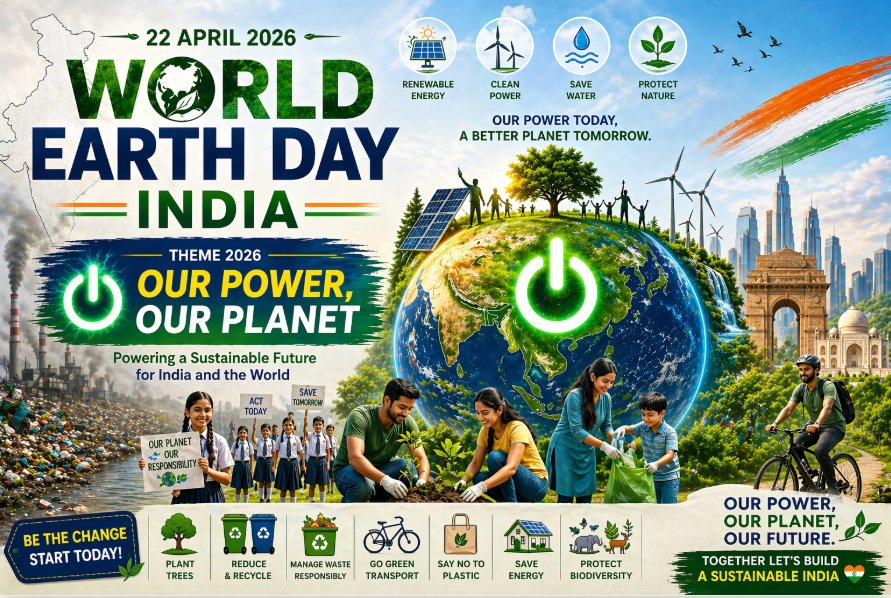
World Earth Day 2026 arrives in an India where air pollution, water stress, climate shocks, and waste overload are shaping everyday life more visibly than ever before. The country is now caught between record green‑energy growth and worsening environmental damage, and this imbalance calls for stringent intervention. The theme of 2026 “Our Power, Our Planet” lands in this space, asking citizens to realise that environmental protection is not a distant policy matter but a shared social responsibility. For India, this means recognising both the power it already has and the power it must choose to use. On World Earth Day 2026, the country does not just reflect on the crisis; it must decide whether to become part of the solution.
I still remember a winter morning in Delhi when the AQI hovered in the “very unhealthy” band, yet offices opened and traffic grew as usual. A neighbour joked, “At least the smoke keeps the air warm,” while burning dry leaves outside his gate. That moment captured how easily Indians normalise harm until it becomes routine. On World Earth Day 2026 in India, the real question is not whether we know the problem; it is whether we finally treat it as one that belongs to us, not just to the system. A slogan will not clean the air, but the choices of millions might.
The theme of World Earth Day 2026 and its relevance to India
The global theme of World Earth Day 2026, “Our Power, Our Planet”, speaks directly about India’s moment of crisis and opportunity. It asks people to see that environmental action is not optional, but a collective right and duty. In India, the theme resonates because the country is now experiencing both rapid economic growth and severe environmental stress at the same time. The power to change the future lies partly in governments and industries, but also in citizens, communities, and everyday choices. The slogan is a reminder that India cannot rely only on foreign technology or global aid; it must use its own scale, energy, and imagination to build a cleaner, safer future.
India’s recent advances in renewable energy, urban planning, and sanitation show that change is possible when will, money, and public support align. The country has already crossed key clean‑energy targets, expanded water‑harvesting experiments, and improved waste‑management awareness. Yet, pollution, flooding, heatwaves, and inequality still shape daily life for many. The theme of World Earth Day 2026 therefore feels like a moral and practical call: India must now turn partial progress into a full‑scale movement. The planet is not a distant idea; it is the air people breathe, the water they drink, and the land they depend on. For India, this Earth Day becomes a choice between continuing to live with the damage or leading a transformation for us and for future generations to come.
World Earth Day 2026 and India’s environmental reality
Earth Day, observed every year on April 22nd, began as a global teach‑in and has grown into a movement of over a billion people acting for the planet. In India, Earth Day has gradually shifted from school posters and occasional tree‑planting into a broader conversation about air quality, water security, and climate‑smart cities. Schools, housing societies, colleges, and corporate campuses now mark World Earth Day with clean‑ups, awareness sessions, and policy dialogues. The day assumes more relevance now, as environmental stress touches health, jobs, and daily life in visible ways.
Environmental issues in India include air pollution, water scarcity, plastic waste, climate change impacts, and biodiversity loss, and these problems are not isolated. Recent incidents of air pollution in Delhi and water scarcity in Chennai throw light on the alarming nature of these problems. They intersect with inequality, health, and livelihoods. When heatwaves grow longer as is evident this summer, floods become more frequent, and rivers and lakes turn foul, the abstract idea of “climate” becomes very intimate and urgent. For many Indians, World Earth Day 2026 is less about a slogan and more about breathing, drinking, moving safely, and planting crops. The day must not only celebrate technology and policy but also protect the people who feel the crisis most.
Air pollution and public health
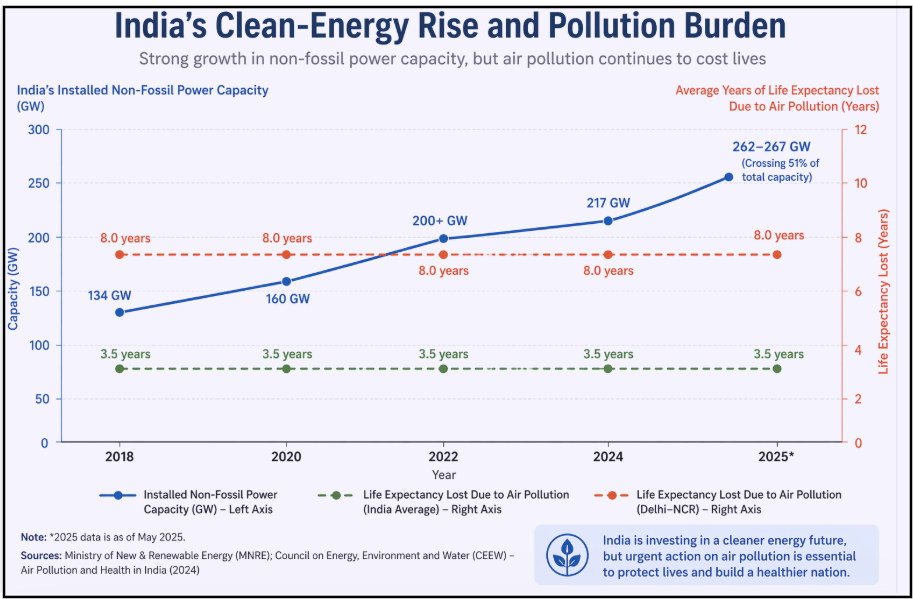
Air pollution remains one of the most visible and harmful environmental issues in India. Cities like Delhi often see “very unhealthy” or even “hazardous” AQI levels, even as daily life moves on. Recent global assessments estimate that particulate pollution shortens the average Indian’s life by about 3.5 years, and residents of the Delhi–NCR region may lose around 8 years of life expectancy if pollution stays at current levels. This is not only an environmental problem; it is a major public‑health emergency that hits the most vulnerable hardest.
Outdoor workers, street vendors, traffic police, children, the elderly, and people in low‑income neighbourhoods breathe the dirtiest air, often without the means to escape it. They face higher rates of respiratory disease, heart problems, and stroke; yet they rarely appear in the media narratives. Environmentalist Sunita Narain has often said that pollution is not just technical; it is a question of justice. She urges India to build a “water‑wise and air‑wise” future, where fairness shapes policy as much as technology. On World Earth Day 2026 in India, clean air must be treated as a basic right, not a luxury or a privilege.
Water scarcity and the everyday struggle
India’s water story is one of deep imbalance and growing stress. The country sees too much rain in some parts and too little in others, and too much dependence on rivers and groundwater without enough storage or recharge. In 2024, extreme weather events linked to climate change occurred on 322 days, triggering about 5.4 million internal displacements, many tied to water‑related shocks. Hundreds of districts face falling groundwater levels, and rivers and lakes suffer from untreated sewage and industrial pollution, often with weak monitoring and enforcement.
City residents queue for water, rely on tankers, and pay for bottled water, while farmers in distant villages see wells dry up. Some communities tolerate this as normal, yet the strain deepens every year. Women and children often walk longer distances for water, and agriculture bears the brunt of this uncertainty. This tension shows that environmental issues in India are not only technical but also social and political. On World Earth Day 2026 in India, water must be treated as a shared resource, not just a private or political commodity. The day offers a chance to revive traditional water‑harvesting methods and rethink where water goes in cities and villages equally.
Plastic waste and the throwaway habit
Plastic waste has become one of India’s most visible and troubling environmental problems. Streets, rivers, and drains are regularly littered with bags, packaging, bottles, and styrofoam. Municipal solid‑waste volumes keep rising, and dumps like Ghazipur or Deonar are often toxic, flammable, and leaching into soil and water. At the same time, regulations on single‑use plastic and extended producer responsibility struggle to match the pace of production and consumption. The habit of “throw it and forget it” remains strong.
We often buy “eco‑friendly” goods wrapped in plastic, ordering organic groceries in layers of packaging while forwarding climate‑Day quotes on social media. This irony is almost darkly comic. As environmental activist, Vandana Shiva warns, “cheating nature always returns with a bill”, and India is beginning to receive part of it. Swachh Bharat Abhiyan placed cleanliness and sanitation high on the national agenda. However, wate segregation, and recycling and reuse still lag. On World Earth Day 2026 in India, the focus must shift from symbolic cleanliness to concrete habits: refusing unnecessary plastic, segregating waste at home, and supporting local recyclers. Waste is everyone’s responsibility, and every household has the power to change that story.
Climate change and extreme weather
Climate change in India is no longer a distant scientific concept; it has become a lived reality. The country now faces longer heatwaves, erratic monsoons, more frequent floods, and drought‑prone stretches of farmland. The 2025 environment report notes that extreme weather strikes some part of India on most days of the year, displacing people, damaging crops, and testing infrastructure. Outdoor workers, slum dwellers, and coastal communities feel the impact first; yet they are often the last to receive protection or support.
At the same time, India’s greenhouse‑gas emissions now make up about 7–8% of global totals, even though per‑capita emissions remain low compared with many industrialised nations. This duality is central to India’s call for climate justice in global negotiations. Prime Minister Narendra Modi has described climate justice as a moral duty, tying fairness to environmental action. For World Earth Day 2026, climate is not just about “weather.” It is about who bears the cost of pollution, who loses livelihoods, and who leads the clean‑energy transition. The day must connect climate ambition with empathy and justice.
Forests, biodiversity, and cultural loss
Forests, grasslands, mangroves, and wetlands quietly support India’s climate and livelihoods; yet they keep shrinking. Road projects, farms, cities, and infrastructure often treat natural ecosystems as “empty land.” Tree‑cover data may look hopeful, but natural, diverse forests still face damage. Wildlife loss also weakens pollination, water control, and food security. This is not only ecological; it is cultural and social for many communities.
Thinkers like Vandana Shiva and Sunita Narain stress that biodiversity is not a luxury but a foundation for any genuinely sustainable development model for India. They remind us that living systems are the backbone of water, food, and climate stability. When habitats fragment, the damage spreads into villages, fields, and cities. For a country with deep cultural ties to nature, this loss is emotional as well as practical. On World Earth Day 2026, protecting forests and wetlands must become a shared social responsibility, not only a conservation project. A healthy India needs healthy forests.
Government initiatives and the policy framework
Swachh Bharat Abhiyan: from sanitation to waste
Swachh Bharat Abhiyan helped end open defecation, and it placed cleanliness and hygiene firmly on the national agenda. Nearly every village now has toilets, and many cities built new public sanitary facilities. Yet, solid‑waste management and waste segregation still lag behind expectations. Many urban areas rely on poorly managed dumps and informal labour, and plastic and hazardous waste pose new challenges. The mission built a strong base, but the real test is how India scales good practices.
For World Earth Day 2026, the focus should shift from “no littering” to a systemic approach: segregation at source, safer landfills, and real recycling. Communities and local governments must work together to turn waste into a resource. The mission needs to evolve from image‑making to long‑term habit‑making. If India can normalise cleanliness, it can hopefully normalise smart waste handling too.
National Solar Mission and clean energy
The National Solar Mission has helped India expand solar power at a rapid pace. Non‑fossil sources now make up about 51% of the country’s installed power capacity, crossing a major climate target five years early. Solar, wind, and other renewables now supply a large share of new capacity every year. This is a strong step toward cleaner air, energy security, and low‑carbon growth. Rooftop solar, ultra‑mega parks, and distributed generation are slowly changing the energy mix.
However, the benefits are not always visible in daily life. The grid still depends on coal, and many households feel little change in cost or convenience. Heavy transport and industrial heating still rely on fossil fuels. On World Earth Day 2026 in India, the goal must be to make clean energy accessible in homes, schools, and small towns. That means expanding solar at the local level, improving efficiency, and connecting climate action with jobs and health.
Namami Gange: cleaning a sacred river
Namami Gange aims to clean and protect the Ganga with sewage‑treatment plants, riverfront work, and pollution‑source control. After years of investment, some stretches show improved water quality, and more sewage now gets treated before entering the river. However, heavy loads from untreated waste, industrial effluents, and plastic still enter via tributaries and smaller towns. The river’s story reflects a larger national dilemma: symbolic reverence without strong practical protection.
Many worship the Ganga yet also dump into it, creating a deep cognitive dissonance. In 2025, Ganga pollution during Kumbh Mela revealed alarming contamination levels. The river is not only a religious icon; it is a lifeline and an ecosystem that supports millions. On World Earth Day 2026, Namami Gange can become a symbol of broader water‑body protection. Legal, infrastructural, and cultural change must work in tandem to achieve this objective. If India can truly respect the Ganga, it may learn to respect all its rivers and lakes.
India’s health and energy snapshot
Key recent indicators for India (environment and energy)
| Indicator | Values / estimates | Source |
|---|---|---|
| Average life expectancy lost due to air pollution in India | About 3.5 years | AQLI 2025 |
| Life expectancy lost in Delhi–NCR due to air pollution | Around 8 years | AQLI 2025 Delhi–NCR analysis |
| Share of India’s population exposed above WHO PM2.5 guideline | 100% | Global air‑pollution summaries |
| India’s non‑fossil installed power capacity (late 2025) | Around 262–267 GW | Ministry of New and Renewable Energy |
| Share of non‑fossil in total installed capacity | Approximately 51% | Government of India / Power Ministry |
Source: AQLI 2025 and Indian government power and energy releases (2023–2025)
India’s clean‑energy rise and pollution burden
Local stories and India’s power
A Bengaluru housing society once asked a simple question: what if waste is treated as the residents’ own responsibility? The community introduced segregation at source, diverted wet waste to an on‑site composter, and sent dry waste to local recyclers. Over time, the society also added rooftop solar panels, reducing electricity bills and carbon emissions. The change was small, yet visible in cleaner premises, lower costs, and greater awareness among children and elders.
The story is not about dramatic heroism; it is about consistency and awareness. The same pattern can be seen in villages restoring tanks, schools banning single‑use plastic, and cities experimenting with better water‑management. On World Earth Day 2026 in India, these micro‑stories matter as much as big reports. They show that “Our Power, Our Planet” can begin in a single street, colony, or school. Real change is not one big event; it is many small, daily choices repeated over time.
Holistic solutions for a sustainable future India
India’s path forward must be holistic, not fragmented. The government must enforce existing environmental laws, expand public transport, and invest in green cities, water‑harvesting, and climate‑resilience programmes. Businesses must move from greenwashing to genuine circular‑economy practices, reducing waste, improving energy efficiency, and using sustainable materials. Communities must revive traditional water‑harvesting and protect local ecosystems, turning tanks, ponds, and lakes into centres of climate adaptation.
Schools and colleges must integrate climate literacy and climate‑justice themes into the curriculum, so that every child understands their role in shaping the future. Religious and cultural institutions can align rituals with ecological responsibility, turning worship into active stewardship. When Sunita Narain calls for a “different tomorrow,” she is asking for a development model that respects both people and nature. When Vandana Shiva warns against cheating nature, she is calling for humility and long‑term thinking. On World Earth Day 2026, these ideas can become the backbone of a sustainable future of India.
Turning concern into quiet, everyday action
World Earth Day 2026 is more than just a date; it is a choice. India can keep normalising smog, water‑queues, and climate chaos, or it can decide to build a truly sustainable future for India where air is breathable, water is reliable, and the land is resilient. The power lies in many hands: the policymaker who signs cleaner regulations, the engineer who designs efficient systems, the farmer who protects soil and water, the student who speaks up, and the household that changes its habits.
Here is a clear, story‑style call to action:
- Start small but think big. Change one habit – segregate waste, cut unnecessary plastic, conserve water, choose public transport, support solar or efficient appliances – and turn it into a daily practice.
- Join a community – neighbourhood green committee, local clean‑up group, or climate‑awareness campaign – and multiply your impact.
- Demand climate‑justice as a voter, consumer, and citizen by asking for fair, clean, and inclusive policies.
- Protect local ecosystems – trees, water bodies, and biodiversity – and integrate them into personal and community life.
If sufficient number of Indians step up, the meaning of “Our Power, Our Planet” will shift from a theme for World Earth Day 2026 to a lifelong promise for India. Rather than only sharing alarming posts, citizens can become the people who actually changed the story – one street, one village, and one generation at a time.
On behalf of ExpressIndia.info, I wish that this World Earth Day 2026 becomes the quiet beginning of a louder, lasting change – where India’s power truly becomes the planet’s greatest ally, one conscious choice at a time. 🌍💚🌱
#WorldEarthDay2026 #IndiaCleanAir #SustainableIndia #ClimateJusticeIndia #GreenIndia
India’s problems are:
1. greed of politicians and builders. Remember the late Ajith Pawar. When a lady IPS officer prevented illegal mining, he threatened her saying: “Mein tuje dekh lunga”. When he died in the plane crash, I did not shed any tear. I only felt that a worm has been removed from the society.
2. out of sight, out of ming attitude of the citizens. If the solid waste from my compound is dumped onto the neighbour’s compound, I feel happy.
3. the double standards of western countries. They advise the third world countries to restrict carbon emission; plastics use etc. while they themselves use BBQ for their meat preparations both inside and outside their homes. I have firsthand knowledge. They use plastic carry bags, cling foils etc. with impudence.
4. vulgarization and damaging and littering our tourist spots. Remember a video for public consumption by Modi when Xi Ping was about to visit Mahabalipuram. The video shows Modi walking along the beach early morning with a gunny bag on his shoulder and picking up deliberately littered trash. It was pure publicity stunt. When a foreign dignitary visits a beach, will not the state administration take extra care to keep the place spic and span. The purpose of this act was either to belittle the state administration or for the consumption of Northern admirers.
5. there is no point in making slogans like “swath Bharat” and token sweeping of roads for photo apps. The programme needs to be followed by strict monitoring and accountability.
Thank you sir for your valuable inputs. I totally agree that strict enforcement of the law by all means is the need of the hour. Besides, citizen awareness campaigns through different media, including civic duties as part of the curriculum in the form of value-added education from a very young age, and a lot more needs to be implemented to bring about a holistic and sustainable change in our society.