
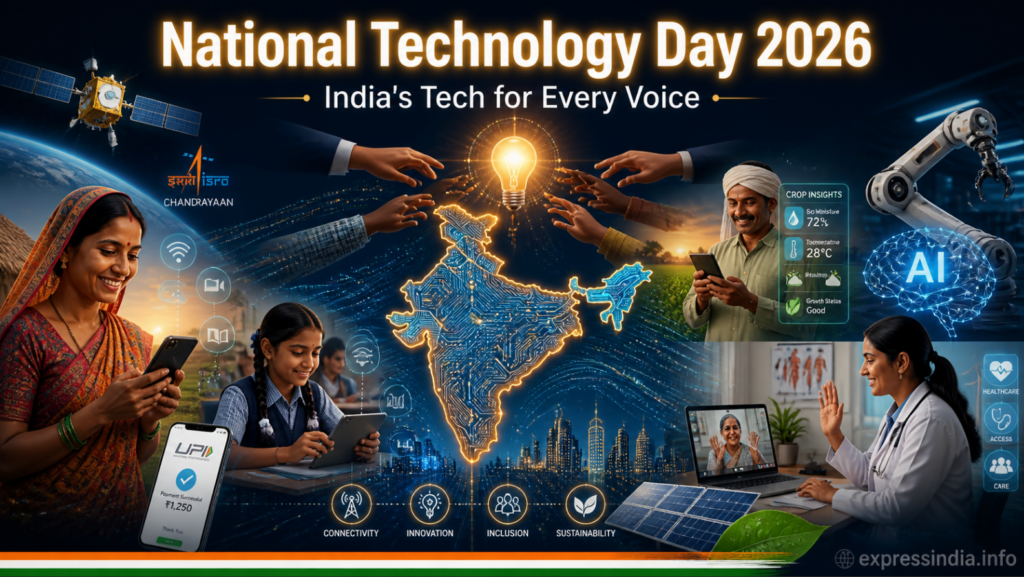
🌗 National Technology Day 2026 is not just a celebration – it is a mirror that reflects both the dazzling promise and the uncomfortable gaps of India’s tech revolution.
Outrightly, let me be honest with you. I find this day genuinely thrilling – and in equal measure troubling. As we know, India launched Chandrayaan-3 in 2023, and it landed near the Moon’s south pole. Paradoxically, millions of rural families still struggle to access a basic, stable internet connection. India processes more digital payments than almost any nation on Earth. Yet, countless farmers still negotiate their crop prices in cash – no app, no data, no lifeline. Does that contrast not strike you as deeply, almost darkly, ironic?
The theme of National Technology Day 2026 is “Responsible Innovation for Inclusive Growth“ – and honestly, it couldn’t have been timelier or imperative at this juncture. India races ahead in AI, deep-tech, and semiconductors at a breathtaking pace. Meanwhile, the benefits of this revolution still pool stubbornly in metro cities and premier tech hubs. This blog explores what that theme truly demands – the wins worth celebrating, the gaps worth confronting, and the voices that still deserve amplification. Buckle up: this is a story of two Indias, and the bridge we urgently need to build. 🧵Stay with me – because by the end, you may see your own role in this story very differently.
Before the Celebrations: The Extraordinary Day That Started It All
⏮️Before we debate where India’s tech is going, let’s revisit the extraordinary day that started it all.
On May 11th, 1998, India achieved three remarkable feats in a single, historic day. Scientists at Pokhran successfully conducted the Shakti nuclear tests, declaring India a nuclear-capable state. On that very same day, India’s first indigenously developed civilian aircraft, the Hansa-3 aircraft took its maiden flight. Additionally, the Trishul missile underwent successful testing, completing a triumphant trifecta. Subsequently, the then Prime Minister Atal Bihari Vajpayee declared May 11th as National Technology Day, commemorating this rare convergence of bold, homegrown Indian scientific achievement.
Coordinated by the Technology Development Board (TDB) under the Ministry of Science and Technology, National Technology Day has grown enormously since 1998. Every year, TDB presents national awards to scientists, innovators, and companies whose work meaningfully advances India’s technological growth. Universities host innovation challenges; startups pitch disruptive ideas; policymakers articulate fresh visions for the year ahead. As Dr. Jitendra Singh, Minister of State for Science and Technology, stated powerfully on National Technology Day 2026: “Technology must serve national resilience and public welfare – not just elite innovation corridors.” Indeed, those words carry the entire weight of this year’s theme. The day has evolved from a commemoration into a deeply necessary conversation about India’s technological soul – and who that soul actually serves.
National Technology Day 2026 Theme: From Speed to Accountability
The theme of National Technology Day 2025 – YANTRA: Yugantar for Advancing New Technology, Research and Acceleration – pushed hard on speed, scale, and global leadership. It was essentially India declaring, boldly and proudly: “Look how far we’ve come!” The 2026 theme, however, asks a harder and far more uncomfortable question. Specifically, it asks: who exactly is benefiting from this breathtaking progress? That shift from acceleration to accountability is profoundly significant. Responsible Innovation means building tech that is ethical, accessible, sustainable, and people-first – not just impressive in press releases.
The 2026 theme rests on four clear, non-negotiable pillars. First: ethical use of AI and digital technologies. Second: sustainable and green technological innovation. Third: inclusive access for rural and underserved communities. Fourth and finally: responsible development across healthcare, cybersecurity, agriculture, and education. Dr. Akhilesh Gupta, senior Department of Science and Technology (DST) official, captured it perfectly on LinkedIn during National Technology Day 2026: “Innovation must move beyond laboratories and privileged spaces to address real challenges in healthcare, agriculture, water, education, and livelihoods – only then can it reduce inequalities and build a stronger, self-reliant, equitable nation.” Clearly, inclusive growth demands nothing less from India’s ecosystem. Otherwise, we are building a revolution for the privileged alone – and that, frankly, is not a revolution at all.
2025 vs 2026: A Tale of Two Themes
| Dimension | NTD 2025 (YANTRA) | NTD 2026 (Responsible Innovation) |
|---|---|---|
| Core question | How fast can India innovate? | Who benefits from India’s innovation? |
| Central focus | Speed, scale, deep-tech | Ethics, equity, inclusion |
| Tone | Aspirational, celebratory | Reflective, socially accountable |
| Key sectors | Precision engineering, R&D | Healthcare, AgriTech, EdTech, GovTech |
| Target beneficiary | Global tech leadership | Every Indian citizen |
India Tech 2026: Numbers That Should Make You Genuinely Proud
Impressive? Absolutely. But here’s the catch – and it’s a big one. First, though, let’s genuinely celebrate what India has built, because it deserves celebration. As of March 2026, India has over 2.23 lakh DPIIT-recognised startups, collectively generating 23.36 lakh direct jobs. Furthermore, a record 55,200 startups were recognised in FY26 alone – a remarkable 51.6% jump over the previous year. India now stands as the world’s third-largest startup ecosystem, with 131 unicorns trailing only the US and China. From fintech to agritech to spacetech, Indian founders are genuinely rewriting global rules of innovation.
The digital infrastructure numbers are equally staggering – and worth pausing over before we move on. UPI now serves over 504 million users and 65 million merchants, functioning as a global benchmark for inclusive, scalable digital payments. Moreover, broadband subscribers crossed 1.059 billion as of February 2026 (TRAI data). On the deep-tech front, the India Semiconductor Mission 2.0 (ISM) targets advanced chip manufacturing with a ₹1,000 crore additional outlay for FY 2026-27. ISM 1.0 had already approved ten projects worth ₹1.60 lakh crore across six states. Additionally, the IndiaAI Mission carries a ₹10,300 crore mandate – with a dedicated “Safe and Trusted AI” pillar that signals India is, at last, thinking about responsible AI seriously.
India’s Key Tech Milestones till 2026
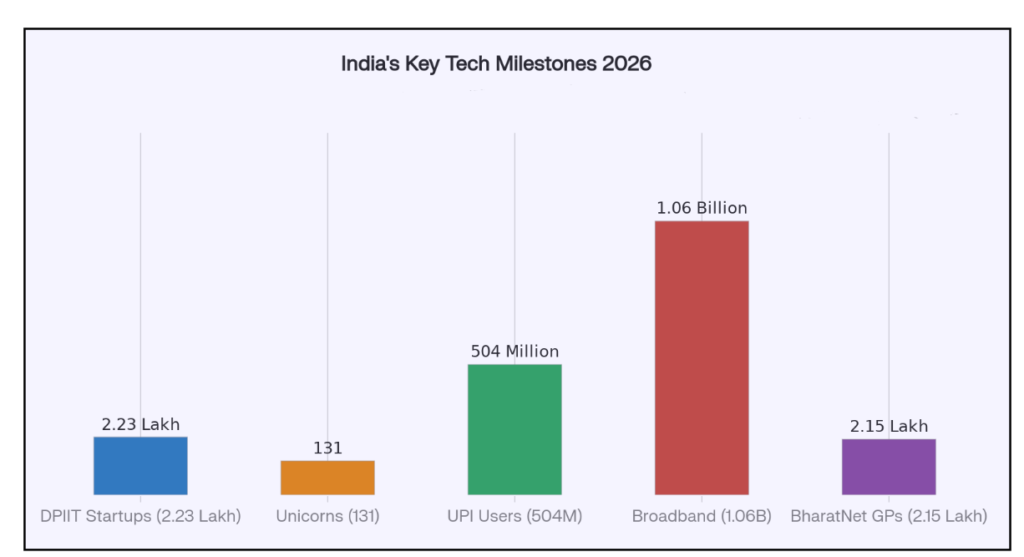
Source: DPIIT, TRAI, NPCI, ISM, IndiaAI Mission | As of May 2026
🪞Now, before you start feeling too proud, let me hand you the other half of the story.
National Technology Day 2026: Who Is Still Being Left Behind?
🔍Here’s where the honest, uncomfortable conversation begins – the one most tech blogs conveniently skip.
For all its headline achievements, India still spends only 0.64–0.66% of its GDP on R&D – far below the global average of 2.7%, and embarrassingly distant from South Korea’s 4.9% or even China’s 2.4%. The National Science, Technology and Innovation Policy 2020 remained a draft and was never formally implemented. As the late Ratan Tata observed, with characteristic bluntness: “My outlook on R&D is that it is an absolutely necessary thing for us to do – and I don’t think we are doing enough.” Those words still sting in 2026, precisely because they remain stubbornly, painfully true.
Then there is the digital divide in India, which quietly undermines every celebration we hold. Rural India now accounts for 548 million – 57% of India’s 958 million active internet users – with rural usage growing at nearly four times the urban pace. However, raw access numbers conceal a deeper truth: speed, reliability, content relevance, and language accessibility still lag badly in villages and small towns. Data costs – once as low as ₹9.08 per GB – have risen sharply; basic prepaid packs now cost ₹299 for barely 1–1.5 GB per day. Consequently, millions of low-income users remain effectively priced out of the very revolution their taxes helped fund. Add to this, most tech interfaces still default to English or Hindi – silently and systematically excluding hundreds of millions of regional language speakers. If that isn’t a digital caste system in the making, I honestly don’t know what is.
R&D Spend as % of GDP – India vs the World (2021-24)
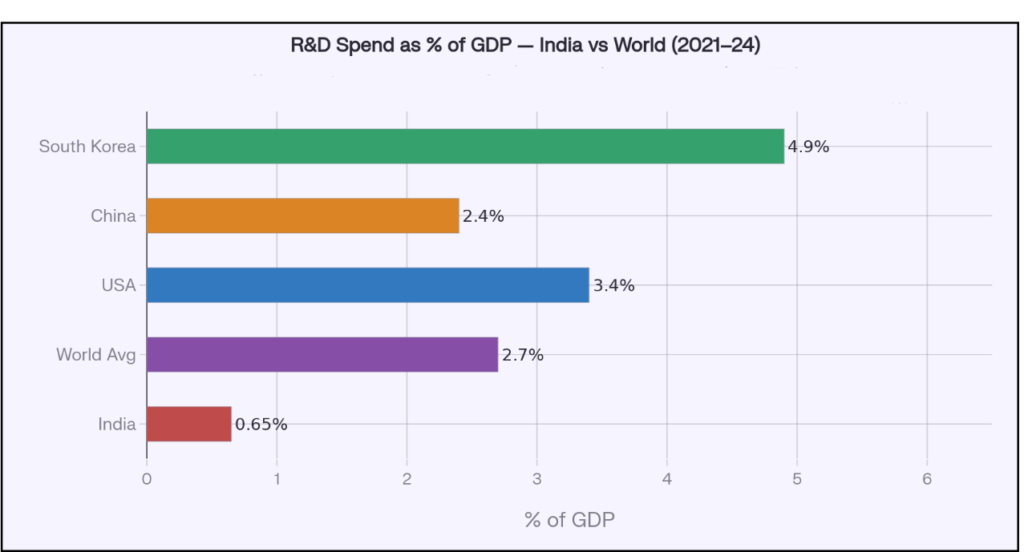
Source: Parliament Reply 2025, World Bank | India at 0.65% lags far behind peers
Rural vs Urban Internet Users 2025
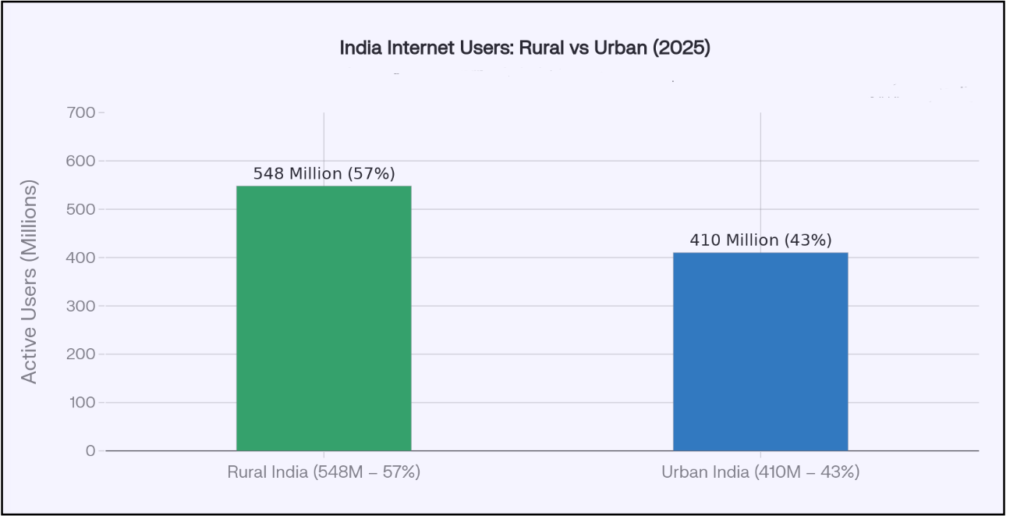
Source: IAMAI–Kantar Internet in India Report, January 2026
The Gender Fault Line: India’s Most Invisible Tech Gap
⚡Here is a statistic that should genuinely trouble every Indian tech optimist, including me.
Women account for 43% of India’s Science, Technology, Engineering, and Mathematics (STEM) graduates – one of the highest ratios in the world. Yet, by the time those same graduates reach senior leadership roles in tech, that figure collapses to barely 20%. The EY 2026 STEM report calls this a “two-step challenge”: first, the transition from academia into the workforce; then, surviving a steep leadership cliff where systemic bias and inflexible workplace culture take a relentless, grinding toll. Women’s overall labour force participation did improve – rising from 32.8% in 2021-22 to 41.7% in 2023-24 (PLFS data). However, the story at senior levels remains deeply and stubbornly unequal.
The broader picture, frankly, is one of extraordinary talent wasted at significant, national scale. LinkedIn data for 2024 shows women represent 41.2% of the overall workforce on the platform, with STEM-heavy sectors genuinely leading in hiring STEM-qualified women at entry level. However, representation at boards, CTO offices, and policy-making desks stays overwhelmingly, disproportionately male. If inclusive growth is truly the goal, fixing this pipeline gap is a non-negotiable precondition for responsible innovation. Moreover, an innovation ecosystem that sidelines half its talent cannot credibly claim to serve every voice. Not on National Technology Day. Not on any day for that matter.
Women in India’s STEM: The Leaky Pipeline
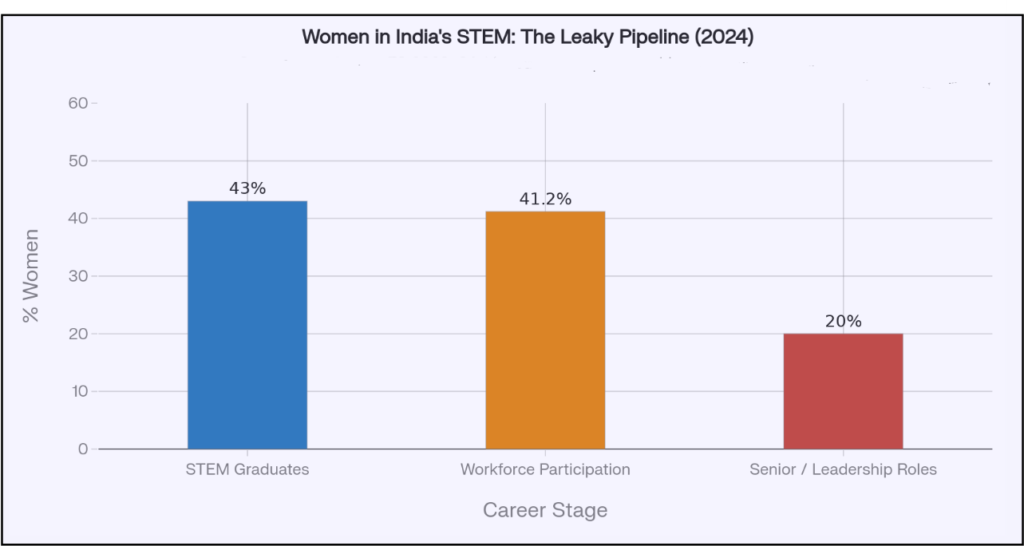
Source: EY 2026, PLFS 2023-24, LinkedIn 2024
Forget the Unicorns: The Real Tech Heroes Are in the Villages
🌾Forget the unicorns for a moment.
The most powerful tech story in India today is unfolding quietly in a village – not in a venture capital meeting room. Smile Foundation‘s digital classrooms are enabling hybrid learning for under-resourced communities in Bihar and Uttar Pradesh, where school attendance was once constrained purely by geography and poverty. Telemedicine vans – rolling health units equipped with digital diagnostic tools – are reaching villages that have never seen a specialist doctor in person. Additionally, BharatNet has now connected over 2.15 lakh Gram Panchayats with fibre optic cables. Meanwhile, 6.39 crore rural citizens gained digital literacy under PMGDISHA between 2017 and 2024. ITC’s e-Choupal, furthermore, has empowered millions of farmers with real-time market prices – cutting out exploitative middlemen and returning dignity to the farmer.
Yet, as Smile Foundation rightly warned in its 2026 National Technology Day blog, India still risks creating a “digital caste system” if conscious inclusion is abandoned. If innovation keeps prioritising the needs of urban, English-speaking, formally educated users, marginalised communities fall further behind – connected in theory, but excluded in devastating practice. Common Service Centres, UMANG, and DigiLocker are genuinely transforming government service access for millions. However, their actual reach depends entirely on the digital literacy and reliable connectivity that surrounds them. Consequently, the challenge is no longer building the platform – it is ensuring every single Indian actually walks through the door. And that, my friend, requires far more than good technology. It requires good intent, sustained over years.
Emerging Tech for Inclusion: Where Real Hope Lives in 2026
🌱I find genuine hope in several tech developments of 2025-26 – specifically because they are being designed for the many, not just the few.
BHASHINI, the MeitY-backed National Language Translation Mission, is building AI tools for speech, text, and translation across India’s 22+ scheduled languages. The BHASHINI Samudaye initiative, launched in January 2026, brings together language experts, civil society, and academia to co-create language AI solutions – essentially crowdsourcing India’s linguistic inclusion at scale. Similarly, the Digital Personal Data Protection (DPDP) Rules 2025, notified on November 14, 2025, have now fully operationalised the Digital Personal Data Protection Act – creating a citizen-centred framework for data governance that protects ordinary people, not just corporations. As India transitions from “Digital India to Intelligent India”, AI copilots and sector-specific tools are increasingly embedded in public services, agriculture, and education.
PM Narendra Modi captured the spirit of this moment in his National Technology Day 2026 message: “Technology has become a key pillar in building a self-reliant India – accelerating innovation, expanding opportunities, and contributing to the nation’s growth across sectors. Our continued focus remains on empowering talent, encouraging research, and creating solutions that serve both national progress and the aspirations of our people.” Beyond GovTech, AgriTech is deploying AI-based crop advisory systems and soil-health monitoring tools reaching remote farms. EdTech companies are building offline-first apps specifically for low-bandwidth rural students. HealthTech solutions are pushing AI-assisted diagnostics directly to Primary Health Centres. Clearly, the technology already exists. The real question – and it is a pointed one – is whether policy will consistently, deliberately direct it towards every voice in India.
Here’s What Most Tech Blogs Conveniently Skip About India’s Policy
The policy architecture India has built is genuinely impressive in scope – and it deserves acknowledgement. The IndiaAI Mission explicitly includes a “Safe and Trusted AI” pillar, signalling that responsible AI is finally no longer an afterthought. The Anusandhan National Research Foundation (ANRF) carries a ₹14,000 crore central outlay for long-term R&D. Additionally, the Research, Development and Innovation (RDI) Scheme provides a ₹1 lakh crore six-year financial pool. The National Quantum Mission adds ₹6,003.65 crore more to India’s deep-tech investment. Altogether, these represent some of the most ambitious tech policy commitments India has ever made.
🚨Here is the part, however, that most tech blogs conveniently skip – what is still dangerously missing from India’s policy playbook.
India’s R&D spend at ~0.65% of GDP simply does not match its ambitions; the National Science, Technology and Innovation Policy (NSTIP) 2020, which should have guided this, was never formally implemented. Data affordability improvements are being quietly eroded by rising telecom prices. The DPDP Rules, while now notified, are still phasing in – full compliance arrives only within 18 months. Crucially, no national mandate yet exists for vernacular-first design in government digital products. Millions of citizens continue to navigate welfare schemes, health portals, and grievance platforms in a language not their own. Clearly, responsible innovation requires urgently, unapologetically fixing this – not in the next policy cycle, but today.
The Road Ahead: What It Would Actually Take
🗺️So, what would it actually take for India’s tech to reach every voice?
As it turns out, the answer is simpler than most policymakers admit. First: raise R&D spending urgently toward the 2% of GDP mark – the RDI Scheme and ANRF are promising starts, but implementation must now follow intent decisively. Second: mandate vernacular-first design across all government digital interfaces; Bhashini already provides the tools, so there is no excuse for delay. Third: intervene specifically at the mid-career stage for women in STEM, where dropout rates are highest – targeted scholarships, mentoring, and flexible workplace norms are all affordable and achievable. Fourth: strengthen AI ethics frameworks before mass deployment, particularly for healthcare, credit decisions, and law enforcement.
Fifth and finally: integrate green tech into every digital expansion from day one – data centres, semiconductor fabs, and telecom towers must be energy-efficient by design. As Dr. Jitendra Singh stated emphatically at DST’s Foundation Day 2026, India’s tech landscape has already shifted decisively – “from laboratories to markets, and from ideas to impact.” Consequently, the next shift must be equally bold: from markets that serve the privileged, to markets that genuinely serve every Indian. Because here is the truth: India does not need a new technology strategy. It needs the courage to implement the one it already has – fully, fairly, and for everyone.
Every Voice Counts: Your Role in India’s Tech Story
🎙️Ultimately, this is not just about policy or platforms – it is about whose story gets written in India’s tech future.
National Technology Day 2026 is not just a government occasion. At its core, it is a personal mirror held up to each one of us – and the reflection it shows is uncomfortable in the best possible way. Each one of us carries a responsibility in this story. Individuals can use technology more consciously, advocate for digital inclusion in their communities, and question whether platforms they build, fund, or promote are genuinely accessible to all. STEM students and professionals can mentor someone from a smaller town — one honest conversation genuinely changes careers. Startup founders and product designers, meanwhile, must ask before every feature launch: does this actually work for someone in rural Odisha or a tribal belt in Jharkhand? If the answer is no, then that is not just a market gap – it is a moral failure.
At a broader societal level, inclusive growth demands a new, conscious social compact around technology. Communities must advocate for digital literacy programmes beyond PMGDISHA’s current reach. Civil society must hold data processors accountable under the newly notified DPDP framework. Academia must push for research on local, urgent challenges – water, sanitation, healthcare, food security – alongside global AI benchmarks. The TDB national awards on National Technology Day are a nudge in the right direction: honouring innovators whose work genuinely uplifts society, not just impresses investors. Ultimately, “India’s Tech for Every Voice” is not a slogan. It is a solemn, binding commitment to over a billion people who are watching, waiting, and entirely deserving of the tech revolution that their taxes, their data, and their deepest aspirations have helped build.
🤝The question is simple: On National Technology Day 2026 and beyond, will we honour that commitment? And more specifically – will you?
At ExpressIndia.info, we believe that India’s tech revolution deserves to be written in every language, heard in every village, and felt in every life – because a nation that innovates for all, grows stronger than one that innovates for some.
#NationalTechnologyDay2026 #ResponsibleInnovation #InclusiveGrowth #DigitalIndiaForAll #IndiaTech2026