
Research and verification cutoff: 24th October 2026. Here, “Counted” means you count as an elector on the roll.
The SIR of electoral rolls in India now determines which names to include in the count before ballots drop. On Friday, 23rd October, I followed reports of marchers heading towards the Election Commission’s headquarters. The Delhi Coordination Committee of People Against SIR called the march. Reports also named farmers’ groups, trade unions, student bodies and Left parties among participants. Marchers demanded the Chief Election Commissioner’s resignation and an end to SIR, alleging wrongful deletions. Police invoked Section 163 of the BNSS and detained over 100 demonstrators, reports said. ABP Live reported that the Commission rejected the allegations, and neither side has proven its broader case.
Still, I refuse to turn this story into a simple morality play. Indeed, India needs accurate lists, because dead, duplicate and departed names distort every contest. Yet a spotless spreadsheet means little if a living, eligible citizen sits outside it. The Chief Election Commissioner of India (CEC) stressed that the aim of the exercise is that “no eligible voter is left out.” Therefore, I will test every claim against documents, not slogans. Can one exercise deliver both accuracy and inclusion without trading one for the other? Stay with me, because the answer lives in the details most headlines skip.
Delhi’s Streets Speak Up
Since October 2nd, protests against the revision and Chief Election Commissioner Gyanesh Kumar have come from many groups, not one. On that day, a protest at Jantar Mantar saw police say they had detained about 550 people, while other accounts put the figure above 700. On October 6th, several INDIA bloc MPs were detained while marching from Parliament to the Election Commission’s headquarters. The Cockroach Janata Party also took to the streets with a tricolour march, and AISA activists joined, with leader Neha Bora detained at Mandi House. On October 23rd, more than 100 protesters were detained near the Commission’s headquarters, and the marchers held a “People’s Parliament” on the road.
These reports describe detentions and restrictions, not proven wrongdoing. So, I’d reserve my comments on human rights violations that happened during the protests, for now. Even so, how the state handles peaceful dissent is itself part of this story. The marchers allege wrongful voter deletions, but no verified evidence yet shows who was wrongly removed. Much like the CJP protest that happened earlier this year, this wave shows a public that feels unheard on how the electoral roll is drawn. The SIR of electoral rolls in India now has to answer that.
How SIR of Electoral Rolls in India Differs from Routine Revision
Special Intensive Revision, or SIR, rebuilds an electoral roll through fresh door-to-door enumeration. Officials distribute forms, verify entries, publish a draft, hear claims and objections, then finalise. By contrast, a Special Summary Revision generally updates an existing list with limited fieldwork. Meanwhile, continuous updating lets eligible people apply for inclusion, correction or shifting between revisions. Under the Representation of the People Act, 1950, the Commission may order special revisions. Article 324 of the Constitution gives the Commission superintendence, direction and control over electoral rolls. Thus, SIR of electoral rolls in India has legal footing; the debate concerns careful use.
First, officials cite deaths, migration, duplicate registration, wrong particulars and changed residence as reasons. Phase III, announced on 14 May 2026, covers 19 jurisdictions, including Delhi. However, each jurisdiction follows its own calendar, so no single national deadline exists. Bihar’s SIR came first, and the Supreme Court later upheld that framework. Former Chief Election Commissioner, S.Y. Quraishi argues the system “had already reached 99% accuracy.” Meanwhile, I treat that figure as his assessment, not an audited national finding. Consequently, my Delhi-heavy evidence cannot prove how SIR of electoral rolls in India performs nationally.
Who Qualifies to Be Registered?
Eligibility begins with three plain tests: citizenship, age of eighteen, and ordinary residence. Section 19 of the 1950 Act sets age and residence qualifications for registration. Article 326 grounds elections on adult suffrage, subject to constitutional and statutory qualifications. Likewise, Article 325 forbids roll exclusion because of religion, race, caste or sex. Importantly, voting enjoys constitutional protection, yet registration and voting operate through statutory qualifications and procedures. Hence, calling voting merely statutory misreads the Constitution, while calling it unlimited misreads the law. Eligibility, however, differs from inclusion, because only the electoral roll finally decides who votes.
Ordinary residence trips up more people than any other phrase in this debate. Section 20 of the 1950 Act indicates that temporary absence need not end ordinary residence. So, a hostel student or a labourer on a distant site is not automatically ineligible. Conversely, a genuine permanent move may require transferring registration instead of holding two entries. Picture a tenant who changes flats twice a year and misses every doorbell visit. A missed visit proves only that nobody answered the door, nothing about eligibility. Likewise, an unreturned enumeration form cannot, by itself, prove death, migration or ineligibility.
Next, remember that a voter ID card does not guarantee a place on the roll. Only the operative electoral roll decides who may walk into the booth. Similarly, Aadhaar helps verify identity in some processes but does not prove citizenship. Citizenship remains a separate legal question, as the Supreme Court’s May 2026 judgement recognises. Likewise, a duplicate entry demands correction, but it never proves that someone voted twice. Do you know whether your own name sits on today’s draft? Hold that thought, because the next section shows why checking matters.
Delhi’s Numbers: What They Show, and What They Cannot
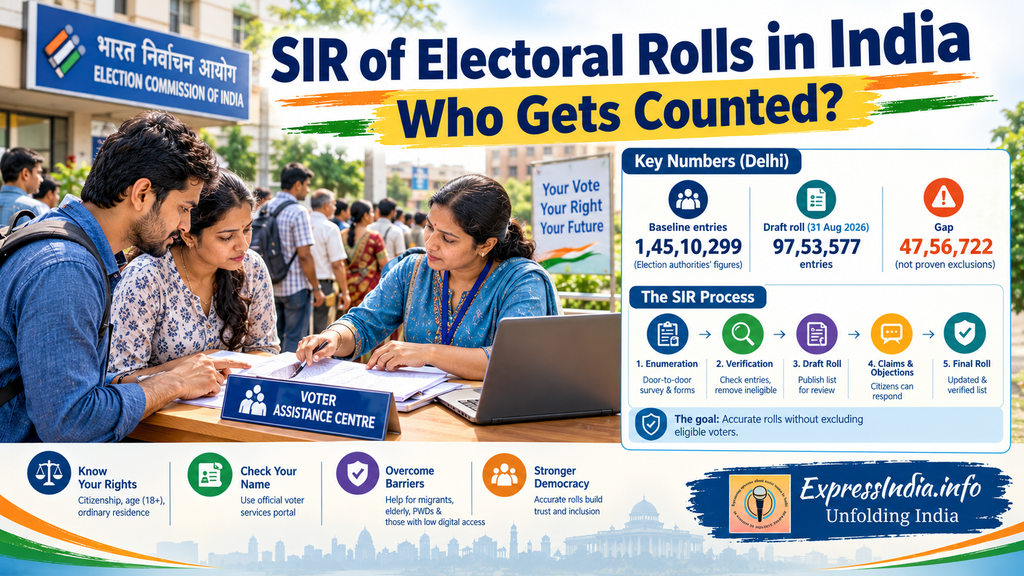
Delhi’s numbers look dramatic, so I will handle each one with tweezers. Election authorities’ figures, put the baseline at 1,45,10,299 entries. Meanwhile, the draft published on 31 August listed 97,53,577 entries in total. The gap, 47,56,722, counts uncollected forms, not proven ineligible people. Separately, roughly 33.1 lakh notice cases among draft-listed electors. Of these, around 13.79 lakh lacked mapping, and 19.33 lakh showed logical discrepancies. Therefore, nobody should add different populations together into one alarming headline.
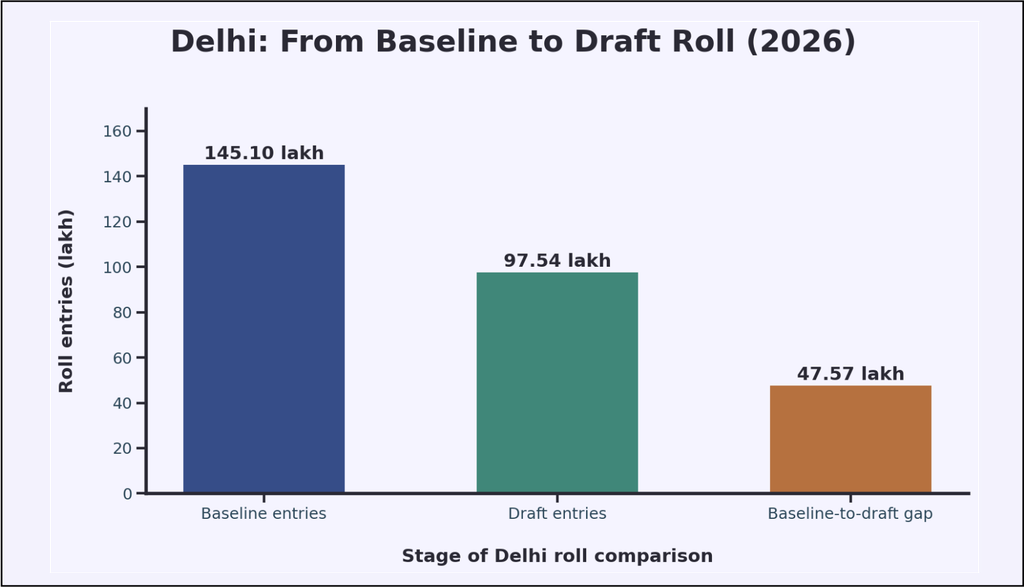
Source: Election authorities’ figures reported by News On AIR, 31 August 2026. Unit: roll entries or forms; draft stage only.
Applications tell a second story, and it needs equally careful reading. Reportedly, there were 3,58,201 applications received between 31st August and 21st October, 2026 across four forms. Form 6 accounted for 2,47,396 applications, while Form 8 added 94,128. Meanwhile, Form 7 recorded 16,238 applications and Form 6A recorded only 439. Applications are requests, not approvals, and none of these figures counts restored voters. The Commission extended claims and objections to 30th October, replacing the earlier 30th September deadline. Disposal runs to 30th November, and reporting places final publication on 4th December. That 4th December date remains scheduled, so I treat it as unfinished.
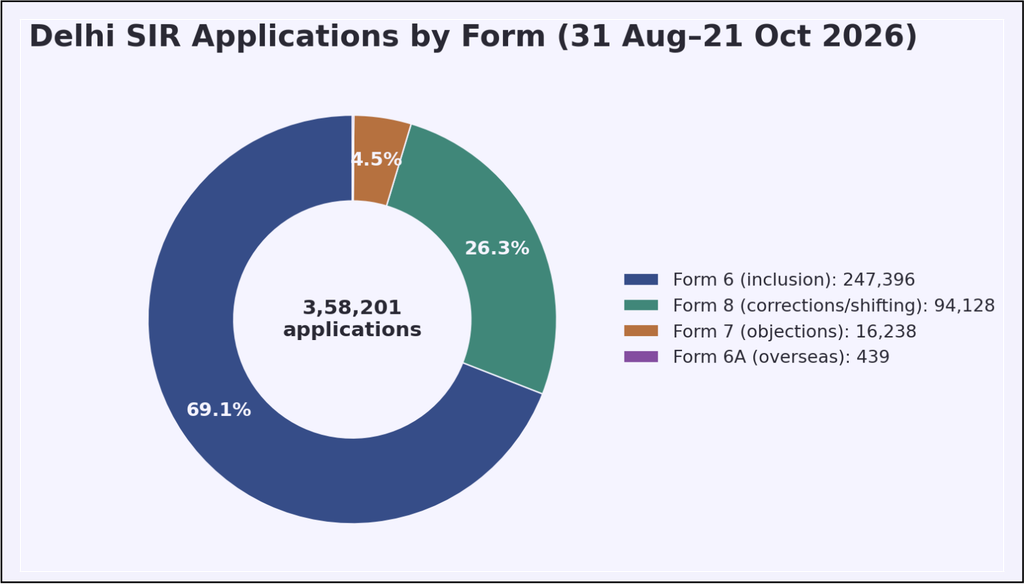
Source: The Tribune, 22nd October 2026. Unit: applications, not approvals.
As per reports, officials resolved roughly 20 lakh of 33 lakh notice cases. Yet “resolved” does not reveal how many entries stayed, changed or disappeared. Therefore, nobody can yet say how many draft omissions become final exclusions. Nor can anyone say how many proposed corrections were justified. A lower total proves neither successful cleansing nor wrongful exclusion on its own. We need final outcomes and appeal data before judging SIR of electoral rolls in India. Until those records appear, I call these figures signals, not verdicts.
| Figure | Unit | Stage and date | What it does not show |
|---|---|---|---|
| 1,45,10,299 | Roll entries | Baseline before draft | Eligibility of any person |
| 97,53,577 | Roll entries | Draft, 31 Aug 2026 | Final roll |
| 47,56,722 | Entries/forms | Baseline-to-draft gap | Final exclusions |
| About 33.1 lakh | Notice cases | Draft-listed electors, September reporting | Notices served or decided |
| 3,58,201 | Applications | 31 Aug–21 Oct 2026 | Approvals or restorations |
| About 20 of 33 lakh | Cases “resolved” | 12 Oct 2026 statement | Outcome of each case |
Sources: News On AIR, Indian Express, The Tribune and ThePrint.
Where Fair Implementation Can Break Down
Primarily, documented SIR difficulties deserve attention, however small the sample looks. As reported, two Delhi electors who shifted homes missed enumeration. Authorities asked them to apply through Form 6, the route for fresh registration. Their final registration outcomes remain unknown in the sources I examined. Consequently, two cases illustrate friction without proving any statewide pattern. The Supreme Court advanced a Delhi hearing to 28th October over that Form 6 confusion. Chief Justice Surya Kant said the bench was “thinking of passing an order” addressing it.
Officials themselves recognise several systemic barriers, judging by their announced remedies. The Commission’s 26th September decision ordered doorstep document collection for specified notice cases. It also announced special camps, plus help desks at shelters and labour sites. Delhi’s authorities scheduled a final round of enrolment camps for 25th October. However, an announced measure does not prove delivery, reach or effectiveness. Public data do not yet show how many camp visitors secured approved inclusion. Would a daily-wage worker lose a day’s pay to attend?
Several risks remain plausible yet unquantified, so I flag them without alleging harm. Seasonal migrants may return home after a household visit has already happened. Tenants in insecure housing may lack rent papers or stable addresses. Elderly citizens and persons with disabilities may struggle with portals, queues and unclear notices. Limited literacy, language barriers and name mismatches across documents could complicate verification further. Travel costs and lost wages could also tilt the playing field. Researchers and officials should measure how these risks affect eligible voters.
Notice, Hearing and Appeal: The Due-Process Test
Fair process separates rigorous SIR of electoral rolls in India from a bureaucratic guessing game. A notice must reach the person, explain the concern and allow time to respond. Issuing a notice is not serving it, and serving it is not understanding it. Field verification by a Booth Level Officer (BLO) helps, yet it cannot replace a reasoned decision. The Electoral Registration Officer (ERO) decides registration matters, while Assistant EROs assist within authorised duties. Chief and District Electoral Officers coordinate, supervise and publish instructions across the system. Meanwhile, party-appointed Booth Level Agents (BLA) differ from official BLOs, a distinction many people miss.
Now to the Supreme Court, because loose summaries have misled many readers. The Supreme Court decided Association for Democratic Reforms v Election Commission of India on 27 May 2026. It upheld Bihar’s Special Intensive Revision framework, recognising the Commission’s authority and safeguards. Notice, a chance to respond, reasoned orders and statutory appeals mattered to that analysis. However, the ruling does not bless every later notice, document demand or individual deletion. Furthermore, an electoral roll decision cannot become a final citizenship determination by itself. Therefore, Delhi’s procedures still need scrutiny on their own facts and records.
Public trust in SIR of electoral rolls in India needs data outsiders can check privately. Which notices reached people, and how many repeat attempts did officials make? What reasons justified each proposed removal, and in which category? How many eligible voters returned through claims and objections, and how fast? Meanwhile, how many appeals reached decision, and how many succeeded in practice? The Commission’s 1st October order already directs BLOs to compare pre-SIR and current rolls. Publishing aggregate results would convert good intentions into verifiable performance.
Why SIR of Electoral Rolls in India Needs Accountability, Not Just a Smaller Roll
Removing dead, duplicate and departed names genuinely improves an electoral roll, and I applaud it. Nevertheless, a smaller roll is not proof of quality, only proof of change. Bihar’s roll fell from about 7.89 crore to 7.24 crore at draft stage. It then reached about 7.42 crore after 21.53 lakh additions and 3.66 lakh removals. Those additions include new electors, so nobody should label them all restorations. Draft omission, therefore, differs sharply from final exclusion, as Bihar’s trajectory suggests.
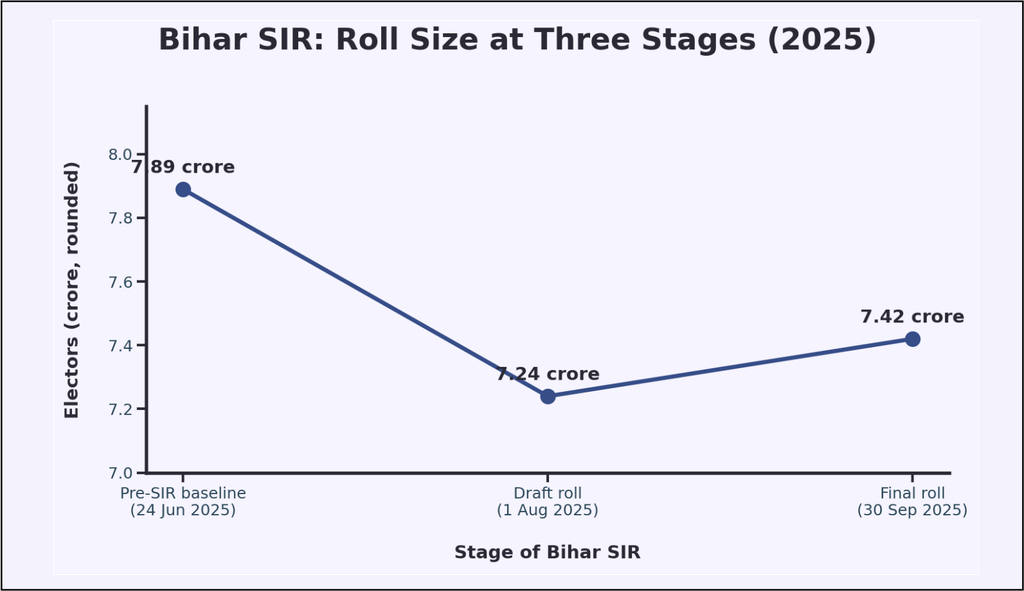
Source: Figures recorded in the Supreme Court judgement hosted by the Election Commission; rounded values, in crore electors.
Technology deserves a careful, unromantic look, because algorithms make excellent scapegoats. Official material documents ECINet, digitisation and categories such as unmapped and logical discrepancy. It does not establish that artificial intelligence makes final deletion decisions. A flag should trigger verification, not operate as a verdict. Likewise, absent, shifted, deceased and duplicate remain administrative categories, not individual legal findings. The Commission has also announced an expert-assisted review of ECINet. Publishing that review’s terms would help citizens judge how the system performs.
Special Intensive Revision safeguards fall into three honest baskets, and I label each plainly. Existing legal requirements include notice, a chance to respond, reasons and appeals. Officially announced practice includes doorstep collection, camps, help desks and exceptional online hearings. Evidence-based editorial recommendations include served-notice rates, repeat contacts and multilingual, disability-inclusive communication. I would add human review of uncertain matches and clear written reasons for proposed exclusion. Additionally, officials should publish aggregate reason-wise statistics and commission privacy-respecting independent sample audits. Uttarakhand’s official note reconciles its draft, additions and deletions, though arithmetic is not accuracy.
What Voters Can Do
- Check your entry. Search the ECI Voters’ Service Portal or electoral search. A voter ID alone never guarantees a place on the operative roll.
- Find the right roll. Confirm whether you are viewing a draft, final roll or supplement, and visit CEO Delhi for Delhi’s documents.
- Reach officials. Use the portal’s directory for your BLO, ERO or AERO, and confirm the helpline 1950 locally.
- Pick the right form. Form 6 seeks inclusion; Form 6A serves overseas electors; Form 7 objects to or seeks deletion of an entry; Form 8 corrects details or shifts residence.
- Mind Delhi’s difference. CEO Delhi’s 8th September guidance directed omitted electors to file Form 6 with the prescribed SIR declaration and documents. The Supreme Court hears a Form 6 plea on 28th October, so recheck instructions first.
- Answer notices promptly. Ask which issue is examined, what evidence helps, and whether a BLO can collect documents at home.
- Keep proof. Save acknowledgements, copies and notices, then track each application on the portal. Filing a form never guarantees inclusion.
- After a rejection, request the written order, then identify the appeal authority and deadline at once.
- Delhi dates only: Claims and objections close 30th October; disposal runs to 30th November; the final roll is scheduled for 4th December; camps are scheduled for 25th October. Other states follow different calendars.
The Questions Still Waiting for Answers
So where does SIR of electoral rolls in India stand today? Honestly, it stands unfinished, with its most important evidence still unpublished. How many draft omissions became final exclusions, and how many eligible voters returned? What does “resolved” actually mean, and did officials serve notices and answer claims and objections? Did doorstep, camp and accessibility measures reach those who needed them? Can officials reconcile Delhi’s baseline-to-final figures transparently, and what did appeals show? Similarly, the same standard applies to all other Indian states as well. I will keep asking, because answers, not applause, build trust.
Authorities can publish served-notice rates, reasoned decisions, restorations and appeal outcomes without exposing anyone’s data. Journalists and researchers can audit samples, document cases and demand clear denominators. Citizens can verify their electoral roll entries today and help neighbours who lack phones. SIR of electoral rolls in India earns trust only when rolls stay accurate and correctable. It must also stay explainable and treat every eligible voter fairly, whatever their address. So, open the voter portal today and check whether your name features in the electoral rolls. Then, spread the message across your contacts, because one checked name can protect another voter.
ExpressIndia.info will keep tracking how SIR of electoral rolls in India is carried out, state by state, and will report the verified facts, the gaps in the data and the official answers still owed. We stand for accurate rolls that do not shut out eligible voters, and we will keep asking, until the evidence settles it, who gets counted and who gets left out.
#SIR #ElectoralRolls #VoterRights #IndianDemocracy #ExpressIndia