
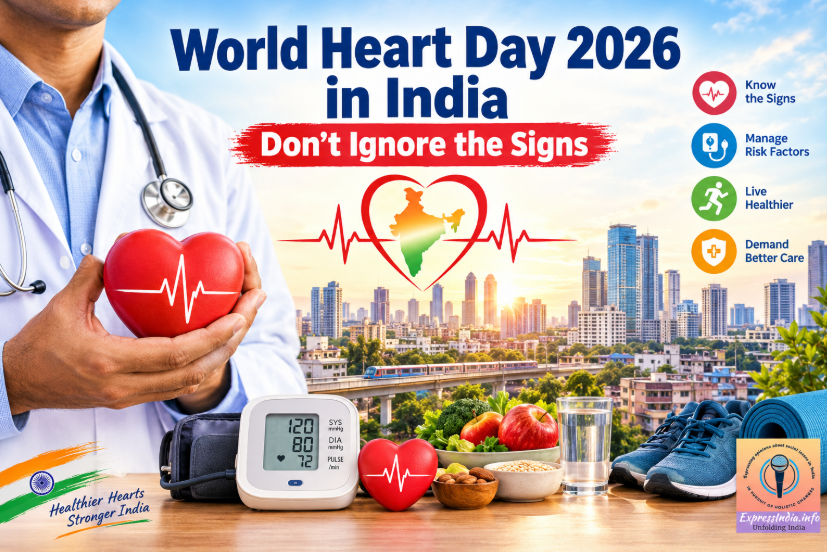
World Heart Day 2026 arrives with a warning that many Indians will quietly ignore. A 42-year-old Bengaluru software architect named Ramesh felt “just tired” for weeks. He walked daily, and he ate mostly home-cooked meals. Moreover, he never smoked, and he never really worried. Yet, a routine check revealed his blood pressure had quietly crossed safe limits. His story repeats across India, because cardiovascular disease often hides behind normal-looking lives. Consequently, this year’s global campaign asks Indians to confront exactly that blind spot.
Heart disease rarely announces itself loudly, and therefore, it can progress for years unnoticed. Ramesh’s brush with hypertension became a wake-up call rather than a diagnosis of doom. Similarly, millions of Indians carry silent risk while assuming that feeling fine equals being fine. World Heart Day 2026 exists precisely to challenge that assumption. Furthermore, the campaign insists that missing a symptom can be as dangerous as missing a diagnosis. What if the biggest threat to Indian hearts is not a heart attack, but a missed warning sign? That question encapsulates every section of this blog.
What “Don’t Miss a Beat” Really Means This World Heart Day 2026
The World Heart Federation calls its 2026 theme “Don’t Miss a Beat,” and the phrase carries more weight than a fitness slogan. Its campaign material describes cardiovascular disease as “hiding in plain sight,” a line chosen deliberately over dramatic warnings. This framing rests on three pillars: “See the signs. Protect your heart. Demand action.” Each pillar targets a different kind of missed opportunity, not simply missed workouts. Missing symptoms is one danger, though missing silent risk factors is arguably worse. Meanwhile, people can feel completely normal while high blood pressure quietly damages their arteries. Inarguably, missing consistent treatment after diagnosis compounds the problem even further.
Indians often associate heart care with gyms and step counts, yet the campaign insists exercise is only one piece. As cardiologist Dr Sanjay Chugh warned ahead of World Heart Day 2026, “We are not just seeing more heart disease—we are seeing it arrive decades ahead of schedule.” That single line reframes the entire conversation for younger readers. Recognising a symptom early, tracking blood pressure regularly, and demanding better health systems all count as “not missing a beat.” Additionally, missing government action on heart-health policy completes this picture too. Therefore, the theme becomes an instruction to notice everything: symptoms, risk factors, treatment gaps and policy failures alike. World Heart Day 2026 works best when readers treat it as a checklist, not a celebration. The call to recognise warning signs continues ExpressIndia.info’s 2025 conversation on helping India protect its hearts.
India’s Cardiovascular Burden: The Big Picture
Cardiovascular disease (CVD) in India is not a distant statistic anymore; it is the country’s leading killer. Sample Registration System data for 2022–2024 shows that CVD caused 32.1 percent of all deaths nationally, up from 27.1 percent in 2015–2017. That single jump places heart disease well ahead of every other tracked cause of death. Meanwhile, Global Burden of Disease (GBD) estimates for 2021 put the toll at roughly 2.86 million deaths, or about 27 percent of total mortality. These two figures do not contradict each other; instead, they simply measure differently, using different samples and modelling assumptions. Consequently, readers should treat SRS and GBD as complementary lenses, not interchangeable numbers.
World Health Organization’s (WHO) country profile separately estimates that CVD represents around 30 percent of Indian deaths, while all Non-communicable diseases (NCD) combined together account for nearly 68 percent. Earlier, age-standardised estimates had placed India’s CVD death rate above the global average, though a fully updated comparison should come directly from the latest GBD results tool rather than repeated secondhand figures. Nevertheless, what remains consistent across every dataset is the direction of travel. Cardiovascular disease in India keeps climbing steadily, not falling gently. That trend alone should worry policymakers just as much as it worries patients. Indeed, no single dataset tells the whole story, but together they confirm one unavoidable conclusion.
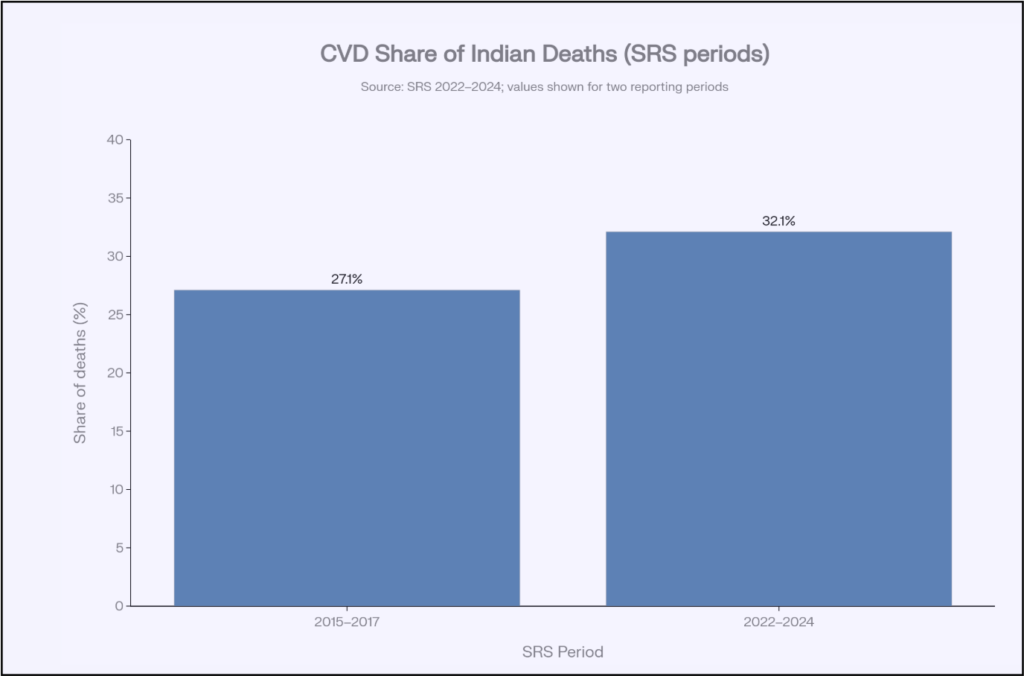
Source: SRS Statistical Report, 2022–2024. Figures represent two non-continuous reporting periods, not an annual trend line.
Note: A screening count is not a prevalence estimate — and a diagnosis is not the same as control.
Silent Risks: Hypertension, Diabetes and Lipids in India
Blood pressure, blood sugar and cholesterol rarely cause symptoms until real damage is already underway. That is precisely why cardiovascular disease hides in plain sight across Indian households. India’s ICMR-INDIAB national study, published in 2023, estimated hypertension prevalence at 35.5 percent among adults nationwide. Diabetes affected 11.4 percent, while hypercholesterolaemia touched roughly 24 percent of the adult population. Additionally, abdominal obesity affected an even larger share, reaching 39.5 percent across surveyed households. These numbers describe a population carrying enormous hidden risk while going about the grind of daily life.
However, the real crisis lies in what happens after detection occurs. WHO’s hypertension profile estimates that 188.3 million Indian adults aged 30 to 79 live with high blood pressure. Yet, only about 37 percent are even diagnosed in the first place. Roughly 30 percent receive any treatment, and just 15 percent achieve proper long-term control. Therefore, as per WHO’s calculation, India needs 67 million more people effectively treated to reach 50 percent control nationally. Feeling fine is simply not the same as being fine, especially given the scale of hypertension in India today.
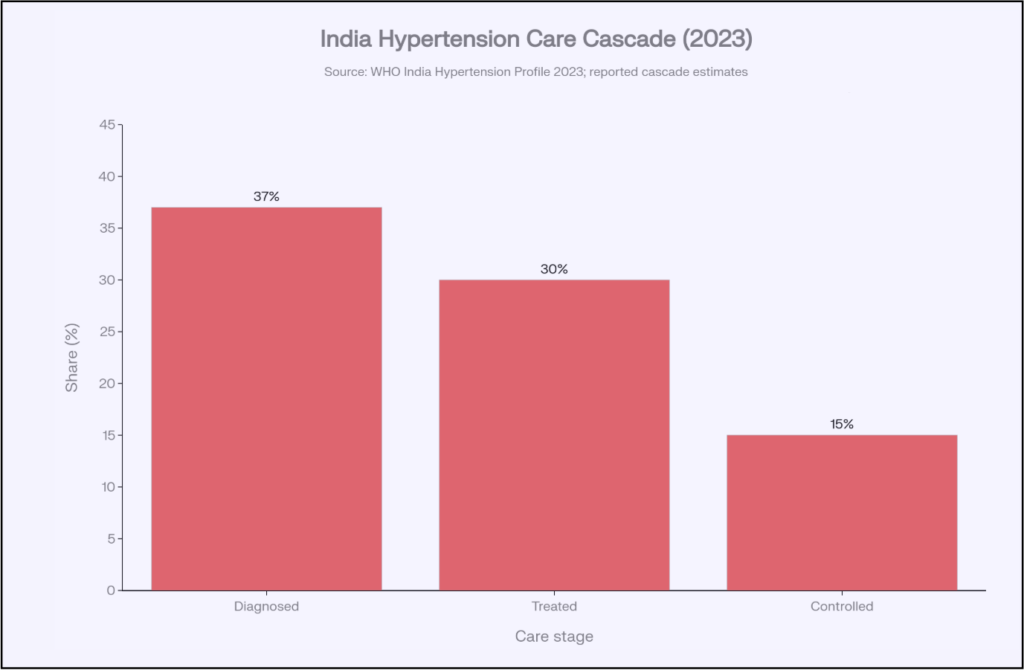
Source: WHO India Hypertension Country Profile, 2023. Diagnosis, treatment and control percentages are reported cascade estimates and may not share an identical denominator.
Not Only Old Age: World Heart Day 2026 and Working-Age Hearts
Heart disease in India is not politely waiting for retirement to strike anymore. SRS data show CVD accounts for 37.3 percent of deaths among Indians aged 30 to 69 (SRS 2022–2024). A GBD-based estimate places roughly 62 percent of India’s cardiovascular deaths between ages 40 and 69, striking during peak earning years. This is not a young-heart-attack panic story; rather, it is a slow-building life-course risk story instead. The oft-repeated claim that Indians develop coronary disease five to ten years earlier deserves careful, precise handling here.
The landmark INTERHEART study found that South Asians experienced their first heart attack roughly six years earlier than other regional populations, a specific and verifiable finding worth citing exactly. Being physically fit certainly lowers risk, yet fitness alone cannot erase inherited disease or untreated hypertension. Occasional headlines about gym-related cardiac events grab attention, though they remain rare and statistically unrepresentative overall. The more useful, if less dramatic, takeaway is straightforward: risk factors quietly accumulate through someone’s thirties and forties, long before any visible event occurs. This World Heart Day 2026, recognising that accumulation early is precisely what “Don’t Miss a Beat” is asking every working-age Indian to do.
The Indian Lifestyle Paradox Behind Rising Heart Disease Symptoms
India presents a genuinely strange contradiction: physically demanding jobs coexist with historically sedentary lifestyles. A pooled international analysis found that 49.4 percent of Indian adults failed to meet physical-activity recommendations in 2022, up sharply from 22.3 percent back in 2000. Insufficient physical activity affected 57 percent of women and 42 percent of men, revealing a gendered gap worth investigating further.
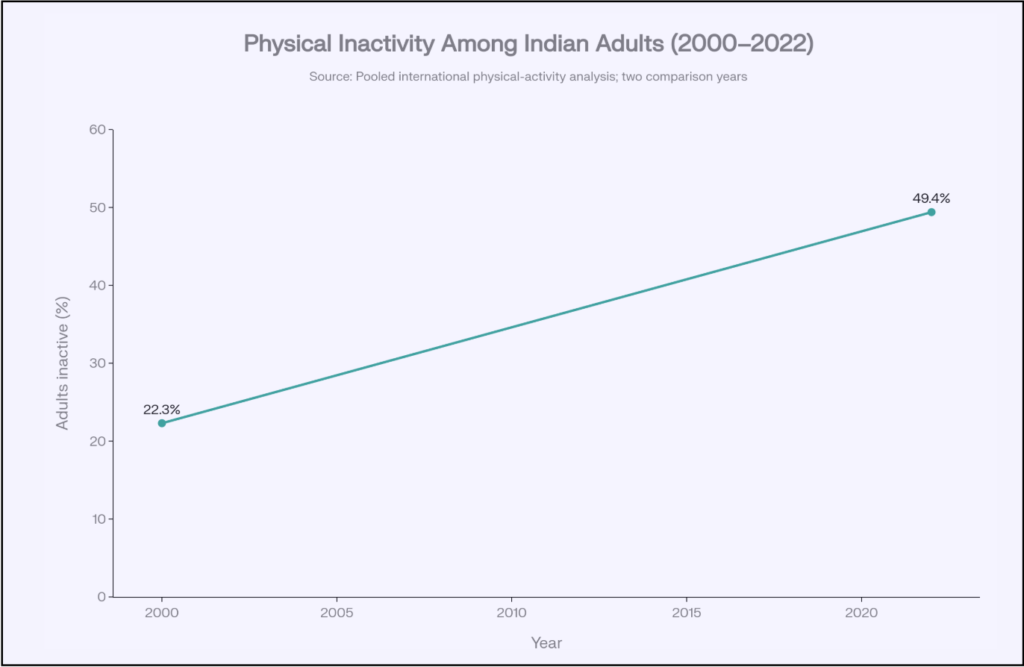
Source: Pooled international physical-activity analysis, 2022. Values reflect two comparison years, not a continuous annual series.
Meanwhile, diet compounds this quietly building problem too. ICMR-NIN’s 2024 dietary guidelines note that many Indians eat only 100 to 200 grams of fruit and vegetables daily, far below the recommended 500 grams. Refined cereals, added sugar and excess salt continue dominating everyday meals, even in households that consider themselves reasonably health-conscious. Tobacco remains a major and chronically underappreciated threat too, hiding behind its own kind of plain sight.
The most recent national survey found that 28.6 percent of adults used tobacco, including 21.4 percent using smokeless forms like khaini and gutka (GATS 2016–17). Smokeless tobacco rarely gets discussed alongside cigarettes, despite the health risk it carries over time. Alcohol use adds another layer entirely, with NFHS-5 data showing 22.9 percent of male respondents reporting alcohol consumption. None of these behaviours alone determines destiny for any individual person. Together, though, they quietly stack the odds against Indian hearts, long before any warning sign ever appears.
Air Pollution and Heart Health in India: The Hidden Link
Air pollution and heart health are connected far more directly than most readers assume. Fine particulate matter, known as PM2.5, does not stay confined politely to the lungs. Instead, WHO confirms that it can enter the bloodstream directly and trigger cardiovascular damage over time. The biological pathway includes systemic inflammation, oxidative stress and disrupted blood pressure regulation, each raising heart attack risk. Meta-analyses focused on low- and middle-income countries found that every 10 microgram increase in long-term PM2.5 correlates with roughly 10 percent higher cardiovascular mortality.
A broader long-term analysis put that figure closer to 14 percent for overall cardiovascular deaths specifically. Prevention, therefore, cannot stop at lifestyle advice alone. Padma Bhushan cardiologist Dr T.S. Kler argued exactly this: “This preventive approach must also take into account the broader environmental and lifestyle factors influencing heart health.” His remarks connected cardiovascular risk to stubble burning, noise pollution, stress and changing work patterns. Furthermore, India’s exposure spans far beyond Delhi-NCR headlines, since household cooking-fuel pollution affects rural communities just as seriously. Clean-air policy, consequently, is not simply an environmental agenda anymore; it is unmistakably a cardiovascular one too.
Women and Heart Disease: A World Heart Day 2026 Reality Check
Cardiovascular disease is often perceived, wrongly, as a predominantly male problem. Indian data, however, tells a rather different and more urgent story altogether. Women account for approximately 40 percent of the country’s cardiovascular deaths, according to an Indian acute coronary syndrome analysis. A separate 2025 review on women’s cardiology found heart disease responsible for nearly 18 percent of all female deaths nationally. Symptom presentation differs meaningfully too, adding another layer of frequently missed diagnosis.
Women may experience breathlessness, nausea, fatigue or jaw and back pain more prominently than classic chest pressure. WHO specifically cautions that women, older adults and people with diabetes often present without obvious chest pain at all. Treatment gaps compound this danger further, and the numbers are genuinely sobering. India’s 2023 NORIN-STEMI registry found that women received angioplasty less often than men, at 62 percent versus 73 percent respectively. One-year mortality among women reached 22 percent, compared with 9 percent among men in that same registry. A Kerala registry echoed this troubling pattern, recording longer prehospital delays among women compared with matched male patients. These remain registry findings, not universal proof, yet they signal a genuine, entirely correctable gap in care.
Screening Is Not Control: India’s Prevention Gap
India has significantly expanded NCD screening through Ayushman Arogya Mandirs, formerly called Health and Wellness Centres. These centres offer blood pressure and glucose screening, counselling, basic diagnostics and medicine initiation for adults aged 30 and above. By December 2025, the National NCD Portal recorded 40.13 crore hypertension screenings and 39.86 crore diabetes screenings nationwide. That distinction matters enormously, because portal figures measure programme activity rather than confirmed, controlled individual outcomes.
A nine-district facility assessment found blood pressure diagnostic capability at 85 percent of surveyed centres, a genuinely encouraging figure on its own. However, essential medicine availability lagged behind at roughly 78 percent across the same centres. The real prevention chain runs from risk assessment through screening, diagnosis, treatment, medicine access, follow-up and eventual control. Every single link in that chain can leak people out of care entirely. Medicine stock-outs, long travel distances and missed follow-up visits all contribute to this leakage. Ultimately, India’s challenge is no longer detecting risk; it is sustaining treatment long enough for it to genuinely matter.
| Programme or Data Point | Figure | Source |
|---|---|---|
| CVD share of deaths, 2022–2024 | 32.1% | SRS 2022–2024 |
| Hypertension prevalence, national | 35.5% | ICMR-INDIAB 2023 |
| Adults with hypertension controlled | ~15% | WHO hypertension profile 2023 |
| Hypertension screenings recorded | 40.13 crore | National NCD Portal, Dec 2025 |
| Adults insufficiently active, 2022 | 49.4% | Pooled international analysis, 2022 |
Sources: SRS Statistical Report 2022–2024; ICMR-INDIAB National Study 2023; WHO India Hypertension Country Profile 2023; National NCD Portal via Parliament reply, December 2025; pooled physical-activity analysis, 2022. Screening figures represent programme activity, not national prevalence.
What Ordinary Indians Can Do to Protect Their Hearts
None of this information helps unless it turns into practical, everyday action for our readers. This remains general public-health guidance, offered here, rather than personalised medical advice of any kind. Adults over 30, or those with a family history, should know their blood pressure, glucose and lipid numbers. India’s public health programme specifically targets screening from age 30 onward at local centres. Movement matters too, though not to the point of obsession or exhaustion.
Aiming for roughly 150 minutes of moderate weekly activity meaningfully lowers cardiovascular risk over time. Reducing salt toward five grams daily, while favouring pulses and whole grains, supports heart health without drastic overhauls. Avoiding tobacco in every form, including smokeless products, remains firmly non-negotiable, evidence-backed advice. Equally important, continuing prescribed medication even after numbers visibly improve matters greatly, since control usually means treatment is working. None of this replaces professional medical care; instead, it simply reduces the odds of needing an emergency later. This focus on prevention also builds on ExpressIndia.info’s 2024 appeal to empower Indians through everyday heart-health choices.
Small Symptoms That Shouldn’t Be Ignored
Heart disease frequently sends signals long before any major event actually occurs. Chest pressure remains the classic warning sign, though it need not feel sharp or severe. Breathlessness, especially when new or unusual, deserves genuine attention too, particularly alongside the signs listed below.
| Warning Sign | What It May Indicate |
|---|---|
| Chest pressure, tightness or discomfort | May be central, persistent or recurrent; not always sharp |
| Pain in arm, jaw, neck, back or upper abdomen | Can occur with or without chest pain |
| New or unusual breathlessness | Especially concerning during exertion |
| Cold sweat, nausea, vomiting or light-headedness | Recognised heart-attack-associated symptoms |
| Sudden fainting or repeated near-fainting | Requires urgent assessment |
| Rapid or irregular palpitations | More urgent alongside chest symptoms |
| Persistent unexplained fatigue | Especially when progressive |
| Heartburn-like discomfort | Common in women, older adults, diabetics |
Source: World Heart Federation 2026 campaign material and WHO cardiovascular symptom guidance, as compiled in the approved research brief.
Anyone experiencing persistent chest pressure or major breathlessness should call 112 immediately, India’s unified emergency number. Many states also operate 108 ambulance services, though availability genuinely varies by region. During a cardiac arrest, bystanders effectively become the first link in the survival chain. As Padma Bhushan cardiologist Dr K.K. Talwar put it plainly, “Every minute is important. It is only the person who is by the side that matters.” Consequently, calling for help comes first if someone collapses, followed by chest compressions if trained. This remains general awareness information only, not a substitute for proper first-aid certification.
From Individual Responsibility to Healthier Cities
Heart health cannot rest entirely on individual willpower when cities work quietly against healthy choices. Walkable streets, safe cycling lanes and clean air all shape cardiovascular risk at a population level. India already has policy precedent through MoHUA’s Streets4People initiative, supporting pedestrian infrastructure across more than 100 cities. Fifteen cities earned recognition as challenge champions for genuinely improving walking infrastructure by 2024.
Yet a city cannot reasonably ask residents to walk more while footpaths remain broken or unsafe, particularly for women after dark. Placing Ayushman Arogya Mandirs and affordable fresh-food markets within walking distance would meaningfully support prevention too. Additionally, reducing traffic emissions near schools and hospitals deserves the same policy urgency as any clinical intervention. Systemic change and personal responsibility are not competing priorities here; instead, they genuinely need to move together.
World Heart Day 2026 Across India: Awareness in Action
New Delhi hosted one of the year’s most visible events, where Union Minister Kiren Rijiju flagged off a three-kilometre marathon from India Gate to Bharat Mandapam. Over 800 participants joined, including 150 heart patients and 100 doctors, all running together to promote heart-healthy living. Meanwhile, in Tiruchirappalli, more than 7,000 runners took part in Kauvery Hospital’s eleventh Heart Health Awareness Marathon, held under the theme “Run for a Healthy Heart.” Participants competed across 21-kilometre, 10-kilometre and 5-kilometre categories, drawing children, working adults and senior citizens alike. Both events transformed a public-health message into a shared civic experience rather than a quiet observance.
Elsewhere, similar energy spread through hospitals, colleges and community groups nationwide. In Jammu, paramedics and students led a rally specifically built around the 2026 theme, “Don’t Miss a Beat.” Dayanand Medical College Hospital in Ludhiana organised free blood-pressure and sugar screening alongside hands-on CPR training for the general public, extending awareness beyond a single day. Meanwhile, the Heart Health India Foundation coordinated cholesterol-awareness sessions, workplace screening drives and public digital-board campaigns across several cities, reinforcing that heart care requires sustained community effort, not a once-a-year ritual.
A World Heart Day 2026 Call to Action: Keep the Beat for India
World Heart Day 2026 should never become another once-a-year ritual of red-lit monuments and quiet symbolism. WHF’s Keep the Beat challenge encourages daily movement throughout September, but India’s version should mean something broader still. Individuals can know their numbers and act on symptoms without needless delay or embarrassment. Meanwhile, workplaces can build movement breaks and CPR training into everyday culture, not as part of annual events.
Governments carry the heaviest responsibility here, from publishing honest screening-to-control data to strengthening emergency referral systems. Civil society and media must keep tracking outcomes after screening camps, not merely maintaining attendance figures alone. World Heart Day 2026 ultimately succeeds only when measured by controlled blood pressure and safer streets, not slogans. Keeping the beat means making heart protection routine at home, at work and in how Indian cities are designed. That, more than any single slogan, is what “Don’t Miss a Beat” was always meant to demand.
ExpressIndia.info believes that India’s next cardiac breakthrough will come not from a new drug, but from a nation that finally decides to take notice.
#WorldHeartDay2026 #DontMissABeat #HeartHealthIndia #CVDAwareness #KeepTheBeat