
Poverty Eradication in India sounds triumphant until you picture a leaking tin roof. Imagine a family of five sharing one damp room in a crowded settlement. Their income may clear every statistical bar, yet fear still arrives with each monsoon. Meanwhile, a notice of eviction can erase years of careful saving overnight. Therefore, I want this 17th October to ask a sharper question than usual. Does escaping a poverty line mean escaping insecurity, or merely relocating it?
Indeed, the numbers have improved dramatically, and I celebrate them without reservation. However, millions still lack the security that makes a home genuinely safe. Over the next sections, I will trace the data, schemes and housing poverty in India. Along the way, we will meet quotes, charts and a few uncomfortable paradoxes. Stay with me, because the story of safe homes for all is surprisingly human. So let us begin with what the United Nations has asked us to notice.
2026 Theme: “United for Peace and Human Rights — Safe Homes for All”
Every 17th October, the world marks the International Day for the Eradication of Poverty. For 2026 to 2028, the umbrella theme reads “United for Peace and Human Rights,” and the 2026 focus is “Safe Homes for All.” The focus turns a broad ideal into a plain promise. Thus, ending poverty becomes a question of dignity, equality and inclusion, not charity alone. A safe home means protection from eviction, violence, floods and heat, not merely walls. It also means clean water, sanitation, electricity, cooking energy, space, accessibility and affordability. The Secretary-General’s 2026 message notes that unaffordable rents, insecure tenure and homelessness can push people deeper into poverty.
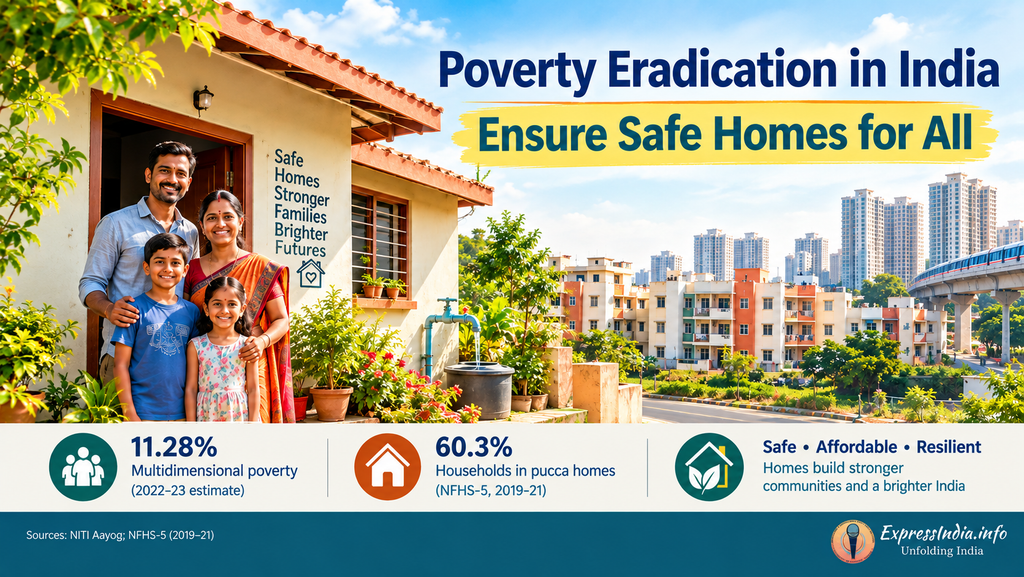
In India, the progress is real, yet housing insecurity still stalks millions of families. Multidimensional poverty fell from 29.17% in 2013–14 to 11.28% in 2022–23, according to NITI Aayog. Yet only 60.3% of households lived in fully pucca homes in 2019–21, per NFHS-5. Homelessness, slums, crowding, shaky rentals and climate displacement quietly drain savings, health and schooling. Consequently, the policy test must shift from houses sanctioned to homes genuinely occupied and serviced. That means affordability, services, climate resilience and secure tenure all belong in the scorecard.
How Far Has Poverty Eradication in India Come?
Let me start with the good news, because it deserves honest applause. The World Bank measures extreme monetary poverty, meaning living below $3 a day. Its October 2026 brief shows that rate falling from 27.1% to 2.6% since 2011. At the $4.20 lower-middle-income line, poverty dropped from 57.7% to 16.1% over the same period. These figures use 2021 purchasing-power prices, so older $2.15 or $3.65 numbers are not comparable. Meanwhile, India’s last official national estimate remains 21.9% for 2011–12, based on consumption.
Next comes multidimensional poverty, which tracks overlapping deprivation in health, education and living standards. NITI Aayog estimates multidimensional poverty fell from 29.17% to 11.28% between 2013–14 and 2022–23. Roughly 24.82 crore people escaped, though both endpoints rest on interpolation around NFHS surveys. Therefore, I treat the headline as a careful estimate, not a laboratory measurement. Similarly, World Bank projections of 14.2% in 2026 and 12.1% by 2028 remain forecasts. Observed survey data and modelled forecasts deserve separate labels in every honest headline.
Monetary poverty and multidimensional poverty figures ask different questions; so they never truly contradict. A $3 measure asks who cannot eat; a $4.20 one asks who stays fragile. Between 2017 and 2023, employment rose by roughly 134 million, yet real earnings barely budged. Besides, rural poverty at the $4.20 measure stood at 19.3%, against 8.6% in cities. Children under fifteen fared worst at 21.8%, so the headline hides a young face. Can we declare victory while over one in five children sits below that measure?
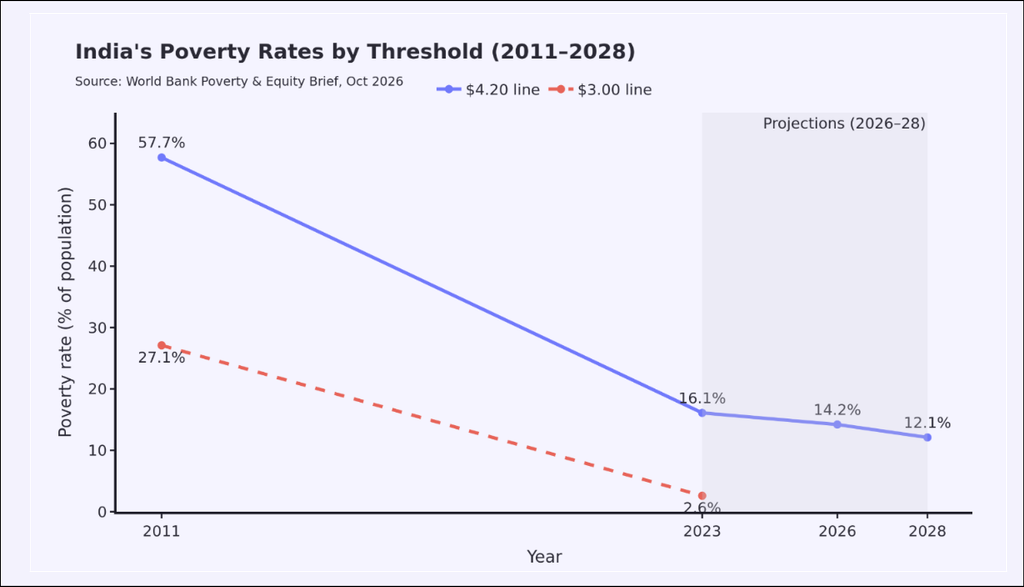
Source: World Bank, India Poverty & Equity Brief, October 2026. The 2026 and 2028 values are projections.
Why Safe Homes Anchor Poverty Eradication in India
Poverty Eradication in India starts inside a home, the first institution a child meets. Health, homework, rest, safety and income all begin behind a front door. When rent swallows earnings, households cut food, medicine and school fees to survive. Likewise, smoke, contaminated water and poor sanitation convert ordinary illness into expensive debt. Secure tenure matters equally, because an address unlocks ration cards, banking and welfare entitlements. Without it, one demolition can erase savings, documents, tools and a livelihood together.
Amartya Sen calls poverty “not having the capability to realise one’s full potential.” A damp, crowded, insecure room quietly shrinks exactly that capability. Chief Justice B.R. Gavai echoed that sentiment while quoting a Supreme Court verdict. A house, the verdict says, embodies “the collective hopes of a family or individuals.” So a safe home functions as both an economic asset and a constitutional promise. Therefore, housing as a human right is not rhetoric but arithmetic. As India reassesses what makes a home genuinely adequate, the debate must move beyond construction numbers to questions of space, services, safety, location and long-term liveability.
What Makes a Home Safe?
First, I look for structure that survives rain, wind, fire and ordinary wear. Next come ventilation and enough space for sleeping, cooking, studying and caring for elders. Then I check water, toilets, drainage, waste collection, electricity and clean cooking fuel. Accessibility matters too, especially for persons with disabilities and ageing parents. Affordability follows, because a cheap-looking house can still demand ruinous rent or transport. Finally, I look for secure tenure, climate protection and short commutes to school and work.
Notice how little of that checklist concerns the wall material alone. A pucca house without a toilet or kitchen remains an unfinished promise. Similarly, a sturdy flat beside a distant highway can sever a family from work. Housing poverty in India therefore demands a wider ruler than bricks and cement. I would measure safety, affordability, services and tenure together, not in separate boxes. Otherwise, we celebrate construction while ignoring the daily business of living.
India’s Housing Deprivation: The Data Behind the Crisis
Start with the oldest numbers, because India still leans on them. Census 2011, a historical baseline, counted 17.73 lakh houseless people across the country. That census also recorded about 6.55 crore slum residents in 13.9 million households. Today’s totals almost certainly differ, and hidden homelessness escapes point-in-time counting methods. Therefore, I refuse to call those figures current 2026 totals. Homelessness in India deserves a fresh, honest count before any new shelter plan.
NFHS-5, conducted in 2019–21, found 60.3% of households lived in pucca homes. Another 34% lived in semi-pucca houses, while 4.6% lived in kutcha dwellings. Moreover, 40.2% of households squeezed three or more people into each sleeping room. About 24.1% cooked indoors without a separate kitchen, and only 58.6% used clean fuel. Improved sanitation reached 69% of households, so the toilet gap remains stubborn. Consequently, a child doing homework beside a smoky stove breathes the statistic daily.
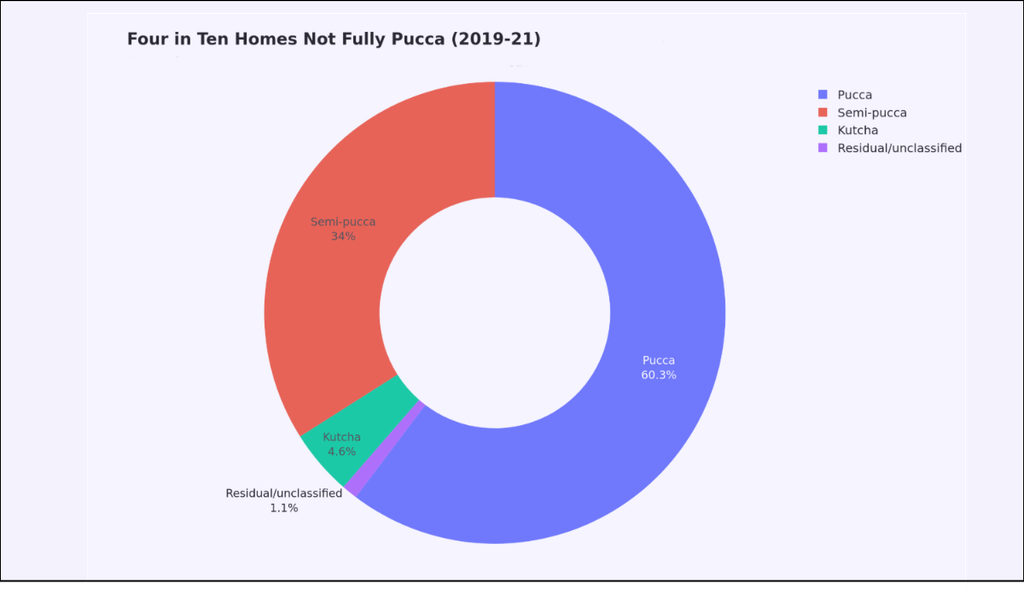
Source: NFHS-5 (2019–21), via CEDA, Ashoka University. The residual is an arithmetic remainder.
Housing poverty in India hides a paradox that fascinates me; so please read closely. Researchers at Ashoka University found only 28.4% of homes were pucca with full amenities. In rural India, that figure sinks to just 13.3%, a strikingly small share. Rentals add another layer, since about 29% of urban households rented in 2018. Secondary analysis suggests 71% of urban renters lacked written contracts, which invites sudden eviction. Why does affordable housing in India still overlook the people who rent?
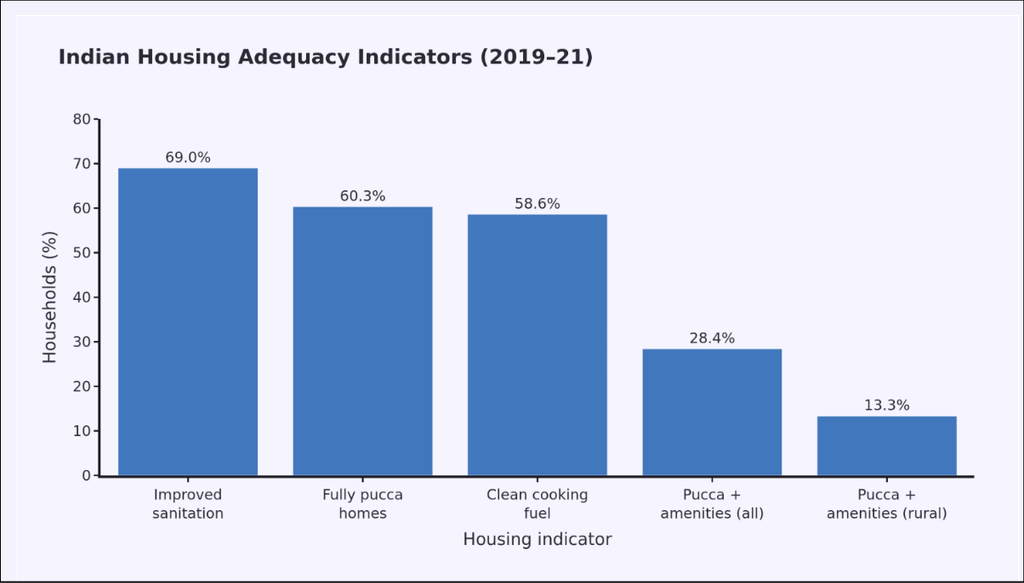
Sources: NFHS-5 (2019–21); CEDA, Ashoka University analysis of NSS data. The surveys differ in definitions and years.
Government Schemes: Progress and Implementation Gaps
Credit first: PMAY has moved mountains of cement across the country. By July 2026, PMAY-U schemes had sanctioned 127.68 lakh homes and completed 99.07 lakh. PMAY-G has completed about 3.11 crore rural homes out of 3.92 crore sanctioned. Budget 2026–27 allocations are ₹21,625 crore for PMAY-U and ₹54,917 crore for rural housing. These are allocations, not outcomes, so spending still needs scrutiny. Yet completed does not mean occupied, serviced, affordable or legally secure. PMAY-G shows the gap: 3.08 crore homes have toilets, while 2.43 crore have water connections.
Rental housing tells a sterner tale about affordable housing in India than ownership schemes admit. Only 5,783 of 83,534 vacant government homes identified for conversion became rentals. Observer Research Foundation (ORF) estimates a 70 lakh rental shortfall against roughly 87,000 units converted or approved. Tamil Nadu alone accounted for all 40,630 new-build rental units completed by August 2026. Meanwhile, DAY-NULM built 1,995 shelters in 981 cities before the mission ended in September 2024. Such figures suggest housing poverty in India still overlooks migrants and homeless residents.
Social protection in India fills some gaps while quietly exposing others. Nearly 79.20 crore people received free grain in June 2026, against 81.35 crore covered. Ayushman Bharat had issued 48.51 crore cards by September 2026, though cards differ from care. e-Shram registered 31.89 crore unorganised workers, but registration is not an automatic entitlement. Moreover, One Nation One Ration Card recorded 221 crore portability transactions by July 2026. Still, I worry that portable rations cannot compensate for non-portable rooms.
| Scheme | Latest figure | Honest caveat |
|---|---|---|
| PMAY-U / 2.0 | 127.68 lakh sanctioned; 99.07 lakh completed (July 2026) | Completed is not the same as occupied |
| PMAY-G | 3.11 crore completed of 3.92 crore sanctioned (June 2026) | Services lag completions |
| Rental conversions | 5,783 of 83,534 homes converted | Far below the estimated shortfall |
| DAY-NULM shelters | 1,995 shelters in 981 cities | Mission ended in September 2024 |
| e-Shram | 31.89 crore registered (August 2026) | Registration is not a benefit |
Sources: PIB and Ministry data as cited in the table; ORF (2026); Hindustan Times (2026).
Who Is Being Left Behind?
Averages flatter Poverty Eradication in India, but communities reveal what averages hide. Five populous states held 54% of India’s extremely poor, the World Bank notes. Migrants and informal workers rent without contracts, so distant ownership flats rarely suit them. Homeless residents depend on shelters counted against a 2011 baseline. Tribal and remote communities face higher construction and service-delivery costs. Women-headed households and persons with disabilities often lack land records, collateral or accessible design.
Children, elderly people and disaster-prone communities face quieter but equally stubborn exclusions. Pensions rarely replace family support, and accessible homes remain scarce for older people. Women gained a safeguard when PMAY-U required female heads to own or co-own houses. Nevertheless, a title deed alone cannot guarantee control or freedom from domestic violence. Repeated floods can push a freshly housed family back into multidimensional poverty. So which communities will our next survey forget to count?
Who is poorer? India’s poverty at the $4.20 line, 2023
| Group | Poverty rate |
|---|---|
| Rural India | 19.3% |
| Urban India | 8.6% |
| Children under 15 | 21.8% |
| Adults with no education | 21.3% |
| Adults with tertiary education | 7.4% |
Source: World Bank, India Poverty & Equity Brief, October 2026
Climate Change Is Turning Housing Into a Poverty Issue
Climate shocks now deepen housing poverty in India, testing every house welfare scheme built. India recorded 5.4 million disaster displacements in 2024, the highest in twelve years. Assam’s floods alone triggered about 2.4 million of those displacements. Remember that displacements count movements, so one family may appear more than once. Low-income households rebuild slowly because savings, documents and tools vanish with the roof. Relocation then adds commuting costs and severs access to work and school.
Heat poses an equally brutal threat to informal workers and their tenements. World Bank analysis says a heatwave can cut informal workers’ earnings by 40%. Meanwhile, India may need over 144 million additional urban dwellings between 2022 and 2070. Affordable housing in India must resist floods, cyclones and heat. Raised plinths, flood-safe sites and cyclone-resistant roofs help families withstand repeated shocks. Cool roofs, shade, cross-ventilation and local materials cut both heat and cost. Cheap homes that cook their occupants are not affordable homes.
Poverty Eradication in India: From Houses Completed to Safe Homes Sustained
Here is my eight-point repair kit for Poverty Eradication in India, offered affectionately. First, build affordable housing in India through rentals and dormitories near employment. Second, guarantee written notice, hearing and rehabilitation before any eviction. Third, upgrade settlements in place with water, drainage, toilets, electricity and tenure. Fourth, make food, health, pension and worker benefits portable across state lines. Fifth, finance disaster- and heat-resilient designs from the first foundation stone.
Sixth, simplify documentation and refresh targeting lists so exclusion errors shrink. Seventh, publish dashboards tracking occupancy, services, affordability and tenure for every sanctioned home. Eighth, hold social audits, grievance hearings and participatory planning with residents. The Supreme Court already requires fifteen days’ notice before demolition. Chief Justice Gavai warned that “the executive cannot become judge, jury, and executioner.” Together, these eight steps bring safe homes for all closer, and they advance the eradication of poverty in India beyond mere construction counts.
Where Poverty Eradication in India Begins
So, has Poverty Eradication in India truly arrived? Not yet, because an income line cannot measure a leaking roof. Safe homes for all will arrive only when families live securely, affordably and healthily. That outcome needs governments, local bodies, builders, NGOs and neighbours pulling together. Policymakers must count occupied, serviced homes rather than merely sanctioned ones. Builders should deliver affordable housing in India designed for heat, floods and daily dignity. Municipal bodies should publish eviction notices, rehabilitation plans and grievance records openly.
Ordinary readers hold power too, and I intend to use mine. Ask your ward councillor how many local homes have water, toilets and secure tenure. Pay domestic workers enough to rent decently, and challenge unfair evictions in your neighbourhood. Share this article with one person who shapes housing decisions in your city. Remember that a roof is a right, not a favour. Demand safe homes for all today, and keep demanding until every door locks from inside.
For ExpressIndia.info, the verdict is simple: Poverty Eradication in India is not complete until every family has a safe home. We will not stop reporting until it does.
#PovertyEradicationInIndia #SafeHomesForAll #HousingRights #PovertyInIndia #AffordableHousing