
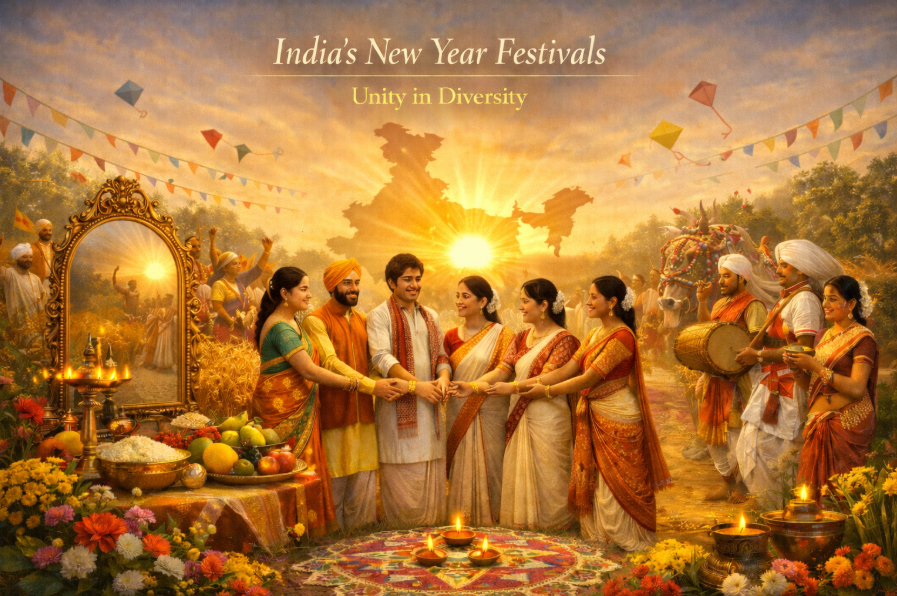
India’s New Year Festivals in a Changing India
India’s New Year Festivals arrive in April with a quiet insistence that time itself can be plural and still shared. While the Gregorian calendar gives India one official New Year, regional celebrations like Vishu, Baisakhi, Puthandu, Pohela Boishakh, Bohag Bihu, and Maha Vishuba Sankranti reboot the emotional calendar of entire communities. These festivals, rooted in agrarian cycles and solar movements, now unfold against a backdrop of rapid urbanisation, digital noise, and polarised public debates. Yet, despite anxieties about fault lines, surveys still show that most Indians see religious diversity and mutual respect as core to being “truly Indian.” That tension between fear and fraternity is precisely where the social meaning of these New Year’s festivals lives today.
This blog treats India’s New Year Festivals as a single, composite social phenomenon rather than six unrelated regional events. It explores how these festivals create everyday experiences of social harmony in a country that hosts more than 19,500 reported mother tongues grouped into 121 major languages and 22 scheduled ones. It also links festivals to internal migration, digital culture, gender roles, and contemporary calls for communal harmony, drawing on data and recent media coverage. In this setting, India’s New Year Festivals become not only cultural markers but also social technologies for building trust, curiosity, and everyday harmony.
Mapping India’s April New Years Under One Umbrella
Six festivals, one seasonal heartbeat
Mid-April marks a cluster of solar New Year celebrations across India: Vishu in Keralam, Puthandu in Tamil Nadu, Bohag (Rongali) Bihu in Assam, Pohela Boishakh in Bengal and parts of the Northeast, Baisakhi in Punjab and neighbouring regions, and Maha Vishuba Sankranti (Pana Sankranti) in Odisha. Each is tied to the sun’s transition into Aries and to agrarian cycles, symbolising fresh beginnings, gratitude for the harvest, and hopes for prosperity. Houses are cleaned, courtyards decorated, families wear new clothes, and communities converge at temples, gurudwaras, and public grounds for special prayers and cultural programmes. Despite differences in language and ritual, the emotional script – renewal, sharing, and intergenerational bonding – is strikingly similar.
Rituals as regional variations on common themes
In Tamil Nadu, Puthandu centres on the auspicious Kanni arrangement and the tasting of Mangai Pachadi, which symbolises life’s mix of sweet and bitter experiences. In Keralam, Vishu begins with the Vishukkani, a carefully curated visual tableau of abundance seen at dawn, followed by Vishu Kaineettam, where elders gift money to younger relatives. After Onam, it is one of the most celebrated festivals in Keralam. Assam’s Bohag Bihu features cattle rituals, Bihu dance gatherings, and the sharing of pitha and laru sweets, while Pohela Boishakh in Bengal opens with business-ledger ceremonies and vibrant street fairs. Baisakhi combines harvest thanksgiving with the commemoration of the Khalsa’s founding, making it both an agrarian and religious landmark. Maha Vishuba Sankranti in Odisha is marked by the cooling Pana drink and folk performances like Danda Nacha, tying spiritual renewal to community resilience in the summer heat.
Key April New Year Festivals Across India
| Festival | Primary regions | Key themes | Social harmony potential |
|---|---|---|---|
| Vishu | Keralam | Solar New Year, abundance, ritual seeing (Vishukkani) | Family bonding, intergenerational gifting, temple gatherings |
| Puthandu | Tamil Nadu | Solar New Year, auspicious Kanni, tasting life’s flavours | Household rituals, temple visits, neighbourhood greetings |
| Bohag Bihu | Assam | New agricultural year, cattle rituals, Bihu dances | Village-level cultural nights, cross-community participation |
| Pohela Boishakh | West Bengal, Tripura | Nobo Barsha, business Haal Khata, fairs | Public melas blending classes and communities |
| Baisakhi | Punjab, Haryana, diaspora | Rabi harvest, Khalsa formation | Langars, Nagar Kirtan, open community kitchens |
| Maha Vishuba Sankranti | Odisha | Solar transition, Pana drink, folk performances | Street-level sharing, inclusive cultural programmes |
Source: News9Live feature in April New Year festivals and related media coverage.
Agrarian Roots, Farmers’ Lives, and Shared Vulnerabilities
Harvest festivals in an era of agrarian stress
Historically, many India’s New Year Festivals coincided with the harvest of the rabi crop or the onset of a new agricultural cycle. Today, they occur amid farmer distress driven by climate variability, input costs, and shifting market dynamics, which periodically erupts into nationwide farmer protests. The contrast between celebratory imagery and real rural hardship creates a powerful frame for solidarity: urban consumers are reminded that their festive feasts rest on precarious agrarian labour. When gurudwara langars on Baisakhi feed thousands for free, or when village communities pool resources for Bihu feasts, they enact a redistributive ethic that counters economic inequality, at least symbolically.
Climate change and the politics of gratitude
Emerging climate data shows that India’s agrarian regions are increasingly vulnerable to erratic rainfall and heat waves, which directly threaten the harvest cycles entwined with these festivals. In this context, thanksgiving rituals acquire a new urgency: gratitude is not a complacent gesture but a political statement about interdependence between farmers, consumers, and the state. New Year gatherings become spaces where discussions about crop insurance, minimum support prices, and sustainable practices enter everyday conversations. As such, the festivals can nurture a culture that recognises the rights and dignity of farmers, deepening social cohesion between rural and urban India.
March–April New Years in Other States
A wider calendar of fresh starts
The April cluster is only part of a larger pattern of traditional New Year observances that usually fall in March or April. In Maharashtra and Goa, people mark Gudi Padwa as the beginning of the Marathi and Konkani traditional year. On the same broad dates, communities in Andhra Pradesh, Telangana, and Karnataka celebrate Ugadi, often described as the “dawn of a new age.” Navreh in Kashmir, Cheti Chand among Sindhi communities, and Sajibu Nongma Panba (also called Sajibu Cheiraoba) in Manipur also occur around this time. Together with Puthandu, Vishu, Pohela Boishakh, Bohag Bihu, Baisakhi, and Maha Vishuba Sankranti, they create a remarkable seasonal chorus of “New Year” across the subcontinent.
Social significance of the shared season
Despite different names and local customs, these observances broadly mark the arrival of spring, the start of a new harvest cycle, or the opening of a new financial or cultural year. People clean their homes, decorate entrances with rangoli or floral torans, prepare special dishes that blend multiple flavours, and visit friends or extended family. This shared pattern has two important social effects. First, it provides a predictable window when people expect renewal, making it easier for workplaces and schools to host inclusive seasonal events that acknowledge several New Years together. Second, it offers a natural opportunity to learn about less familiar observances; someone accustomed to Ugadi can, in the same fortnight, encounter Gudi Padwa or Cheti Chand simply by paying attention to colleagues and neighbours.
March–April Regional New Years and Their Focus
| Name of observance | Main regions/communities | Typical timing | Everyday focus |
|---|---|---|---|
| Gudi Padwa | Maharashtra, Goa | March–April | Household flags, spring cleaning, festive foods |
| Ugadi | Andhra Pradesh, Telangana, Karnataka | March–April | Tasting multiple flavours of life, fresh resolutions |
| Cheti Chand | Sindhi communities | March–April | Community gatherings, cultural programmes, processions |
| Navreh | Kashmir Valley communities | March–April | New almanacs, curated trays of symbolic items |
| Sajibu Nongma Panba | Manipur | March–April | Household rituals, neighbourhood visits, shared meals |
Source: Government sites and explanatory notes on traditional New Year festivals; Drishtiias; Iasgyan
Religion, Tolerance, and Everyday Pluralism
Survey evidence on diversity as an asset
A major Pew Research Center survey of nearly 30,000 Indian adults across 17 languages reports that 53% of respondents see religious diversity as benefiting the country, while about 24% view it as harmful and the rest are neutral or undecided. Even more strikingly, 84% say that respecting all religions is “very important” to being truly Indian, and 80% say that such respect is central to being a good member of their own religious community. In other words, tolerance is framed not only as a constitutional ideal but as a religious obligation. These findings complicate narratives that portray India as uniformly sliding into intolerance, instead revealing a society that values coexistence even as it grapples with segregation and distrust.
Festivals as laboratories of tolerance and segregation
The same Pew study notes that many Indians prefer endogamy and maintain social boundaries, with majorities of both Hindus and Muslims describing the other group as “very different.” Festivals can either reinforce these walls or gently erode them. Baisakhi langars, by tradition, seat all visitors in a single row regardless of caste or religion, embodying the Sikh ideal of equality before the divine. Public Pohela Boishakh fairs and Bohag Bihu cultural nights in cities often feature mixed-audience performances where religious identity recedes behind regional and artistic identities. When APJ Abdul Kalam reminded citizens that “all religions have the common thread of peace, harmony and love,” he described an ethical baseline that New Year festivals regularly rehearse in practice, even if imperfectly.
Language, Culture, and Informal Learning
New Year greetings as language bridges
India’s linguistic landscape remains extraordinary, with Census 2011 recording over 19,500 reported mother tongues that were later grouped into 1,369 rationalised names and 121 major languages. Of these, 22 have scheduled status and account for more than 96% of India’s population. India’s New Year Festivals move comfortably across this terrain. People share greetings like “Puthandu Vazthukal,” “Vishu Ashamsakal,” “Shubho Noboborsho,” “Ugadi Subhakankshalu,” and “Happy Gudi Padwa” in offices, housing societies, and social media posts. For many, these phrases are their first exposure to languages outside their home state.
Festivals as informal cultural classrooms
In practice, this means that New Year seasons become low-pressure language and culture workshops. Colleagues explain the meaning of “Ugadi Pachadi” or “bevu-bella,” describing how one dish purposely combines multiple flavours to signal that life will also mix joy, disappointment, surprise, and challenge. Friends teach each other simple lines of Bihu songs or the symbolism of the “Kanikonna” and “Vishukkani” for Vishu or the “Gudi flag” on Gudi Padwa. Housing societies sometimes display short notes in English and local languages explaining why a particular date is important for one region’s New Year. Over time, these small exchanges build an intuitive sense that hearing unfamiliar words in the corridor is not a threat but a normal part of living in a multilingual democracy.
Migration, Cities, and Hybrid New Year Spaces
Metros as festival crossroads
Internal migration patterns show that while most people still move within their own states, inter-state migration has grown steadily over recent decades. Major cities like Bengaluru, Mumbai, Delhi, Chennai, Hyderabad, and Pune now host substantial communities from nearly every state. In such settings, one calendar date can carry different labels for different residents: Ugadi for some, Gudi Padwa for others, and simply “a festival” for those new to the tradition. When housing societies or resident welfare associations choose to organise joint events for multiple New Year observances, they convert apartment courtyards into spaces where these labels interact.
From parallel lives to shared routines
Instinctively, I often picture a Bengaluru apartment block where one neighbour prepares Puthandu mango pachadi, another strings mango leaves for Ugadi, and a third plans a Vishu sadhya for friends. Initially, these activities might happen behind closed doors. However, once someone suggests a collective “April New Year evening,” the building suddenly acquires a shared seasonal identity. Children perform dances from different regions; adults exchange recipes and stories; noticeboards carry announcements listing all the observances being recognised. Such events do not erase deeper social divisions, but they gently disrupt isolation and encourage residents to see one another as more than passing strangers in a lift.
Gender, Care Work, and Fairness at Home
The invisible labour behind visible joy
Behind every beautifully arranged Vishukkani or perfectly hoisted Gudi stands a great deal of unpaid labour. In many households, women shoulder most of the cleaning, cooking, decorating, and planning that make India’s New Year Festivals memorable. This mirrors broader patterns in which women carry a disproportionate share of unpaid care work. During festival seasons, expectations often rise: homes should look immaculate, perfect kolams or rangolis, food should be elaborate, and hospitality should feel effortless. This can turn what is meant to be a day of renewal into a test of endurance. Yet, they also create moments of female solidarity, as women coordinate recipes, decorations, and mutual support networks across extended families and neighbourhoods.
Negotiating equality within tradition
In recent years, there has been a visible push, especially in urban middle-class households, to redistribute festival labour more equitably. Men increasingly take on cooking duties for Baisakhi or help with Vishu Sadhya preparation; children are encouraged to participate in cleaning and decor, framing these tasks as shared responsibilities rather than gendered obligations. Media narratives and social campaigns around women’s unpaid work often use festival seasons as entry points to discuss fairness at home. When Nehru described India as “a cultural unity amidst diversity, a bundle of contradictions held together by strong but invisible threads,” he could well have been talking about the invisible domestic threads that women manage during festivals. Recognising and valuing this labour is essential to any serious discussion of social harmony.
Digital Media, Commerce, and Ethical Celebrations
Social platforms as festival amplifiers and translators
Digital media have dramatically extended the reach and visibility of India’s New Year Festivals. Instagram reels and brand posts now curate multi-regional montages where Bohag Bihu dances, Pohela Boishakh processions, Vishu Kani layouts, Baisakhi Nagar Kirtans, and Puthandu kolams appear in rapid succession. For younger Indians, especially in cities, these digital narratives may be their first exposure to festivals outside their home region. On the positive side, they foster curiosity and respect; on the downside, they risk flattening complex rituals into aesthetic content optimised for engagement. The challenge lies in leveraging the connective potential of these platforms without losing depth.
Between consumerism and conscience
Festival seasons are also peak periods for commercial campaigns and retail discounts, with spring New Years now joining Diwali and Christmas in brand calendars. While economic activity and livelihoods depend on such cycles, there is growing public concern about waste, environmental impact, and the exclusion of those who cannot afford conspicuous consumption. Some civil-society groups and religious institutions use New Year moments to promote eco-friendly decor, local produce, and donations to farmers or marginalised communities, reframing celebration as an opportunity for ethical action. This is consistent with Kalam’s appeal to cultivate “unity of minds” and to link spiritual values with concrete efforts to reduce poverty and social vulnerability.
Festivals, Conflict, and the Defence of Harmony
Festivals amid polarised politics
India’s public sphere has in recent years witnessed contentious debates and sporadic violence around religious processions, faith-related disputes, and identity-based mobilisation. While India’s New Year Festivals are less frequently at the centre of these flashpoints than some other occasions, they still unfold in a charged environment where any large public gathering is potentially politicised. Mainstream media coverage around April, however, has largely highlighted stories of cross-community participation and inclusive greetings, suggesting a desire – at least symbolically – to foreground togetherness during these spring new year festivals.
Normative frameworks for inclusion
Constitutional values and public statements by leaders and thinkers continue to provide a vocabulary for defending festival-based pluralism. Tagore’s insistence that “let us unite, not in spite of our differences, but through them” resonates with the composite nature of spring New Year festivals, where multiple calendars and communities converge without erasing difference. Similarly, Kalam’s repeated invocations of peace, love, and harmony as the “message given by all religions” remain touchstones in official appeals for calm and solidarity during religious observances. These normative references do not magically dissolve structural inequities or prejudice, but they arm citizens and institutions with moral language to contest exclusionary narratives and protect shared spaces.
Walking Forward Through India’s New Year Festivals
Personal growth through plural celebrations
Engaging deeply with India’s New Year Festivals offers individuals a concrete path toward personal growth and social contribution. At the personal level, learning the stories, songs, and foods of festivals beyond one’s own region expands cultural literacy and empathy, especially in a country where most people nonetheless marry and socialise within their own communities. Practising self-reflection during these New Year moments – asking how one’s consumption choices, household labour practices, and social media behaviour affect others – can align private habits with public values of respect and inclusion. It is also an apt time to revisit the New Year resolutions you had taken in January and take stock of how you “performed”.
On a personal note, today being my birthday, makes the occasion all the more special. I started the day with sowing plant shoots and seeds in my balcony vegetable garden – to commemorate the festivals of harvest and the advent of spring. Making and having poha – a pan-Indian breakfast meal – was as satisfying. Connecting and wishing relatives and friends celebrating the festival in different forms made it even more special, including the birthday wishes that came in. Double delight, to be precise 😊.
From festive sentiment to everyday practice
At the societal level, institutions can leverage India’s New Year Festivals to organise cross-cultural events in schools, workplaces, and local governments, ensuring that Vishu, Baisakhi, Puthandu, Pohela Boishakh, Bohag Bihu, and Maha Vishuba Sankranti are all recognised in calendars, communications, and holiday policies. Municipalities can support inclusive, eco-friendly public celebrations that prioritise accessibility and safety, especially for women, children, and the elderly. Media and civil society can highlight stories where festivals de-escalate tensions or support vulnerable groups, making them exemplars of unity in diversity rather than just colourful spectacles. Ultimately, if India is, in Nehru’s words, “a cultural unity amidst diversity, a bundle of contradictions held together by strong but invisible threads,” then India’s New Year Festivals are among the brightest of those threads, weaving together farmers and office workers, migrants and locals, believers of many faiths, and speakers of countless tongues into a shared celebration of coexistence.
ExpressIndia.info wishes all our readers a joyous and prosperous New Year (in whatever name you celebrate it) filled with unity, harmony, and hope. 🎉✨🤝🇮🇳🌟
#IndiasNewYearFestivals #UnityInDiversity #FestivalsofIndia #AprilNewYearIndia #SocialHarmonyIndia
Yes, most Indian state New years fall in March-April because our calendar is seasonal, agricultural and astronomical. The Gregorian calendar follows tropical or solar year which is approximately 365.2422 days. The Julian calendar has 365.25 days in a year. It has an additional day ever 4th year (Leap year) i.e. 366 days. The Gregorian calendar adjusted for the leap year and made it 365.2422 days.
But the real issue is something else.
Even though it is an agricultural festival, the farmer is the most neglected. The festival celebrated with vigour in urban areas where people have enough and more disposable income.
In rural areas the farmer often takes loan to celebrate the festival and falls into debt trap. No wonder the farmer’s suicide rate keeps rising. They must constantly fight for MSP, loan waiver, and be a bonded labourer for the wealthy landlords.
Even if they take their produce to the mandi the middlemen loot him to the core and the farmer returns with a pittance in his pocket.
People fail to stop and think what would happen if all farmers stopped their cultivation of crops and farm animals.
We will not have our burgers, pizzas, tacos, Subways, KFC etc. on our table.
The government, the bank, the landlord, the money lender and even we who haggle and bargain for a few rupees with the farmer in the marketplace, all are out there to exploit. We get a vicarious satisfaction by when we gain 2 rupees by bargaining. But we have no qualms in tipping the waiter in an upscale dine out. So, mean of us.
So very true. Thank you bro for speaking the obvious. Since the farmer comes at the bottom of the food supply chain, his interests are the most compromised by people who loot money in between. It is high time the govt recognises the plight of the farmers and gives them their due. Otherwise, we would soon run out of farmers and farming land.