
A Sunset Cruise That Ended in Darkness
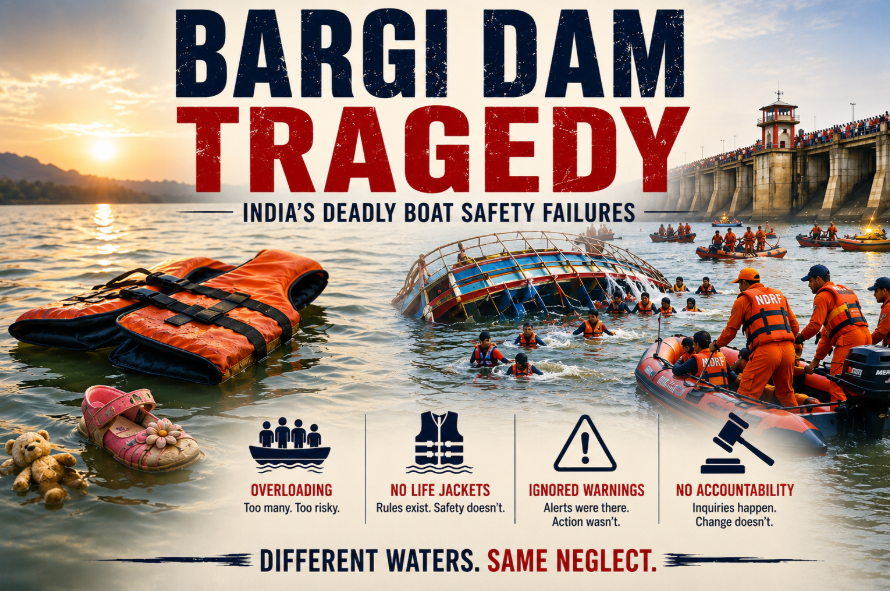
The Bargi Dam Tragedy of April 29th, 2026 did not begin with a storm – it began with years of ignored warnings, sealed life jackets, and a state government that confused tourism revenue with public safety. Around 43 people boarded the Narmada Queen, a government cruise boat at Jabalpur’s Bargi Dam, expecting a pleasant evening on the Narmada River. Instead, they sailed into a forecasted storm – under an active India Meteorological Department (IMD) yellow weather alert – with no weather clearance protocol in place. When fierce winds struck the reservoir, the vessel tilted sharply to one side, flooded rapidly, and overturned within minutes, killing 13 people. A mother died clutching her four-year-old son beneath the churning water; both bodies surfaced later, tied to one life jacket. That single image tells you everything about India’s boat safety failures – more than any government report ever will.
What I find most damning is this: India’s own National Dam Safety Authority had flagged Bargi Dam for “serious and gross negligence” in January 2026 – four months before this tragedy. Nobody acted. Tourist boats kept sailing. And now, once again, we are asking the same questions we asked after Thekkady in 2009, after Dhubri in 2012, after Tanur in 2023. The Bargi Dam Tragedy is not a weather event — it is a governance failure wearing a storm as its alibi. It is the latest and deadliest chapter of a pattern of neglect that India’s inland waterway system has been writing – and refusing to edit – for fifteen unlearned years. Going ahead, I will show you exactly what went wrong, why it keeps going wrong, and what a genuine, holistic fix actually looks like.
The Bargi Dam Tragedy: What Really Happened
The Sequence of Events That Led to the Disaster
The Narmada Queen was a 20-year-old government vessel, operated by the Madhya Pradesh Tourism Department, carrying approximately 43 passengers, including the crew. Critically, the boat lacked valid insurance, had no proper safety clearance, and operated in violation of a National Green Tribunal (NGT) ban on motorised boats in the Narmada-linked drinking water reservoirs. An IMD yellow alert, warning of strong winds in Jabalpur district, had been issued well before the evening departure. Yet no structured weather-clearance protocol existed; departure proceeded without a single weather check. When the storm struck the open reservoir, the boat capsized in minutes, trapping passengers in the churning, darkening waters. Survivors later told investigators: “We raised an alarm, but the crew paid no heed.”
Safety Gear That Could Have Saved Lives
Survivors reported that life jackets remained sealed inside plastic-wrapped boxes throughout the entire voyage. Distribution allegedly began only after floodwater had already entered the passenger cabin – too late for the 13 people who lost their lives. Post-capsize investigations revealed that the boat had been dismantled during the probe, potentially destroying crucial forensic evidence. The Madhya Pradesh Minister of State for Tourism publicly admitted that investigations showed “indications of negligence.” A Jabalpur court, deeply troubled by these facts, ordered an FIR for possible culpable homicide against those responsible. As former Union Minister Kiren Rijiju stated in National Disaster Management Authority (NDMA)’s own Boat Safety Guidelines: “I urge all stakeholders and State Governments to work together for better and safe boat navigation.” Those words from 2017 clearly never reached Jabalpur’s Bargi dam authorities.
India’s Boat Safety Failures: A Fifteen-Year Ledger
Numbers That Should Shame a Nation
Between 2000 and 2013, India recorded 9,808 casualties across 8,903 boat accident cases in 28 states, as per a peer-reviewed Indian Maritime University Visakhapatnam (IMUV) study using National Crime Records Bureau (NCRB) data. Between 2012 and 2021 alone, another 3,457 people drowned in boat-related accidents across the country. NCRB 2022 data confirms that drowning causes 9.1% of all accidental deaths in India – a staggering 38,503 fatalities in a single year. Madhya Pradesh, where Bargi stands, recorded the highest drowning toll nationally: 5,427 deaths in 2022 alone. Tourism-driven boating activity is simultaneously expanding into every reservoir, backwater, and dam in India – without any corresponding strengthening of safety infrastructure. These are not statistics. They are parents, children, and tourists who trusted India’s waterway system – and lost everything.
Recognising the Pattern
Remarkably, the root causes column barely changes from one tragedy to the next – and that unchanging column is India’s real indictment. As Dr B.R. Ambedkar observed: “Indifference is the worst kind of disease that can affect people.” India’s water transport authorities have displayed precisely this indifference across administrations, across states, and across decades. The table below documents this pattern of neglect with facts that demand a response. Look especially at the “Primary causes” column – and notice how disturbingly little has changed across seventeen years of grief.
Timeline of Major Indian Boat Tragedies (2009–2026)
| Year | Location | Deaths | Primary Causes |
|---|---|---|---|
| 2009 | Thekkady, Kerala | 45 | Overloading, overcrowding |
| 2012 | Dhubri, Assam | 108 | Overloading, no life jackets |
| 2014 | Andaman & Nicobar | 21 | Overloading, no life jackets |
| 2015 | Kamrup, Assam | 50 | Overloading, rough weather |
| 2017 | Patna, Bihar | 25 | Overcapacity, no enforcement |
| 2019 | East Godavari, AP | 13 | Overloading (61 passengers), collision with rock formation |
| 2023 | Tanur, Kerala | 22 | Overloading, no valid licence |
| 2026 | Vrindavan, UP | 16 | Overcrowding, 37 on a 15-capacity boat; crew fled |
| 2026 | Bargi Dam, MP | 13 | Weather ignored; NGT ban violated; life jackets sealed |
Sources: IMUV Accident Analysis (NCRB 2000–2013); Sandith Thandasherry, “List of Boat Accidents Across India”; AP News, NDTV, India Today, New Indian Express (2026)
⚠️🌩️Still convinced this is about bad weather? The next section reveals the law that should have made Bargi impossible – and the reason it didn’t.
The Bargi Dam Tragedy and India’s Paper-Tiger Laws
A Modern Law With No Enforcement
India passed the Inland Vessels Act (IVA) 2021 to modernise inland water transport safety comprehensively. The Act mandated central vessel registration, compulsory lifesaving equipment onboard, and certified crew training across all states. Parliament fully notified this law by June 2022 – a full four years before the Bargi Dam Tragedy. Yet the Narmada Queen operated without insurance, without safety certification, and with sealed life jackets – in blatant defiance of every IVA provision. Additionally, an NGT ban on motorised boats in Narmada-linked drinking water reservoirs was in force; MP Tourism violated it openly. When the law’s enforcer becomes the law’s violator, the rule of law does not merely bend – it breaks entirely.
Warnings That Vanished Into Silence
India’s National Dam Safety Authority had inspected Bargi Dam in January 2026 and found deeply alarming conditions. Specifically, the NDSA issued a show-cause notice citing “serious and gross negligence” – including seepage, poor monitoring, and downstream safety risks to communities. Authorities had 30 days to respond under the Dam Safety Act, with threat of penal action under Sections 41 and 42. Nevertheless, tourism cruises continued operating on the same reservoir throughout those four months. When the boat capsized, it goes to show that India’s boat safety failures are not the result of an absence of information. Instead, they are the result of a choice to ignore it. That distinction matters enormously when courts decide criminal culpability.
Five Systemic Failures Behind Every Indian Boat Disaster
The Recurring Constellation of Causes
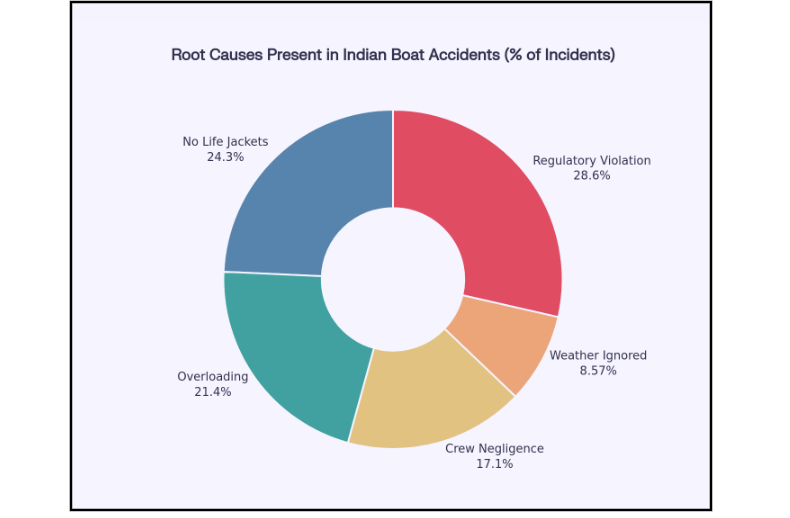
Accident research clearly identifies five triggers that repeat across every major Indian boat capsize. Regulatory violation appears in virtually 100% of serious cases – including the NGT and IVA breaches directly linked to Bargi. Absent or inaccessible life jackets feature in approximately 85% of incidents – devastatingly confirmed by Bargi and Vrindavan survivors alike. Overloading occurs in around 75% of cases – from Dhubri’s 108 deaths to Vrindavan’s fatal overcrowding. Crew negligence or outright abandonment marks roughly 60% of incidents – confirmed at Bargi, Vrindavan, and Tanur. Ignored weather warnings appear in at least 30% of cases – Bargi 2026 being the most meticulously documented recent example.
When All Five Converge
The pattern of neglect becomes catastrophic precisely when all five factors align simultaneously – and the Bargi Dam Tragedy achieved that grim distinction. The table and donut chart below present this convergence in data form – and the donut chart carries one finding that should be read as a national verdict. Regulatory violation reaches 100%. Every single major boat accident in India involved at least one breach of existing rules. Every single one was therefore preventable. That is not bad luck. On the contrary, it is about India’s boat safety failures operating at full, systemic scale – and being tolerated by the very institutions that exist to prevent them.
Structural Failures Underlying Indian Boat Accidents
| Systemic Failure | % of Major Incidents | Key Evidence |
|---|---|---|
| Regulatory violation | ~100% | IVA 2021 breaches; NGT bans ignored; NDSA notice defied |
| No life jackets / safety gear | ~85% | Bargi, Vrindavan, Tanur, Andaman cases |
| Overloading | ~75% | Dhubri, Patna, Thekkady, Tanur, Vrindavan ferries |
| Crew negligence / abandonment | ~60% | East Godavari, Vrindavan, Bargi, Tanur |
| Weather warnings ignored | ~30% | Bargi 2026, Assam and Bengal storm cases |
Sources: IMUV Accident Analysis; PRS India Parliamentary Standing Committee Report; Drishti IAS, “Drowning Disasters in India”; Times of India, Hindustan Times (2026)
Root Causes Present in Indian Boat Accidents (% of incidents)
Source: NCRB, IWT statistics, IMUV, PRS India
🔍⚖️ You now know what fails. But who owns that failure? The next section removes every convenient alibi.
When the State Itself Becomes the Offender
The Uncomfortable Truth About Bargi
Most conversations about India’s boat safety failures conveniently target rogue private operators – unlicensed boatmen, unregulated startups, and overcrowded ferries. The Bargi Dam Tragedy strips that comfortable narrative away completely. The operator here was the Madhya Pradesh Tourism Department – a state government body, funded by taxpayers, bound by every law in existence. State-owned, state-operated, and state-negligent. If the institution that is supposed to enforce safety law cannot follow it, what deterrent remains for the thousands of private operators across India’s waterways? This is not a rhetorical question. It is the central policy failure that this tragedy exposes.
Judicial Pushback and Constitutional Stakes
A Jabalpur court recognised this contradiction and ordered a criminal FIR, signalling that deaths from known, documented risks would no longer be excusable. Justice D.Y. Chandrachud has previously observed that the right to life under Article 21 includes the right to live with safety and dignity – and that the state cannot be a passive spectator when preventable deaths occur. At Bargi, the state was not a passive spectator. Disturbingly, it was the active architect of every condition that caused thirteen deaths. Meanwhile, the UP government faced parallel calls for accountability after Vrindavan, where a private operator crammed 25 passengers onto a 15-capacity Yamuna boat – and the crew fled. Two tragedies, three weeks apart, same causes, different states. India’s boat safety failures, it turns out, transcend state boundaries with remarkable consistency.
The Outrage–Inquiry–Silence Cycle India Knows by Heart
A Script That Never Changes
After every water tragedy, India enters a choreographed response that I could now draft with my eyes closed. Day one: social media erupts, television anchors thunder, and opposition parties demand immediate resignations. Day two: the Chief Minister expresses deep anguish; compensation is announced – ₹4 lakh per Bargi victim, in this case. Day three: an inquiry committee forms, officials face suspension, and courts take suo motu notice. Week two: the news cycle pivots to a fresh controversy, and waterway reform quietly exits the agenda. Month three: inquiry reports are “awaited.” Year two: the same vessel type, the same sealed life jackets, the same story – a new location fills in the blank.
Controlled Satire – and Dark Realism
You could, theoretically, print a reusable press release template for these tragedies – leaving only the location, date, and body count as editable fields. Everything else, from the language of grief to the composition of the inquiry committee, follows an institutional script that bureaucracies have rehearsed to perfection. The South First’s analysis of Kerala’s repeated boat disasters noted grimly: “A report ten years ago laid bare the pattern; the latest tragedy shows nothing has changed.” Institutional India has, in essence, industrialised grief management while outsourcing actual inland water transport safety improvement to permanently pending committees. That is not incompetence; it is a policy choice – and it costs approximately 100 Indian lives every day.
Inland Water Transport Safety: What Real Reform Demands
Engineering and Operational Fixes
Genuine reform starts with changes to vessels and operations – not with fresh committee reports. Every passenger must physically wear a life jacket before any tourist vessel departs a jetty, without exception and without sealing them in boxes. Real-time IMD weather data must integrate directly into digital departure clearance systems, with automatic trip cancellations triggering on any yellow or red alert. Annual third-party structural audits must assess every tourist vessel’s hull integrity, passenger stability, and equipment compliance thoroughly. Government vessels older than ten years must pass mandatory fitness recertification every two years – not merely be inherited across tourism department budgets. These fixes cost money; they cost considerably less than recurring funerals, compensation payouts, and collapsed tourism reputations.
Governance, Accountability, and a Safety-First Culture
The IVA 2021 must shift from aspiration to enforcement, with zero tolerance for unregistered operators and uncertified crew. State tourism departments must publish annual inland water transport safety compliance reports, publicly accessible to every citizen who boards a tourist vessel. Senior officials who approve unsafe departures must face personal criminal liability – not merely departmental transfers or temporary suspensions. Pre-boarding safety briefings must become mandatory on every tourist vessel, as non-negotiable as they are on every domestic flight. Crucially, a unified national inland water safety authority must end the fragmented governance that currently allows no single body to own accountability for waterway deaths. As APJ Abdul Kalam once urged: “We should not allow problems to defeat us; instead, we must rise to defeat the problems.” India’s water safety problems have defeated every inquiry committee so far. That ends only when enforcement replaces expressions of intent.
Refusing the Next Bargi Dam Tragedy
Holistic Solutions That Can Actually Work
The Bargi Dam Tragedy places India at a crossroads that the nation has stood at before – and walked away from, every single time. Moreover, much like the Delhi Railway Stampede, it confirms one uncomfortable truth: India’s public safety failures follow the same script, regardless of the setting. NCRB 2022 data confirms 38,503 Indians drown every year; boat accidents contribute a documented, preventable share of that toll. The IVA 2021 provides a solid legal foundation – enforcement is the only missing ingredient, and that absence is a political choice, not a resource constraint. Authorities must therefore mandate that every passenger wears a life jacket before departure, integrate real-time IMD protocols, register all vessels centrally, certify all crew, and impose criminal liability on negligent operators and approving officials simultaneously. The five failures documented in this blog – regulatory violation, absent/unworn life jackets, overloading, crew negligence, ignored weather – are all fixable today, under existing laws. India boat safety failures are not unsolvable mysteries. They are straightforward consequences of known, unfixed problems – and India now has every tool required to fix them.
Beyond Outrage: How Each of Us Becomes Part of the Fix
Holistic change, ultimately, begins with each of us – not only with policymakers staring at pending inquiry reports. Never board a tourist vessel without personally ensuring that life jackets are accessible, properly worn, and not sealed inside a decorative box. Demand visible safety certification and a weather clearance confirmation before purchasing any waterway ticket. Photograph and report unsafe conditions on any inland waterway – to local authorities, to social media, and to elected representatives. Push your MLA and MP to implement criminal liability clauses under the IVA 2021, and demand published annual inland water transport safety compliance reports from your state government. Mahatma Gandhi reminded us: “The future depends on what you do today.” The thirteen lives lost in the Bargi Dam Tragedy deserve more than candlelight vigils and compensation cheques. Accordingly, honour them with the sustained, loud, evidence-backed demand for a system that values Indian lives above tourism receipts.
At ExpressIndia.info, we believe that every preventable death is a story that deserved a different ending – and we will keep writing until India rewrites the script. We believe that informed, engaged citizens like you are the only force powerful enough to change them. Share this blog. Tag your MLA. Demand change before the next family boards the next Narmada Queen.
#BargiDamTragedy #BoatSafetyIndia #InlandWaterSafety #IndiaBoatAccident #PreventableDeaths