
A Movement That Refused to Stay Online
The Cockroach Janata Party protest has just reached its most consequential turning point – an end, and perhaps, a beginning. I still remember writing about the viral birth of the Cockroach Janata Party (CJP) in May, when a courtroom remark from CJI Surya Kant sparked an online storm and a satirical movement was born overnight. Back then, the story was about hashtags and follower counts. Today, however, the story is about tear gas, negotiations, and a government finally sitting across the table. Consequently, this follow-up isn’t a rehash – it’s a report from the frontlines of a movement that grew teeth.
So, buckle up, because what follows is not satire anymore. This is about real injuries, real resignations, and a real settlement that could reshape how India’s youth engage with power. Furthermore, it’s about Sonam Wangchuk’s evolving, carefully calibrated support – the support that mattered more than most realised at the time. Ultimately, though, one question looms large over everything: was this truly a victory? Let’s find out together.
From Instagram Feeds to City Streets
Gen Z Involvement Takes a Physical Turn
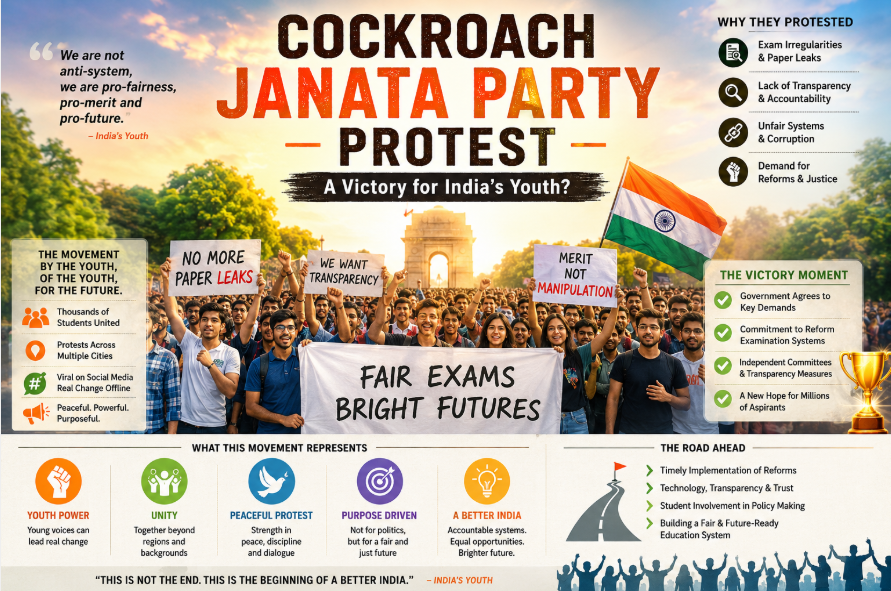
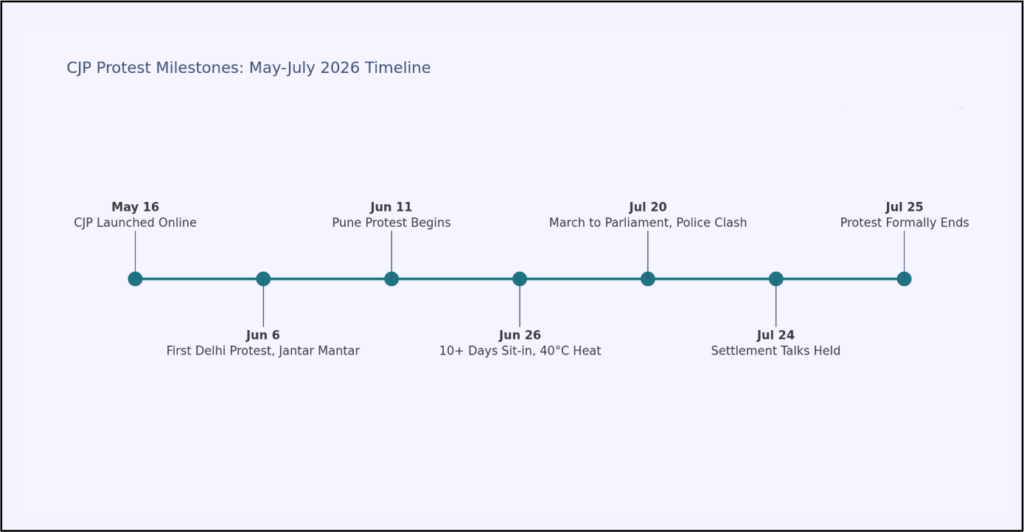
By early June, the Cockroach Janata Party protest had clearly outgrown its Instagram origins. On June 6th, thousands gathered at Delhi’s Jantar Mantar, waving national flags and holding textbooks, demanding Education Minister Dharmendra Pradhan’s resignation over the NEET-UG paper leak. Just five days later, on June 11th, hundreds more assembled in Pune, marking CJP’s first major protest outside the capital. Meanwhile, the movement’s focus had visibly widened, addressing unemployment, rising living costs, and broader institutional accountability. By then, the protest with Gen Z involvement was no longer confined to memes and reels; it had physical, sweaty, real-world stakes.
By June 26th, protesters were still camped at Jantar Mantar, enduring temperatures above 40 degrees Celsius for over ten consecutive days. Abhijeet Dipke, the founder, described this endurance to the BBC as proof that frustration had outlasted comfort. Indeed, the sheer persistence signalled something deeper than viral enthusiasm. Moreover, this sustained presence transformed CJP from a digital curiosity into a genuine civic-pressure campaign. As a result, government officials could no longer dismiss it as a passing internet fad. The Cockroach Janata Party protest had become, unmistakably, a fixture of India’s summer news cycle.
The July 20th Flashpoint
When Peaceful Protest Met Police Barricades
Everything escalated on July 20th, when tens of thousands marched toward Parliament, defying an official police ban. Naturally, this represented the boldest test yet of CJP’s staying power and the government’s tolerance threshold. Clashes broke out, and by the next day, reports confirmed at least 60 protesters wounded, alongside 118 injured police personnel. Consequently, this single day became the movement’s most violent chapter, transforming a youth-led sit-in into front-page international news.
International outlets, including the BBC, framed this as a pivotal moment for India’s youth movement. Meanwhile, Dipke told reporters that the government had finally initiated contact for talks, though no official confirmation existed yet at that stage. Interestingly, this ambiguity itself became newsworthy – protesters didn’t know whether they were being heard or merely tolerated. Nevertheless, the march achieved something crucial: it forced sustained national attention onto demands that had, until then, been easy to ignore. Clearly, the Cockroach Janata Party protest had crossed a threshold from which there was no quiet retreat.
Source: BBC, AP, The Week (May–July 2026)
Sonam Wangchuk’s Calculated Solidarity
An Activist’s Gradual, Public Endorsement
Sonam Wangchuk’s support for CJP unfolded in careful, deliberate stages rather than a single dramatic gesture. On May 27-28th, Ladakh’s Lieutenant Governor VK Saxena publicly questioned the movement’s origins, hinting at possible foreign influence. Wangchuk swiftly rejected this claim, doubling down on his backing and dismissing the allegation as an attempt “to please some Delhi boss.” This defence mattered enormously, since it came from someone with genuine credibility on institutional accountability, not just internet virality.
Then, on June 1-2, Wangchuk announced that he would personally join CJP’s Delhi protest on June 6th, explicitly tying his participation to accountability over the exam scandal. He stated plainly that a “developed India by 2047” depends on implementation, not intention alone. Notably, he also clarified that his involvement would “strengthen, not dilute” parallel causes like Ladakh’s own movement – addressing concerns that his attention might be divided. By July 26th, once the settlement was announced, Wangchuk publicly welcomed the government’s acceptance of CJP’s demands, closing the loop on a carefully staged, three-month arc of solidarity.
The NEET Scandal Behind Every Placard
Why Exam Reforms Became Non-Negotiable
At the heart of every march sat one unresolved wound: the NEET-UG paper leak and its devastating human cost. This NEET protest in India was never purely symbolic – it represented millions of aspirants whose futures had been thrown into uncertainty. Reports of student suicides linked to examination pressure and scandal fatigue added painful urgency to every rally. The CBSE OSM controversy further intensified concerns among students about transparency, accountability, and trust in India’s education system, reinforcing broader calls for systemic reforms. Therefore, when protesters carried textbooks instead of banners, the message was unmistakable: this was about broken trust in the system meant to reward merit.
Exam reforms in India became the movement’s most emotionally resonant demand, cutting across political lines because nearly every Indian family has a stake in education. Consequently, CJP’s insistence on Pradhan’s resignation wasn’t simply punitive; it was framed as the minimum threshold for restoring institutional credibility. Meanwhile, the demand for a CBI probe and mandatory re-test reflected a broader ask: that exam integrity be treated as non-negotiable, not optional. In many ways, this thread connected disparate grievances – unemployment, corruption, accountability – into one coherent, deeply personal cause.
The Settlement: What Was Actually Agreed
Reading the Fine Print of the July 24-25th Deal
After 36 days of sustained agitation, the Cockroach Janata Party protest formally ended following a joint press conference on July 24-25th. Union Ministers J.P. Nadda and Jitendra Singh sat alongside CJP spokespersons Saurav Das and Ashutosh Ranka to announce the terms. Nadda confirmed that no retaliatory action would be taken against protesters, with FIR copies to be provided so that cases could be formally dropped. CJP’s own statement captured the moment’s cautious optimism: “As the government accepted all our demands after 36 days of protests, we appeal to everyone to peacefully withdraw from protest sites and go home.
The government also committed to compensating families of students who died by suicide amid the NEET controversy, “according to rules and regulations.” Additionally, Education Minister Dharmendra Pradhan resigned on July 25th amid the backlash, with the NEET matter handed to the CBI. The promised re-test was conducted on June 21st, and the results declared. Crucially, though, the broader five-point charter on structural exam reform wasn’t resolved outright – both sides agreed to reconvene for a fourth round of talks roughly four weeks later. This detail matters immensely, since it means the settlement addresses immediate grievances while leaving deeper reforms pending.
📋 What the Government Agreed to Deliver
| Agreed Action | Status/Timeline |
|---|---|
| Education Minister’s resignation | Completed immediately |
| Withdrawal of protester FIRs | Written assurance promised, cases to be dropped |
| No future retaliatory action | Confirmed by Union Minister J.P. Nadda |
| Compensation for NEET-suicide families | Agreed “as per rules and regulations” |
| CBI probe + NEET-UG re-test | Announced alongside minister’s resignation |
| Five-point education charter | Deferred to fourth round of talks (~4 weeks) |
Source: New Indian Express, The Week, DNA India (July 24-25, 2026)
How the Country Responded
Numbers That Tell Their Own Story
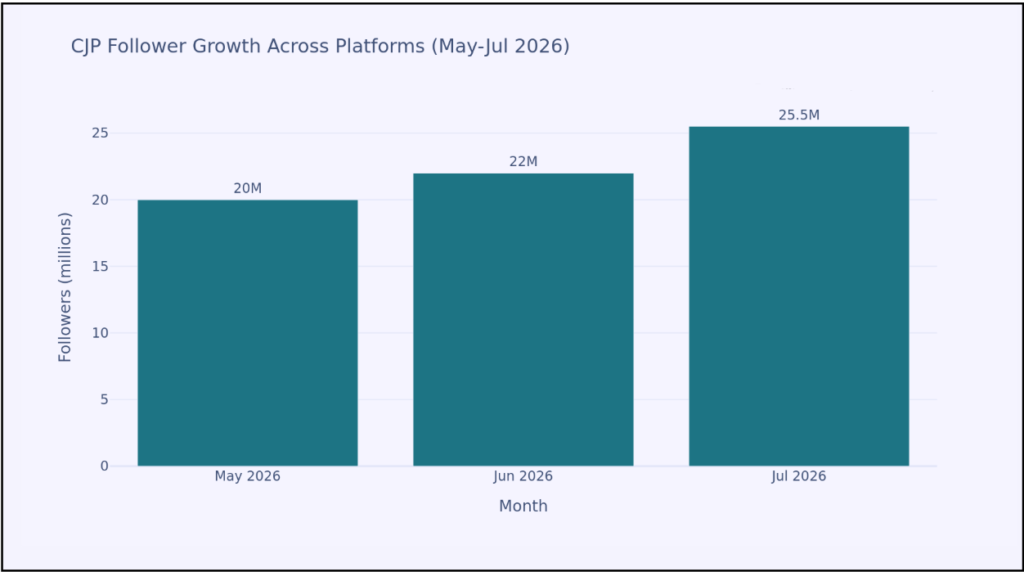
By the time the settlement was reached, CJP’s digital footprint had grown far beyond its original scale, with followers exceeding 25 million across platforms. Incidentally, India’s youth movement milestone reflects something rarely achieved by any single campaign – sustained, multi-month attention from a demographic often accused of political apathy. Furthermore, the movement’s geographic spread – from Delhi to Pune and beyond – demonstrated that CJP’s appeal wasn’t confined to one city’s frustrations. Rather, it tapped into a nationwide undercurrent of dissatisfaction shared by young Indians everywhere.
Notably, this reception wasn’t purely celebratory; it was layered with scepticism, hope, and cautious relief in equal measure. Many participants expressed exhaustion after 36 days, viewing the settlement as necessary rather than triumphant. Meanwhile, commentators across mainstream outlets debated whether the concessions represented genuine reform or simply strategic damage control. Either way, the sheer scale of public engagement confirmed that CJP had achieved what few youth-led efforts manage: forcing institutional response through sustained, visible pressure rather than fleeting outrage.
Source: Reuters, ABC News, BBC (May–July 2026)
What Remains Genuinely Unresolved
The Gap Between Promises and Practice
Despite the settlement’s headline achievements, several critical elements remain deliberately open-ended. The five-point charter on structural exam reforms – arguably the movement’s most transformative demand – awaits a fourth round of negotiations, still weeks away. Consequently, whether this translates into lasting institutional change depends entirely on follow-through that hasn’t yet been tested. Similarly, while FIR withdrawals were promised in writing, actual implementation across every state and jurisdiction remains unverified as of this writing.
Compensation for affected families, too, hinges on bureaucratic processes that historically move slowly in India. Therefore, genuine accountability will only be visible months from now, not in this settlement’s immediate afterglow. Moreover, the CBI probe’s findings and the re-test’s fairness will determine whether trust is actually restored. In essence, this agreement represents a beginning, not a conclusion – a fragile truce built on written assurances that now require diligent, public monitoring to become real.
Was This Really a Victory?
Holding Space for Nuance, Not Verdicts
So, was the Cockroach Janata Party protest truly a victory for India’s youth? Honestly, I think the answer resists easy binaries – it was, quite possibly, both a victory and merely a first step simultaneously. Certainly, forcing a sitting minister’s resignation and a formal government settlement counts as remarkable, especially for a movement born from satire. However, victory implies closure, and this story clearly isn’t closed; it’s paused, awaiting a fourth round of talks and real-world delivery on paper promises.
Perhaps, the more honest framing is this: young Indians proved they could organise, sustain pressure, and extract concrete commitments from powerful institutions. That alone represents a meaningful shift in how India’s youth movement engages with governance – less passive, more persistent, and unafraid of friction. Whether this becomes a lasting template for accountability, though, depends entirely on what happens next. Genuine victory, ultimately, will be measured not by July’s headlines but by whether every promise made survives contact with bureaucratic reality.
Latest Update: CBI Charge Sheet and What Comes Next
Thirteen Named, But the Investigation Isn’t Over
As of July 29th, the biggest new development is the CBI’s first charge sheet in the NEET-UG 2026 paper leak case, filed on July 28th in Rouse Avenue Court. Thirteen individuals now stand formally accused, including three National Testing Agency subject experts – P.V. Kulkarni, Manisha Mandhane, and Manisha Sanjay Hawaldar – alongside a Latur-based coaching institute owner identified as the alleged kingpin. The charge sheet cites 360 witnesses and 422 pieces of material evidence, built by a 72-officer CBI team supported by eight forensic specialists.
Notably, no NTA official has been named yet, and the agency has confirmed the probe and forensic analysis remain ongoing. This partial charge sheet, therefore, offers accountability without closure – a detail every young protester at Jantar Mantar will be watching closely.
Meanwhile, a Delhi court granted the CBI permission this week to collect fresh handwriting samples from the arrested physics professor, since earlier samples proved insufficient for forensic matching. This suggests the investigation is still actively building its case rather than winding down. On the political front, Union Minister J.P. Nadda has publicly reaffirmed that the government would honour its July 24th commitments – FIR withdrawal copies, victim compensation, and a review of CJP’s five-point education charter.
CJP spokesperson Saurav Das confirmed the government promised FIR copies “within three to four days” of the settlement, though as of July 29th, protesters are still awaiting formal delivery. No state government has issued a separate statement on protester action, keeping the response centralized with the Union government for now. In short, the paperwork of victory is still being written.
Building on This Moment – Together
What Comes Next, For All of Us
Real accountability, going forward, requires more than headline settlements; it demands sustained civic attention long after cameras leave. As individuals, we can commit to tracking whether compensation reaches families, whether FIRs are genuinely dropped, and whether the fourth round of talks actually happens. Moreover, as communities, we can support independent verification efforts and credible journalism that follows through on promises, rather than moving on to the next viral story. As a society, we owe this generation of protesters — students, volunteers, and organisers alike — continued visibility, not fleeting attention.
Consider these concrete steps toward turning this moment into lasting change:
- Track government follow-through on the fourth-round education charter talks
- Support independent journalism verifying FIR withdrawals and compensation delivery
- Encourage civic literacy among young Indians about institutional accountability mechanisms
- Advocate for transparent examination systems as a baseline, not an exception
- Recognise and platform grassroots youth organising as legitimate civic participation
The cockroach, resilient as ever, has proven it can survive scrutiny, heat, and even police barricades. Whether India’s institutions match that resilience with genuine follow-through remains, the real story still unfolding.
Do you think this settlement marks genuine progress, or just a temporary pause before the next round of frustration? Share your thoughts below – and if you believe accountability deserves continued attention, share this piece with someone who’s still watching this story unfold. 🪳
At ExpressIndia.info, we’ll keep tracking this story – because real accountability deserves real follow-through, not just a headline.
CockroachJanataParty #CJPProtest #IndiaYouthMovement #NEETProtestIndia #GenZIndia